
Quick Answer: Cashing out a 401(k) to pay off debt is almost always the wrong move — not because of the 10% early withdrawal penalty, but because of the compounding opportunity cost that nobody calculates. A $40,000 withdrawal costs you roughly $304,000 in retirement wealth over 30 years. That’s the number I want you to sit with before you touch that account.
Part of a series: This post is part of my Should You Invest or Pay Off Debt? research hub — where I cover the math, psychology, and scams around investing while in debt.
Expert Context: I’ve been helping people navigate debt since 1994, and I filed bankruptcy myself in 1990 after my real estate business collapsed. In three decades of watching people make financial decisions under pressure, raiding retirement accounts is the single most common mistake I see — and it’s almost always driven by shame and fear rather than math. The people who cash out their 401(k) to “be debt free” end up trading a solvable short-term problem for an irreversible long-term one. I’ve run the calculation thousands of times. The answer is almost never “take the 401(k).”
Every debt article tells you what to do about your debt. Almost none of them calculate what it actually costs to use your 401(k) to do it. I’m going to show you that number — and it’s going to change how you see this decision.
Each weekday I send one short email: one money story that caught my attention, why it might matter to you, and one manageable thing you can do with it. A couple of minutes, and a dad joke.
In the latest issue (Oct 14): Do you want the money back you left behind?
Free. I sell nothing. Unsubscribe any time.
Key Terms Defined
Early withdrawal penalty: The IRS charges a 10% penalty on 401(k) withdrawals made before age 59½, on top of regular income taxes.
Opportunity cost: The future value of money you remove from an investment — what that money would have earned if you’d left it alone. This is the number most debt advisors never mention.
ERISA protection: The Employee Retirement Income Security Act protects retirement accounts (401(k), 403(b), pensions) from creditors — including in bankruptcy. Your 401(k) is one of the most legally protected assets you own.
401(k) loan: An alternative to withdrawal — you borrow from your own account and repay yourself with interest. No penalty, no immediate taxes, but risks apply (see below).
Prefer to watch? I made a short video walking through what cashing out or borrowing from a 401(k) to pay off credit cards can really cost you by retirement.
The Math Nobody Is Running for You
Let me walk through the actual calculation, because I’ve never seen a mainstream personal finance article do this honestly.
Say you have $40,000 in credit card debt and $40,000 in your 401(k). The instinct is clean and satisfying: wipe out the debt, start fresh. Here’s what actually happens:
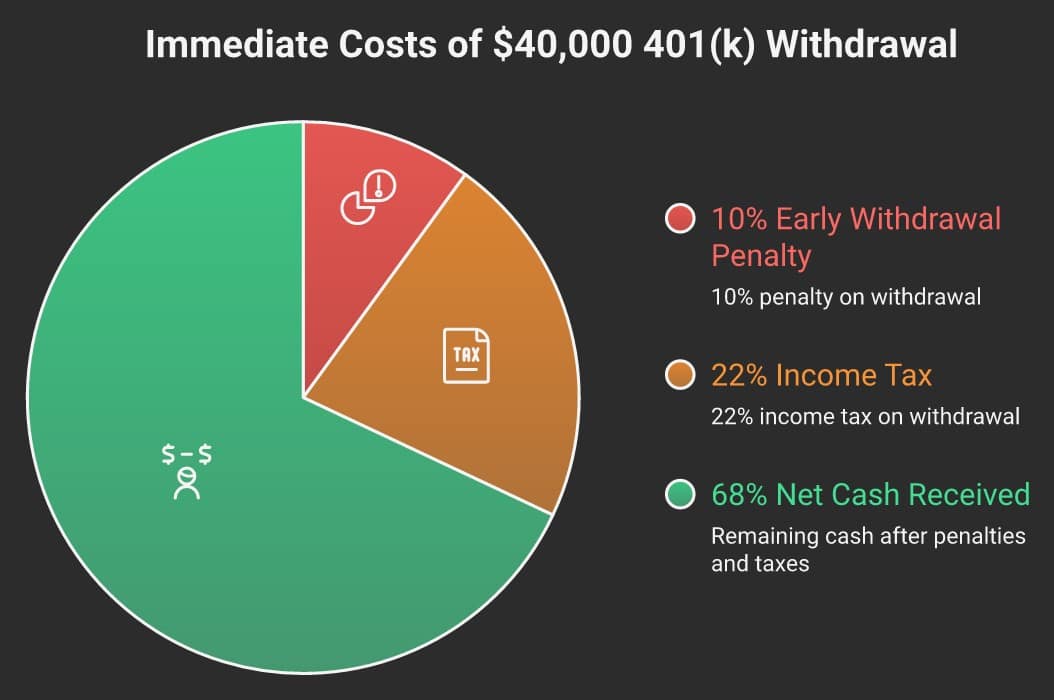
Step 1: The immediate haircut. If you’re in the 22% federal income tax bracket, your $40,000 withdrawal gets hit with a 10% penalty ($4,000) plus roughly $8,800 in income taxes. That’s $12,800 gone before you pay a single dollar of debt. You net approximately $27,200 — not $40,000.
Step 2: The debt doesn’t disappear. $27,200 covers your $40,000 in debt — except it doesn’t. You’re still roughly $12,800 short. So you’ve depleted your entire retirement account and you still have debt. Many people in this situation then turn to the next card or a personal loan to cover the gap.
Step 3: The real cost hits 30 years later. This is where the calculation gets devastating. That $40,000, left in your 401(k) and growing at the stock market’s historical average of roughly 7% annually (inflation-adjusted), becomes approximately $304,000 over 30 years. Not $40,000. Not even $80,000. $304,000.
You didn’t lose $40,000. You lost $304,000 — plus you paid $12,800 in immediate taxes and penalties to do it.
What If You Have $100,000 in Your 401(k)?
Scale this up and the numbers become almost surreal. If you’re considering withdrawing a full $100,000 to eliminate debt:
- Immediate tax + penalty at 22% bracket: approximately $32,000 gone immediately
- Net received: approximately $68,000
- What $100,000 grows to at 7% over 30 years: $761,000
You’re trading $761,000 in future retirement security for $68,000 in debt relief today. And you’re still on the hook for any debt the $68,000 doesn’t cover.
This is the calculation that earns the “$400,000 mistake” label. Depending on your account balance, timeline, and return rate, the opportunity cost of a single retirement account withdrawal can easily exceed $400,000 — sometimes far more. I’ve seen people cash out $80,000 and lose over $600,000 in retirement wealth. The math is merciless.
The Myth: “If I pay off the debt, I’ll free up monthly payments I can put back into retirement. I’ll make it up.”
The Reality: You cannot make up compounding. The money that was growing for 10, 20, or 30 years cannot be replaced by contributions that start late. A dollar invested at 35 is worth roughly four times a dollar invested at 55. The compounding clock does not restart. What you lose is the early years — and those are the most valuable.
Why Bankruptcy Is a Better Answer Than You Think
Here’s the counterintuitive fact that changes everything: your 401(k) is 100% protected in bankruptcy.
Under ERISA and federal bankruptcy law (11 U.S.C. § 522), qualified retirement accounts — including 401(k)s, 403(b)s, IRAs up to approximately $1.5 million, and pensions — are exempt assets. Creditors cannot touch them. A bankruptcy trustee cannot take them. They are protected by federal law.
So here’s the scenario most people don’t consider: you file Chapter 7 bankruptcy, discharge the credit card debt, and keep every dollar in your 401(k). You don’t pay the 10% penalty. You don’t pay income taxes on a forced withdrawal. You don’t destroy 30 years of compounding growth.
I filed bankruptcy myself in 1990. I know what the word feels like the first time you say it. But I also know what it’s like to come out the other side with your retirement intact — versus watching someone hand over their life savings to pay off debt they could have discharged anyway.
The debt option most people don’t calculate: The credit card debt you’re considering cashing out your 401(k) to pay is almost certainly dischargeable in bankruptcy. Unsecured debt — credit cards, medical bills, personal loans — gets wiped in Chapter 7. Meanwhile, your 401(k) is untouchable. Filing bankruptcy protects your retirement in a way that paying off debt with your own retirement savings never can — federal law shields ERISA-qualified plans like 401(k)s completely.
Free Tool — Judgment Proof Checker: Think creditors can take everything? Many people in financial hardship are legally protected. The free Judgment Proof Checker shows whether collectors can actually collect anything from you in your state. Check My Status →
Comparing Your Real Options
Bankruptcy (Chapter 7)
- Discharges unsecured debt completely
- 401(k) fully protected by law
- Done in 3-6 months
- Credit score recovers faster than most people think
- Retirement compounding continues uninterrupted
Cashing Out 401(k)
- 10% penalty + income taxes: ~32% immediate loss
- May not cover all debt anyway
- Destroys compounding — can’t be undone
- Debt still exists if withdrawal doesn’t cover full balance
- No legal protection for remaining debts
401(k) Loan (Not Withdrawal)
- No immediate taxes or penalties
- You pay interest back to yourself
- Keeps money technically “in” your account
- Can be a bridge while exploring other options
401(k) Loan — Hidden Risks
- If you leave your job, full balance due within 60-90 days
- Defaulting on the loan triggers taxes + penalty anyway
- Money not invested = lost growth during loan period
- Still doesn’t solve the underlying debt problem
What About Debt Management Plans and Credit Counseling?
I ran a credit counseling organization. I saw from the inside how the math works — and I’m going to tell you something the industry doesn’t advertise.
A debt management plan (DMP) typically runs 4-5 years. During that time, most DMP contracts require you to stop contributing to retirement accounts — or at minimum, redirect every discretionary dollar to debt repayment. Those are years of compounding you never get back.
I’ve calculated that the opportunity cost of a 5-year DMP, accounting for foregone retirement contributions and lost compounding, can exceed $400,000 over a 30-year horizon for someone who was contributing $500-600 per month to their 401(k). The debt gets paid — but the retirement cost is almost never disclosed.
This is why my debt option analysis shows bankruptcy winning on the retirement dimension: it’s done in months, not years, and your retirement contributions can resume immediately.
When Retirement Withdrawal Might Make Sense
I want to be honest: there are narrow scenarios where accessing retirement funds isn’t automatically wrong.
- You’re over 59½ — no 10% penalty applies. The tax still hits, but the calculus changes significantly.
- You have a very small 401(k) — if your account has $5,000-8,000 and you’re facing a judgment or wage garnishment, the compounding loss is smaller relative to the immediate problem.
- The debt carries an interest rate higher than your expected return — if you’re paying 29% APR on a card and your 401(k) is earning 7%, the math is tighter (though the tax hit still damages the comparison).
- You’ve ruled out bankruptcy and all other options — this should be last resort, not first instinct.
Even in these scenarios, I’d want you to have a complete picture of your options before touching the account. The quiz at that link takes about 3 minutes and helps identify which path fits your situation.
Free Tool — Wage Garnishment Calculator: Worried about your paycheck being seized? The free Wage Garnishment Calculator shows exactly how much creditors can legally take in your state — and some states prohibit garnishment entirely. Calculate My Risk →
The One Move I See Most Often That I Wish I Could Stop
People call their 401(k) plan administrator, get the withdrawal amount, pay off the debt, and feel a wave of relief. Then in April, they get a tax bill they didn’t account for. And by the time they’re 65 and running the math on retirement, the decision they made at 42 in a moment of financial panic has cost them $300,000 or more in retirement wealth.
Debt is math. It responds to math. The solution to a math problem is rarely “sacrifice your most legally protected asset, pay a 32% immediate fee, and permanently destroy 30 years of compounding growth.” There is almost always a better answer.
Key Takeaways
- A $40,000 401(k) withdrawal costs approximately $304,000 in retirement wealth over 30 years — not $40,000
- The immediate tax + penalty haircut is ~32% for most people, meaning you net about $27,200 from a $40,000 withdrawal
- Your 401(k) is 100% protected in bankruptcy — filing Chapter 7 discharges credit card debt without touching retirement
- A 401(k) loan avoids the immediate tax hit but carries job-change risk and still doesn’t solve the root problem
- Debt management plans have their own retirement opportunity cost — 4-5 years of disrupted contributions adds up
- The question isn’t “how do I pay off this debt?” — it’s “what option costs me the least long-term?”
The Bottom Line
If you’re staring at your 401(k) balance and your credit card statements at the same time, I understand the pull. It feels like the clean answer — take the money, pay the debt, start over. But the math tells a different story, and I’ve spent 30 years watching people live out the ending of that story in retirement with far less than they should have. The credit card debt you’re considering cashing out your retirement to pay is almost certainly dischargeable in bankruptcy — which means your 401(k) doesn’t have to be part of this equation at all. If you’re deciding between paying down debt or keeping that money invested, the math on investing vs. paying off debt lays out the full calculation. You don’t have to choose between debt relief and retirement security. Run the real numbers, explore every option, and protect the account that federal law is already protecting for you. Your future self — the one who needs that money to actually retire — is counting on the decision you make today.
Frequently Asked Questions
Is it ever a good idea to cash out a 401(k) to pay off debt?
Rarely, and almost never as a first move. The 10% early withdrawal penalty plus income taxes typically erase 30-32% of the account value immediately. Add the lost compounding growth over decades, and the true cost is multiples of what you withdrew. Bankruptcy discharges unsecured debt while leaving your 401(k) fully protected under federal ERISA law. That combination — debt gone, retirement intact — is almost always the better outcome than a withdrawal.
What is the 10% early withdrawal penalty and who pays it?
The IRS imposes a 10% additional tax on withdrawals from traditional 401(k) accounts made before age 59½. This is on top of ordinary income taxes on the full withdrawal amount. There are exceptions — certain medical expenses, disability, substantially equal periodic payments (72(t) distributions) — but most people cashing out to pay debt do not qualify for an exception.
Is my 401(k) protected if I file bankruptcy?
Yes. Under 11 U.S.C. § 522(d) and ERISA, qualified retirement accounts including 401(k)s, 403(b)s, and most IRAs are exempt assets in bankruptcy. Creditors and the bankruptcy trustee cannot access these funds. This is one of the strongest asset protections in American law — stronger than home equity in many states, and stronger than most people realize.
What’s the difference between a 401(k) withdrawal and a 401(k) loan?
A withdrawal permanently removes money from the account and triggers taxes and penalties immediately. A 401(k) loan lets you borrow from yourself — typically up to 50% of the vested balance or $50,000, whichever is less — and repay it with interest back into your own account over up to 5 years. No immediate taxes or penalties. However, if you leave your job, the outstanding balance typically becomes due within 60-90 days, and if you can’t repay it, it converts to a taxable withdrawal. A loan is better than a withdrawal, but neither solves the underlying debt problem.
How long does the credit score damage from bankruptcy last?
A Chapter 7 bankruptcy stays on your credit report for 10 years. But the research shows most filers see meaningful credit score recovery within 12-24 months of filing, and many reach 700+ scores within 3-4 years. The Federal Reserve’s research on bankruptcy outcomes shows that filers outperform non-filers on income growth and financial stability within a few years. Meanwhile, cashing out your 401(k) has zero positive effect on your credit score — and leaves you with less retirement security permanently.
Here is my full guide on how long bankruptcy stays on your credit report and the actual recovery timeline.
Related: Gas prices are spiking again, and it’s creating the exact kind of pressure that tempts people to cash out retirement savings. Here’s what actually happens when gas spikes — and what to do instead.
With recession warnings piling up: If you’re reading this because you’re worried about what’s coming, don’t stop here. I wrote a complete 30-day recession prep checklist — protecting your 401(k) is step one, but there are three more weeks of moves to make.
Dealing With Debt? Understanding your options is the first step. See how all your debt relief options compare — including ones most sites won’t tell you about. The Find Your Path quiz gives a recommendation based on your actual numbers, and the Scam-O-Meter checks any company’s complaint history before you sign. Federal Reserve research shows bankruptcy filers recover faster than those who don’t file.



