
Veterans have powerful legal protections most lenders will never mention — including a 6% interest rate cap on pre-service debts, mandatory foreclosure protections, and bankruptcy rules that exclude disability pay entirely. Right now, 90,000 veterans are behind on their mortgages following the shutdown of the VA’s rescue program. If you’re a veteran in financial crisis, you have rights and options that civilians don’t — but you have to know to ask. If you’re a federal worker affected by the current DHS shutdown, those protections matter even more right now.
Update (April 2026): the new TurboTax / Credit Karma class action under the Military Lending Act — new developments that affect what I wrote below.
I’ve been helping people with debt since 1994, and veterans represent some of the most systematically underserved people I’ve seen. There’s a law on the books that caps their interest rates at 6%. Lenders know which customers qualify. And fewer than 1 in 10 ever get the benefit. That’s not ignorance — that’s a pattern. My job here is to put everything you’re legally entitled to in one place so you know what to ask for.
The numbers are stark. Veterans carry credit card debt at higher rates than civilians (35% vs. 27%), are nearly twice as likely to use payday loans, and file for bankruptcy at a disproportionately higher rate than their share of the population. Ninety-one percent of veterans in a 2025 survey said debt worsens PTSD symptoms. And right now, 90,000 veterans are behind on their VA mortgages after the government shut down the program that was keeping them in their homes — according to NPR reporting from April 2026.
Each weekday I send one short email: one story that caught my attention, why it might matter to you, and one manageable thing you can do with it. A couple of minutes, and a dad joke.
In the latest issue (Oct 16): The check that looks like a scam may be real
Free. I sell nothing. Unsubscribe any time.
The financial system that welcomes veterans with military discounts often treats them very differently when the bills come due. Here’s what you’re actually entitled to.
“A law exists. Servicemembers qualify. Lenders know they qualify. Fewer than 1 in 10 get the benefit. That’s not ignorance — that’s a pattern.”
The SCRA: Your 6% Interest Rate Cap
The Servicemembers Civil Relief Act (SCRA) is the most powerful financial protection most veterans have never heard of — or heard of but never used.
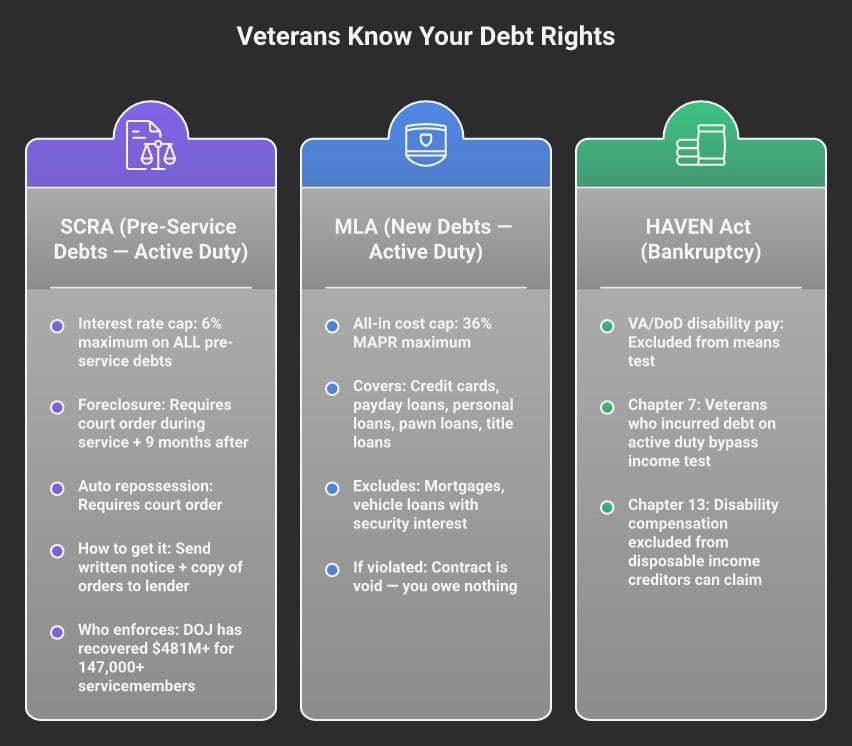
If you took on debt before entering active duty — credit cards, auto loans, a mortgage, student loans, a personal loan — your lender is required by federal law to cap the interest rate at 6% for the duration of your service. Not an introductory rate. Not a discount. A legal obligation.
There’s one catch: you have to ask.
The SCRA uptake gap — one of the biggest untold stories in military finance: A CFPB study of Guard and Reserve members found that fewer than 1 in 10 with eligible auto loans received the rate reduction they were legally owed. Fewer than 1 in 6 with personal loans got it. Over a 2007–2018 study period, this added up to $100 million in interest that servicemembers paid and shouldn’t have.
How to Invoke Your SCRA Rights
- Write to your lender — email, letter, or secure portal message all count
- Include a copy of your military orders to active duty (or a letter from your commanding officer with the date active duty began)
- The CFPB provides a free sample letter you can use — fill in the blanks and send it
- The lender must also refund the excess interest retroactively from the day active duty began — not just from when you asked
The 6% cap applies during your entire period of active duty. For mortgages specifically, it extends for one full year after you leave active service. For all other debts, it ends on your separation date.
SCRA Foreclosure Protections
If you have a pre-service mortgage, your lender cannot foreclose without a court order for the duration of your active-duty service and for nine months after you separate. The court must appoint an attorney to represent you if you can’t appear, and must issue an automatic 90-day stay if your presence is needed.
The DOJ and CFPB issued a joint warning letter to auto finance companies in December 2024 about SCRA compliance failures — signaling that enforcement is intensifying. Since 2011, DOJ has recovered over $481 million for more than 147,000 servicemembers from SCRA violations alone.
If Your Lender Violated the SCRA
- File a complaint with the CFPB at consumerfinance.gov/complaint or call (855) 411-2372 — the CFPB routes SCRA complaints to DOJ
- Report to DOJ Servicemembers Initiative at justice.gov/servicemembers — they can bring suit for compensatory and punitive damages
- You can also sue directly — the SCRA provides a private right of action for interest rate violations, and pre-service arbitration clauses can’t block your SCRA claim
The Military Lending Act: The 36% Cap on New Debts
The SCRA covers old debts. The Military Lending Act (MLA) covers new ones.
If you’re an active-duty servicemember (or a covered dependent), any lender offering you a credit card, payday loan, vehicle title loan, personal loan, or overdraft line of credit is legally barred from charging you more than 36% MAPR — that’s the all-in cost including fees, insurance, add-ons, and charges.
The MLA has a significant gap: It does not cover residential mortgages or auto loans where the lender holds a security interest in the vehicle. VA loans, conventional mortgages, and dealer-financed cars are all MLA-exempt. SCRA is the relevant law for those. Near military bases, predatory auto dealers exploit this gap constantly.
The threats go beyond lending violations — a Chicago man was just sentenced to 27 months in prison for running a financial scam targeting active-duty troops through social media.
The FTC has gone after credit repair operators targeting the military too — its case against a $200 million credit repair scheme accused of using Google ads to target servicemembers alleges the same kind of predatory targeting.
If a lender violates the MLA, the loan is void from inception — you’re not legally bound by a contract that breaks this law. The CFPB settled a case in 2025 against FirstCash, a pawnshop chain with 1,000+ locations including many near military bases, for exactly this: making MLA-violating loans to thousands of servicemembers. The settlement: $9 million. The pattern continues because the profits are real and enforcement is periodic rather than continuous.
The VA Mortgage Crisis Happening Right Now
This section is time-sensitive. If you have a VA-backed mortgage and you’re behind, the landscape has changed dramatically in the past year.
The VA Servicing Purchase program (VASP) launched in May 2024 and allowed the VA to buy defaulted VA-guaranteed loans from servicers and modify them to a fixed 2.5% rate. It helped more than 33,000 veterans avoid foreclosure in its first year. The Trump administration shut it down on May 1, 2025 — with about a week’s notice. The NPR reporting from April 2026 documents what happened next.
If you’re a veteran with a VA loan facing default, here’s what still exists:
- Repayment plan — catch up on arrears over time while resuming regular payments
- Special forbearance — temporary pause; requires a repayment plan agreed in advance
- Loan modification — roll arrears into balance and re-amortize, though current market rates make this financially brutal vs. the original 2-3% loans many veterans have
- Short sale or deed-in-lieu — exit options; affect future VA entitlement
- Call the VA directly: (877) 827-3702 to reach a VA loan technician who can review your specific situation
VA loan guarantee and future benefits: When a VA-guaranteed loan ends in foreclosure or short sale, the VA pays the lender’s guaranteed amount — and then the veteran owes that money back before their full VA loan entitlement can be restored. Short sales and deeds-in-lieu also affect entitlement. Get specific advice from the VA before choosing an exit.
The Option Nobody Tells Veterans About: Bankruptcy
Veterans are disproportionately present in bankruptcy filings — representing roughly 15% of filers despite being about 10% of the population. A significant portion of those filings come in the first year after military separation, when income drops, the structure of service disappears, and debt accumulated during deployment comes due.
What most veterans don’t know is that Congress specifically carved out protections for them in bankruptcy:
The HAVEN Act: Your Disability Pay Is Protected
Before 2019, courts counted VA disability compensation as income when calculating whether a veteran could afford Chapter 13 repayment plan payments. The Honoring American Veterans in Extreme Need (HAVEN) Act, signed in 2019, fixed this in two ways:
- Means test exception for Chapter 7: Veterans who incurred their debt while on active duty are entirely exempt from the Chapter 7 means test — they cannot be pushed out of Chapter 7 for having too high an income, regardless of disability payment amounts
- Chapter 13 disposable income: VA and DoD disability pay and combat-related injury compensation are excluded from “disposable income” that creditors can claim in a Chapter 13 plan
What this means in practice: A disabled veteran’s VA compensation check cannot be taken by creditors in bankruptcy. The protection that servicemembers earned through their sacrifice is specifically shielded from the bankruptcy process. This was not always true — it took an act of Congress to fix it, and many veterans still don’t know the law exists.
How Bankruptcy Compares for Veterans
Using my framework for comparing debt relief options, bankruptcy performs well across every dimension that matters — and it’s the only option that actually resolves the debt rather than just restructuring payments indefinitely:
Chapter 7 — Walk Away Clean
- Discharges credit cards, medical bills, personal loans completely
- Disability pay excluded from means test (HAVEN Act)
- Completed in 4–6 months
- Automatic stay stops all collection immediately
- Does not erase VA benefits or security clearances (in most cases)
- Credit score typically improves within 12–24 months due to debt discharge
Chapter 13 — Restructure and Keep Assets
- Immediately stops foreclosure — even day-of sale
- Creates 3–5 year plan to catch up on mortgage arrears
- Disability pay excluded from disposable income creditors can claim
- Can strip second mortgages if home is underwater
- Protects non-exempt property you want to keep
What About Security Clearances?
This is the question veterans ask most often — and the fear that most often keeps them from bankruptcy when they actually need it. The short answer: financial irresponsibility is what endangers a clearance, and bankruptcy is often evidence of the opposite.
DoD guidelines evaluate the totality of a person’s financial situation. Filing bankruptcy to responsibly address overwhelming debt is viewed more favorably than ignoring debt, having judgments entered, or having wages garnished — all of which creditors can trigger without your cooperation. Many veterans have maintained or received clearances after bankruptcy. Consult a JAG attorney or veterans legal aid before deciding.
Free Help Available Right Now
Resources that cost you nothing:
- Military OneSource: (800) 342-9647 or militaryonesource.mil — up to 12 free financial counseling sessions per year, available worldwide, 24/7. They can help negotiate with creditors, review debt options, and connect you with legal assistance.
- JAG / Installation Legal Assistance Office: Free legal advice on SCRA rights, debt collection, and bankruptcy options. Find yours at your installation or via your branch’s legal assistance portal.
- CFPB Servicemember Affairs: (855) 411-2372 — file complaints, get rights information, and access free publications on SCRA and MLA protections.
- VFW Unmet Needs Program: Grants up to $2,500 (not loans, no repayment) for active-duty and activated Guard/Reserve members facing financial hardship. Payments go directly to creditors. Apply at vfw.org/assistance/financial-grants.
- VA loan technicians: (877) 827-3702 — if you have a VA mortgage in trouble, call the VA directly. They work independently of your loan servicer.
FAQ
Does the SCRA apply to National Guard and Reserve members?
Yes — but only during periods of active-duty service. Guard and Reserve members activated under Title 10 (federal orders) or qualifying Title 32 orders are covered by the SCRA for the duration of that activation. Weekend drill and annual training do not qualify. The CFPB study showing the 1-in-10 uptake rate specifically examined Guard and Reserve members, so this community is particularly underserved.
Will filing bankruptcy affect my VA benefits?
VA disability compensation, VA pension, and other VA benefits are protected from creditors in bankruptcy — they cannot be taken to pay debts. The HAVEN Act specifically shields disability pay from the means test and from disposable income calculations. Filing bankruptcy does not reduce or eliminate VA benefits.
If you also draw military retired pay, check which 2027 COLA applies to you before you budget on it, because not every military retiree gets the full 3.6%.
Free Tool — Judgment Proof Checker: Think creditors can take everything? Many people in financial hardship are legally protected. The free Judgment Proof Checker shows whether collectors can actually collect anything from you in your state. Check My Status →
Can I lose my security clearance if I file bankruptcy?
Bankruptcy does not automatically revoke a security clearance. DoD adjudicates clearances based on the totality of financial circumstances. Responsible resolution of overwhelming debt — including bankruptcy — is generally viewed more favorably than unresolved debts, judgments, wage garnishment, or repeated delinquencies. Consult a JAG attorney before deciding, but don’t let clearance fear drive you into a worse financial outcome.
Free Tool — Wage Garnishment Calculator: Worried about your paycheck being seized? The free Wage Garnishment Calculator shows exactly how much creditors can legally take in your state — and some states prohibit garnishment entirely. Calculate My Risk →
What if a lender charges me more than 6% interest under SCRA?
They owe you a refund of the excess interest retroactively from the date your active duty began. File a complaint with the CFPB (consumerfinance.gov/complaint) and contact the DOJ Servicemembers Initiative (justice.gov/servicemembers). You also have a private right of action to sue for compensatory and punitive damages. Pre-service arbitration clauses cannot block your SCRA claims.
I’m a veteran (not active duty) — do I still have any special debt protections?
The SCRA and MLA apply only during active-duty service. As a veteran, your main financial protections are the same as any civilian — but bankruptcy has special protections for you via the HAVEN Act (disability pay shielded), and you may be eligible for free legal and financial assistance through Military OneSource (for recently separated veterans), JAG alumni programs, VFW/DAV programs, and state veterans legal aid. Your VA disability compensation cannot be garnished by creditors.
Bottom Line
Veterans earned legal protections that most lenders systematically fail to apply. The SCRA interest rate cap is real, but fewer than 1 in 10 eligible servicemembers get it because lenders don’t volunteer it. The VASP mortgage rescue program that was keeping 33,000+ veterans in their homes is gone. Right now, 90,000 veterans are at risk of losing their homes. If you’re a veteran in financial crisis, you have rights that civilians don’t — but you have to invoke them. Start with a call to Military OneSource (800-342-9647) or a free JAG consultation before making any decisions about debt settlement, consolidation, or bankruptcy.
Dealing With Debt? Understanding your options is the first step. See how all your debt relief options compare — including ones most sites won’t tell you about. The Find Your Path quiz gives a recommendation based on your actual numbers, and the Scam-O-Meter checks any company’s complaint history before you sign. Federal Reserve research shows bankruptcy filers recover faster than those who don’t file.



