
CareCredit’s promotional “no interest if paid in full” offers sound like 0% financing — they’re not. It’s deferred interest, which means if you don’t pay every dollar off before the promotional period ends, you get charged interest on the original full balance going back to day one. At 32.99% APR, that can add hundreds or thousands of dollars to a medical bill you thought you were managing responsibly.
Update (April 2026): Maine just passed LD 2129 blocking wage garnishment and home liens on medical debt — new developments that affect what I wrote below.
I’ve spent 30 years watching financial products get marketed to people in vulnerable moments. CareCredit shows up in doctors’ offices, veterinarians’ offices, dentists’ offices — places where you’re stressed, you need the service, and someone is offering you a way to say yes. That’s not a coincidence. It’s a business model designed to reach consumers when their guard is down. Let me explain exactly how the deferred interest math works, because the difference between “0% interest” and “deferred interest” is not a technicality — it’s potentially thousands of dollars.
CareCredit is a medical credit card issued by Synchrony Bank, accepted at over 260,000 healthcare providers including dentists, veterinarians, optometrists, and cosmetic surgery practices. It offers promotional financing periods — typically 6, 12, 18, or 24 months — described as “No Interest if Paid in Full.” In 2021, Senator Elizabeth Warren’s office sent CareCredit a formal letter raising concerns about deceptive practices, and the CFPB has received thousands of complaints about medical credit cards using exactly this structure.
Every weekday I read the enforcement actions, filings and fine print the outlets skip, and turn them into the one or two moves that actually improve your position — a rate worth moving for, a fee you can refuse, a deadline to beat before it costs you.
In the latest issue (Oct 8): A parent's nursing home bill can become yours
I write Your Money Actually most weekdays — actionable money information you will not find anywhere else, and the small decisions that compound. It is free, I sell nothing, and I take no money from any company I write about.
Here’s what the fine print means for your actual bill.
“‘No interest if paid in full’ is not the same as 0% interest. One forgives the interest. The other charges it all at once if you don’t beat the deadline.”
Free Tool — Wage Garnishment Calculator: Worried about your paycheck being seized? The free Wage Garnishment Calculator shows exactly how much creditors can legally take in your state — and some states prohibit garnishment entirely. Calculate My Risk →
How Deferred Interest Actually Works
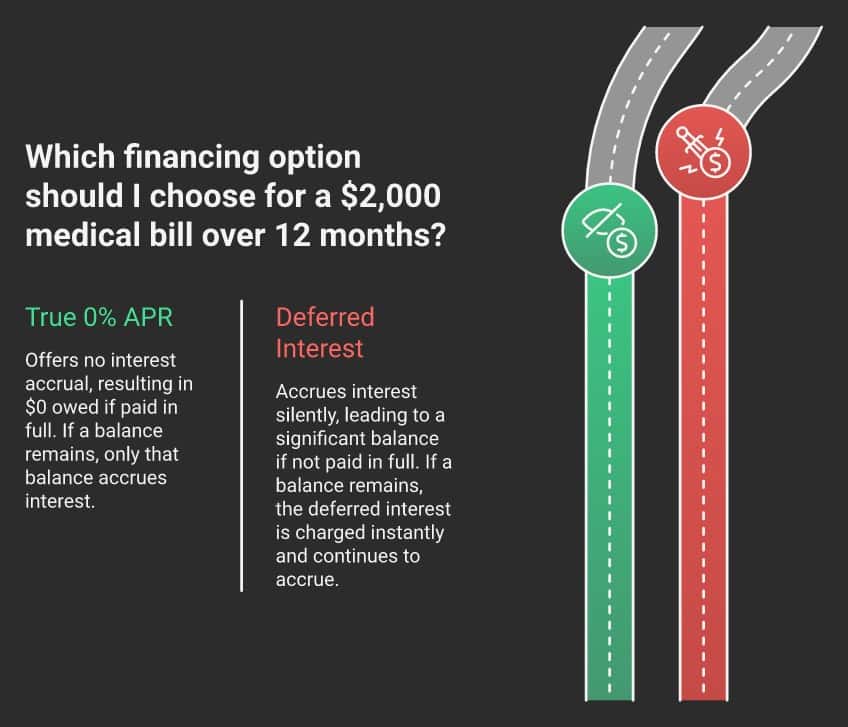
When a credit card offers a true 0% APR promotional period, no interest accrues during that period. If you pay off the balance before the promotion ends, you pay zero interest. If you don’t — say you have $50 left — you only pay interest on that $50 going forward at the regular rate.
Deferred interest works completely differently. With deferred interest:
The Daily Money Brief — Free, at 10 AM
Money you may be owed, scams to dodge, and the fine print decoded — the consumer money news that affects your wallet, every weekday.
- Interest accrues silently the entire promotional period at the regular APR (32.99% for CareCredit)
- If you pay the full balance before the promotional period ends, that accumulated interest is waived — you pay nothing
- If you have even $1 remaining when the promotional period expires, all of the accumulated deferred interest is charged to your account at once
The math on a $2,000 dental bill with a 12-month CareCredit promotion:
- Monthly payment to pay off in 12 months: ~$167/month
- Interest accruing silently at 32.99% APR over 12 months: ~$330
- If you pay off completely by month 12: you owe $0 in interest
- If you have $200 remaining at month 12: $330 in accumulated interest gets added immediately
- Your $200 balance becomes a $530 balance overnight
- That $530 then continues accruing interest at 32.99%
The promotional “minimum payments” CareCredit suggests are often set low enough that you won’t pay off the balance in time — which is not an accident. If you make only the minimum payments throughout a 12-month promotion, you will almost certainly have a balance remaining at the end, and the deferred interest will trigger.
The Numbers Behind CareCredit
For context: the average credit card APR in the U.S. was about 22% in early 2025. CareCredit’s 32.99% is significantly higher. The promotional period creates the illusion of a good deal — but if you don’t beat the deadline, you’re paying a rate worse than most credit cards, plus all the interest that silently accumulated while you thought you were making progress.
Why People Get Caught
The trap has several components, all designed to increase the odds that promotional interest triggers:
- Misleading framing. “No interest if paid in full” sounds identical to “0% APR” to most people. It isn’t.
- Low minimum payments. Minimum payments are set below what’s required to pay off the balance in the promotional period. Making minimums virtually guarantees the deferred interest fires.
- Multiple promotional balances. If you use CareCredit for multiple purchases, each has its own promotional end date. A payment may apply to the wrong balance at the wrong time.
- Point-of-service enrollment. You’re signing up at a dental office or vet’s office when you’re stressed and need the care. You’re not shopping for a credit card — you’re trying to help your child or your dog.
- Balance transfers and new purchases. Adding a new promotional balance resets the clock — and can complicate which payments apply where.
The CFPB has documented this pattern. Medical credit cards with deferred interest structures have generated thousands of consumer complaints. The CFPB’s 2023 report on medical credit cards specifically flagged deferred interest as a consumer harm — patients who used medical credit cards to cover healthcare costs ended up with higher debt burdens than those who used other payment methods.
If You Already Have CareCredit and You’re Behind
If you’re already carrying a CareCredit balance at the full APR — either because the promotional period triggered or because you never had one — here’s how to think about your options:
Option 1: Call and Negotiate
CareCredit (Synchrony Bank) has hardship programs. They won’t advertise them, but you can call and ask. If you’re in financial hardship, they may offer a temporary reduced interest rate or a payment plan. It’s worth asking before assuming you’re stuck at 32.99%.
Option 2: Transfer the Balance
If your credit score is good enough, a 0% true APR balance transfer card could move your CareCredit balance to genuine zero-interest financing. Read the fine print carefully — some balance transfer cards also use deferred interest. Look explicitly for “0% APR” not “no interest if paid in full.”
Option 3: Personal Loan
A personal loan at a lower rate than 32.99% — which is most personal loans — can consolidate the CareCredit balance into a fixed monthly payment that actually pays down principal. This works best if your credit score qualifies you for a rate significantly below 32.99%.
Option 4: Ask Your Healthcare Provider
Many healthcare providers have their own hardship programs, charity care, or payment plans that don’t involve CareCredit at all. If the balance originated with a specific provider, call their billing office directly and ask what options they have. Hospitals especially are legally required to have charity care programs.
Option 5: Bankruptcy (If CareCredit Is One of Multiple Debts)
If CareCredit is one of several unaffordable debts — medical bills, credit cards, personal loans — bankruptcy discharges all of them. A Chapter 7 discharge typically takes 4–6 months and eliminates unsecured debt including credit card balances. If the math of paying down multiple high-interest debts over years doesn’t work, addressing all of it at once produces better outcomes than grinding.
Use our Find Your Path tool to see which debt relief option fits your full financial picture — not just the CareCredit balance.
How to Use CareCredit Without Getting Burned
If you’ve already accepted a CareCredit offer (or are considering one), here’s how to use it in a way that avoids the deferred interest trap:
- Calculate the exact monthly payment required to zero the balance before the promotion ends — not CareCredit’s suggested minimum payment
- Set up automatic payments at that calculated amount — don’t rely on manually making payments
- Set a calendar reminder for 30 days before the promotional period ends to verify the balance is on track
- Never add new purchases to the card unless you understand exactly how payment allocation works
- Confirm your payoff amount in writing with Synchrony before the promotion expires — don’t assume the online balance is exact
FAQ
Is CareCredit the same as 0% interest financing?
No. CareCredit offers deferred interest, not 0% APR. With deferred interest, interest accrues at 32.99% throughout the promotional period. If you pay the full balance before the promotion ends, that interest is waived. If you have any balance remaining when the promotion expires, all of the accumulated interest is charged immediately. True 0% APR means no interest accrues — and if you don’t pay it all off, you only pay interest on the remaining balance going forward.
What happens if I don’t pay CareCredit off in time?
All the interest that accrued silently during the promotional period is added to your account at once. On a $2,000 balance over 12 months at 32.99%, that’s approximately $330 in deferred interest charged in a single statement. Your balance jumps, and then that higher balance continues accruing interest at 32.99% until paid.
Can I dispute the deferred interest charges?
Deferred interest is disclosed in CareCredit’s cardholder agreement, which makes it legally difficult to dispute if you agreed to the terms. That said, if you believe the terms were misrepresented to you at the point of enrollment — a healthcare provider who told you it was “interest free” without explaining the deferred interest structure — you can file a complaint with the CFPB (consumerfinance.gov/complaint) and dispute with the issuer on those grounds. Complaints have real effects: the CFPB uses complaint data to target examinations and enforcement.
Is there a better alternative to CareCredit for medical bills?
Yes. Ask your provider about direct payment plans, charity care, or financial assistance programs — especially for hospital bills. True 0% APR credit cards (not deferred interest) are an option if you qualify. HSA and FSA funds can cover eligible medical expenses without any interest. Personal loans at rates below 32.99% work well for larger balances. And for bills already in collection, medical debt has specific rules — including that medical debt under $500 was removed from credit reports in 2023, and proposed CFPB rules would eliminate medical debt from credit reports entirely.
Bottom Line
CareCredit’s “no interest if paid in full” is a deferred interest product marketed in the most vulnerable moment of the consumer relationship — when you’re at a doctor’s office and need care. The 32.99% APR that accrues silently during the promotional period is not a minor detail — it’s the whole mechanism. If you use it, calculate the exact monthly payment needed to zero the balance before the deadline and set it up automatically. If you’re already carrying a balance at the full rate, there are options — from hardship programs to balance transfers to bankruptcy if the balance is part of a larger debt problem.
Dealing With Debt? Understanding your options is the first step. See how all your debt relief options compare — including ones most sites won’t tell you about. The Find Your Path quiz gives a recommendation based on your actual numbers, and the Scam-O-Meter checks any company’s complaint history before you sign. Federal Reserve research shows bankruptcy filers recover faster than those who don’t file.