

Retiring with debt is not automatically a crisis — it depends on what kind of debt, how much, and what your income sources are. Mortgage debt at a low rate may be fine to carry. High-interest credit card debt going into retirement is a serious problem, because retirement income is often fixed and largely protected from creditors, but the math of paying down debt on fixed income usually doesn’t work. The question isn’t “can I retire with debt” — it’s “which debt, and what does the math say?”
Update (April 2026): Meta is cutting 8,000 jobs starting May 20 — if you or someone you know is facing a layoff, protecting your retirement account is the first thing to get right.
I’ve been helping people with debt since 1994, and one of the most consistent mistakes I see is people draining retirement accounts to pay off debt before they retire — or worse, staying in a debt management plan for five years while their retirement window closes. The retirement savings you protect are worth more than the debt you eliminate. Credit scores recover. Lost compound growth doesn’t. Let me walk you through what retiring with debt actually means for your finances.
About half of Americans are heading into retirement with debt — up significantly from previous generations. The nature of that debt matters enormously: a $200,000 mortgage at 3.5% is a completely different problem than $30,000 in credit card debt at 24%.
Every weekday I read the enforcement actions, filings and fine print the outlets skip, and turn them into the one or two moves that actually improve your position — a rate worth moving for, a fee you can refuse, a deadline to beat before it costs you.
I write Your Money Actually most weekdays — actionable money information you will not find anywhere else, and the small decisions that compound. It is free, I sell nothing, and I take no money from any company I write about.
“The retirement savings you protect are worth more than the debt you eliminate. Credit scores recover. Lost compound growth never does.”
Not All Retirement Debt Is Equal
Debt that may be manageable in retirement
- Low-rate mortgage — if the monthly payment fits comfortably within fixed income and the home provides stability, carrying a low-rate mortgage is often better than liquidating retirement accounts to pay it off
- Federal student loans — income-driven repayment plans cap payments at a percentage of discretionary income; Social Security income may qualify for very low or zero payments; loans are discharged at death
- Low-balance, low-rate debt — manageable monthly payment with a payoff date you can see
Debt that creates serious retirement risk
- High-rate credit card debt — on fixed income, minimum payments may barely cover interest; balance can grow even while you make payments
- Variable rate debt — rate increases can make previously manageable payments unaffordable
- Co-signed debt — you’re liable for someone else’s inability to pay
- Medical debt accumulating with no income to repay
What Income Is Protected From Creditors in Retirement
This is the section most financial advisors skip — and it changes the calculus entirely.
In retirement, much of your income is legally protected from most creditors:
- Social Security benefits — cannot be garnished by private creditors (only by the IRS, student loan servicers, and for domestic support obligations). If you’re only receiving Social Security, most creditors literally cannot touch your income.
- 401(k) and IRA funds — federally protected from most creditors under ERISA while in the account. Once distributed, protections vary by state.
- Pension income — varies by state, but many states protect pension income from garnishment
- VA disability benefits — fully protected from private creditor garnishment
- SSI — protected from private creditors
If your only income is Social Security, you may be “judgment-proof” against most creditors. This means creditors can get a judgment against you, but they can’t collect — because there’s nothing to collect from. They can’t garnish Social Security, they can’t seize retirement accounts in ERISA protection, and if you own no property above your state’s homestead exemption, they have no assets to go after. That’s not a comfortable situation, but it changes the urgency of debt repayment decisions.
Free Tool — Judgment Proof Checker: Think creditors can take everything? Many people in financial hardship are legally protected. The free Judgment Proof Checker shows whether collectors can actually collect anything from you in your state. Check My Status →
The $400,000 Retirement Cost Nobody Calculates
When someone chooses a debt management plan or debt settlement over bankruptcy, they often make monthly payments for 3–5 years. Let’s run the math that nobody in debt counseling will show you.
The Daily Money Brief — Free, at 10 AM
Money you may be owed, scams to dodge, and the fine print decoded — the consumer money news that affects your wallet, every weekday.
The hidden cost of “grinding it out” instead of resolving debt:
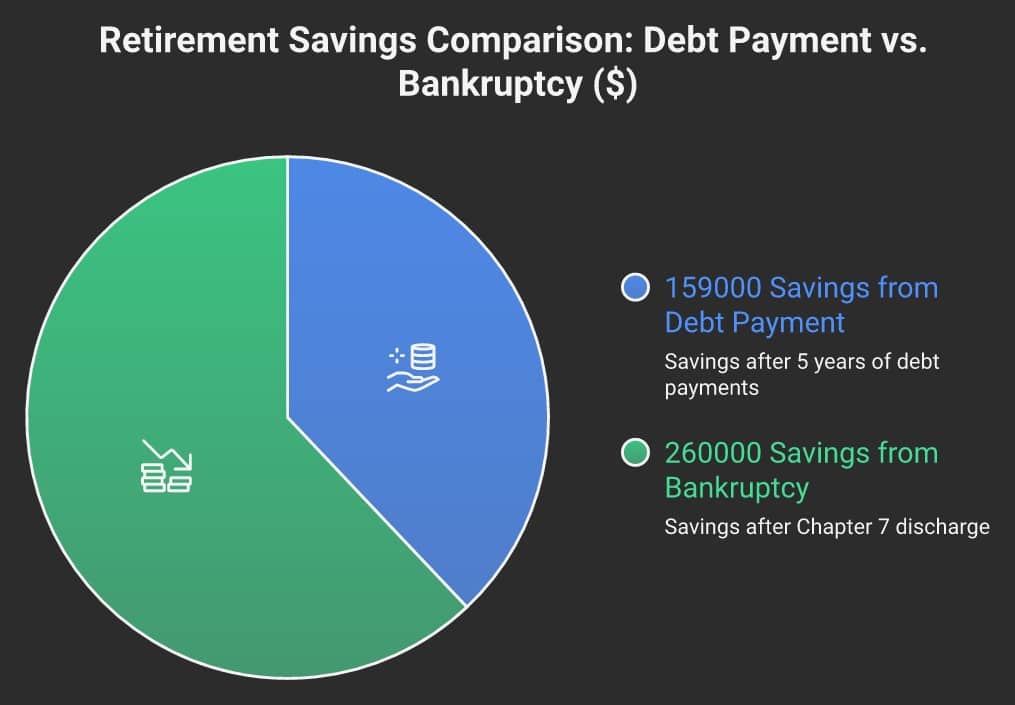
- Monthly debt payments: $500/month over 5 years = $30,000 paid to creditors
- If that $500/month had gone into a 401(k) at 7% average return for 20 years: approximately $260,000
- If the person is 45 and retiring at 65, the 20-year window is the highest-value compounding period of their career
- The “cost” of the debt isn’t the $30,000 paid — it’s the retirement savings those dollars never became
- For someone 10 years from retirement, the opportunity cost of $500/month redirected to retirement savings is still $87,000+
I have been saying this for 30 years: the people who get hurt worst by grinding through debt repayment are not the ones with bad credit — they’re the ones who drained their retirement window to keep creditors happy, then discovered there’s nothing left for the last third of their life.
Should You Pay Off Debt Before Retiring?
The conventional answer is “yes, pay everything off before you retire.” My answer: it depends on the math, and the math is almost always run wrong.
When paying off debt before retiring makes sense
- High-rate credit card debt you can eliminate from regular income without touching retirement accounts
- Debt with a variable rate that will likely increase
- Debt with a cosigned obligation you want to free yourself from
When paying off debt before retiring often doesn’t make sense
- Cashing out 401(k) to pay off debt — you pay income tax plus a 10% penalty on pre-59½ withdrawals, effectively losing 30–40 cents of every dollar to taxes before it reaches the creditor. This is almost always a losing trade.
- Reducing 401(k) contributions to pay debt faster — you lose the employer match (which is an immediate 50–100% return) and the compounding window to pay creditors who are earning interest on your balance anyway
- Delaying retirement by years to pay off a manageable mortgage that would be covered by your retirement income anyway
Never cash out retirement accounts to pay unsecured debt. This is one of the most expensive financial mistakes a person can make. The tax penalty alone makes it irrational in most situations. If the debt is unmanageable, there are better solutions — including bankruptcy, which protects retirement accounts entirely.
Bankruptcy and Retirement: The Protection Nobody Mentions
If you’re approaching retirement with unmanageable debt, bankruptcy specifically protects the thing you need most: your retirement savings.
- 401(k), 403(b), and pension accounts are fully exempt in bankruptcy under ERISA — creditors cannot touch them
- IRA and Roth IRA accounts are exempt up to approximately $1.5 million (adjusted periodically) under federal bankruptcy law
- Social Security benefits remain protected in bankruptcy
- Chapter 7 discharge eliminates unsecured debt (credit cards, medical bills, personal loans) in 4–6 months without touching retirement accounts
A person at 58 with $200,000 in a 401(k) and $40,000 in credit card debt has a choice: drain the retirement account (losing roughly $14,000+ in taxes and penalties) to pay the cards, or file Chapter 7 and keep every dollar of the retirement account while discharging the cards. The math is almost always better for bankruptcy — and the retirement account is legally untouchable in the process.
Federal Student Loans in Retirement: The Income-Driven Path
If you’re carrying federal student loans into retirement, the income-driven repayment rules create a specific path worth knowing:
- SAVE, IBR, or ICR plans cap payments at 5–20% of discretionary income
- Social Security income may place you below or near the poverty line for discretionary income calculation — resulting in $0/month payments
- Federal student loans are discharged at death — they do not transfer to heirs or your estate
- After 20–25 years of income-driven payments (10 years for public service), remaining balances are forgiven
- If you’re near retirement and your federal loan balance is large relative to income, the math often favors income-driven repayment over aggressive payoff
FAQ
Can creditors garnish my Social Security in retirement?
Private creditors cannot garnish Social Security. The federal government can garnish Social Security for unpaid taxes, defaulted federal student loans, and domestic support obligations (alimony, child support). State and local tax authorities have separate rights that vary by state. But for credit card debt, medical debt, personal loans, or other private creditor debts — Social Security is fully protected from garnishment.
Should I use my 401(k) to pay off debt before retiring?
Almost never. Withdrawing from a 401(k) before age 59½ triggers a 10% penalty plus ordinary income tax — effectively losing 30–40 cents of every dollar before it reaches your creditor. Even after 59½, you pay ordinary income tax on withdrawals. The tax cost of using retirement funds to pay unsecured debt is usually worse than the debt itself. If the debt is unmanageable, bankruptcy protects your retirement accounts completely.
What happens to debt when I die?
Debt doesn’t pass to your heirs — they’re not personally responsible for your debts unless they co-signed. Creditors can make claims against your estate (the assets you leave behind). Retirement accounts with named beneficiaries pass directly to heirs outside the estate and are generally not available to creditors. If you die with more debt than assets, creditors get whatever the estate has — and heirs get nothing — but heirs personally owe nothing.
Does carrying debt into retirement affect Medicare or Social Security benefits?
Carrying debt does not affect Medicare eligibility or Social Security benefits. However, garnishment orders from the federal government (unpaid taxes, defaulted federal student loans) can reduce Social Security payments — up to 15% can be withheld for defaulted federal student loans, and up to 15% for federal tax debt. Private creditor debt has no effect on these benefits.
Bottom Line
Retiring with debt is a math problem, not a moral one. Social Security and most retirement accounts are protected from private creditors — which changes the urgency of debt repayment decisions. Never cash out retirement savings to pay unsecured debt; the tax cost makes it almost always irrational. If debt is truly unmanageable, bankruptcy protects retirement accounts entirely while discharging the debt. The biggest retirement risk isn’t carrying a low-rate mortgage — it’s spending your highest-compounding earning years grinding through debt payments that a bankruptcy could have resolved in six months.
Dealing With Debt? Understanding your options is the first step. See how all your debt relief options compare — including ones most sites won’t tell you about. The Find Your Path quiz gives a recommendation based on your actual numbers, and the Scam-O-Meter checks any company’s complaint history before you sign. Federal Reserve research shows bankruptcy filers recover faster than those who don’t file.



