

“Dave Ramsey has helped millions of people. He’s also never once asked a caller whether they have ADHD before telling them to make a budget. That one gap explains a lot of suffering.” — Steve Rhode
I want to be clear about something before we go any further: Dave Ramsey has genuinely helped a lot of people. His message that debt is serious, that you should have a plan, and that financial discipline matters — I agree with all of that. I’ve been saying the same things since 1994.
But after 30 years of helping people with debt, filing bankruptcy myself in 1990, and founding a credit counseling organization that grew to 70 employees, I’ve watched thousands of people try Dave’s approach and feel like failures when it didn’t work. The problem usually wasn’t their willpower. It was that the advice was built for a brain they don’t have.
This isn’t an attack on Dave Ramsey. It’s the information his approach leaves out — and that missing information matters enormously depending on your situation.
Each weekday I send one short email: one story that caught my attention, why it might matter to you, and one manageable thing you can do with it. A couple of minutes, and a dad joke.
In the latest issue (Nov 9): Check your power bank and your French press
Free. I sell nothing. Unsubscribe any time.
What Dave Ramsey Gets Right
Let’s give credit where it’s due. Dave Ramsey has built an empire because his core message resonates with millions of people:
- Debt is a serious problem that requires a real plan, not wishful thinking
- Emotional spending is often the root cause, not just income
- The debt snowball creates psychological wins that build momentum
- Living below your means is genuinely necessary for financial progress
- Emergency funds prevent good people from spiraling after one bad event
- His community provides real accountability and encouragement
If Dave’s approach is working for you, keep going. Seriously. I’m not here to talk you out of something that’s working.
But if you’ve tried his methods and keep ending up back at square one — feeling stupid, lazy, or broken — keep reading. Because the problem almost certainly isn’t you.
The Brain Chemistry Gap Nobody Talks About
I wrote a full deep-dive on this — ADHD and Debt: Why Standard Money Advice Doesn’t Work — that covers the neuroscience in detail. The short version: On a recent episode of The Get Out of Debt Guy Show, Damon Day put it plainly: “If all the advice you’re getting is tailored towards one segment of the population, but you don’t fit that — if your brain works a little bit differently — the standard ‘just buck up and create a budget’ is never going to work.”
Here’s what budgets actually require:
- Sustained working memory — remembering what you’ve spent across days and weeks
- Prospective memory — anticipating future expenses before they arrive
- Inhibitory control — resisting in-the-moment impulses, every single day
- Consistent re-engagement — returning to the budget week after week, month after month
ADHD disrupts all of these. Not because someone is lazy or stupid — because of brain chemistry. The solution isn’t to budget harder. It’s to automate the decisions the budget was meant to govern, so the right things happen whether or not your brain is cooperating that day.
Time Blindness: The Hidden Saboteur
There’s a concept called time blindness — an impaired ability to perceive time and its passage. It’s a core ADHD feature, but debt stress can trigger it in anyone. When future consequences don’t feel emotionally real, present-moment spending decisions aren’t moderated by the weight of those consequences.
This is why making only the minimum payment feels fine. The accumulating interest is a later problem — and the ADHD brain (or the stressed-out brain) has genuine difficulty making “later” feel present. Automation addresses this directly. The payment happens whether or not the future feels real right now.
Manufactured ADHD: The Stress Effect
Here’s what most financial advice ignores entirely: you don’t need a diagnosis for this to apply to you.
Research shows that financial stress causes measurably ADHD-like symptoms in people who don’t otherwise have ADHD. Your reasoning gets slower. Your attention span shortens. You become laser-focused on immediate threats and lose the ability to plan ahead. The shame spiral that follows — I know what I should do but I can’t make myself do it — makes everything worse, because shame triggers avoidance, and avoidance lets the debt grow.
The Retirement Cost Nobody Calculates
Dave Ramsey’s Baby Step 2 is to pay off all non-mortgage debt before investing in retirement (except employer match). For a 35-year-old with $40,000 in debt and a five-year payoff timeline, that advice can cost over $400,000 in lost compound growth by retirement.
I ran a credit counseling organization. I watched people sacrifice their retirement savings for five years on debt management plans — while creditors lowered interest rates but kept them paying long enough to drain whatever compounding years they had left. Dave’s approach has the same hidden cost when it delays retirement investment for years.
The Bankruptcy Question Dave Never Answers Directly
Dave Ramsey filed bankruptcy himself in the late 1980s before his radio career. His own financial reset came courtesy of the bankruptcy system — the same one he discourages his listeners from using.
I’m not saying that to be snarky. I’m saying it because it matters: bankruptcy is a constitutional legal tool, not a moral failure. It exists because society recognized that people sometimes end up in impossible situations through no fault of their own — and that giving them a fresh start serves everyone better than decades of financial servitude.
Dave’s answer to almost every financial problem is a variation of “budget harder, spend less, work more.” For some people in some situations, that’s exactly right. But for someone who is 58 years old with $60,000 in credit card debt and no retirement savings, grinding through a five-year payment plan is a catastrophically bad plan. Bankruptcy — which Dave essentially built his career on — might be the only rational choice.
Where Dave’s Advice Works and Where It Doesn’t
Dave Ramsey’s Approach Works Best When:
Good Fit
- You have a stable income above your expenses
- Your debt is manageable relative to your income
- You’re neurotypical and respond to structured plans
- You’re young enough that a 3-5 year plan doesn’t destroy retirement
- You need motivation and community more than financial optimization
- The emotional accountability of the snowball method works for you
Poor Fit
- You have ADHD or significant financial stress symptoms
- You’re over 50 and can’t afford to delay retirement investing
- Your debt-to-income ratio makes a 5-year plan mathematically impossible
- Medical bills, divorce, or job loss created the debt — not spending habits
- You’ve tried budgeting repeatedly and keep ending up back at zero
- Bankruptcy would resolve everything in months instead of years
Free Tool — Money Personality Quiz: Your spending habits are as individual as your debt. The free Money Personality Quiz identifies your money type — and why standard budget advice probably isn't working for you. Discover Your Type →
What Actually Works Instead
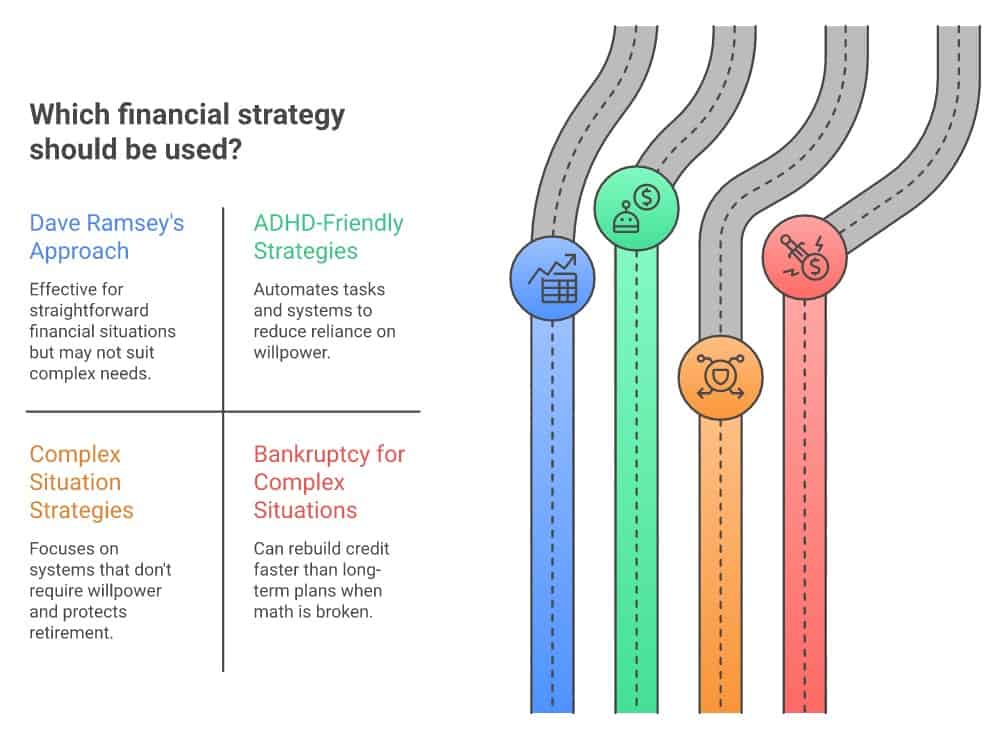
The alternative to Dave Ramsey’s approach isn’t “do nothing.” It’s “match the tool to the actual situation.”
If You Have ADHD or Stress-Related Focus Problems
- Automate every payment — remove willpower from the equation entirely
- Set up automatic savings transfers the day your paycheck arrives
- Use a high-yield savings account linked to your checking — one transfer, set and forget
- Build systems, not budgets — budgets require daily re-engagement; systems don’t
- Get evaluated for ADHD if you’ve never been — it changes which solutions actually work
If You’re Over 50 or Debt Is Overwhelming
- Calculate the real cost of each path — including retirement opportunity cost
- Talk to a bankruptcy attorney before ruling it out — a free consultation costs nothing
- Explore debt settlement for credit cards if bankruptcy isn’t the right fit
- Never cash out retirement accounts to pay unsecured debt — protected in bankruptcy, destroyed otherwise
If the Math Simply Doesn’t Work
- No budget fixes a situation where expenses exceed income by $500/month
- Debt consolidation works if the math works — if the new rate and payment are genuinely lower
- Credit counseling can help if the creditors will negotiate meaningful rate reductions
- Bankruptcy is the fastest path to financial recovery in many cases — not the last resort
The Bottom Line
Dave Ramsey’s advice works for people whose situation fits his model. But debt is math, not morality — and the math is different for everyone. If you’ve tried his approach and keep failing, the problem probably isn’t your character. It’s that you need a different tool for a different situation. Get all the information. Make the decision that serves your future, not the one that fits someone else’s framework.
Frequently Asked Questions
Is Dave Ramsey’s financial advice good?
For certain situations, yes. His emphasis on eliminating debt, building emergency funds, and investing for retirement is sound. Where his advice falls short is in its one-size-fits-all application — particularly for people with ADHD, those over 50, or anyone whose debt-to-income situation makes a multi-year payment plan mathematically ruinous.
Why doesn’t Dave Ramsey’s budgeting advice work for everyone?
Budgeting requires sustained working memory, impulse control, and consistent re-engagement over months. These are exactly the capacities disrupted by ADHD and by severe financial stress. For roughly 10% of adults with diagnosable ADHD — and many more experiencing stress-induced cognitive effects — budgeting harder is the wrong prescription.
Did Dave Ramsey file bankruptcy himself?
Yes. Dave Ramsey filed bankruptcy in the late 1980s after his real estate business collapsed. His financial reset came through the very bankruptcy system he discourages his listeners from using. That doesn’t make his subsequent advice wrong — but it does illustrate that bankruptcy is a legal tool, not a moral failure.
What’s the real cost of following Dave Ramsey’s Baby Steps?
The hidden cost is retirement compounding. Baby Step 2 instructs people to pay off all non-mortgage debt before seriously investing in retirement. For someone in their mid-30s to mid-40s, a five-year debt payoff delay can cost $400,000 or more in lost compound growth. Whether that tradeoff makes sense depends entirely on your age, debt level, and income.
What should I do if Dave Ramsey’s advice hasn’t worked for me?
First, don’t assume the problem is your discipline or character. Consider whether ADHD (diagnosed or not) or stress-related focus issues might be a factor. Then honestly evaluate whether your debt-to-income situation makes a multi-year payment plan feasible. If it doesn’t, consult a bankruptcy attorney — a free consultation will tell you whether that path makes more sense than years of grinding.
Is Steve Rhode anti-Dave Ramsey?
No. Steve Rhode ran a credit counseling organization for years and has spent 30 years helping people get out of debt. His position is that no single approach works for everyone — and that people deserve all the information, not just the advice that fits one framework. If Dave’s approach is working for you, keep going. If it isn’t, there are other options worth knowing about.
Dealing With Debt? Understanding your options is the first step. See how all your debt relief options compare — including ones most sites won’t tell you about. The Find Your Path quiz gives a recommendation based on your actual numbers, and the Scam-O-Meter checks any company’s complaint history before you sign. Federal Reserve research shows bankruptcy filers recover faster than those who don’t file.



