
Quick Answer: To verify a debt collector is legitimate, demand a written validation notice (required by law within 5 days of first contact), look up the company in the CFPB complaint database and your state’s licensing registry, search their phone number and business name independently, and never give payment or personal information before verification is complete. Fake debt collectors use real fear tactics — the steps below take 10 minutes and can protect you from a scam that costs victims thousands.
Expert Context: I’ve been tracking debt collector scams since the 1990s — including after my own 1990 bankruptcy, when I was on the receiving end of collection calls and learned firsthand how hard it is to tell the real ones from the fraudulent ones. Over three decades of documenting this industry, the fake collector playbook has barely changed: create urgency, threaten consequences, and get money before you have time to think. The verification steps I use haven’t changed much either.
If someone claiming to be a debt collector just contacted you, you have the right to verify who they are before paying a cent — and legitimate collectors know this and will cooperate. Fake ones won’t.
Key Terms Defined
Validation Notice: A written document a debt collector must send you within 5 days of first contact under FDCPA § 1692g. It must include the debt amount, the creditor’s name, and your right to dispute the debt in writing within 30 days.
Each weekday I send one short email: one money story that caught my attention, why it might matter to you, and one manageable thing you can do with it. A couple of minutes, and a dad joke.
In the latest issue (Oct 15): The ones who need the Social Security raise the most keep the least of it
Free. I sell nothing. Unsubscribe any time.
Mini-Miranda Warning: The statement a debt collector must include in every communication that reads: “This is an attempt to collect a debt and any information obtained will be used for that purpose.” Its absence is a red flag.
Debt Validation (vs. Verification): When you dispute in writing within 30 days, the collector must stop all collection activity until they mail you written verification of the debt — not just call you back and repeat the claim.
Step 1: Ask for the Validation Notice — in Writing
The Fair Debt Collection Practices Act requires every debt collector to send you a written notice within 5 days of first contact. If they haven’t, that’s already a problem. This notice must contain five specific things:
- The exact dollar amount of the alleged debt
- The name of the creditor who says you owe it
- A statement that you have 30 days to dispute the debt in writing
- A notice that if you dispute, they must stop collection and send written verification
- A statement that upon written request, they’ll provide the original creditor’s name and address
If any of these are missing, send a written validation request immediately. The free Debt Validation Letter Generator on this site creates a ready-to-send letter in under a minute. Send it certified mail — the tracking receipt matters if this ends up in a dispute.
The 30-Day Window: You have 30 days from receiving the validation notice to dispute in writing. Once you dispute, collection must stop completely until they provide written verification. Don’t let the clock run out — disputing in writing protects you even if you ultimately do owe the debt, because it forces them to prove it.
Free Tool — Debt Validation Letter Generator: Being contacted by a debt collector? The free Debt Validation Letter Generator creates a personalized FDCPA validation letter in seconds — forcing the collector to prove the debt is real before they can continue. Generate My Letter →
Step 2: Search the CFPB Complaint Database
The CFPB complaint portal is public. Search the company name at consumerfinance.gov/data-research/consumer-complaints/ and look for:
- Volume of complaints — occasional complaints are normal; hundreds with no resolution are not
- Complaint categories — filter for “False statements or representation” and “Debt not owed” specifically
- Company response rate — legitimate collectors respond to complaints; scam operations don’t
You can also use the free Scam Checker tool on this site, which pulls CFPB data and flags warning patterns automatically.
The Daily Money Brief — Free, at 10 AM
Money you may be owed, scams to dodge, and the fine print decoded — the consumer money news that affects your wallet, every weekday.
Step 3: Check State Licensing Requirements
Most states require debt collectors to be licensed. Your state’s attorney general or department of financial institutions maintains a public registry. If the collector can’t be found there, that’s a significant red flag. The CFPB has a guide to finding your state’s licensing database.
Note: some collectors operate across state lines. A lack of your state license may not mean fraud, but it warrants further investigation before any payment.
Step 4: Search the Company Independently
Never use the phone number or website the collector gave you to verify them. Search independently:
- Google the company name + “complaints” — look for a pattern of fake debt reports, not just negative reviews
- Search the phone number separately — use a reverse phone lookup; legitimate collection agencies have traceable business histories
- BBB lookup at bbb.org — not definitive, but large legitimate agencies usually have a record
- Check PACER.gov — real debt collection agencies that sue routinely will have a record in the federal court system
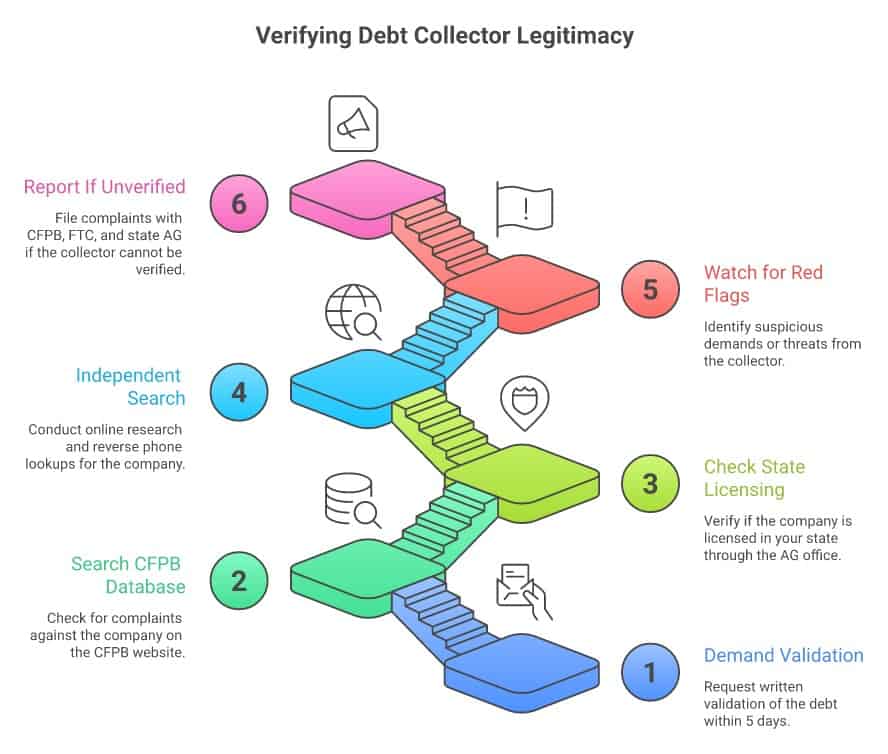
Step 5: Know the Red Flags That Identify Fakes
What fake collectors say: “You must pay today or we’re filing criminal charges.” / “This is your last warning before we contact your employer.” / “We don’t send written notices — this is verbal only.”
What the law actually says: Debt collectors cannot threaten criminal charges for civil debts. Contacting your employer about a debt (except to confirm employment) is generally illegal under FDCPA § 1692c. And every legitimate collector must send a written validation notice — “verbal only” is a fabrication designed to prevent you from verifying their identity.
What fake collectors say: “We already verified the debt — disputing it just makes things worse.”
What the law actually says: Disputing in writing is your right under the FDCPA, and exercising it legally obligates them to stop collection and prove the debt before continuing. Any collector who discourages you from exercising a legal right is operating outside the law.
Step 6: What to Do If You Can’t Verify the Collector
If the collector refuses to send a validation notice, can’t be found in any state licensing registry, has no traceable business address, or pressures you for wire transfer or gift card payment — stop all contact and report immediately.
- File with the CFPB at consumerfinance.gov/complaint/ or call 1-855-411-2372
- File with the FTC at reportfraud.ftc.gov
- Report to your state attorney general — state enforcement often moves faster on local fraud patterns
- Consider consulting an FDCPA attorney — if a collector violated the FDCPA, you may be entitled to sue for up to $1,000 in statutory damages plus attorney’s fees
As consumer law professor Judith Fox documented in her research on debt collection practices, close to 80% of debtors fail to respond to collection actions — often because they’re scared or uncertain about what they’re dealing with. That silence is what scammers count on. Verification takes 10 minutes and costs nothing.
Free Tools on This Site: The Scam Checker pulls CFPB complaint data on any collector. The Debt Validation Letter Generator creates a ready-to-send FDCPA letter in under a minute. The Contract Decoder analyzes debt-related documents if the collector sends you paperwork. All free, no signup required.
Key Takeaways
- Every legitimate debt collector must send a written validation notice within 5 days of first contact — demand it if you don’t receive one
- You have 30 days to dispute in writing; once you do, collection must stop until they prove the debt
- 40% of CFPB debt collection complaints involve debts consumers don’t actually owe — verifying before paying is essential, not paranoid
- Red flags: demands for wire transfer or gift cards, threats of arrest, refusing to provide written notice, pressure to pay “today only”
- Report unverifiable collectors to the CFPB, FTC, and your state AG — the FDCPA lets you sue fake collectors for up to $1,000
The Bottom Line
If you got a call today from someone claiming you owe money — and something felt off — trust that feeling. Fake debt collectors are professionals at manufacturing fear. But the law is on your side: you have the absolute right to demand written proof of any debt before paying, to look up any collector’s history publicly, and to report anyone who refuses to cooperate with those requests. I’ve watched this industry for 30 years and the most important thing I can tell you is this: any collector worth paying will wait the 10 minutes it takes you to verify them. The ones who won’t are the ones you should never pay.
Related Reading:
Frequently Asked Questions
How do I verify a debt collector is legitimate?
Demand the written validation notice required by FDCPA § 1692g (must arrive within 5 days of first contact), search the company name in the CFPB complaint database, verify their phone number and business address independently (not using contact info they provided), and check your state’s debt collector licensing registry through your state attorney general’s office.
Does a debt collector have to tell you who they are?
Yes. The FDCPA requires collectors to disclose their identity in every communication. In the first communication, they must state the communication is from a debt collector and include the Mini-Miranda warning. They cannot use a fictitious or misleading business name to hide their identity.
What is a validation notice and what must it include?
A validation notice is a written document required by the FDCPA that must be sent within 5 days of first contact. It must include the debt amount, the creditor’s name, your 30-day right to dispute, a statement that disputing triggers a verification obligation, and an offer to provide the original creditor’s information on written request.
Can I sue a fake debt collector?
Yes. If a collector violates the FDCPA — including impersonating a legitimate collector or making false statements — you can sue in federal court for actual damages, statutory damages up to $1,000, and attorney’s fees. Many FDCPA attorneys work on contingency. File a complaint with the CFPB and FTC first to create a record.
What should I do if a debt collector refuses to send written verification?
That refusal is itself an FDCPA violation. Document it (note the date, time, what was said). Send a written validation request by certified mail immediately. Report the refusal to the CFPB, the FTC, and your state attorney general. Consult an FDCPA attorney — refusal to provide written notice is a textbook violation with statutory damages available.
Know Your Rights: If a debt collector is contacting you, you have legal protections. See the complete list of FDCPA violations collectors commit most often. Use the free Debt Validation Letter Generator to demand proof of the debt, or check this collector’s complaint history with the Scam-O-Meter.
Dealing With Debt? Before you pay a collector, understand all your debt relief options — including ones the collector won’t tell you about. If the debt feels unmanageable, take the 2-minute bankruptcy quiz to see if the math favors a fresh start. Federal Reserve research shows filers recover faster than those who don’t file.