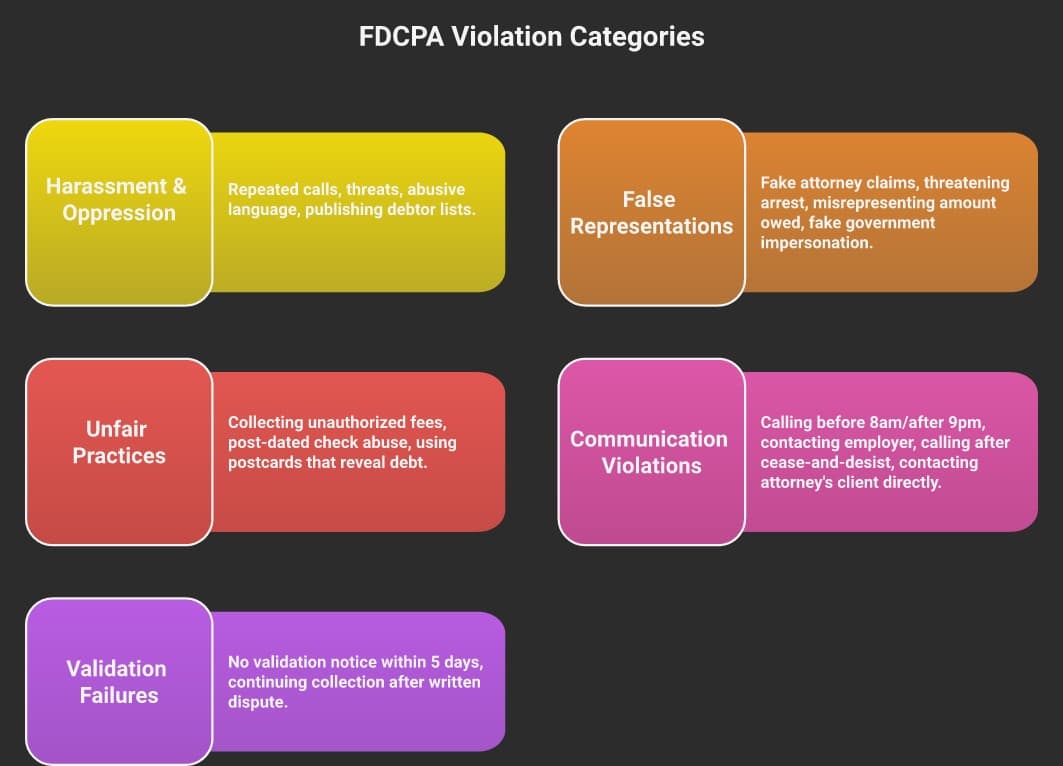
Quick Answer: FDCPA violations fall into five categories: harassment or oppression (§1692d), false or misleading representations (§1692e), unfair practices (§1692f), unauthorized communications (§1692c), and validation failures (§1692g). If a debt collector commits any of these violations, you can sue in federal court for up to $1,000 in statutory damages plus attorney’s fees — and a class action can reach $500,000. Below is the complete categorized list of violations, what each looks like in practice, and what you can do about it.
Expert Context: I studied debt collector tactics from the receiving end — I filed bankruptcy in 1990 and found myself fielding collection calls before and after, which gave me a firsthand education in what collectors will and won’t do when they think nobody’s watching. Three decades later I’ve documented hundreds of enforcement actions. The violations below aren’t hypothetical; they’re patterns I’ve seen enforced by the FTC and CFPB repeatedly.
If the calls about a specific debt — like a retail store card — are the underlying issue, I have a step-by-step guide on how to document every collector call and what the FDCPA prohibits, including a June 2026 case that shows why your paper trail matters.
The Fair Debt Collection Practices Act has been federal law since 1977, but most people who are being violated don’t know it — because collectors count on that.
Each weekday I send one short email: one money story that caught my attention, why it might matter to you, and one manageable thing you can do with it. A couple of minutes, and a dad joke.
In the latest issue (Oct 16): The check that looks like a scam may be real
Free. I sell nothing. Unsubscribe any time.
Key Terms Defined
FDCPA (Fair Debt Collection Practices Act): Federal law at 15 U.S.C. §§ 1692–1692p that governs third-party debt collectors — companies hired to collect debts on behalf of the original creditor. Does NOT apply to the original creditor collecting their own debt (your bank calling you directly is governed by state law, not FDCPA).
Debt Collector (FDCPA definition): Any person who regularly collects debts owed to someone else. Includes collection agencies, debt buyers, and in some cases attorneys. Does not include the original creditor or their employees acting in the ordinary course of business.
Statutory Damages: Damages you can collect without proving actual harm — just proving the violation. Up to $1,000 per lawsuit (not per violation). Court also awards attorney’s fees if you win, which makes FDCPA cases viable even when actual harm is small.
Category 1: Harassment and Oppression (§1692d)
§1692d prohibits conduct whose natural consequence is to “harass, oppress, or abuse” any person in connection with collecting a debt. Specific violations include:
- Threatening violence or other criminal means — “We know where you live” counts here
- Using obscene, profane, or abusive language — any language designed to degrade the debtor
- Publishing a list of debtors to coerce payment — sometimes called a “deadbeat list”
- Advertising the debt for sale to coerce payment
- Causing a telephone to ring repeatedly with intent to annoy — calling 5, 10, 15+ times per day on the same debt
- Failing to identify themselves on a call — a collector who calls without identifying the name of the collection company
Real-world example: A collector calls six times before 9am. On the fifth call they say “You need to pay or things are going to get unpleasant.” Each of those elements — the call volume, the veiled threat — is a separate potential violation. (See: what happens when your phone bill goes to collections.)
The “7-in-7” Rule (Reg F, effective 2021): Under CFPB Regulation F, debt collectors cannot call more than 7 times in 7 days for a single debt — and cannot call within 7 days after reaching you. This is a bright-line rule; exceeding it is a per se violation.
Free Tool — Debt Collector Rights Lookup: Being contacted by a debt collector? The free Debt Collector Rights Lookup shows your state-specific protections — statute of limitations, garnishment limits, and what collectors are legally prohibited from doing. Look Up Your Rights →
Category 2: False or Misleading Representations (§1692e)
§1692e is the broadest FDCPA provision — it prohibits ANY false, deceptive, or misleading representation in connection with collecting a debt. The statute lists 16 specific examples; the most commonly violated:
- Falsely claiming to be an attorney — using letterhead suggesting attorney involvement when no attorney was meaningfully involved
- Falsely claiming to be from the government — impersonating a government agency (sheriff’s office, court, IRS)
- Misrepresenting the amount owed — adding unauthorized fees, inflating the balance, claiming interest not permitted by the original contract
- Threatening arrest for civil debt — you cannot be arrested for not paying a credit card or medical bill; threatening this is a federal violation
- Threatening to take legal action they have no intention or authority to take — “We’re filing suit tomorrow” when they have no intention of doing so
- Threatening to seize, garnish, or sell property without legal right — or without disclosing that legal action is required first
- Using a fake business name — a collector using a name that implies government authority or suggests a different company
- Failing to disclose that the communication is from a debt collector — the “Mini-Miranda” warning is required in every communication
- False representations about credit reporting — threatening to ruin your credit for a debt they have no legal ability to report
Real-world example: A letter arrives on letterhead reading “Law Offices of [Name]” with language like “Legal action is imminent.” If no attorney reviewed the letter or made a determination that legal action was appropriate, that letterhead is a §1692e violation — a practice the FTC has brought multiple enforcement actions against.
Category 3: Unfair Practices (§1692f)
§1692f prohibits unfair or unconscionable means to collect a debt. Specific violations:
- Collecting amounts not authorized by the original agreement or permitted by law — the most common: adding collection fees, processing fees, or interest rates not in the original contract
- Accepting a post-dated check for payment more than 5 days in the future (unless they provide notice 3-10 days before depositing)
- Threatening to deposit a post-dated check early
- Soliciting post-dated checks for the purpose of threatening criminal prosecution
- Collecting fees or charges not expressly authorized — “processing fees,” “convenience fees,” or “administrative charges” added onto the debt without contractual basis
- Taking or threatening to take non-judicial action to repossess property when there is no legal right to do so, or the collector has no present intention of doing so
- Communicating with a debtor via postcards — which can disclose the debt to anyone who sees the postcard
- Debt parking — placing a collection account on your credit report before contacting you — since November 2021, CFPB Regulation F (§ 1006.30) requires collectors to contact you or attempt contact first; before that rule, parking invalid debts was an §1692f unfair practice the FTC pursued directly
Category 4: Prohibited Communications (§1692c)
§1692c restricts when, where, and to whom a collector can communicate about your debt:
- Calling before 8am or after 9pm in the debtor’s local time — any call in that window is a per se violation
- Calling your workplace after being told not to — once you tell a collector your employer prohibits such calls, further calls to that number violate the FDCPA
- Contacting a represented debtor directly — once you have an attorney, the collector must contact your attorney and cannot contact you directly (except to provide location information)
- Contacting you after a written cease-and-desist — the 11-word phrase (“Please cease and desist all calls and contact with me”) triggers a communication prohibition; further contact (except to notify of specific legal actions) is a violation
- Communicating with third parties about the debt — collectors can call a third party (spouse, parent, neighbor) only to locate you. They cannot tell a third party you owe a debt or reveal details of the collection
Common Misconception: “A debt collector can call my family to pressure me.”
Reality: A collector can contact a family member exactly once to ask for your location information — and cannot say anything about the debt. Calling your mother to tell her you owe a credit card bill is a §1692c violation. Calling your employer for anything other than confirming your employment status is also prohibited.
Category 5: Validation Failures (§1692g)
§1692g governs the validation process — the single most underused consumer protection in the FDCPA:
- Failing to send a written validation notice within 5 days of first contact — the notice must include debt amount, creditor name, and dispute rights
- Continuing collection activity after a written dispute — once you dispute in writing within 30 days, all collection must stop until verification is mailed
- Failing to cease collection after receiving a written dispute — even calling to “discuss” the account is a violation if you’ve disputed in writing
- Providing inadequate verification — sending a single letter repeating the original claim rather than actual account documentation doesn’t satisfy the verification requirement
- Overshadowing the validation notice — putting demand-for-immediate-payment language in the same letter as the validation notice in a way that obscures the 30-day dispute right
As consumer law scholar Neil Sobol documented in his research on debt collection practices, between 70–90% of collection lawsuits against unrepresented defendants result in default judgments — most because people didn’t know they had the right to demand proof of the debt first. Requesting validation is the most powerful tool most people never use.
What to Do If a Collector Violated the FDCPA
- Document everything — dates, times, what was said, who called (get a name and company name on every call)
- Send a written validation request — certified mail, keep the receipt. Use the free Debt Validation Letter Generator
- File a CFPB complaint at consumerfinance.gov/complaint — creates a permanent record
- File an FTC complaint at reportfraud.ftc.gov
- Consult an FDCPA attorney — most take FDCPA cases on contingency because the statute awards attorney’s fees to prevailing plaintiffs. You don’t need money upfront to sue a violating collector
Free Tools: The Scam Checker pulls CFPB complaint data for any collector. The Debt Validation Letter Generator creates a ready-to-mail FDCPA dispute letter. If you’re unsure which path makes sense for your situation, the Find Your Path quiz helps identify your best options in minutes.
If collectors are actively calling you right now and you want a step-by-step action plan alongside this violations list, see my crisis guide: Debt Collectors Are Calling Me — it covers the 30-day validation window, cease-and-desist letters, the 7-call weekly cap, and when bankruptcy stops everything immediately.
Key Takeaways
- FDCPA violations fall into five categories: harassment, false representations, unfair practices, prohibited communications, and validation failures
- You can sue for up to $1,000 in statutory damages plus actual damages and attorney’s fees — no need to prove you were harmed by the specific dollar amount
- Most FDCPA attorneys work on contingency — winning plaintiffs have legal fees paid by the violating collector
- A written cease-and-desist stops all collection contact except specific legal notifications; further calls after receipt are violations
- The 30-day validation window is your most powerful tool — disputing in writing freezes collection until they prove the debt
The Bottom Line
If you’re reading this because a collector is doing something that feels wrong — they probably are. The FDCPA is one of the most specific and enforceable consumer protection laws on the books, and collectors who push boundaries count on the fact that most people don’t know where those boundaries are. Now you do. The law doesn’t just give you rights; it gives you remedies. A collector who crosses any of the lines above has handed you the basis for a federal lawsuit, and thousands of people file those suits every year and win. The debt might be real. The way they’re collecting it might not be legal. Those are two separate questions.
Related Reading:
- What Happens If a Debt Collector Ignores My Validation Letter?
- A Debt Collector Called About My Dead Spouse’s Debt. Here’s What You Actually Owe (and What You Don’t).
- How to Get Rid of a Debt Collector Without Paying — The Legal Options Nobody Explains Clearly
- The 777 Rule for Debt Collectors: What It Is and What It Actually Means for You
- I Already Paid This Debt But a Collector Says I Still Owe It
Free Tool — Debt Validation Letter Generator: Being contacted by a debt collector? The free Debt Validation Letter Generator creates a personalized FDCPA validation letter in seconds — forcing the collector to prove the debt is real before they can continue. Generate My Letter →
Frequently Asked Questions
What are FDCPA violation examples?
Common FDCPA violations include: calling before 8am or after 9pm, threatening arrest for civil debt, falsely claiming to be an attorney, failing to send a written validation notice within 5 days, continuing collection after a written dispute, contacting a debtor’s employer about the debt, calling more than 7 times in 7 days, and using obscene or abusive language. Any of these can be the basis for a federal lawsuit for up to $1,000 in statutory damages plus attorney’s fees.
Can I sue a debt collector for FDCPA violations?
Yes. Under FDCPA §1692k, you can sue in any federal or state court of competent jurisdiction within one year of the violation. The court awards up to $1,000 in statutory damages regardless of actual harm, plus actual damages, plus attorney’s fees if you win. Most FDCPA attorneys take these cases on contingency because the fee-shifting provision makes them viable even for small violations.
Does the FDCPA apply to the original creditor?
Generally no. The FDCPA applies to third-party debt collectors — companies that collect debts for someone else. If your original lender (bank, hospital, credit card company) is collecting their own debt in-house, they are typically not covered by the FDCPA. They may still be subject to state law equivalents. Once an original creditor sells or assigns the debt to a collection agency, the collection agency becomes subject to the FDCPA.
What is the FDCPA 7-in-7 rule?
Under CFPB Regulation F (effective November 2021), a debt collector cannot place telephone calls to a consumer more than 7 times within a 7-day period for a single debt, and cannot call within 7 days after having a telephone conversation with the consumer. Violating this bright-line rule is a per se FDCPA violation with no safe harbor.
How long do I have to sue for an FDCPA violation?
One year from the date of the violation. This is a hard statute of limitations — missing it bars your claim regardless of how clear the violation was. Document violations as they happen, including dates and times, and consult an FDCPA attorney promptly if you believe your rights were violated.
Related: Private credit funds now hold 350 billion in consumer debt — why collection is about to get worse.
Dealing With Debt? Understanding your options is the first step. See how all your debt relief options compare — including ones most sites won’t tell you about. The Find Your Path quiz gives a recommendation based on your actual numbers, and the Scam-O-Meter checks any company’s complaint history before you sign. Federal Reserve research shows bankruptcy filers recover faster than those who don’t file.