
Quick Answer: If you stop paying a Buy Now Pay Later (BNPL) service like Afterpay, Klarna, or Sezzle, the typical sequence is: late fees immediately, account suspension within weeks, referral to a debt collection agency within 60–120 days, potential credit bureau reporting (Klarna reports to Equifax; Afterpay and Sezzle policies vary by product), and in some cases a lawsuit for larger balances. BNPL debt is real debt — the same collection laws and credit reporting rules that apply to credit cards apply here too.
Expert Context: BNPL services have been marketing their products as debt-free alternatives since the beginning, and millions of Americans believed it. I’ve been tracking consumer credit since 1994, and I’ve watched this exact cycle before with payday loans, rent-to-own, and deferred interest retail cards — products that are presented as “easy” until the consequences arrive. The consequences here are real, and the industry’s rapid growth means debt collectors are now building entire practices around BNPL defaults.
Buy Now Pay Later is debt by another name — and when you don’t pay it, the collection process that follows looks very much like any other consumer debt.
If a buy-now-pay-later miss pushed you toward a payday loan to cover it — and now that loan is trapping you — see I’m Trapped in a Payday Loan Cycle. Here’s What to Do Right Now.
Each weekday I send one short email: one money story that caught my attention, why it might matter to you, and one manageable thing you can do with it. A couple of minutes, and a dad joke.
In the latest issue (Oct 16): The check that looks like a scam may be real
Free. I sell nothing. Unsubscribe any time.
Key Terms Defined
BNPL (Buy Now Pay Later): Short-term installment products offered at checkout — typically 4 payments over 6 weeks (Afterpay, Klarna) or longer-term monthly plans. Companies include Afterpay, Klarna, Sezzle, Affirm, Zip, and PayPal Pay Later. Different products within the same company may have different credit reporting and collection rules.
Charge-Off: An accounting entry where the lender writes the debt off as a loss — typically after 120–180 days of nonpayment. A charge-off does NOT mean you no longer owe the debt; it typically triggers transfer to a collection agency and credit reporting.
What Happens First: Late Fees and Account Suspension
Every BNPL provider charges late fees. Rates vary:
- Afterpay: Fees up to $8 per missed payment (capped at 25% of the order value). Account frozen immediately on the first missed payment.
- Klarna: Late fees vary by product — their pay-in-4 product charges $7 per missed payment; monthly financing products may charge up to 29.99% APR if financed. Account access suspended on missed payments.
- Sezzle: Charges a $10 fee after 2 days of a missed payment; account suspended. Reschedule fees apply to move payment dates.
- Affirm: Does NOT charge late fees — but does report negative information to Experian for some products and will pursue collections.
- Zip (formerly Quadpay): Late fees up to $7 per missed installment; account suspended.
Account suspension means you cannot make new purchases on the platform until the balance is cleared — which matters if you rely on it regularly.
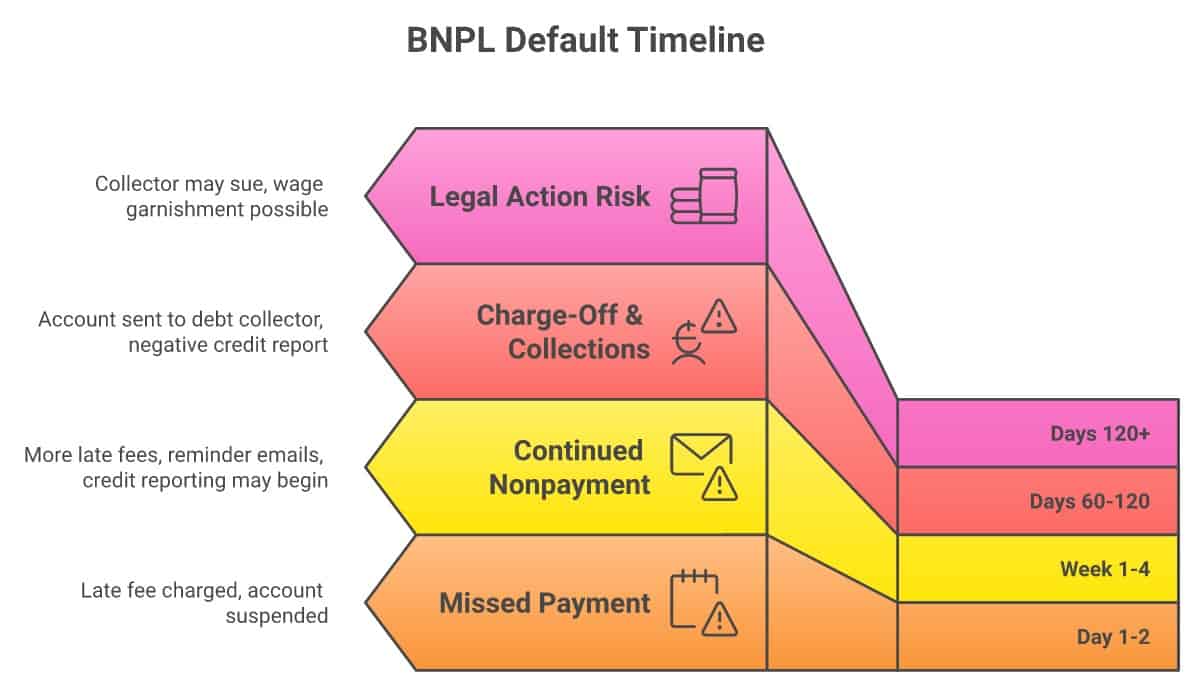
Credit Reporting: Will It Hit Your Credit Score?
This is where BNPL gets complicated — and where the marketing has been misleading. The CFPB’s 2022 BNPL report flagged inconsistent credit reporting as a significant consumer protection problem.
What BNPL companies imply: “It won’t affect your credit — there’s no hard pull and no reporting.”
What actually happens: Klarna reports to Equifax for most products. Affirm reports to Experian for some products. Afterpay and Sezzle historically reported only derogatory information (missed payments and collections), not on-time payments — meaning you get none of the credit-building upside but all of the downside. The CFPB has been pushing for standardized reporting, and policies are changing. Check the current terms for your specific product.
Collections: The 60–120 Day Window
If you don’t pay after late fees and account suspension, BNPL providers typically refer the account to a third-party debt collection agency within 60–120 days, depending on the provider and balance size. Once an account goes to collections:
- The debt collector contacts you by phone and mail
- The account appears on your credit report (if not already reporting) as a collections account
- The collector may attempt to negotiate a settlement for less than the full balance
- For larger balances, the collector may file a lawsuit
The same FDCPA protections that apply to credit card debt apply here — the collector must send a written validation notice within 5 days of first contact, must stop collection after a written cease-and-desist, and cannot call before 8am or after 9pm. BNPL debt in collections is governed by exactly the same rules as any other consumer debt once it reaches a collection agency.
Can They Sue You?
Yes — but typically only for balances worth litigating. Most BNPL balances are small ($50–$500), which makes them unprofitable to sue over individually. However:
- Klarna and Affirm offer higher-balance financing products ($1,000–$10,000) that are more likely to result in legal action on default
- Debt buyers sometimes purchase portfolios of small BNPL debts and file mass small-claims actions
- A judgment allows the creditor to garnish wages or bank accounts (depending on your state’s exemption rules)
What to Do If You’re Behind on BNPL Payments
- Contact the BNPL company directly before it goes to collections — most have hardship programs or payment rescheduling options that don’t appear in the standard app flow
- If it’s already in collections, request debt validation — use the free Debt Validation Letter Generator to send a written request. The collector must prove the debt before continuing collection.
- Don’t pay a collection account without getting the agreement in writing — partial payment may reset the statute of limitations in some states
- Check if you’re judgment-proof — if your income is all from protected sources (Social Security, SSI, SSDI, veterans benefits) and you have no significant assets, a judgment may be uncollectable even if obtained
- For multiple BNPL debts plus other debt, consider a full debt review — take the Find Your Path quiz to see if a consolidation, DMP, or bankruptcy makes more sense than paying each one separately
State Law Matters: Statute of limitations on BNPL debt varies by state — from 3 to 10 years. Some states (Texas, Pennsylvania, North Carolina, South Carolina) have strong wage garnishment exemptions that make judgments difficult to enforce. Your state law matters as much as federal law in determining what a collector can actually do to you. CFPB has a guide to state statutes.
Key Takeaways
- Missing a BNPL payment triggers late fees immediately and account suspension within days — this isn’t “soft” debt
- Credit reporting varies by provider and product — Klarna reports to Equifax; Affirm reports to Experian for some products; negative information is widely reported even when on-time payments aren’t
- Unpaid BNPL debt goes to collection agencies within 60–120 days and follows all standard FDCPA rules
- Legal action is rare for small balances but real for higher-balance BNPL products (Klarna Pay Later, Affirm financing)
- Contact the BNPL company before collections — hardship plans exist but aren’t advertised prominently
The Bottom Line
BNPL companies built their businesses on the marketing idea that this wasn’t really debt. It is. The collection industry treats it exactly like a credit card balance once it goes delinquent — same agencies, same calls, same legal processes. If you’re behind on multiple BNPL accounts right now, you’re not alone; the CFPB found that 41% of users paid late at least once. What matters is what you do next: contact the companies before they hand it off, know your rights once it reaches a collector, and don’t let the small-balance nature of these debts trick you into ignoring them until the consequences are much bigger than the original purchase.
Related Reading:
- New York Proposes Nation’s First Comprehensive BNPL Licensing Rules: What It Means for You
- New York’s New Buy Now Pay Later Law: What Shoppers Need to Know
- 41% of Buy Now Pay Later Users Paid Late Last Year — And They’re Using It for Groceries
- Fries Now, Regret Later? Klarna, DoorDash & the Debt Trap You Didn’t See Coming
Free Tool — Wage Garnishment Calculator: Worried about your paycheck being seized? The free Wage Garnishment Calculator shows exactly how much creditors can legally take in your state — and some states prohibit garnishment entirely. Calculate My Risk →
Frequently Asked Questions
Free Tool — Statute of Limitations Checker: Dealing with old debt? The free Statute of Limitations Checker tells you if the collection clock has expired in your state — including the zombie debt and clock-restarting traps collectors use. Check My Status →
What happens if you don’t pay Afterpay?
Afterpay charges late fees up to $8 per missed payment (capped at 25% of order value) and immediately suspends your account. After continued nonpayment — typically 60–120 days — the account is referred to a third-party collection agency. The debt is then subject to standard FDCPA collection rules, and the collector may report it to credit bureaus. Afterpay itself does not proactively report to credit bureaus for most products, but collection accounts will appear.
What happens if you don’t pay Klarna?
Klarna charges late fees and suspends your account. Klarna reports to Equifax for most products — including on-time payment history for some. Missed payments will appear on your Equifax credit report. After 60–120 days, unpaid accounts go to collections. Klarna’s longer-term financing products carry interest rates up to 29.99% APR and behave more like traditional credit card debt in collections.
What happens if you don’t pay Sezzle?
Sezzle charges a $10 late fee after 2 days and suspends the account. Continued nonpayment results in account closure and referral to a collection agency. Sezzle historically reported derogatory information to credit bureaus; their current reporting policy varies by product. Check their terms directly for the most current information.
Can BNPL debt go to court?
Yes, though it’s less common for small balances. BNPL companies and the debt buyers who purchase their portfolios can and do file lawsuits — particularly for balances over $500 or for higher-balance financing products. A judgment allows wage garnishment and bank levies (subject to your state’s exemption laws). If you receive a court summons for a BNPL debt, respond — 70-90% of collection lawsuits result in default judgments against consumers who don’t respond at all.
Does unpaid BNPL hurt your credit score?
It can. Credit reporting varies significantly by provider and product. Klarna reports to Equifax for most products. Affirm reports positive and negative information to Experian for some products. Afterpay and Sezzle primarily report derogatory events (collections, charge-offs) rather than ongoing payment history. A collection account for any BNPL provider will appear on your credit report and significantly damage your score. Always check the specific terms for your product — policies are changing as the CFPB pushes for standardization.
Recent Federal Lawsuits:
Dealing With Debt? Understanding your options is the first step. See how all your debt relief options compare — including ones most sites won’t tell you about. The Find Your Path quiz gives a recommendation based on your actual numbers, and the Scam-O-Meter checks any company’s complaint history before you sign. Federal Reserve research shows bankruptcy filers recover faster than those who don’t file.
Related: One of the biggest myths about BNPL is that it doesn’t count as real debt or affect your credit. I break down exactly what’s actually happening — and when that’s about to change. They Said Buy Now, Pay Later Isn’t Real Debt. It’s On Your Credit File Now — Just Not Scored Yet.



