
Quick Answer: A collection agency cannot garnish your wages without first suing you and winning a court judgment. The only exceptions are federal student loans, tax debts, and child support — those can be garnished without a court order. If a collector threatens wage garnishment without a lawsuit, they’re violating the law. Federal limits cap garnishment at 25% of disposable pay, and four states ban it almost entirely for consumer debts.
Expert Context: I’ve studied collector tactics since the 1990s, including as someone who was on the receiving end after my own bankruptcy. The wage garnishment threat is one of the most common fear tools collectors use — and most of the time, they’re bluffing. Understanding the actual legal process gives you power they don’t want you to have.
A debt collector just called and said they’re going to garnish your wages. Your heart is racing. Your paycheck is the only thing between you and disaster. Here’s what they’re not telling you: in most cases, they can’t do it without suing you first — and even then, the law limits how much they can take.
Key Terms Defined
Wage Garnishment: A court order requiring your employer to withhold a portion of your paycheck and send it directly to a creditor. Under the federal Consumer Credit Protection Act (CCPA), this requires a court judgment for most debts.
Every weekday I read the enforcement actions, filings and fine print the outlets skip, and turn them into the one or two moves that actually improve your position — a rate worth moving for, a fee you can refuse, a deadline to beat before it costs you.
In the latest issue (Oct 8): A parent's nursing home bill can become yours
I write Your Money Actually most weekdays — actionable money information you will not find anywhere else, and the small decisions that compound. It is free, I sell nothing, and I take no money from any company I write about.
Disposable Earnings: Your take-home pay after legally required deductions (taxes, Social Security, Medicare). This is the number the garnishment percentage applies to — not your gross pay.
Administrative Garnishment: Wage garnishment without a court order, available only to federal agencies for specific debts (student loans, taxes, child support). Regular collection agencies cannot use this.
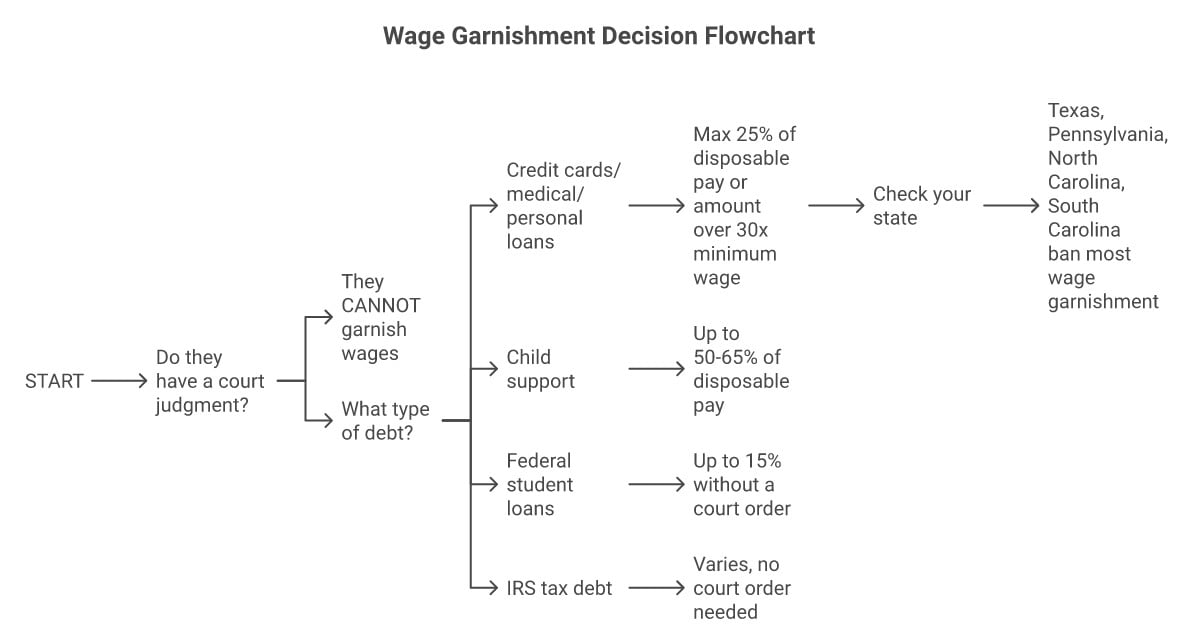
The Three Things That Must Happen Before Garnishment
For regular consumer debt (credit cards, medical bills, personal loans, phone bills), a collector must complete all three steps before touching your paycheck:
- Step 1: File a lawsuit. The collector must sue you in court. You’ll receive a summons and complaint — this is your notice and your chance to respond.
- Step 2: Win a judgment. Either you lose at trial, or — far more commonly — you don’t respond and the court enters a default judgment. (Never ignore a debt lawsuit — that’s how most garnishments happen.)
- Step 3: Apply for a garnishment order. With judgment in hand, the collector asks the court to order your employer to withhold a portion of your pay.
Warning: If a collector threatens to garnish your wages and has NOT filed a lawsuit, that’s an FDCPA violation. Document the threat (date, time, what was said) and file a complaint with the CFPB. You may be entitled to damages.
Free Tool — Wage Garnishment Calculator: Worried about your paycheck being seized? The free Wage Garnishment Calculator shows exactly how much creditors can legally take in your state — and some states prohibit garnishment entirely. Calculate My Risk →
Federal Garnishment Limits
Even with a court judgment, federal law limits how much a collector can take. The Consumer Credit Protection Act caps garnishment at the lesser of:
- 25% of your disposable earnings (after taxes and mandatory deductions), OR
- The amount by which your weekly disposable pay exceeds 30 times the federal minimum wage ($7.25 × 30 = $217.50/week in 2026)
This means if your weekly disposable income is $300, the maximum garnishment is $82.50 (the amount over $217.50) — not $75 (25% of $300). The law uses whichever calculation leaves you with more money.
Example: Your weekly disposable pay is $500.
25% of $500 = $125
$500 – $217.50 = $282.50
The lesser amount is $125, so that’s the maximum garnishment.
Free Tool — I'm Being Sued for Debt Guide: Being sued by a creditor or debt collector? The free I'm Being Sued Guide gives you a personalized action plan — deadlines, defenses, and options based on your state. Most states require a response within 20–30 days. Get My Action Plan →
States That Limit or Ban Wage Garnishment
Federal law sets the floor, but states can only make it stricter — never looser. Four states provide near-total protection from wage garnishment on consumer debts:
States That Ban Most Garnishment
- Texas — No garnishment for consumer debt
- Pennsylvania — No garnishment for consumer debt
- North Carolina — No garnishment for consumer debt
- South Carolina — No garnishment for consumer debt
States With Lower Caps
- New York — Only 10% of gross or 25% of disposable, whichever is less
- California — Only 25% of disposable minus 40x state minimum wage
- Florida — Head of household earning under $750/week is exempt
- Many states — Use higher minimum wage thresholds than federal
Even in states that ban garnishment, exceptions exist for child support, taxes, and federal student loans.
Exceptions: Debts That Can Be Garnished Without a Court Order
Three types of debt don’t require a lawsuit before garnishment:
- Federal student loans: The Department of Education can garnish up to 15% of disposable pay through administrative garnishment — no court order needed
- Federal tax debt: The IRS can issue a levy on wages without a court judgment. The amount varies based on filing status and dependents
- Child support/alimony: Garnishment can reach 50-65% of disposable pay depending on whether you support other dependents
How to Fight a Garnishment
If you’ve been served with a lawsuit or already have a garnishment order, you have options:
- Respond to the lawsuit. The single biggest mistake people make is ignoring the summons. Over 70% of debt collection cases end in default judgments — meaning the debtor never showed up. Show up.
- Challenge the debt. The collector must prove they own the debt, that the amount is correct, and that the statute of limitations hasn’t expired. Many can’t.
- Claim exemptions. If your income is below your state’s threshold, or you’re head of household in Florida, or your income is primarily from protected sources (Social Security, disability), you can file a claim of exemption.
- File for bankruptcy. A Chapter 7 filing triggers an automatic stay that immediately stops all garnishment. The underlying debt is then discharged. This is often the fastest and most complete solution.
- Negotiate a settlement. Even after a judgment, collectors will often settle for less than the full amount. They want cash now, not garnishment payments over months.
What’s Protected From Garnishment (No Matter What)
Certain income sources are federally protected from garnishment by regular creditors:
- Social Security benefits (with narrow exceptions)
- SSI and SSDI payments
- Veterans benefits
- Federal retirement and disability benefits
- Railroad retirement benefits
Not sure where you stand? Take the free Find Your Path quiz to see whether bankruptcy, settlement, or another approach makes the most sense for your specific situation.
Key Takeaways
- Collection agencies need a court judgment before garnishing wages for consumer debt — no exceptions
- Federal law caps garnishment at 25% of disposable pay or the amount over 30x minimum wage
- Texas, Pennsylvania, North Carolina, and South Carolina ban most wage garnishment entirely
- Never ignore a debt lawsuit — default judgments are how most garnishments happen
- Bankruptcy immediately stops garnishment through the automatic stay
- Social Security, SSI, SSDI, and veterans benefits are federally protected
The Bottom Line
The collector threatening to garnish your wages is banking on your fear, not the law. They need to sue you, win, and get a court order — and even then, the law protects a significant portion of your paycheck. Four states don’t allow it at all. If you respond to the lawsuit instead of hiding from it, you have a real chance of stopping garnishment before it starts. And if a judgment already exists, bankruptcy halts it immediately. You have more protection than the collector wants you to know. Use it.
Frequently Asked Questions
Can a collection agency garnish my wages without a court order?
No — not for regular consumer debts like credit cards, medical bills, or personal loans. The collector must first sue you and win a court judgment, then apply for a garnishment order. The only debts that can be garnished without a court order are federal student loans (15% through administrative garnishment), IRS tax debt, and child support/alimony.
How much of my paycheck can be garnished?
Federal law caps it at the lesser of 25% of your disposable earnings or the amount by which your weekly disposable pay exceeds 30 times the federal minimum wage ($217.50/week). Your state may set a lower cap. Four states — Texas, Pennsylvania, North Carolina, and South Carolina — ban most wage garnishment entirely.
If your wages are already being garnished, see the emergency crisis guide for immediate steps.
Can my employer fire me for having my wages garnished?
Federal law prohibits your employer from firing you because of garnishment for any single debt. However, this protection does not extend to garnishments for two or more separate debts. Some states provide broader protection.
What if I can’t afford the garnishment?
File a claim of exemption with the court explaining that the garnishment creates a financial hardship. Many states allow judges to reduce or eliminate garnishment for heads of household or low-income workers. Filing for Chapter 7 bankruptcy immediately stops all garnishment through the automatic stay and can eliminate the underlying debt entirely.
Can they garnish my bank account instead of my wages?
Yes — with a court judgment, a creditor can levy your bank account (called a bank garnishment or bank levy). This is different from wage garnishment and typically takes the full amount in the account up to the judgment amount. Social Security and certain federal benefits deposited into your account are protected for two months of deposits. If your account is levied, act immediately — you may need to file a claim of exemption or bankruptcy petition to recover the funds. But if your income is Social Security, the rules flip in your favor — my crisis guide on collector threats against Social Security explains why that money is almost always untouchable.
Know Your Rights: If a debt collector is contacting you, you have legal protections. See the complete list of FDCPA violations collectors commit most often. Use the free Debt Validation Letter Generator to demand proof of the debt, or check this collector’s complaint history with the Scam-O-Meter.
Dealing With Debt? Before you pay a collector, understand all your debt relief options — including ones the collector won’t tell you about. If the debt feels unmanageable, take the 2-minute bankruptcy quiz to see if the math favors a fresh start. Federal Reserve research shows filers recover faster than those who don’t file.



