
Quick Answer: Business debt collection operates under completely different rules than consumer debt collection. The Fair Debt Collection Practices Act (FDCPA) — the federal law that protects consumers from abusive debt collectors — generally does not apply to business debts. If you took out a loan, credit line, or signed a contract primarily for business purposes, collectors can use tactics against you that would be illegal if the debt were personal. Understanding this gap could save your business — and your personal assets.
Update (April 2026): A surge in mega corporate bankruptcies is creating new urgency for small business owners dealing with payment delays and contract rejections.
Part of the FDCPA Rights Hub: This post is one piece of my complete Debt Collectors and Your FDCPA Rights: The Complete Guide — what collectors can and cannot do, how to stop calls, demand validation, fight back in court, and sue collectors who cross the line.
Related crisis help: if your business closed and you personally guaranteed the loan, here’s exactly what to do right now — before you sign or pay anything.
Every weekday I read the enforcement actions, filings and fine print the outlets skip, and turn them into the one or two moves that actually improve your position — a rate worth moving for, a fee you can refuse, a deadline to beat before it costs you.
In the latest issue (Oct 8): A parent's nursing home bill can become yours
I write Your Money Actually most weekdays — actionable money information you will not find anywhere else, and the small decisions that compound. It is free, I sell nothing, and I take no money from any company I write about.
Expert Context: I’ve been helping people deal with debt collectors since 1994, and I’ve been on the receiving end myself after filing bankruptcy in 1990. Over three decades, I’ve watched countless small business owners get blindsided by aggressive collection tactics they assumed were illegal — only to discover that the rules they thought protected them simply don’t apply to business debt. This is one of the most dangerous knowledge gaps I see.
Every week, I hear from small business owners who are shocked — genuinely shocked — to learn that the debt collector harassing them at all hours, threatening to seize everything they own, isn’t breaking any federal law. They assumed the FDCPA had their back. It doesn’t. And that assumption is costing people their businesses, their personal savings, and in too many cases, their homes.
Key Terms Defined
FDCPA (Fair Debt Collection Practices Act): The federal law (15 U.S.C. 1692) that prohibits abusive, deceptive, and unfair debt collection practices — but only for debts incurred “primarily for personal, family, or household purposes.”
Personal Guarantee: A legally binding promise that you, personally, will repay a business debt if the business cannot. This makes you individually liable regardless of your LLC or corporate structure.
Piercing the Corporate Veil: A legal action where a court holds business owners personally liable for business debts, typically when the owner has commingled personal and business finances or failed to maintain proper corporate formalities.
UCC (Uniform Commercial Code): A set of standardized laws governing commercial transactions between businesses, adopted in some form by all 50 states.
Subchapter V: A streamlined form of Chapter 11 bankruptcy designed specifically for small businesses with debts under $7.5 million.
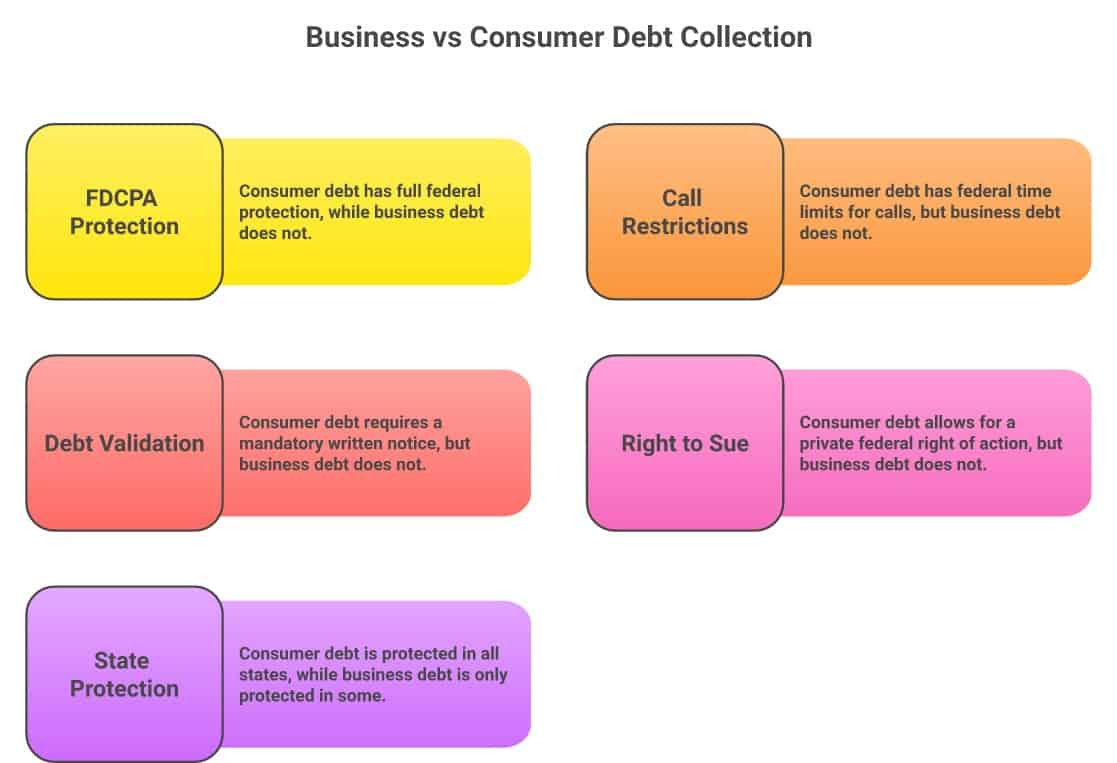
Why the FDCPA Doesn’t Cover Business Debt Collection
Here’s the specific language that creates this gap. Under 15 U.S.C. 1692a(5), the FDCPA defines “debt” as:
“Any obligation or alleged obligation of a consumer to pay money arising out of a transaction in which the money, property, insurance, or services which are the subject of the transaction are primarily for personal, family, or household purposes.”
— Fair Debt Collection Practices Act, 15 U.S.C. 1692a(5)
That phrase — “primarily for personal, family, or household purposes” — is the dividing line. If you took out a business loan, signed a commercial lease, used a business credit card for inventory, or got a merchant cash advance to fund operations, those debts fall outside the FDCPA’s protection.
Congress made this distinction deliberately. The logic was that businesses are more sophisticated than individual consumers and can negotiate with collectors on equal footing. But anyone who’s run a small business knows that’s often fiction. A sole proprietor with $80,000 in business debt is not JPMorgan Chase.
What Business Debt Collectors Can Do (That Consumer Collectors Cannot)
Without FDCPA protection, business debt collectors have significantly more latitude. Here’s what that looks like in practice:
Consumer Debt (FDCPA Applies)
- Collectors can’t call before 8 a.m. or after 9 p.m.
- Must stop calling your workplace if asked
- Can’t discuss your debt with third parties
- Must send written validation within 5 days
- Can’t use abusive, deceptive, or unfair practices
- You can sue for violations ($1,000+ per violation)
Business Debt (FDCPA Usually Doesn’t Apply)
- No federal call-time restrictions
- May contact you at your business during business hours
- Fewer restrictions on third-party contact
- No federal debt validation requirement
- Broader range of permissible collection tactics
- No private right of action under federal law
This doesn’t mean business debt collectors can do anything they want. But the protections are patchwork, inconsistent, and often weaker than what consumers get.
Business Debt Collection Laws That Do Apply
Even without the FDCPA, business debtors aren’t completely unprotected. Here’s what still applies:
The Telephone Consumer Protection Act (TCPA)
The TCPA applies to both consumer and business debt collection. Collectors cannot use auto-dialers or prerecorded messages to call your cell phone without prior consent. They must honor “do not call” requests for robocalls. This is one federal law that doesn’t care whether your debt is personal or commercial.
State Fair Business Practices Laws
Most states have laws prohibiting fraud, deception, and harassment in commercial transactions — even if they don’t have specific business debt collection statutes. Some states go further:
- California (SB 1286): As of July 1, 2025, California extended consumer-style collection protections to commercial debts of $500,000 or less under the Rosenthal Fair Debt Collection Practices Act. This includes protections for individual guarantors of business debt.
- New York: Has broad consumer protection laws that apply to commercial collection practices, requiring collectors to avoid harassment and deceptive practices regardless of debt type.
- Florida: Maintains a separate Florida Commercial Collection Practices Act alongside its consumer collection law.
- Texas: The Texas Debt Collection Act covers some commercial debt collection practices.
Don’t assume your state protects you. Many states have no specific business debt collection statute. Check with an attorney in your state to understand what protections, if any, apply to your situation. The CFPB’s state-by-state guide is a starting point, but it focuses primarily on consumer protections.
Contract Law and the UCC
The Uniform Commercial Code (UCC) governs commercial transactions between businesses and provides a framework for how debts can be collected and enforced. This includes rules about security interests, liens, and asset seizure. However, UCC protections are about enforcing the original contract terms — they don’t regulate collector behavior the way the FDCPA does.
Common Law Fraud and Harassment
Even without specific debt collection statutes, basic legal protections still exist. A business debt collector who commits fraud, makes threats of physical violence, or engages in tortious interference with your business relationships can still face legal consequences. But you’ll need an attorney and a lawsuit — there’s no simple complaint process like filing with the CFPB.
Am I Personally Liable for Business Debt?
This is the question that keeps small business owners up at night. The answer depends on your business structure, what you signed, and how you’ve managed your finances.
The Myth: “My LLC protects all my personal assets from business debt collectors.”
The Reality: LLC protection is real but conditional. If you signed a personal guarantee, commingled personal and business funds, or failed to maintain your LLC properly, courts can “pierce the corporate veil” and come after your personal assets — including your home, savings, and retirement accounts.
When Your Personal Assets Are at Risk
- You signed a personal guarantee. This is the most common way business owners end up personally liable. Most small business loans, commercial leases, and even some merchant cash advances require personal guarantees. When you sign one, your LLC doesn’t matter — you’re on the hook personally.
- You commingled funds. If you’ve been paying personal bills from your business account or vice versa, courts can treat your business and personal finances as one entity.
- You’re a sole proprietor. If you haven’t formed an LLC or corporation, there is no legal separation between you and your business. Every business debt is a personal debt.
- Your LLC was undercapitalized. If you started your business without adequate funding and used debt to cover foreseeable expenses from the start, courts may disregard the LLC protection.
- You didn’t maintain corporate formalities. No operating agreement, no separate bank accounts, no documented business decisions — these failures give courts grounds to treat your LLC as a sham.
When Your Personal Assets Are Protected
- The debt is purely in the business name with no personal guarantee
- You’ve maintained strict separation between personal and business finances
- Your LLC has an operating agreement and you follow it
- The business was adequately capitalized from the start
- You haven’t engaged in fraud or misrepresentation
The Business Debt Recovery Process: What to Expect
When a business debt goes into collections, the process typically follows a more aggressive timeline than consumer collections:
- Demand letters and calls (Days 1-30): The collector contacts you demanding full payment. Unlike consumer debt, there’s often no required validation period.
- Negotiation window (Days 30-90): This is your best opportunity to negotiate. Business debt collectors are often more willing to negotiate settlements because they know the alternative is expensive litigation.
- UCC liens and asset holds (Varies): Collectors may file UCC liens against business assets or seek to freeze business bank accounts.
- Lawsuit (60-180 days): Business debt collectors tend to sue faster than consumer collectors because court procedures for commercial debt are often more straightforward.
- Judgment enforcement: A court judgment can lead to asset seizure, bank account garnishment, and if you signed a personal guarantee, garnishment of personal wages and seizure of personal property.
Business Debt Bankruptcy Options
If your business debt is overwhelming, bankruptcy isn’t failure — it’s a legal tool designed to give you a fresh start. I filed bankruptcy myself in 1990 after my real estate business collapsed, and it was the best financial decision I ever made. Here are your options:
Business Bankruptcy Options Compared
Chapter 7 Liquidation
What it does: Closes the business and sells assets to pay creditors. Eliminates most business debts.
Best for: Businesses that can’t be saved and owners who want a clean break.
Key point: Personal assets are protected by exemptions if you file individually.
Chapter 11 Reorganization
What it does: Lets the business continue operating while restructuring debt under court supervision.
Best for: Larger businesses with viable operations but unsustainable debt loads.
Key point: Expensive and complex — attorney fees alone can run $15,000-$50,000+.
Subchapter V (Small Business)
What it does: A streamlined Chapter 11 specifically for businesses with debts under $7.5 million.
Best for: Small businesses that want to reorganize without the cost and complexity of full Chapter 11.
Key point: Faster, cheaper, and the owner keeps control of the business.
Chapter 13 (Individual + Business)
What it does: Lets sole proprietors reorganize both personal and business debt under one plan.
Best for: Sole proprietors with combined personal and business debt under $2.75 million.
Key point: Only available to individuals, not LLCs or corporations.
Not sure which path is right? Take my free Find Your Path quiz to get personalized guidance on your best options for dealing with debt — whether it’s business debt, personal debt, or both.
What to Do When a Business Debt Collector Contacts You
Here’s my practical advice based on three decades of helping people deal with debt collectors:
- Step 1: Determine the debt type. Is this purely a business debt, or was it incurred for personal purposes too? A business credit card used for personal expenses might qualify for FDCPA protection. The “primarily for” test looks at the majority use.
- Step 2: Check your personal exposure. Did you sign a personal guarantee? Are you a sole proprietor? If yes, your personal assets may be at risk.
- Step 3: Document everything. Even without the FDCPA, documentation helps. Record dates and times of calls, save all written communications, and note any threats or misrepresentations.
- Step 4: Check your state’s laws. Some states offer protections that the federal government doesn’t. California’s new SB 1286 is the most comprehensive, but other states have their own rules.
- Step 5: Negotiate from strength. Business debt collectors are often more willing to negotiate than consumer collectors because commercial litigation is expensive for both sides. A reasonable settlement offer, backed by documentation of your financial situation, can resolve most disputes.
- Step 6: Consult a business bankruptcy attorney. If the debt is unmanageable, a free consultation with a bankruptcy attorney is the smartest investment you can make. Subchapter V has made small business bankruptcy faster, cheaper, and more accessible than ever.
Never ignore a business debt lawsuit. Research by legal scholars including Judith Fox of Notre Dame has documented that up to 80% of debtors who don’t respond to collection lawsuits end up with default judgments. A default judgment gives the collector everything they asked for — and in business debt cases, that can include your personal assets if there’s a personal guarantee.
Key Takeaways
- The FDCPA does not protect most business debts — only debts “primarily for personal, family, or household purposes” are covered.
- Without FDCPA protection, business debt collectors have fewer restrictions on how and when they can contact you.
- Personal guarantees are the most common way business owners lose their personal asset protection — read everything before you sign.
- California’s SB 1286 (effective July 2025) is the first state to extend consumer-style protections to commercial debt under $500,000.
- The TCPA still protects you from robocalls and auto-dialed calls regardless of debt type.
- Subchapter V bankruptcy offers a streamlined path for small businesses to reorganize debt without shutting down.
- Document everything, know your state’s laws, and consult an attorney before making any deals with a business debt collector.
The Bottom Line
If you’re a small business owner getting calls from debt collectors, I know the fear you’re feeling right now. You built something, and now it feels like it’s all falling apart. Here’s what I want you to understand: the rules are different for business debt, and knowing that difference is power, not a reason to panic. The fact that the FDCPA doesn’t cover you doesn’t mean you’re helpless — it means you need a different strategy. Business debt is math, not a moral judgment on you as a person. I filed bankruptcy in 1990 when my business failed, and I rebuilt everything from zero. You can deal with this debt and build something even better on the other side.
Free Tool — I'm Being Sued for Debt Guide: Being sued by a creditor or debt collector? The free I'm Being Sued Guide gives you a personalized action plan — deadlines, defenses, and options based on your state. Most states require a response within 20–30 days. Get My Action Plan →
Frequently Asked Questions
Free Tool — Contract Decoder: Have a contract from a debt relief company? The free Contract Decoder analyzes it for red flags, hidden fees, and problematic terms — before you sign anything. Decode My Contract →
Does the FDCPA apply to business debt collection?
No. The FDCPA only covers debts incurred “primarily for personal, family, or household purposes” under 15 U.S.C. 1692a(5). Business loans, commercial leases, merchant cash advances, and other business-purpose debts are excluded. However, if a business credit card was used primarily for personal expenses, the debt might qualify for FDCPA protection under the “primarily for” test.
What business debt collection laws protect small business owners?
Federal protections are limited mostly to the TCPA (which restricts robocalls). State laws vary significantly — California’s SB 1286 (effective July 2025) is the most comprehensive, covering commercial debts under $500,000. Other states like New York and Florida have their own commercial collection statutes. General fraud, harassment, and unfair business practices laws also apply in most states.
Am I personally liable for my LLC’s business debt?
Generally, no — unless you signed a personal guarantee, commingled personal and business funds, undercapitalized the LLC, or failed to maintain corporate formalities. Any of these can result in a court “piercing the corporate veil” and holding you personally responsible. Personal guarantees are the most common cause of personal liability for business debt.
Can a business debt collector garnish my personal wages?
Only if the collector obtains a court judgment against you personally — which requires either a personal guarantee, a pierced corporate veil, or sole proprietorship (where there’s no legal separation between you and the business). If the debt is solely in the business’s name with no personal guarantee and proper corporate formalities, your personal wages should be protected.
What is Subchapter V bankruptcy for small businesses?
Subchapter V is a streamlined form of Chapter 11 bankruptcy created specifically for small businesses with debts under $7.5 million. It’s faster, less expensive, and less complex than traditional Chapter 11. The business owner typically keeps control, a court-appointed trustee helps facilitate a reorganization plan, and there’s no requirement for creditor approval of the plan.
Dealing With Debt? Understanding your options is the first step. See how all your debt relief options compare — including ones most sites won’t tell you about. The Find Your Path quiz gives a recommendation based on your actual numbers, and the Scam-O-Meter checks any company’s complaint history before you sign. Federal Reserve research shows bankruptcy filers recover faster than those who don’t file.
Part of a Research Series: This post is part of Merchant Cash Advances: The Research and Data the Industry Doesn’t Show You — a complete collection of research on merchant cash advances for small business owners.



