
Quick answer: Labor Secretary Lori Chavez-DeRemer just resigned amid a misconduct investigation. If your employer owes you unpaid overtime, has misclassified you as a contractor, or is stealing tips — the federal enforcement agency that handles those complaints is now in leadership transition. File your complaint this week, not next month. Cases already in the pipeline are harder to slow down than new ones submitted during a vacancy.
Why I’m writing this: I’ve been helping people with debt since 1994 and I can tell you that unpaid wages are one of the most common hidden drivers of debt. People don’t connect the two — but when you’re working 50 hours and getting paid for 40, you’re not just losing income. You’re borrowing the difference on credit cards. The Department of Labor’s Wage and Hour Division is the only federal agency that goes after employers for wage theft. When that agency’s leadership is in chaos, enforcement slows. And employers who were borderline on compliance stop worrying.
Table of Contents
Each weekday I send one short email: one money story that caught my attention, why it might matter to you, and one manageable thing you can do with it. A couple of minutes, and a dad joke.
In the latest issue (Oct 14): Do you want the money back you left behind?
Free. I sell nothing. Unsubscribe any time.
What Just Happened — and Why Workers Should Pay Attention
On April 21, 2026, Labor Secretary Lori Chavez-DeRemer resigned from the Trump administration amid an inspector general investigation into allegations of misconduct. Keith Sonderling was named acting secretary.
Every news outlet is covering the political drama. I’m covering what it means for the person working 50 hours a week and only getting paid for 40.
“When the boss of the wage theft cops leaves under a cloud, the wage thieves breathe easier. Don’t give them that luxury.”
Why a Cabinet Resignation Matters to Your Paycheck
The Department of Labor’s Wage and Hour Division (WHD) is the federal agency that investigates and enforces claims of:
- Unpaid overtime — working more than 40 hours without time-and-a-half
- Employee misclassification — being called a “contractor” when you’re really an employee
- Tip theft — employers taking a portion of tips or requiring illegal tip pools
- Minimum wage violations — being paid below the federal or state minimum
- Off-the-clock work — required to work before or after your scheduled shift without pay
When a cabinet secretary resigns under investigation, the enforcement apparatus goes into caretaker mode. Career staff continue their work, but new priorities stall, policy direction pauses, and the overall pace of investigations slows during the transition.
Here’s what 30 years of watching Washington has taught me: Leadership transitions at federal agencies don’t stop existing cases — but they create a window where new complaints get processed slower, borderline investigations get deprioritized, and employers who were worried about enforcement start relaxing. The longer the vacancy, the wider the window. An acting secretary doesn’t have the same political capital to launch aggressive enforcement.
The Connection Between Wage Theft and Debt That Nobody Talks About
I’ve counseled thousands of people drowning in debt. And in a surprising number of cases, the math was broken not because they spent too much — but because they earned too little for the hours they worked.
When your employer skims 10 hours of overtime per week, that’s hundreds of dollars a month you should have earned but didn’t. That gap gets filled with credit cards. The debt isn’t a spending problem — it’s a wage theft problem wearing a debt costume.
What people think: “I’m in debt because I can’t manage money.”
What might actually be happening: Your employer is paying you for 40 hours when you’re working 50. The missing 10 hours a week — at time-and-a-half — could be $200-$400/month. That’s your credit card payment. The debt isn’t a budgeting failure. It’s stolen wages showing up on a different statement.
What to Think About Doing This Week
If your employer owes you overtime, has been misclassifying you, or has been taking tips — this week matters more than next month. Here’s why and what to do:
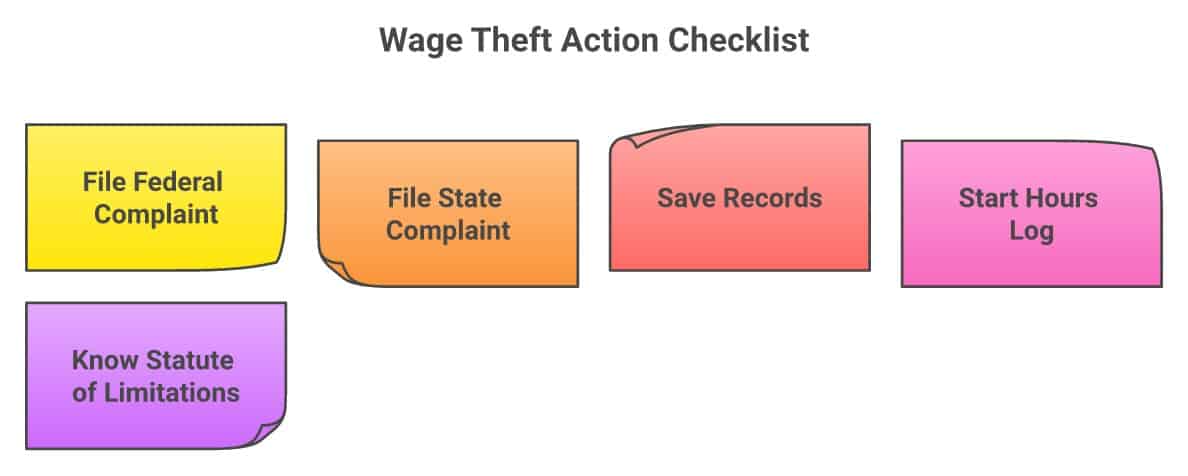
- File your federal complaint now — not after a new secretary is confirmed. Go to dol.gov/agencies/whd/contact/complaints and file online. Cases already in the system when new leadership arrives are much harder to deprioritize than complaints that come in during the transition.
- File a parallel complaint with your state labor department. State enforcement doesn’t depend on who’s running the federal DOL. Many states have stronger protections than federal law and can investigate independently. Search “[your state] department of labor wage complaint” to find your state’s filing page.
- Save every pay stub, time record, and schedule screenshot on a personal device today. Not on your work computer. Not in your work email. On your personal phone or a USB drive you take home. If your employer realizes an investigation is coming, records can become harder to access.
- Document your actual hours worked. Starting today, keep a simple log: date, hours worked, hours paid. A personal record is admissible evidence if your employer’s records are “incomplete.”
- Know the statute of limitations. For federal FLSA claims, you typically have 2 years to file (3 years if the violation was willful). For state claims, it varies — some states allow up to 6 years. Don’t assume you have unlimited time.
Retaliation is illegal — and common. If you’re worried about filing a complaint against your employer, know that the FLSA explicitly prohibits retaliation for reporting wage violations. If your employer fires, demotes, or reduces your hours after you file, that’s a separate violation — and it strengthens your case. Document everything.
Free Tool — Statute of Limitations Checker: Dealing with old debt? The free Statute of Limitations Checker tells you if the collection clock has expired in your state — including the zombie debt and clock-restarting traps collectors use. Check My Status →
If You’re Already in Debt Because of Unpaid Wages
If wage theft has been quietly pushing you into credit card debt, address both problems at the same time:
- File the wage complaint — recovery of back wages can take months, but the money owed to you is real and the DOL can require your employer to pay it.
- Run your debt numbers — use the debt relief options calculator to see where you stand on the debt side. Don’t wait for the wage recovery to address debt that’s compounding now.
- Talk to a consumer attorney — an FLSA attorney can often take wage cases on contingency (you pay nothing upfront). Find one through the National Association of Consumer Advocates or search for “FLSA attorney” in your state.
The Bottom Line
The Labor Secretary just resigned. The political drama will dominate the news cycle. But for anyone whose employer owes them overtime, misclassifies them as a contractor, or steals their tips — this is a practical signal to act now. File your federal complaint this week while career staff are still processing normally. File a state complaint in parallel. Save your records on a personal device today. The enforcement window gets smaller during leadership transitions — don’t let it close on you.
FAQ
Does the Labor Secretary’s resignation mean my existing wage complaint will be dropped?
No. Cases already in the pipeline continue to be processed by career staff at the Wage and Hour Division. The resignation affects priorities and pace for new investigations, not cases already under review.
Can I file a wage complaint if I’m an undocumented worker?
Yes. The FLSA protects all workers regardless of immigration status. The Wage and Hour Division does not share information with immigration enforcement agencies. You have the same right to be paid for your work as any other employee.
How long does a DOL wage complaint investigation take?
Typically 3-12 months, depending on complexity and caseload. During leadership transitions, new cases may take longer to be assigned to an investigator. Filing sooner means you’re earlier in the queue.
What’s the difference between filing with the federal DOL and my state labor department?
Federal complaints go to the Wage and Hour Division and are subject to federal leadership changes. State complaints are handled by your state’s labor agency, which operates independently. Many states offer stronger protections and faster processing. File both for maximum coverage.
Can my employer fire me for filing a wage complaint?
Retaliation for filing a wage complaint is illegal under the FLSA. If your employer fires, demotes, or reduces your hours after you file, that’s a separate violation that strengthens your case and can result in additional damages. Document any changes in your employment after filing.
More from today: Goldman’s inflation forecast.
I don’t cover politics on this site. I cover what political events mean for your wallet. The Labor Secretary resigned — and if your employer has been cutting corners on your pay, the enforcement apparatus that protects you just got weaker temporarily. File now. Save your records. And if the unpaid wages are the reason you’re in debt, deal with both at once. That’s your decision to make — I’m just making sure you have the information to make it.
Dealing With Debt? Understanding your options is the first step. See how all your debt relief options compare — including ones most sites won’t tell you about. The Find Your Path quiz gives a recommendation based on your actual numbers, and the Scam-O-Meter checks any company’s complaint history before you sign. Federal Reserve research shows bankruptcy filers recover faster than those who don’t file.



