

What This Episode Covers
In this episode, Steve Rhode and Damon Day tackle the financial pressure cooker that 2026 has become — from record gas prices to rising bankruptcy filings to the scams targeting people in financial distress. The key message: the one thing you can control when everything else feels out of control is your own debt situation, and waiting to act is the most expensive option.
Are Gas Prices a Debt Problem or Just a Budget Problem?
Gas prices spiked 21% in a single month, and Steve and Damon break down why this isn’t just pain at the pump — it’s pain everywhere. Oil costs flow into groceries, shipping, manufacturing, and every part of the supply chain.
Damon Day: “No matter what part of the supply chain you’re in, when basic fuel prices increase as dramatically as they have, it gets passed down to people like you and me. It’s exactly like the tariffs.”
The episode makes a critical distinction: people with positive cash flow notice higher gas prices but absorb them. People already living paycheck to paycheck see an extra $150-200 per month that breaks their budget completely. That’s not a willpower problem — it’s a math problem.
The Daily Money Brief — Free, at 10 AM
Money you may be owed, scams to dodge, and the fine print decoded — the consumer money news that affects your wallet, every weekday.
Every weekday I read the enforcement actions, filings and fine print the outlets skip, and turn them into the one or two moves that actually improve your position — a rate worth moving for, a fee you can refuse, a deadline to beat before it costs you.
In the latest issue (Oct 8): A parent's nursing home bill can become yours
I write Your Money Actually most weekdays — actionable money information you will not find anywhere else, and the small decisions that compound. It is free, I sell nothing, and I take no money from any company I write about.
Why Bankruptcy Filings Spiking 14% Is Actually Good News
Bankruptcy filings rose 12% last year and another 14% in Q1 2026. Steve reframes this as positive: those filers are people who will rebuild credit, eliminate debt, and be in a position to handle rising costs within a year or two.
Steve Rhode: “When you can’t make it through the month anymore, that is not a moral failure. That is a math failure.”
Damon adds context for new listeners: they’re not “just the go-file-bankruptcy guys.” Bankruptcy is one option they evaluate, and sometimes the math says it’s wrong for a particular situation. But refusing to even look at it because of shame means paying the most expensive possible price.
The $400,000 Hidden Cost of Minimum Payments
One of the episode’s most striking numbers: $50,000 of credit card debt paid through minimum payments doesn’t cost $50,000. It costs roughly $400,000 in lost future retirement savings — the money that could have been invested instead of going to interest payments.
Damon outlines the three states of financial operation: you can survive with savings and credit, with savings and no credit, or with credit and no savings. But when both savings and available credit hit zero, one unexpected expense becomes a crisis with no escape route. His advice: make the decision before you reach that point.
Should You Use Government Benefits While in Debt?
Steve pushes back against the stigma of using government assistance programs. If you’re eligible for food assistance, utility help, or healthcare programs, those are your tax dollars coming back to you — no different from a tax refund arriving in a different form.
Resources mentioned: the benefits and free money finder at getoutofdebt.org (under free tools) and benefits.gov for checking eligibility.
Debt Validation Letters: When to Use Them and When Not To
A reader question about whether collection agencies are unauthorized “third parties” leads to a practical discussion. Steve explains the legal reality: creditors can share information and sell debt under existing law, and standing in front of a judge claiming otherwise won’t work.
Damon’s practical advice: don’t send debt validation letters on debts you know you owe, especially if your goal is negotiating a settlement. It adds busy work that makes the collector less willing to negotiate. Only use validation when you genuinely don’t recognize the debt or the collector.
Free Tool — Debt Validation Letter Generator: Being contacted by a debt collector? The free Debt Validation Letter Generator creates a personalized FDCPA validation letter in seconds — forcing the collector to prove the debt is real before they can continue. Generate My Letter →
The Bottom Line
Spring cleaning your finances means facing the actual numbers — not the numbers you hope are true. Pull your free credit reports at annualcreditreport.com, set up expense tracking software like Monarch Money, and figure out whether the math of your current debt situation actually works. If it doesn’t, every month you wait costs more than the month before.
Related: Why the 14% Bankruptcy Spike Is Not What You Think · What Happens to Your Debt When Gas Prices Spike.
Dealing With Debt? Understanding your options is the first step. See how all your debt relief options compare. The Find Your Path quiz gives a recommendation based on your actual numbers, and the Scam-O-Meter checks any company complaint history. Federal Reserve research shows bankruptcy filers recover faster than those who do not file.
Free Tool — Cost of Inaction Calculator: Thinking about waiting to deal with your debt? The free Cost of Inaction Calculator shows exactly how much more you'll owe — in interest and lost retirement savings — for every month you delay. Calculate the Cost →
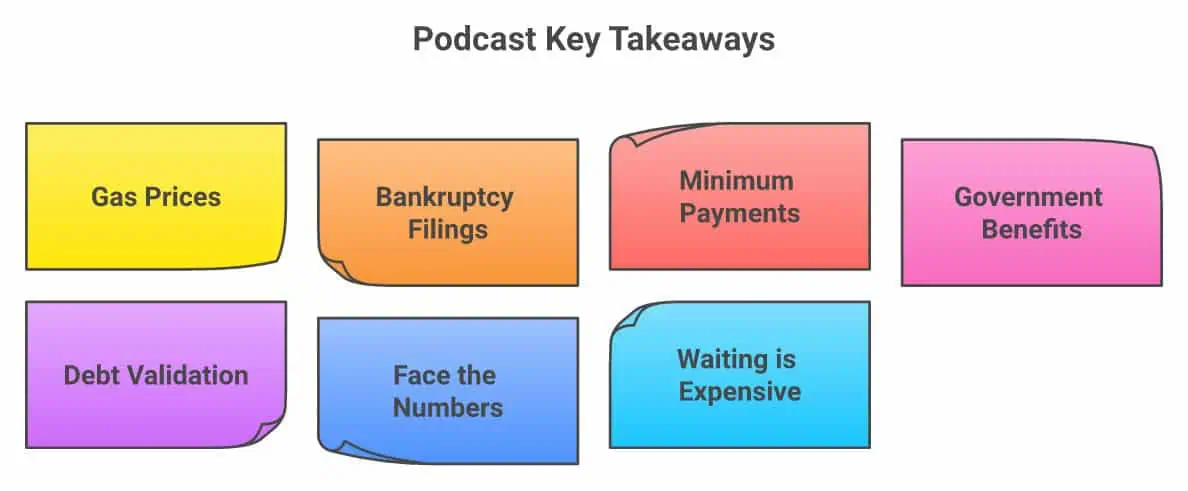
Key Takeaways
- Gas price spikes affect everything in the supply chain — groceries, shipping, manufacturing — not just what you pay at the pump
- Bankruptcy filings spiked 14% in Q1 2026, and Steve frames this as good news: those filers will rebuild credit within 1-2 years
- Paying $50,000 in credit card debt through minimum payments actually costs roughly $400,000 in lost retirement savings
- Government benefits like food assistance are your tax dollars coming back — check eligibility at benefits.gov
- Only send debt validation letters when you genuinely don't recognize the debt — not as a stall tactic on debts you know you owe
- Scammers are now placing fake renewal notices directly on Google Calendars — never click links from unknown calendar events
- Use expense tracking software like Monarch Money to see where money actually goes — guessing leads to bad financial decisions
Full Transcript
Click to expand transcript
Episode Introduction
Steve Rhode: Hey, you’re back with Steve Rhode, the old original Get Out of Debt Guy, and as always, Damon Day, the new fresher, probably more talented Get Out of Debt Guy, who knows? Say, Damon. Hey, Damon.
Damon Day: All right, good job.
Steve Rhode: All right, so this week, we’re talking about spring cleaning your finances and a whole bunch of other stuff. But spring cleaning isn’t just for closets. In fact, talking about spring cleaning, today was trash day here at the Rhode house, and we had like triple the trash that we normally have out there. And I ran out there because I’ve learned from my trash people that they oftentimes say no, but a 20 goes a long way. I had one conversation with my trash guy and he goes, I’m sorry, we can’t take that. And I said, does this $20 bill make it look different? He goes, absolutely. So they said to me, I get it. It’s spring cleaning. That’s why you got a lot of stuff out here.
So time to spring clean your finances too. And today we’re refreshing everything, your numbers, your accounts, your progress. And have you been with us since the beginning? You’ve listened to all these years. A lot has happened since the beginning of the year. So let’s get a clear picture of where you actually stand right now. No assumptions, no guessing, just the facts.
Gas Prices and the Debt Impact
Steve Rhode: Damon, before we get started into that topic, tell me what caught your eye on posts that I have been pouring out this week.
Damon Day: The biggest one, and I’m sure everyone is well aware of this issue, most people have absolutely no idea what to do about it, but gas prices. So this article, gas prices just spiked. Here’s what happens to your debt next. And I thought it was a very good article. Obviously you were being captain obvious, right? Gas prices have spiked, but what a lot of people don’t realize is it’s not just the pain at the pump. When gas prices spike, it’s pain everywhere. Every freaking where. And it’s either caused by prices going up or shrinkflation, right? The size of things going down. No matter what part of the supply chain you’re in, when basic fuel prices increase and as dramatically as they have, it gets passed down to people like you and me and our listeners, because somebody’s got to pay for it. It’s exactly like the damn tariffs. All the tariffs get passed down to you and me and make things more expensive. And everything between the tariffs and the gas prices, everything has been getting more expensive and people have been getting squeezed more and more. So what do we do, Steve?
Steve Rhode: Well, you know, I would love to tell you the obvious things about cutting back and, you know, honestly, there’s no real good answer. Well, the good answer is a pickup from where we left off last week. If you listened to our last week’s podcast, everything goes back to you got to get out of the damn debt because there’s nothing you individually can do about the price of gas. You can modify some things on how much you’re going to spend. But again, oil energy permeates into every aspect of your life. But one thing that you could do that you can control is get yourself in a financial position so when things like this happen, it doesn’t affect you as much. Gas prices affect people that have positive cash flow in a different way and less intrusively than it affects people that are right on the edge, already paycheck to paycheck, don’t have any breathing room in their budget. Gas goes up a dollar a gallon, and then all of a sudden that adds another 150, 200 bucks a month or more to your budget. If you are already maxed out, you have a much bigger problem.
Electric Vehicles and Fuel Costs
Damon Day: The problem is that the gas prices go up significantly now, and you’re feeling the pressure today. It’s hard to put a solution in place instantly. Now, there are things that we can do. I think one of the funniest things are the people who are resistant about electric vehicles. Dude, buying that Tesla was the best thing I ever did a couple of years ago. Every day I drive by them. I’m so glad I’m driving the Tesla, not my diesel truck today.
Steve Rhode: Well, I’m looking at the primary Tesla that we have. And over the last 12 months, including all the road trips and the supercharging and everything else, we have spent $178 total in fuel.
Damon Day: You gotta start doing a YouTube channel or something. But you know, it’s a good article because again, this is largely out of your control in the short term. You can do other things to mitigate some of this expense, but the biggest thing you can do right now, if you’re listening to this podcast, I know you’re in debt, you gotta get serious about getting out of the debt. All that extra money that you’re throwing at this debt every month could be helping you absorb life and life is really expensive right now.
Bankruptcy Filings Spike 14%
Steve Rhode: This segues into bankruptcy filings just spiked 14%. So bankruptcy filings are up and that’s good news because those are people who are going to be able to rebuild their credit and move past their debt and be in a situation within another year or two where they’re able to lease a fuel economy car or buy a fuel economy car.
Damon Day: And they’ll be able to afford gas today.
Steve Rhode: I think it’s ironic that people who want to avoid bankruptcy because they feel like it’s a moral failure and “I made a promise to repay.” Did you also make a promise to repay when gas prices went up or when tariffs increased the cost of everything? Is that in your wheelhouse? It’s a risk of doing business for the credit card companies.
Damon Day: For the new listeners, because we do talk about bankruptcy a lot, we’re not just the go-file-bankruptcy guys. We talk about it as one of the options we can look at. We’re just always against saying no to something just to say no to something because you think this or somebody told you that. I talk to people every day and they say, I don’t want to file bankruptcy. Hey, I get it, nobody does. But my job is to work through why is that? And let’s look at the specifics.
Steve Rhode: When you find yourself in a situation where things are really tight and gas prices go up and you can’t make it through the month anymore, that is not a moral failure. That is a math failure.
The $400,000 Cost of Minimum Payments
Damon Day: The one thing that you can control to deal with the things that are largely out of your control is your own personal finances. Carrying debt hoping it’s gonna get better is the most expensive option. Just trying to keep the status quo, keep everybody paid, keep my credit score up, that is the most expensive option. Wouldn’t it be better to meet it head on and take care of it right now? Why wait two years and struggle for two years and then file bankruptcy?
Steve Rhode: 50 grand of debt that you’re trying to pay off by eating beans and rice is actually not costing you 50 grand. It’s costing you $400,000 in lost future retirement if you had put that money in a fund now.
Damon Day: I always tell clients, you can operate with savings and available credit. You can operate with savings and no credit. You can operate with credit and no savings. But what you cannot do is operate when you have no savings and no available credit. Now you need tires and you’re screwed. So why do we want to wait until we get to that point?
How to Pay Off Debt With No Extra Money
Steve Rhode: How to pay off your debt when you have no extra money. One of the things I don’t think I’ve heard Dave Ramsey say is, you need to go and apply for all the government benefits that you’re entitled to. Those are your tax dollars at work. And if you’re entitled to it and you can qualify for it, you should get it. You can go to the getoutofdebt.org website, go down to the very bottom under free tools, the benefits and free money finder. You can also go to benefits.gov and see what you’re eligible for.
Damon Day: If the IRS called you up and said, hey, we see that you’re entitled to a $3,000 refund, are you going to say, no, that’s for other people? Getting some assistance with food is the same thing. You’re just getting it back in a different form.
You have a debt problem, but you really have a cash flow problem. And if you’re earning money, you can afford to file bankruptcy. It’s just a matter of choosing what we’re going to be spending the money on. It doesn’t make any sense to be shelling out $2,000 a month on debts that are going to get discharged in bankruptcy. You can withhold payment from those creditors, save up that extra money for a month, two months, three months, four months. And in most cases, at that point, you’ll have plenty of money to hire a bankruptcy attorney.
Debt Collectors and Your Rights
Steve Rhode: One interesting reader question that I answered today was Lisa who came in and said, is it true when you sign up for a credit card or loan, it states in the small print that the creditor will not share my personal information with a third party and isn’t a collection agency a third party? That assumption is what I like to call wrong. Because what the privacy notice actually says is that they can’t pass your information off to an unrelated company, not affiliated third parties. However, there’s a loophole — a creditor can share your information that is necessary to affect, administer or enforce a transaction that a consumer requests or authorizes.
Damon Day: You can stand on business all you want and have all kinds of cute theories, but at the end of the day, it’s gonna come down to you may or may not end up in court. And if you do, how confident are you in your ability to stand in front of a judge and explain why you don’t owe the money because they’re a third party?
Steve Rhode: If you want to know, can the person who’s collecting that money now validate that debt is real and they have enough information, you can use the debt validation letter creator on getoutofdebt.org under free tools.
Damon Day: I would not send validation letters on a debt that you know for sure that you owe. If your ultimate goal is to resolve the debt with that collector for a settlement or a payment plan, throwing a whole bunch of busy work at a creditor is usually not a good way to get them in a forgiving mood.
Scam Alert: Calendar Spam
Damon Day: So I get a notification on Monday. These scammers are such bastards. I get this notification on my schedule as an alert — “Reminder, your service plan renewal is approaching. Thank you for choosing WebRoot. Your current plan will be renewed automatically. The renewal fee is $583.99.” And the renewal date is today. These scammers got on my Google calendar somehow. They’re literally on my Google calendar forcing me to address it. I just Googled WebRoot scam and it popped up, of course, it’s a scam. But these bastards aren’t just swimming in my spam email folder anymore. They’re on my calendar.
Steve Rhode: This year I have filed a patent and some trademarks. And once you do that, I’ve started getting mail that says like an invoice due to the United States Patents Office — not patent, they put an S on the end to fool you into paying this invoice. You gotta be so on your toes.
Damon Day: This is why Steve and I always say never use a debit card for anything. Use a credit card for everything. Pay it off every month. If something happens, you’re dealing with credit card fraud protection, not money directly taken from your checking account. Your mortgage is not going to bounce because you use credit cards responsibly.
Spring Cleaning Your Finances
Steve Rhode: One of my favorite things in spring cleaning your finances is if you haven’t done it recently, it’s time to go to annualcreditreport.com and get a copy of the three major credit bureau reports. It’s free. Take a look at each report and make sure you recognize the accounts. Generally there are two surprises: either “I didn’t realize I still owed that” or “what is this?” — you could be a victim of identity theft.
I actually go beyond that. My credit reports, I have a freeze on them. So nobody can access the credit report to do any credit report pulls. One of the traps though — when people look at their credit reports, they say things like, “I’ve got these old accounts, I should close them.” No. They’re helping boost your credit score. Don’t just close old accounts.
Damon Day: My big tip from a spring cleaning standpoint — if you don’t use software to track money in and money out, you need to. I like Monarch Money. It’s one of my favorites. It’s about a hundred bucks a year. But it will absolutely save you that and more just by having your expenses automatically tracked. Once you set it up, everything’s automatic at a glance. You and your spouse can be on the same page about where the money’s going. And then you can use that actual information to start making better decisions about how do we right this ship.
Steve Rhode: It’s garbage in, garbage out. If you’re guessing how much you’re spending or where it’s going and then you’re making financial decisions based on that, it’s never gonna work out.
Damon Day: Having that information helps you make better decisions where you might really want to Dave Ramsey your way out of this thing, but the math might say no.
Wrap Up
Steve Rhode: All right, Damon, well, let’s wrap it up for today. And we will be back next week. Same time, same channel. Until then, Damon, I will see ya.
Damon Day: Yeah, tune in next week. We’ll be bitching about more stuff, damn scammers. Peace.
Frequently Asked Questions
What should I do about rising gas prices when I'm already in debt?
Focus on what you can control: your debt situation. Gas prices are temporary but credit card interest at 24% APR on the extra spending is permanent. Getting out of debt gives you the cash flow to absorb price spikes without going deeper into the hole.
Is it true that bankruptcy filings are up in 2026?
Yes. Bankruptcy filings rose 12% in 2025 and another 14% in Q1 2026. Steve Rhode views this as positive because filers are taking action to eliminate debt, protect retirement savings, and rebuild credit within 1-2 years.
Can I afford to file bankruptcy if I have no extra money?
If you are earning money and making minimum payments on debts, you can redirect those payments toward saving for bankruptcy filing costs. Damon Day explains that paying $2,000 per month on debts that will be discharged makes less sense than saving that money for 2-3 months to hire an attorney.
Should I apply for government benefits while dealing with debt?
Yes. Steve Rhode encourages using benefits you qualify for — food assistance, utility help, healthcare programs. These are funded by your tax dollars and are no different from receiving a tax refund. Check eligibility at benefits.gov or the free tools section at getoutofdebt.org.
When should I send a debt validation letter to a collector?
Only when you genuinely do not recognize the debt or the company collecting it. Do not send validation letters as a stall tactic on debts you know you owe, especially if you plan to negotiate a settlement — it creates busy work that makes collectors less willing to negotiate.
Is buying an electric vehicle a good way to save on gas costs?
It depends on your situation. Damon Day spent $178 total on fuel over 12 months with a Tesla, compared to over $1,200 per month his diesel truck would cost. But Steve cautions against taking on new car debt just to solve a gas problem — only consider it if you are already in the market and can charge at home.



