
“Everyone says wait to collect Social Security. I took mine at 62. Here’s the math they’re not showing you — and why the ‘right’ answer depends on a question nobody can answer.”
Every financial advisor in America will tell you the same thing: delay your Social Security benefits as long as possible. Wait until 67. Better yet, wait until 70. You’ll get a bigger check. It’s free money. Only a fool would leave it on the table.
I took mine at 62.
Not because I didn’t understand the math. Because I did understand it — and what I found is that the math everyone quotes is built on an assumption nobody can verify: that you’ll live long enough to collect the difference.
Claiming money you are owed is one good day. What you do over the following year is what actually changes your position.
In the latest issue (Oct 16): The check that looks like a scam may be real
Each weekday I send one short email: one story that caught my attention, why it might matter to you, and one manageable thing you can do with it.
Free. I sell nothing. Unsubscribe any time.
The Breakeven Math Nobody Shows You
If you were born in 1960 or later, your Full Retirement Age (FRA) is 67. Claiming at 62 means a permanent 30% reduction in your monthly benefit. That sounds devastating — until you do the actual math.
The 62 vs. 67 Breakeven Calculation
Assume your FRA benefit is $2,000/month:
- Claim at 62: $1,400/month (70% of FRA)
- Claim at 67: $2,000/month (100% of FRA)
- Head start from claiming early: $1,400 × 60 months = $84,000
- Monthly advantage of waiting: $600/month
- Months to erase the head start: $84,000 ÷ $600 = 140 months (11 years, 8 months)
- Breakeven age: 78 years, 8 months
That breakeven is the same regardless of your benefit amount — the ratio is what matters. And it means the person who waited until 67 doesn’t collect a single dollar more in total lifetime benefits until they’re nearly 79 years old.
But here’s where it gets interesting. That calculation uses a 0% return on your money. It assumes the person who claims at 62 stuffs their checks under a mattress. Nobody does that.
The Number That Changes Everything
If you invest your early Social Security checks at a modest 4% return — roughly what a balanced portfolio has historically delivered after inflation — the breakeven age doesn’t stay at 79. It pushes to age 84-85. At a 5% return, it’s closer to age 87. A 2024 study in the Financial Planning Association Journal found that with realistic investment returns, you’d need to live to age 89 for waiting from 67 to 70 to pay off. Seventy-seven percent of 67-year-old men are dead before 89.
The Question Nobody Can Answer
The entire “wait to claim” argument rests on one assumption: that you’ll live long enough to collect the difference. And here’s the problem — nobody knows whether that’s true for you.
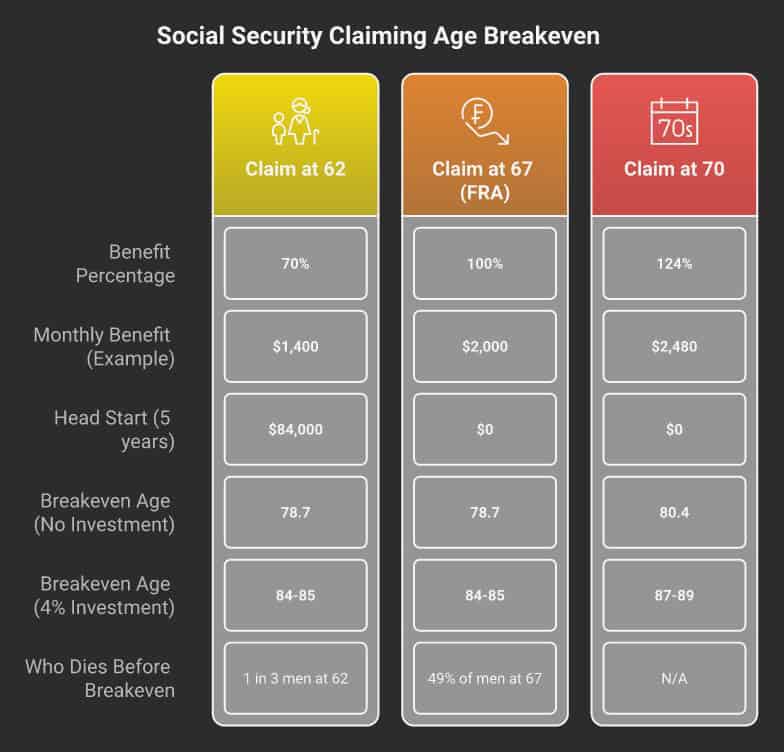
Those are SSA actuarial numbers. Not worst cases. Not outliers. That’s roughly one in three to one in two men who would have been better off claiming early. For women, the numbers are somewhat better for waiting — about 1 in 4 die before 78 — but still far from the certainty the “always wait” crowd implies.
And those survival odds aren’t evenly distributed. Brookings Institution research found a 12.7-year life expectancy gap between men in the highest and lowest income quintiles. If you worked a physically demanding job, have health issues, or come from a family where people don’t live into their late 80s, the “wait until 70” advice isn’t just wrong — it’s advice to leave money on the table that you’ll never collect.
What the SSA Actually Says (Hint: Not What You Think)
Here’s something that might surprise you: the Social Security Administration itself does not recommend a specific claiming age. Their official position is that the benefit formula is designed to be “actuarially fair” — meaning that for someone with average life expectancy, total lifetime benefits should be roughly equal regardless of when you claim.
Read that again. The agency that writes the checks says the system is designed so it shouldn’t matter when you start. The 30% reduction at 62 isn’t a penalty — it’s a mathematical adjustment for the fact that you’re collecting for five extra years.
So where does the “always wait” advice come from? Largely from academic studies — most notably a widely cited NBER paper that found “more than 90% of workers should wait until 70.” But that study uses a 0% discount rate. It assumes money has no time value. That’s not how the real world works.
When researchers at the Financial Planning Association ran the same analysis with realistic investment returns, their conclusion was the opposite: “Our calculations do not support the presumption that the vast majority of people who choose to start their Social Security retirement benefits before age 70 are making a mistake.”
My Own Advisor Told Me I Was Wrong
This is the part where I stop talking about studies and tell you what actually happened to me.
I’m 66. I took Social Security at 62. And getting there was a fight — with my own financial advisor.
Here’s the thing: earlier in my career, I was a registered investment advisor myself. I know the math. I know the models. So when I became eligible, I sat down with my investment advisor and walked him through the breakeven analysis — the same math I just showed you. I even laid out the case for taking it early and investing the difference, because who knows what the future will bring.
He pushed back. Hard. His position was essentially: trust that it will be there in eight years. He parroted back the same mantra you hear from every financial outlet — “you need to wait.” No new math. No analysis of my specific situation. Just the conventional wisdom, delivered with confidence.
And I was left with a question: “Do I?”
So I did the math myself. The same math I’m sharing with you now. And I came to my own answer based on what was best for me — my health, my other savings, my plans for the next decade of my life.
Money has a different value at different ages. A dollar at 63 — when you can travel, stay active, enjoy meals out, play with grandkids on the floor — is worth more in lived experience than a dollar at 83. No spreadsheet captures that. No breakeven calculator accounts for the fact that your knees don’t work at 80 the way they did at 65. I decided I’d rather enjoy a fuller life while I was still young enough to get around.
Now, I need to be honest: my situation made early claiming rational. I had retirement savings growing separately. Social Security wasn’t my only income source. I could afford to take the smaller check because I had other money working for me.
If you’re counting on Social Security as your primary retirement income — if you don’t have a 401(k) or IRA providing the rest — the calculus is genuinely different. Maximizing that monthly check matters more when it’s your only check.
When Waiting IS the Right Call
I’m not here to tell you that claiming early is always right. That would be the same kind of blind advice I’m criticizing. Here’s when waiting genuinely makes sense:
- Social Security is your primary income. If you have little or no other retirement savings, the larger monthly check at 67 or 70 is your best hedge against outliving your money.
- You’re the higher-earning spouse. Your benefit becomes your spouse’s survivor benefit. If you claim at 62, your widow or widower gets 70% of your FRA benefit for life instead of 100% or 124%. This is the strongest mathematical argument for waiting in married couples.
- You’re healthy with long-lived parents. If your family routinely lives into their late 80s and 90s, the odds favor delay.
- You’re still working and earning well. If you earn above $23,400 while collecting before FRA, Social Security withholds $1 for every $2 over the limit. Claiming early while working at a high salary creates a partial clawback.
When Claiming Early Makes More Sense
- You have health concerns or a family history of shorter lifespans. If you don’t expect to reach 79-80, the math is clear — every month you wait is a month of benefits you’ll never collect.
- You’d have to drain retirement savings to bridge the gap. If claiming early means your 401(k) keeps growing at 6-8% instead of being depleted, the opportunity cost of waiting can exceed the benefit increase. Depleting $100,000 in retirement savings to delay Social Security for five years means losing years of compound growth.
- You want to live while you can. If you value experiences at 63 more than a bigger check at 78, that’s not irrational — it’s a quality-of-life decision that every spreadsheet ignores.
- You worked a physically demanding job. SSA research found that roughly half of early claimers were in physically demanding occupations. Your body decides your retirement date — not a financial planner.
- You have dependent children. Once you claim, eligible children can receive up to 50% of your FRA benefit.
What people believe: “Delaying Social Security until 70 is always the smart financial move. Only people who don’t understand the math claim early.”
What’s actually true: The “always delay” math uses a 0% return assumption and ignores that one-third of men die before the breakeven age. With realistic investment returns, the breakeven pushes into the mid-80s. Vanguard’s own research found that for people with adequate savings and average life expectancy, claiming at 62 produces higher median wealth through age 88. The SSA itself says the formula is designed so total benefits are roughly equal regardless of when you claim. The “right” answer depends entirely on your health, your savings, and what you value — not a one-size-fits-all rule.
Free Tool — Cost of Inaction Calculator: Thinking about waiting to deal with your debt? The free Cost of Inaction Calculator shows exactly how much more you'll owe — in interest and lost retirement savings — for every month you delay. Calculate the Cost →
The Real Math You Should Be Doing
Instead of asking “when should I claim Social Security,” ask these questions:
- What other retirement income do I have? If Social Security is your only source, maximizing it matters. If you have a 401(k), IRA, pension, or other savings — the smaller early check might be fine because the rest is growing.
- What’s my honest health situation? Not what you hope. Not what your doctor says is possible. What does your family history and your current health actually suggest?
- Am I married? If so, coordinate with your spouse. The lower earner claiming early while the higher earner delays can give you both income now and maximum survivor benefits later.
- Would I have to spend savings to delay? If bridging the gap until 67 or 70 means drawing down your retirement accounts, calculate what that money would have grown to. Sometimes the “bigger” Social Security check costs you more in lost investment growth than it adds.
- What do I want my 60s to look like? This isn’t a frivolous question. It might be the most important one.
One Place Where the Law IS Clear
Whatever you decide about claiming age, never cash out your 401(k) or IRA to bridge the gap. Those accounts are protected in bankruptcy. Cashing out retirement to cover expenses loses 30-40% immediately to taxes and penalties and roughly $200,000 in compound growth over 20 years. Protect what’s protected.
And there’s another force at play now: a new proposal would cap Social Security COLA increases for higher earners, while the trust fund is projected to run dry by 2032. Whether you claimed early or are still deciding, these numbers affect your plan.
The Bottom Line
The “always wait until 70” advice is built on a math problem nobody can solve — because it requires knowing when you’ll die. The simple breakeven of claiming at 62 vs. 67 is age 79. Factor in even modest investment returns, and it pushes past 84. One-third of men who reach 62 never see 79. The SSA itself says the system is designed to be actuarially neutral. There is no universally “right” answer — and anyone who tells you there is hasn’t done the math, or hasn’t done YOUR math. Look at your health, your savings, your spouse’s situation, and what you actually want your retirement to look like. Then make the decision that’s right for you — not the one a financial columnist told you was right for everyone.
My investment advisor — a professional I trust and pay — told me to wait. I was a registered investment advisor myself, and even I had to fight through the noise to find my own answer. That’s how deep the assumption runs. Question authority. Stop believing common assumptions just because everyone repeats them. Ask questions. Don’t assume. Do your own math. And then make the decision that’s right for your life — not the one someone else decided was right for everyone.
If this changed how you think about Social Security, send it to someone within 10 years of retirement. They deserve to see the math before they make a $100,000 decision based on a rule of thumb.
One more thing worth knowing if you’re on Medicare: there’s a new $50-a-month program for weight-loss drugs starting July 2026 — but the fine print decides whether it’s actually a deal for you, and for some lower-income folks it isn’t.
Dealing With Debt? Understanding your options is the first step. See how all your debt relief options compare — including ones most sites won’t tell you about. The Find Your Path quiz gives a recommendation based on your actual numbers, and the Scam-O-Meter checks any company’s complaint history before you sign. Federal Reserve research shows bankruptcy filers recover faster than those who don’t file.



