
“I’ve been doing this for 30 years. The call I dread most isn’t from someone who panicked. It’s from someone who kept spending — and now has nothing left to work with.”
Consumer confidence just hit the lowest recorded level since 1978 — lower than the 2008 financial crisis, lower than the pandemic, lower than the 2022 inflation spike.
The University of Michigan’s final April sentiment index: 49.8. Anything below 50 hasn’t been seen in decades of data. The preliminary reading was 47.6, the worst ever measured.
That number tells you how scared people are. Here’s the part that concerns me much more: they haven’t stopped spending.
Each weekday I send one short email: one story that caught my attention, why it might matter to you, and one manageable thing you can do with it. A couple of minutes, and a dad joke.
In the latest issue (Nov 13): The shelf price isn't always what you pay
Free. I sell nothing. Unsubscribe any time.
Why “Scared But Spending” Is the Most Dangerous Pattern I Know
Marketplace reported on April 20 that despite record-low confidence, consumer spending has remained solid. Economists call this a “disconnect.” I call it the setup for a debt spiral I’ve watched play out thousands of times.
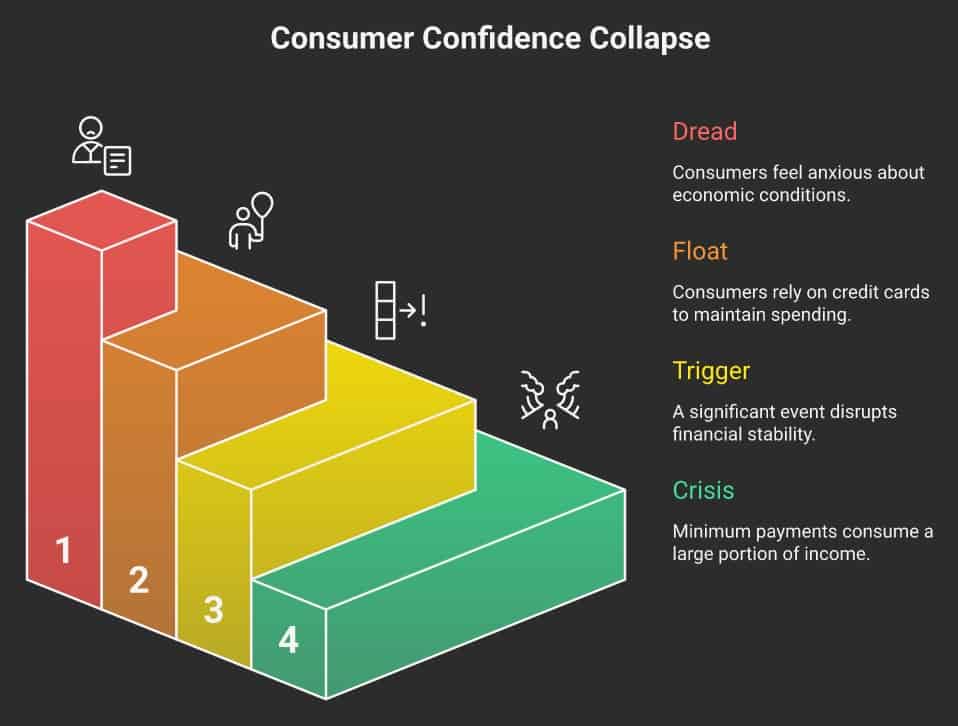
Here’s how it goes:
- Phase 1 — The Dread: People feel the squeeze. Groceries cost more. Gas costs more. The news is terrible. But life goes on — kids need things, the car needs repairs, the birthday still happens.
- Phase 2 — The Float: Rather than cutting sharply, people float expenses on credit cards. “Just for now.” The balance creeps from $3,000 to $8,000 to $15,000. Each month feels manageable.
- Phase 3 — The Trigger: Something breaks the math — a job loss, a medical bill, a rate increase on the card. Suddenly the minimum payments alone are $400/month and there’s nothing left.
- Phase 4 — The Call: That’s when they find me. By then, they’ve often cashed out retirement savings, borrowed from family, and spent two years convinced it was going to get better.
Tax refund season just ended — and the IRS just kept $1.2 billion in refunds from people who never filed. That cash buffer is gone. Inflation expectations jumped to 4.7% — and the UAE just left OPEC today, which could eventually reduce energy costs if it translates to more oil supply. But that relief, if it comes, is weeks to months away — people expect prices to keep rising. The Iran war has oil above $110 a barrel. Tariffs are adding $760 to $1,500 a year to the average household’s costs. The math is getting worse, not better.
The disconnect economists are watching: Historically, when consumer confidence falls this far, spending follows within 2-4 months. The lag exists because people exhaust savings and credit buffers before they cut. We’re currently in that lag period. If the pattern holds, the spending pullback — and the debt crisis that comes with it — hits late summer 2026.
What Record-Low Confidence Actually Means for Your Wallet
Michigan Consumer Sentiment, April 2026. Lowest since data collection began in 1952. Below the 2008 crash. Below COVID.
What Americans expect inflation to be over the next year — up sharply from 3.8% in March. When expectations rise, behavior changes: people buy now before prices go higher, accelerating the problem.
Annual cost of current tariffs per U.S. household. This is a permanent drag on purchasing power that isn’t going away regardless of sentiment.
Low confidence on its own doesn’t cause a financial crisis. But low confidence combined with high debt, high interest rates, and rising prices creates the conditions for one. Add a housing market that just split in two — falling in Sun Belt cities, rising in Rust Belt markets — and the safety valves many people counted on are closing. Every one of those boxes is currently checked.
The Inflation Expectations Problem Nobody Is Talking About
When people expect prices to rise 4.7%, they make a rational but dangerous decision: spend now while things are cheaper. That means buying ahead on durable goods, accelerating discretionary purchases, and floating more on credit.
This is the inflation expectations loop — fear of higher prices causes behavior that actually drives higher prices and higher debt loads simultaneously.
What feels logical right now: “I’ll buy the appliance now before prices go up more. I’ll put it on the card and pay it off when things improve.”
Update: Jamie Dimon just warned that a credit recession will be “worse than people think” — and SoFi’s refusal to raise guidance despite record earnings confirms lenders are already getting cautious. If you’re carrying balances, the approval window for refinancing is narrowing.
What 30 years of experience tells me: “Things improve” rarely arrives on schedule. The card doesn’t get paid off. The appliance becomes part of a $20,000 balance that takes 15 years to clear at minimum payments. The timing of “when things improve” is almost always wrong — by the time it improves, the debt has already done its damage.
What To Think About Doing Right Now
This isn’t “stop buying lattes.” That advice doesn’t work, never has, and misses the point entirely. Here’s what actually matters at this moment:
- Do a honest balance sheet — today. Write down every debt balance and its interest rate. Then write down your monthly take-home income. Do the math: what percentage of your income is going to minimum debt payments? If it’s over 20%, you’re in the danger zone. If it’s over 30%, you need to make a real decision now, not later.
- “Do nothing and monitor” is sometimes the right answer — but only if you know the number. If your balance sheet shows you have runway, then watching and waiting makes sense. But “I think we’re okay” is not a balance sheet. Uncertainty is its own kind of emergency.
- Do not respond to inflation expectations by accelerating purchases on credit. If you can’t pay cash for it, the inflation savings you’re chasing don’t exist — they’re just swapped for 22% APR. A $1,000 appliance purchased “before prices rise 10%” saves you $100. At 22% APR on a credit card you don’t pay off for a year, it costs you $220 in interest. You lost $120 by trying to beat inflation.
- If you’re already carrying $15,000 or more in credit card debt, stop treating this as something you’ll grind through. At current rates, the interest alone on $15,000 is over $275/month. The Fed isn’t cutting — that rate isn’t going anywhere soon. You’re paying $3,300 a year just to stand still. A free bankruptcy consultation takes 30 minutes. Schedule it. Also worth knowing: the CFPB — the agency protecting you from abusive debt collectors — is being gutted right now. Document every contact you have with creditors. The Federal Reserve’s own research shows people who file recover faster than people who don’t.
- Build a real buffer before the crunch, not during it. If you have a small emergency fund, now is not the time to deplete it. The spring tax refund period just ended — most households that had cash buffers are about to feel the difference. If you still have some cushion, protect it.
The Bottom Line
Consumer confidence is at its lowest point in recorded history. That matters — not because how people feel causes recessions, but because scared-but-spending is the most dangerous financial pattern I know. The spending pullback is coming. The question is whether it comes on your terms or the debt’s terms. A balance sheet today is worth more than a hundred news articles. Know your number. Then decide.
Frequently Asked Questions
Why is consumer confidence at a record low in April 2026?
The University of Michigan’s April 2026 sentiment index hit 49.8 — the lowest since data collection began. The primary causes: the Iran war pushing oil above $110/barrel and gas to $4.15 nationally, tariffs adding $760-$1,500 annually per household, and inflation rising to 3.3% in March with expectations now at 4.7%.
If confidence is so low, why are people still spending?
People use savings and credit buffers before they cut spending — there’s typically a 2-4 month lag between sentiment collapse and actual spending pullback. The spring tax refund season also just ended, meaning that cash cushion is now gone. Economists expect spending to slow significantly by late summer 2026.
Should I buy things now before prices go up more?
Only if you’re paying cash. Buying on credit to “beat inflation” almost always backfires — you save 5-10% on the purchase price but pay 22% APR if you carry the balance. On a $1,000 purchase, that’s a net loss of $120+ in the first year alone.
What does record-low consumer confidence mean for my debt?
High credit balances during periods of economic uncertainty are dangerous because the triggers that cause payment difficulty — job loss, medical bills, rate changes — become more likely when the economy contracts. If your debt-to-income ratio is above 20%, now is the time to act, not wait.
What should I do if I’m already carrying a lot of credit card debt?
Get a real number first: list every balance and its rate. If total unsecured debt exceeds $15,000 and you’re making minimum payments, schedule a free bankruptcy consultation — the math on grinding through at 22% APR rarely works out. Federal Reserve research shows bankruptcy filers recover faster than those who continue minimum payments.
This is what I’m seeing after three decades of watching these cycles play out. Your situation is yours — I can tell you what the pattern looks like and what I’d tell my own family. Only you can decide what’s right. Don’t let anyone, including me, make that decision for you.
Your next move: If the spending-while-scared pattern describes you, here’s the 30-day recession prep checklist — week-by-week steps to run your numbers, make the calls, and know your options before the window closes.
Dealing With Debt? Understanding your options is the first step. See how all your debt relief options compare — including ones most sites won’t tell you about. The Find Your Path quiz gives a recommendation based on your actual numbers, and the Scam-O-Meter checks any company’s complaint history before you sign. Federal Reserve research shows bankruptcy filers recover faster than those who don’t file.



