

“Where you bought a house in 2021 now determines whether you’re sitting on a windfall or trapped in a math problem you didn’t sign up for.”
The U.S. housing market just split in two — and which half you’re in matters more than almost anything else about your financial situation right now.
Fortune reported in April that housing prices are doing something economists didn’t predict: collapsing in Sun Belt cities while rising sharply in Rust Belt markets. Home sales nationally fell to 3.98 million annualized — the slowest rate since 2012. The market isn’t frozen for everyone equally. It’s frozen for some people and moving for others.
Related: Foreclosures just hit a 6-year high as insurance and tax costs squeeze homeowners
Every weekday I read the enforcement actions, filings and fine print the outlets skip, and turn them into the one or two moves that actually improve your position — a rate worth moving for, a fee you can refuse, a deadline to beat before it costs you.
In the latest issue (Oct 6): When fear picks your debt plan
I write Your Money Actually most weekdays — actionable money information you will not find anywhere else, and the small decisions that compound. It is free, I sell nothing, and I take no money from any company I write about.
Here’s what that split means for your wallet, your debt options, and the decisions in front of you right now.
The Daily Money Brief — Free, at 10 AM
Money you may be owed, scams to dodge, and the fine print decoded — the consumer money news that affects your wallet, every weekday.
The Two Housing Markets You Need to Know About
Rust Belt Rising
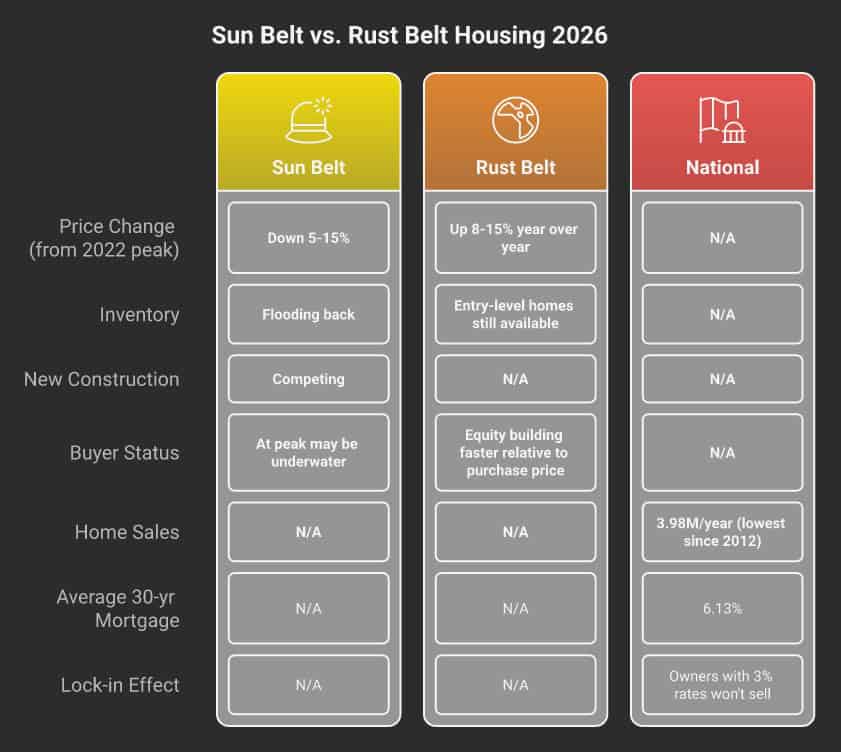
- Pittsburgh, Cleveland, Detroit, Buffalo, Cincinnati
- Prices up 8–15% year over year in some markets
- First-time buyers still finding entry-level homes
- Lower starting prices = more equity built relative to purchase price
- If you bought here in 2019–2021, you likely have real equity
Sun Belt Sliding
- Phoenix, Austin, Dallas, Tampa, Las Vegas, Atlanta
- Prices down 5–15% from 2022 peaks in some areas
- Inventory flooding back as pandemic-era buyers sell or default
- New construction competing with existing homes
- If you bought at 2021–2022 peak, you may be at or near underwater
The national “real estate is always a good investment” story breaks down completely when you look at this map. Someone who bought in Pittsburgh in 2021 and someone who bought in Phoenix in 2021 are in completely different financial situations — even if they paid the same price.
If You’re in a Sun Belt Market: What Underwater Actually Means
Being “underwater” means your home is worth less than your mortgage balance. You can’t sell without bringing cash to the closing table. You can’t refinance to a better rate. You’re essentially stuck.
The “just wait it out” trap: The instinct is to hold on until prices recover. Sometimes that’s right. But it can take 7–10 years to recover from a real correction — and during that time, you’re paying a mortgage on an asset that isn’t building equity, while your life circumstances may change (job relocation, family size, income). “Wait it out” isn’t always an option.
Here’s what to actually think about if you’re in a sliding Sun Belt market:
- Get an honest current value, not Zillow. Zillow’s estimates lag real market moves by 3–6 months. Call a local agent and ask for a comparative market analysis (CMA) — it’s free, takes 24 hours, and gives you the real number based on what’s actually sold recently in your ZIP code.
- Calculate your actual equity position. Current value minus your mortgage balance. If it’s negative, you’re underwater. If it’s within $20,000 of zero, you’re at risk of going underwater if prices slide further.
- Understand your options before you need them. If underwater: you can’t sell conventionally, but you may qualify for a short sale (bank accepts less than owed) or a deed-in-lieu (you hand the keys back). Neither is great for credit, but both are better than foreclosure. If you’re struggling to pay: contact your servicer now, before you miss payments. Hardship programs exist but require proactive contact.
- Do not use your home equity line to pay credit card debt. If home values are falling, you’re converting unsecured dischargeable debt into secured debt backed by an asset that’s declining in value. That’s one of the most dangerous debt moves you can make.
If You’re in a Rust Belt Market: What Unexpected Equity Means
Equity you didn’t expect is a different kind of problem than it sounds. People make expensive decisions when they feel flush — renovations they can’t actually afford, vacation purchases financed against the home, kids’ college costs funded via HELOC. I’ve seen this movie too.
If you have equity you didn’t expect: Resist the temptation to immediately access it. Home equity is real wealth — but it’s illiquid, and the housing market can reverse. The right question isn’t “what can I spend this on?” It’s “what does this change about my risk profile and my options?” If you have unsecured debt at 22% APR, yes — there’s a math case for using equity to pay that down. But get a real financial picture first, and never touch home equity to fund lifestyle spending.
The National Picture: Why This Matters Even If You Rent
The housing “psychological freeze” — the phrase used by real estate researchers to describe the current market — affects renters too. When homeowners can’t sell, they don’t move. When they don’t move, rental inventory stays tight. When rental inventory stays tight, rents stay high. The frozen market at the ownership level transmits directly into the rental market. With consumer confidence at its lowest point since 1952, renters are feeling the squeeze from every direction.
Annual rate of home sales in March 2026 — the lowest since 2012. Half the normal pace.
Average 30-year fixed mortgage rate today. Anyone who bought at 3% in 2021 isn’t selling. That lock-in effect keeps supply frozen.
National home price appreciation in the 12 months ending February 2026 — the slowest since 2012. The boom is over nationally, but the divergence between markets is enormous.
The Debt Angle Nobody Is Talking About
Here’s the connection between housing and debt that I rarely see discussed: for millions of people, their home was their financial safety valve. When things got hard, they’d sell, pay off the debt, and start over. Or tap a HELOC. Or refinance and cash out.
In a frozen, bifurcated housing market, those valves are closed for a lot of people — either because they’re underwater, or because selling means giving up a 3% mortgage rate and stepping into a 6% one. The housing market freeze is also a debt options freeze — and with the Fed holding rates at 22%+ territory, there is no relief coming from that direction either.
If that escape valve is closed for you, it changes your debt math significantly. The options that remain — negotiating directly with creditors, debt management plans, bankruptcy — look different when your primary asset can’t be liquidated on your timeline.
The Bottom Line
The housing market split is real and it’s wide. Where you bought, and when, now defines your financial options in ways that have nothing to do with how hard you worked or how responsibly you saved. If you’re in a Sun Belt market that’s slid, get a real current value now and understand your position before you need to act. If you’re in a Rust Belt market with unexpected equity, understand what that changes about your risk — not what it lets you spend. And if the housing freeze has closed off options you were counting on, the debt options that remain are worth understanding clearly.
Frequently Asked Questions
Which cities have falling home prices in 2026?
Sun Belt cities hit hardest include Phoenix, Austin, Dallas, Tampa, Las Vegas, and Atlanta — markets that saw extreme run-ups in 2021-2022 and are now experiencing inventory correction as pandemic-era buyers sell or default.
Which cities have rising home prices in 2026?
Rust Belt markets including Pittsburgh, Cleveland, Detroit, Buffalo, and Cincinnati are seeing prices rise 8-15% year over year, driven by relative affordability and limited new construction compared to Sun Belt markets.
What does it mean to be underwater on your mortgage?
You are underwater when your home is worth less than your mortgage balance. You cannot sell without bringing cash to closing, cannot refinance to a better rate, and are building no equity. In a declining market, your options narrow to short sale, deed-in-lieu, or staying put and hoping for recovery.
Should I use my home equity to pay off credit card debt?
Only in specific circumstances. If your home value is stable or rising and the math clearly favors it, converting 22% unsecured debt to 7-8% secured debt can make sense. But in falling markets, you risk converting dischargeable unsecured debt into debt backed by a declining asset — one of the most dangerous financial moves you can make.
How does the housing freeze affect renters?
When homeowners can’t sell, they don’t move. This keeps rental inventory tight and rents elevated. The ownership market freeze transmits directly into the rental market — renters pay the price of a market they don’t participate in.
This is what I’m seeing in the data and what I’d tell my own family. Where you live shapes your options in ways that aren’t your fault. But knowing your actual position — clearly, with real numbers — is the first move. Only you can decide what’s right from there.
Dealing With Debt? Understanding your options is the first step. See how all your debt relief options compare — including ones most sites won’t tell you about. The Find Your Path quiz gives a recommendation based on your actual numbers, and the Scam-O-Meter checks any company’s complaint history before you sign. Federal Reserve research shows bankruptcy filers recover faster than those who don’t file.



