

Quick Answer: The DHS shutdown — now 74+ days and the longest in U.S. history — is about to stop paying 35,000+ federal employees in May 2026 after emergency funds run dry. Coast Guard members have already had utilities cut at their housing. TSA officers are walking off the job. If you are a DHS employee or a Coast Guard service member, the financial window that matters most is the one right in front of you — before the first missed payment hits your credit report. Here is what you need to know and exactly what to do.
“I’ve been through every government shutdown since 1995. The people who survive them financially aren’t the ones who earned the most. They’re the ones who made the first call before they missed the first payment.”
Expert Context: I ran a nonprofit credit counseling organization through multiple government shutdowns. What I saw was consistent: the federal workers who came through in the best financial shape weren’t the ones who got paid fastest when the shutdown ended. They were the ones who called their creditors within the first two weeks and activated every program available before they fell behind. The ones who waited — who assumed it would be resolved “any day now” — ended up 60 to 90 days past due, and that takes years to recover from.
What You Need to Know
The DHS shutdown started February 14, 2026 over disagreements about ICE and CBP reform following deadly shootings in Minnesota. A one-week spending bill passed April 26 kept the lights on briefly, but it resolved nothing about the underlying immigration policy stalemate — and the emergency funds that had been paying DHS employees are now exhausted.
Every weekday I read the enforcement actions, filings and fine print the outlets skip, and turn them into the one or two moves that actually improve your position — a rate worth moving for, a fee you can refuse, a deadline to beat before it costs you.
In the latest issue (Oct 6): When fear picks your debt plan
I write Your Money Actually most weekdays — actionable money information you will not find anywhere else, and the small decisions that compound. It is free, I sell nothing, and I take no money from any company I write about.
That means payroll for 35,000+ workers — Coast Guard, FEMA, CISA, and TSA — stops in May. DHS burns through $1.6 billion in payroll every two weeks. There is no reserve left to draw on.
The situation at Coast Guard is already past crisis. These are not hypothetical hardships. This is happening right now. (And if your household includes someone at risk of deportation, the financial stakes are even higher — see the 5 documents every at-risk family needs this week.)
- Nearly 1,000 Coast Guard housing units at risk of electricity shutoffs — 43% of housing units have invoices 30+ days past due
- Water outages at duty stations in Port Huron, Michigan and Station Channel Islands, California
- Natural gas lines locked at Air Station Barbers Point, Hawaii due to unpaid utility bills
- Power cut at a Coast Guard rear admiral’s residence in New Orleans
- Officers at a St. Louis recruiting station working by flashlight after electricity was shut off
- Roughly 300 Coast Guard personnel still deployed in the Middle East during the Iran conflict — serving without pay
And over 1,000 TSA officers have already quit their jobs over this shutdown — not retired, not transferred. Left.
The Daily Money Brief — Free, at 10 AM
Money you may be owed, scams to dodge, and the fine print decoded — the consumer money news that affects your wallet, every weekday.
Why You Need to Know This — From 30 Years of Experience
Coast Guard has a unique status that makes this worse than any other government shutdown scenario I’ve tracked. It is the only branch of the U.S. Armed Forces that falls under a civilian agency — DHS — rather than the Department of Defense. When DOD gets funded in a continuing resolution, Coast Guard doesn’t automatically come with it. Service members who swore the same oath, wear a uniform, carry weapons, and deploy to active conflict zones can be left without pay in a way that Army, Navy, Air Force, and Marine personnel cannot.
I want to say something directly to the service members reading this: I am not going to offer you political analysis of why this happened. That’s not useful to you right now. What is useful is that you understand debt is math, not morality — and the math of your situation is being broken by external forces you did not create. Asking for help, calling creditors, using every program that exists is not weakness. It is exactly what I’d tell my own family to do.
The financial mistake I’ve watched people make in every shutdown since 1995 is the same one every time: they wait. They assume the shutdown will end this week. They don’t want to make the call. They don’t want to explain the situation to a creditor. And then they’re 30 days late, and a different set of rules applies — harder rules, less flexibility, no more “call us before you miss a payment” deals.
The 30-day line matters more than almost anything else. Creditors have two very different postures: proactive hardship (before 30 days past due) and reactive collections (after). The forbearance programs, the interest waivers, the skip-a-payment options — nearly all of them require you to call before you miss. Once you’re past 30 days, you’ve crossed into a different department, a different script, and a different set of options. The government shutdown is not your fault. But the timing of when you call is entirely in your control.
Things to Consider
Beyond the immediate paycheck, here are the second-order effects that hit people who don’t plan ahead:
- Scammers are watching this news too. Every time there’s a high-profile group of people in financial distress — a layoff wave, a natural disaster, a shutdown — debt relief scammers and predatory lenders immediately start marketing to them. They monitor the news. If you get an unsolicited call or text offering you a “government shutdown emergency loan” or “fast cash for federal workers,” that is almost certainly a scam. Military members are particularly targeted — this has been documented repeatedly. Before you talk to any debt company, check them through the Scam-O-Meter.
- Your security clearance is not at risk if you handle this responsibly. I know this fear runs high in the federal employee community. The guidance from security officials is consistent: a financial hardship you communicate about and manage proactively is not the same as financial irresponsibility. What creates clearance risk is unaddressed debt, delinquencies you ignored, or judgment liens. Calling your creditors, requesting forbearance, and documenting what you’re doing is the protective move — not the risky one.
- Retirement accounts are your last resort, not your first. I know the TSP balance feels like a safety net. It is not — it is your future, and it is protected from creditors even in a worst-case bankruptcy scenario. A TSP early withdrawal costs you 10% immediately plus income tax at your marginal rate — on money you may not actually need to touch if you activate the forbearance programs first. The math almost never works. The long-term cost is staggering.
- If you’re already carrying credit card debt, this shutdown is a pressure multiplier. Credit card issuers are watching economic distress signals and have been cutting lines. If your available credit gets reduced while your income is interrupted, you lose two cushions at once. This is the sequence that precedes debt spirals. Consumer confidence is already at a 48-year low — lenders are not in a generous mood right now.
- The work-stoppage financial principles apply directly here. I’ve written specifically about money tips during a work stoppage and a second guide with deeper specifics. Both are worth reading if you’re in this situation.
Free Tool — Judgment Proof Checker: Think creditors can take everything? Many people in financial hardship are legally protected. The free Judgment Proof Checker shows whether collectors can actually collect anything from you in your state. Check My Status →
What to Think About Doing
These are the specific steps I’d walk a family member through. They are in priority order — start at the top.
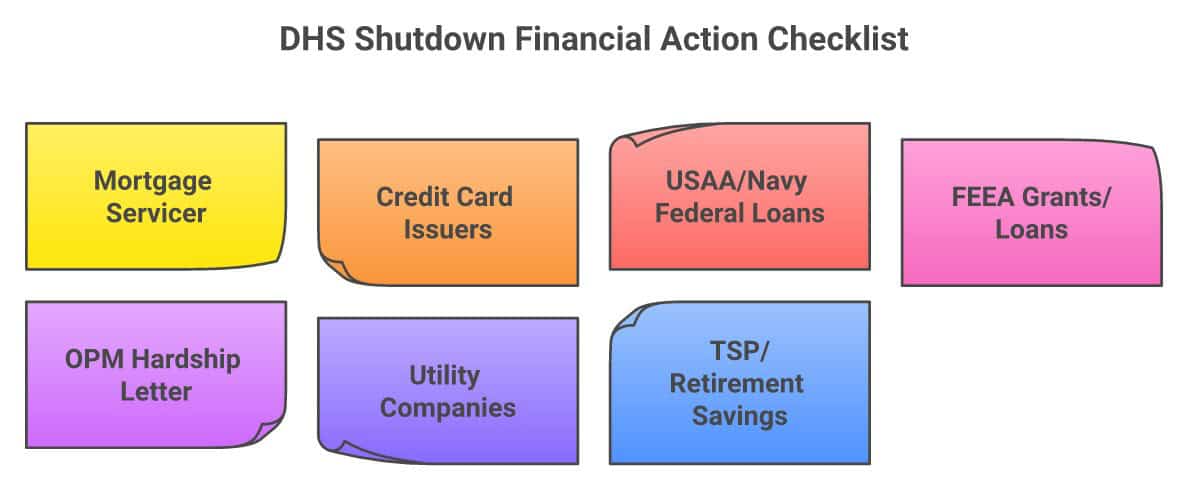
- Call your mortgage servicer today — not when you miss a payment. Federal mortgage programs require servicers to offer forbearance to federal employees during government shutdowns. Fannie Mae and Freddie Mac servicers are required by their guidelines to provide this. Call the servicer number on your mortgage statement and say: “I am a federal employee affected by the DHS government shutdown and I need to request forbearance.” They have a protocol. It exists. But you have to initiate it.
- Call your credit card issuers this week. Chase, Citi, Capital One, Bank of America, and others all have internal hardship programs — they are not advertised, but they are real. Ask specifically: “What hardship programs do you have available for customers experiencing a government shutdown?” You may get a temporary rate reduction, a skipped payment, or a reduced minimum. Every issuer is different, but none of them can offer you something you don’t ask for.
- Contact USAA or Navy Federal if you’re eligible. USAA is offering no-interest loans up to $6,000 with 3-month repayment for members affected by the DHS shutdown. Navy Federal Credit Union has a similar zero-interest loan program up to $6,000. These are not payday loans — they are specifically structured to bridge the income gap without adding to your debt. If you have access to either of these credit unions, use this before touching any retirement account or taking a commercial loan.
- Apply to FEEA for an emergency grant or 0% loan. The Federal Employee Education and Assistance Fund provides both grants and zero-interest loans to federal employees in financial hardship. This is a nonprofit, not a lender. Grants don’t need to be repaid. Apply before you run out of options — not after.
- Get an OPM hardship letter and send it to creditors. The Office of Personnel Management provides official documentation letters you can provide to landlords, creditors, and utility companies explaining that your missed payments are due to the government shutdown, not financial irresponsibility. These letters matter — they create a paper trail that distinguishes your situation from ordinary delinquency.
- Contact your utility companies before service is cut. Ask for a payment arrangement, a hardship deferral, or a state utility assistance program. Every state has some form of utility assistance. This is exactly the situation those programs exist for.
- Use the shutdown assistance map. MyFEDBenefits maintains a shutdown assistance map that aggregates resources by state and situation — local food banks, emergency funds, utility help, and nonprofit services available specifically to federal employees.
Before you talk to any debt relief company: I cannot say this strongly enough — the window when you are receiving media attention as a group of people in financial distress is exactly when predatory lenders and debt settlement companies ramp up their marketing. Before you sign anything, talk to anyone, or enroll in any program, take the Find Your Path quiz to see what options actually apply to your situation — it’s free and takes two minutes. And run any company through the Scam-O-Meter before you give them your information.
Key Takeaways
- Call mortgage servicer, credit card issuers, and utility companies NOW — before 30 days past due
- USAA and Navy Federal offer zero-interest bridge loans up to $6,000 for eligible members
- FEEA provides emergency grants and 0% loans specifically for federal employees
- Do NOT touch TSP or retirement savings — they’re protected even in bankruptcy
- Proactively managing the situation protects your security clearance, not the opposite
The IRS is facing similar staffing collapse — funding cuts mean automated tax collection keeps running while negotiation staff disappears. Federal workers dealing with both a shutdown and tax debt need to act on both fronts.
The Bottom Line
If you’re a federal employee reading this right now wondering how you’re going to cover next month’s bills — I hear you. This is not your fault. The math of your household is being broken by forces you didn’t create and can’t control. But here’s what I know after watching every shutdown since 1995: the people who come through in the best shape are the ones who make the call before they miss the payment. Not after. The forbearance programs exist. The emergency loans exist. The OPM hardship letters exist. Use every single one of them, and do not let shame or optimism keep you from picking up the phone today. You are not your debt. This situation is happening to you, not because of you.
Free Tool — Contract Decoder: Have a contract from a debt relief company? The free Contract Decoder analyzes it for red flags, hidden fees, and problematic terms — before you sign anything. Decode My Contract →
Frequently Asked Questions
Are mortgage servicers required to offer forbearance to DHS employees during the shutdown?
Yes, if your mortgage is backed by Fannie Mae or Freddie Mac (which covers the majority of conventional mortgages), your servicer is required under their guidelines to offer forbearance to federal employees experiencing a government shutdown. You must initiate the request — call the servicer number on your mortgage statement, identify yourself as a federal employee affected by the DHS shutdown, and specifically ask for forbearance. FHA and VA loans have similar provisions. The servicer does not automatically apply this; you have to ask.
Will requesting financial hardship help during the shutdown hurt my security clearance?
No — and this is one of the most important things to understand. Security clearance adjudicators distinguish between financial hardship that is documented, communicated, and being responsibly managed versus financial irresponsibility that is ignored. Calling your creditors, requesting forbearance, and using official hardship programs is the responsible response. What creates clearance risk is unaddressed debt, hidden delinquencies, or judgment liens. Proactively managing this situation actually demonstrates responsibility, not the opposite.
What is the FEEA and how do I access their shutdown assistance?
The Federal Employee Education and Assistance Fund is a nonprofit organization that provides emergency financial assistance specifically to federal employees. During government shutdowns, they offer both 0% interest loans and outright grants — grants you don’t have to repay. Visit feea.org/shutdown to apply. Unlike commercial lenders, FEEA is not trying to profit from your situation. Apply early, before their funds for the shutdown are depleted, and before you are in serious arrears.
Should I take an emergency loan from USAA or Navy Federal to cover missed pay?
If you are eligible for USAA or Navy Federal, their shutdown emergency loan programs — zero-interest loans up to $6,000 with structured short-term repayment — are far better than any commercial alternative you will be offered. They are specifically designed to bridge a temporary income gap without adding to your debt load long-term. The key is that they are short-term bridge loans, not long-term debt. The critical comparison: a zero-interest $6,000 loan with a 3-month repayment is dramatically better than a $6,000 cash advance from a credit card at 29% APR or, worse, an early withdrawal from your TSP.
What if the DHS shutdown ends — will I get back pay for the missed paychecks?
Federal law requires that federal employees receive back pay once a shutdown ends. This has held in every previous shutdown. However, “eventually” doesn’t help you this month. The back pay guarantee is a reason not to panic — but it is not a reason to wait on activating hardship programs and forbearance. The creditors you owe don’t pause their clock because you’re expecting back pay. Use every available resource now, and treat the back pay as the repayment mechanism when it arrives.
I’ve watched every government shutdown since 1995 play out financially. This one is worse because it’s the longest, and because the Coast Guard — which protects our shores and serves in active conflict — is the only branch of the military that can be left without pay this way. Whatever you think about the politics, these are real people in real financial distress through no fault of their own. If you know someone in this situation, send them this. The information is free and it could save them years of debt recovery. — Steve
If someone you know is a federal employee or Coast Guard member affected by this shutdown, please send them this page. The financial window that matters is right now — before the first payment is missed.
Dealing With Debt? Understanding your options is the first step. See how all your debt relief options compare — including ones most sites won’t tell you about. The Find Your Path quiz gives a recommendation based on your actual numbers, and the Scam-O-Meter checks any company’s complaint history before you sign. Federal Reserve research shows bankruptcy filers recover faster than those who don’t file.



