

Quick Answer: New NerdWallet data shows 69% of Americans now say college isn’t as important as it used to be for earning a good living. Among 2026 high school graduates heading to four-year schools, the average student will borrow $43,500 — and 39% are considering skipping college entirely because of AI. If you’re a parent carrying your own debt while trying to figure out how to pay for a kid’s college, here’s what 30 years of watching families make this decision has taught me.
Expert Context: I’ve been helping people with debt since 1994. The college decision is the single biggest financial choice most families make — and it’s also the one where the most bad advice gets handed out. I’ve watched parents drain retirement accounts, co-sign loans they couldn’t afford, and take on second mortgages to send kids to schools that didn’t change their career trajectory. The math has changed. The conversation needs to change too.
Nearly 7 in 10 Americans now say college isn’t as important as it used to be for earning a good living. That number comes from a new NerdWallet survey of over 2,000 adults, and it represents a seismic shift in how families are thinking about the biggest financial decision most of them will ever make.
But here’s what the headlines are missing — and it’s the part that matters most if you’re a parent or a young person trying to make this call right now.
Every weekday I read the enforcement actions, filings and fine print the outlets skip, and turn them into the one or two moves that actually improve your position — a rate worth moving for, a fee you can refuse, a deadline to beat before it costs you.
In the latest issue (Oct 8): A parent's nursing home bill can become yours
I write Your Money Actually most weekdays — actionable money information you will not find anywhere else, and the small decisions that compound. It is free, I sell nothing, and I take no money from any company I write about.
The Real Problem Isn’t College — It’s How We Pay for It
The NerdWallet data tells a story that’s more nuanced than “kids are skipping college.” Actually, 65% of Americans still say a four-year degree is financially smart. What’s broken is the financing.
A 2026 high school graduate entering a public four-year college will borrow an estimated $43,500 in student loans. That’s just the federal cap for dependent undergrads — it doesn’t include private loans, Parent PLUS loans, or the credit card debt families rack up covering the gap.
The Daily Money Brief — Free, at 10 AM
Money you may be owed, scams to dodge, and the fine print decoded — the consumer money news that affects your wallet, every weekday.
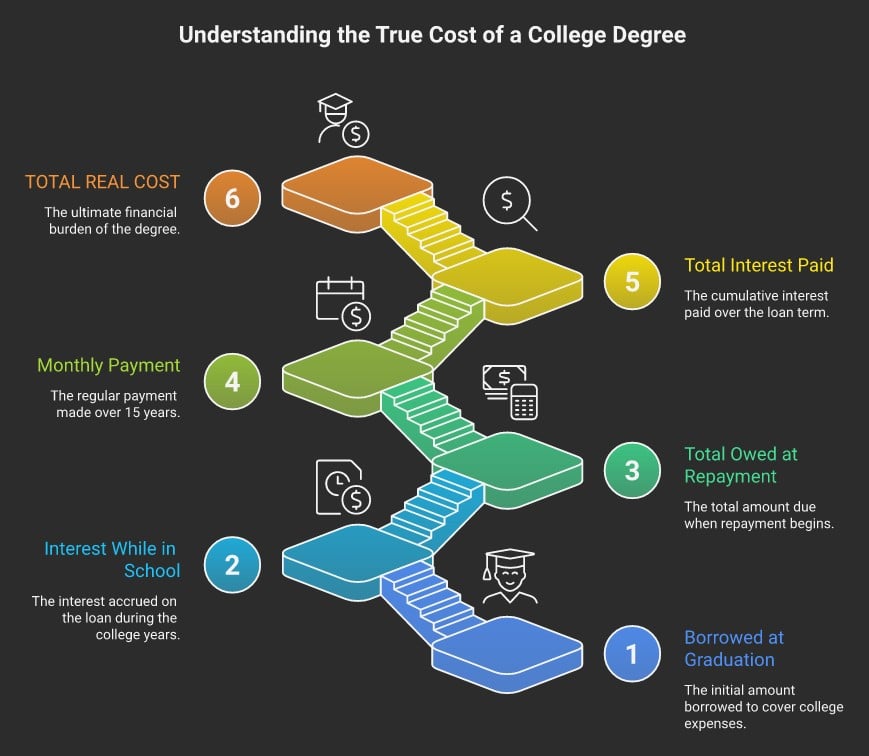
Here’s the math nobody shows you at orientation: that $43,500 becomes $38,061 by the time you start repaying (thanks to interest accruing while you’re in school). On a standard 15-year repayment plan, you’ll pay $329 a month and spend $28,266 in interest alone. Your $43,500 education costs you $66,327.
And that’s if you graduate. The five-year completion rate is 57%. If you borrow $43,500 and don’t finish — you have the debt without the degree.
What Parents Carrying Debt Need to Hear
This is the conversation I have most often with parents in debt. They’re struggling with credit card balances, maybe making minimum payments, and they’re trying to figure out how to add a $43,500 college tab on top of it.
I’m going to say something that goes against every instinct you have as a parent: your retirement matters more than your kid’s college tuition.
Here’s why. Your child can borrow for college. They can get scholarships. They can work. They can go to community college for two years and transfer. They can start at a trade school where the average electrician apprentice earns while learning and comes out debt-free making $60,000+.
You cannot borrow for retirement. There is no scholarship for being 68 and broke. And if you drain your 401(k) to pay tuition — which I’ve watched hundreds of families do — you lose the compound growth AND pay a 10% penalty plus income taxes on every dollar. A $50,000 401(k) withdrawal to cover tuition costs you $65,000+ after taxes and penalties, and it costs you roughly $400,000 in lost retirement growth over 20 years.
The AI Factor Nobody’s Talking About
Here’s a data point from the NerdWallet survey that stopped me cold: 39% of young people are considering skipping college because of AI. And 43% say AI will influence what career they pursue.
They’re not wrong to think about this. But they might be drawing the wrong conclusion. AI is disrupting entry-level knowledge work — the exact jobs many four-year degrees prepare you for. But it’s not replacing plumbers, electricians, nurses, or the people who fix the machines that run AI.
The real question isn’t “should I go to college?” It’s “what am I going to college FOR?” A four-year degree in a field AI is already automating, financed with $43,500 in debt, at a school with a 57% graduation rate — that’s a $66,000 bet with bad odds. A two-year technical degree or apprenticeship in a skilled trade — that might be the smartest financial decision a young person can make right now.
What I’d Tell My Own Family
- If you’re a parent carrying debt: Do not co-sign student loans. Do not take Parent PLUS loans. Do not touch your retirement. Take the Find Your Path quiz and deal with your own debt first — your kid’s options are better than yours.
- If you’re an 18-year-old deciding right now: Community college for two years, then transfer. You get the same degree for roughly half the debt. Nobody’s diploma says “started at community college.”
- If you’re considering trades: 77% of Americans now say trade jobs are more secure than office positions. Electricians, plumbers, HVAC techs — these are $60K-$90K careers that can’t be outsourced, can’t be automated, and don’t require $43,500 in loans to start.
- If you’re already in student loan debt: Bankruptcy can now discharge student loans in more situations than most people realize. The rules changed. If your payments are drowning you, look at this before you assume you’re stuck.
- If you’re a parent who already co-signed: Understand what you’ve agreed to. If your child defaults, those loans are 100% your problem. If the total debt is unmanageable, run the numbers on all your options — including the one nobody wants to talk about.
“Financial literacy as an ineffective substitute for financial regulation… places too high a burden on non-expert consumers.”
— David Puelz and Robert Puelz, Financial Literacy and Perceived Economic Outcomes (2022)
That quote from a peer-reviewed study captures exactly what’s happening with college financing. We tell 18-year-olds to “make informed decisions” about $43,500 in debt — then hand them loan documents that would confuse a finance professor. The system isn’t broken because young people are making bad choices. It’s broken because 75% of Americans identify cost as the primary barrier to college and we’ve done nothing to fix the cost.
This is what I’m seeing after 30 years of helping families with debt. The college conversation has changed — and most of the advice people are getting hasn’t caught up yet. These are the questions I’d ask if one of my own kids were making this decision today. Take it as input, not instruction. Your family, your numbers, your call. Nobody gets to make this decision for you — not the school, not the lender, not me.
Listen: Steve and Damon discuss this topic in detail on the latest podcast episode — AI Layoffs, Student Loans, and Social Security.
Dealing With Debt? Understanding your options is the first step. See how all your debt relief options compare — including ones most sites won’t tell you about. The Find Your Path quiz gives a recommendation based on your actual numbers, and the Scam-O-Meter checks any company’s complaint history before you sign. Federal Reserve research shows bankruptcy filers recover faster than those who don’t file.



