
“The people who end up in the worst shape during a recession aren’t the ones who lose their jobs. It’s the ones who saw the warnings, did nothing, and then made panic decisions after the first missed paycheck.” — Steve Rhode (See also: E-shaped economy splitting Americans.)
On the same day, CNBC used the phrase “sleepwalking into a recession.” The New York Fed’s John Williams warned of “significant and unpredictable” risks to the economy. Reuters reported U.S. inflation is heading toward 4%. Gas just hit $4.46 a gallon. And 92,000 tech workers lost their jobs in April alone.
Related: Oracle just laid off 30,000 people — here is the 30-day plan if you are next
You don’t need tea leaves to read this one. It’s shouting at you.
Each weekday I send one short email: one money story that caught my attention, why it might matter to you, and one manageable thing you can do with it. A couple of minutes, and a dad joke.
In the latest issue (Oct 16): The check that looks like a scam may be real
Free. I sell nothing. Unsubscribe any time.
I filed bankruptcy in 1990 during the last oil-shock recession. I’ve counseled thousands of families through three recessions since. And the pattern is always the same — the headlines start piling up, most people tell themselves it won’t affect them, and then six months later they’re cashing out retirement accounts to make minimum payments on credit cards they should have dealt with when they still had options. (See also: holiday spending debt trap.)
I’m not going to let that happen to you. Here’s what you need to know right now, and exactly what to do about it in the next 30 days.
What You Need to Know
This isn’t one bad headline. This is four independent signals converging at the same time:
When the NY Fed, Wall Street analysts, and Reuters all use crisis language on the same day — while nearly 100,000 people just lost their jobs — the recession signal is no longer theoretical. Jamie Dimon already warned about a credit recession, and SoFi’s earnings confirmed it’s starting.
The Strait of Hormuz — where 20% of the world’s oil passes through — is disrupted by the Iran conflict. OPEC+ made a small production bump, but it won’t offset a war choking off the world’s most important shipping lane. Gas prices aren’t coming down soon. And everything that rides on a truck gets more expensive when diesel does.
Why You Need to Know This — From 30 Years of Experience
Here’s what the headlines won’t tell you: recessions don’t hurt people the way you think.
The financial damage doesn’t come from the recession itself. It comes from what people do during the recession out of fear. I’ve watched this movie three times, and the script never changes:
- Gas and groceries go up, so people put more on credit cards to keep the same lifestyle
- Hours get cut or a job disappears, so they start missing minimum payments
- Panic sets in, so they cash out $50,000 from their 401(k) to buy six months of breathing room
- Six months later the breathing room is gone, the debt is back, AND the retirement money is gone forever
The 401(k) trap is real. I’ve seen it hundreds of times. Someone cashes out $50,000 in retirement to make credit card payments they could have discharged in bankruptcy — wiping out roughly $400,000 in future retirement value. Your retirement is fully protected in bankruptcy. Don’t sacrifice what’s protected to save what’s dischargeable.
I talked about this exact pattern in my recent podcast episode on financial disaster recovery. Resilience isn’t about being unbreakable — it’s about learning how to bend without falling apart. And the bending starts with having a plan before the ground shifts, not after.
The media covers recession as a Wall Street story — markets down, yields up, analysts debating basis points. But it’s a kitchen-table story. It’s about whether you can cover rent on one paycheck instead of two. It’s about whether your credit card hardship program still has room when you finally call. It’s about whether you made the phone calls this week or waited until the panic hit.
Things to Consider
First, the most important thing: do not panic. Recession warnings are not the same as a recession. What we have right now is a window — probably 30 to 90 days — where you can prepare while the options are still good. Hardship programs have better terms when you’re current on payments. Bankruptcy attorneys have more availability when they’re not slammed with filings. Lenders are still lending.
That window closes when everyone panics at once.
The 30-day window matters. When a recession hits, credit card companies tighten hardship programs, lenders pull back, and bankruptcy attorneys get backlogged. The people who called before the wave get the best terms. The people who called after get whatever’s left. I saw this in 2008 — by mid-crisis, some hardship programs had 6-week wait lists.
Second, consider what kind of recession this could be. An oil-shock recession hits differently than a housing crash or a banking crisis. Gas and energy prices stay elevated for months. If you heat with oil, I wrote about what to read before you prepay a dealer this winter. Everything that gets shipped — which is everything — costs more. The squeeze comes from the expense side, not the income side (at first). That means the credit card trap is the primary danger right now — people maintaining their lifestyle on plastic while costs climb.
Third, if you’re already carrying debt and barely making it, this is the moment to honestly assess your situation. Not next month. This week. The debt relief options calculator takes about 5 minutes and shows you everything — including options most people don’t know exist.
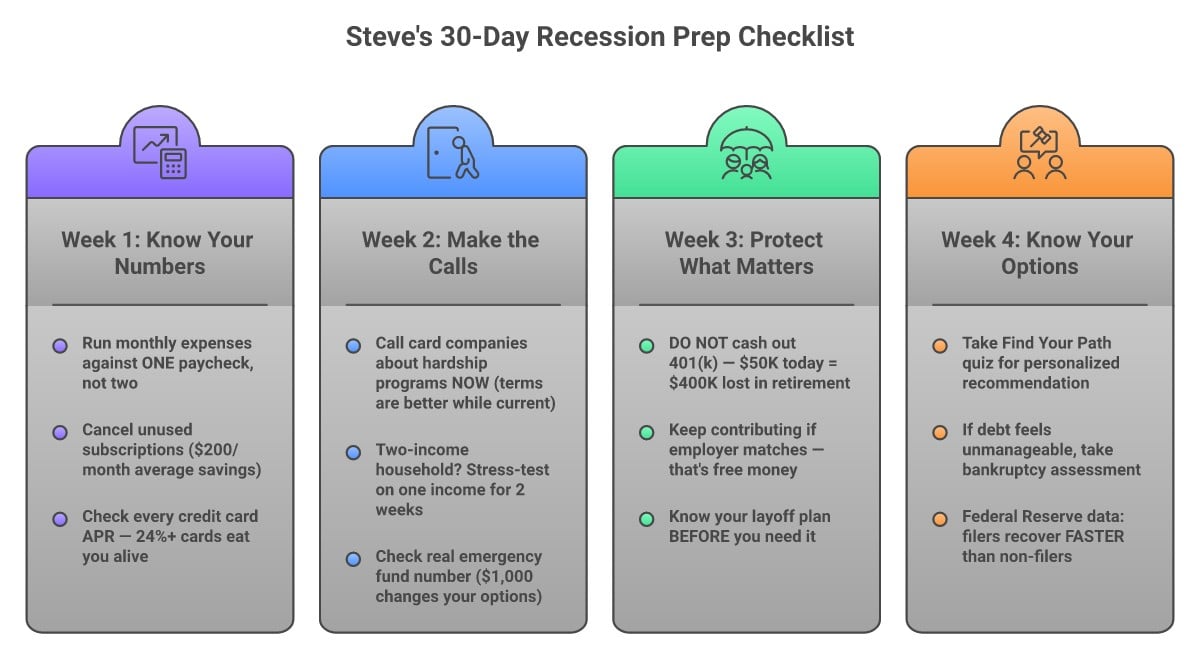
What to Think About Doing — Steve’s 30-Day Recession Prep
I’m giving you the same checklist I’d give my own family. Do these in order, this week and next:
Week 1: Know Your Numbers
- Run your monthly nut against ONE paycheck. Add up rent, minimum payments, insurance, gas, food, utilities. Now divide by one paycheck instead of two. How many months can you survive? If the answer is less than two, you need to act now, not later.
- Check every subscription and recurring charge. I’m not talking about giving up lattes — I’m talking about the $14.99, $9.99, $22.99 charges that add up to $200/month that you don’t even notice. Cancel anything you haven’t used in 30 days.
- Know your credit card APRs. Pull up every statement. If any card is above 24%, that’s the one that will eat you alive when balances grow. That’s where you focus first.
Week 2: Make the Calls
- Call every credit card company and ask about hardship programs. You want to know what exists BEFORE you need it. “What hardship options do you offer if my income drops?” Write down what they say. The terms are better when you’re current — once you miss a payment, the conversation changes.
- If you’re in a two-income household, run a one-income stress test. Seriously — live on one income for two weeks. Pay everything from one paycheck. Put the second paycheck in savings untouched. You’ll know within 48 hours whether your budget is real or a page of lies.
- Check your emergency fund honestly. I know the usual advice is “3-6 months.” That’s fine as a goal. But right now I want you to know the real number. Even $1,000 in accessible cash changes your options dramatically.
Week 3: Protect What Matters
- Do NOT touch your 401(k). I cannot say this loudly enough. Cashing out $50K in retirement to make credit card payments is a $400,000 mistake. Your retirement is protected in bankruptcy. Your credit card balance is not. Don’t sacrifice what’s protected to save what’s dischargeable.
- Don’t stop 401(k) contributions either — especially if your employer matches. That match is free money. Stopping contributions to make minimum payments is trading guaranteed returns for interest payments. The math doesn’t work.
- If you’ve been laid off or think layoffs are coming, read the 3 mistakes that turn a layoff into a debt crisis and what to do before the first missed payment. The decisions you make in the first 30 days after a job loss determine whether this is a setback or a spiral.
Week 4: Know Your Options
- Take the Find Your Path quiz — it gives you a recommendation based on your actual numbers, not someone else’s situation.
- If the debt already feels unmanageable, take the 2-minute bankruptcy quiz. I know the word scares people. But Federal Reserve research shows filers recover faster than people who don’t file. Credit scores typically rise within 12-18 months. And your retirement stays untouched.
- If you’re not sure whether you’re ready to act — talk it through first. Schedule a free consultation with Damon Day, an independent debt coach and my co-host on the Get Out of Debt Guy podcast. I receive no payment for this referral. He listens, asks the right questions, and helps you figure out which option actually fits your situation. Sometimes the most valuable thing is hearing someone say “here’s what I’d do if I were you” — with nothing to sell.
What NOT to Do
- Don’t cash out retirement to pay credit cards. I’ve said it three times. I’ll say it again.
- Don’t take on new debt to cover rising costs. A personal loan to “consolidate” while expenses are climbing just adds another payment to the pile.
- Don’t ignore it. The consumer confidence numbers are at a 48-year low but spending is still rising — that gap is credit cards filling the hole. If that’s you, acknowledge it now.
- Don’t make permanent decisions based on temporary fear. Selling investments at a loss, pulling kids from activities, moving — those are last-resort moves, not first responses.
For anyone approaching retirement, the recession risk doubles when combined with a Social Security squeeze from COLA caps and trust fund depletion. Your recession checklist should include recalculating retirement at 20% less in benefits.
The Bottom Line
Recession warnings are piling up from every direction — the Fed, Wall Street, Reuters, and 92,000 fresh layoffs. You have a 30-day window right now where the options are still good: hardship programs have better terms, bankruptcy attorneys have availability, and lenders are still lending. That window closes when everyone panics at once. Run your numbers this week. Make the calls next week. Know your options before you need them. The people who prepare when it’s calm are the ones who survive when it’s not.
This is what I’m seeing after 30 years of helping people deal with debt — including filing bankruptcy myself during the last oil-shock recession. I’m telling you what I’d tell my own kids. But only you know your full situation. Take this as one informed perspective, not a directive. Use it as input for your decision. Nobody gets to tell you what to do with your money — not me, not anyone. If you want to talk it through, I’m here.
Know someone who’s worried about what’s coming? Send them this. Sometimes the most helpful thing you can do is share a checklist with someone who doesn’t know where to start.
Dealing With Debt? Understanding your options is the first step. See how all your debt relief options compare — including ones most sites won’t tell you about. The Find Your Path quiz gives a recommendation based on your actual numbers, and the Scam-O-Meter checks any company’s complaint history before you sign. Federal Reserve research shows bankruptcy filers recover faster than those who don’t file.
Related: Commercial bankruptcies surged 42% in April 2026 — the data point driving that checklist. Full breakdown: Commercial Bankruptcies Jumped 42% in April — What That Means for Your Job, Your Debt, and Your Next Move.



