
Updated October 21, 2026: Claims are now open, and the purchase window ends March 29, 2025. An earlier version of this post gave the wrong end date (March 29, 2026) and said claims were not open yet, which is no longer true. I also removed a preliminary-approval date I could not verify, made clear that $25 is an estimate and not a minimum, and updated the payment options.
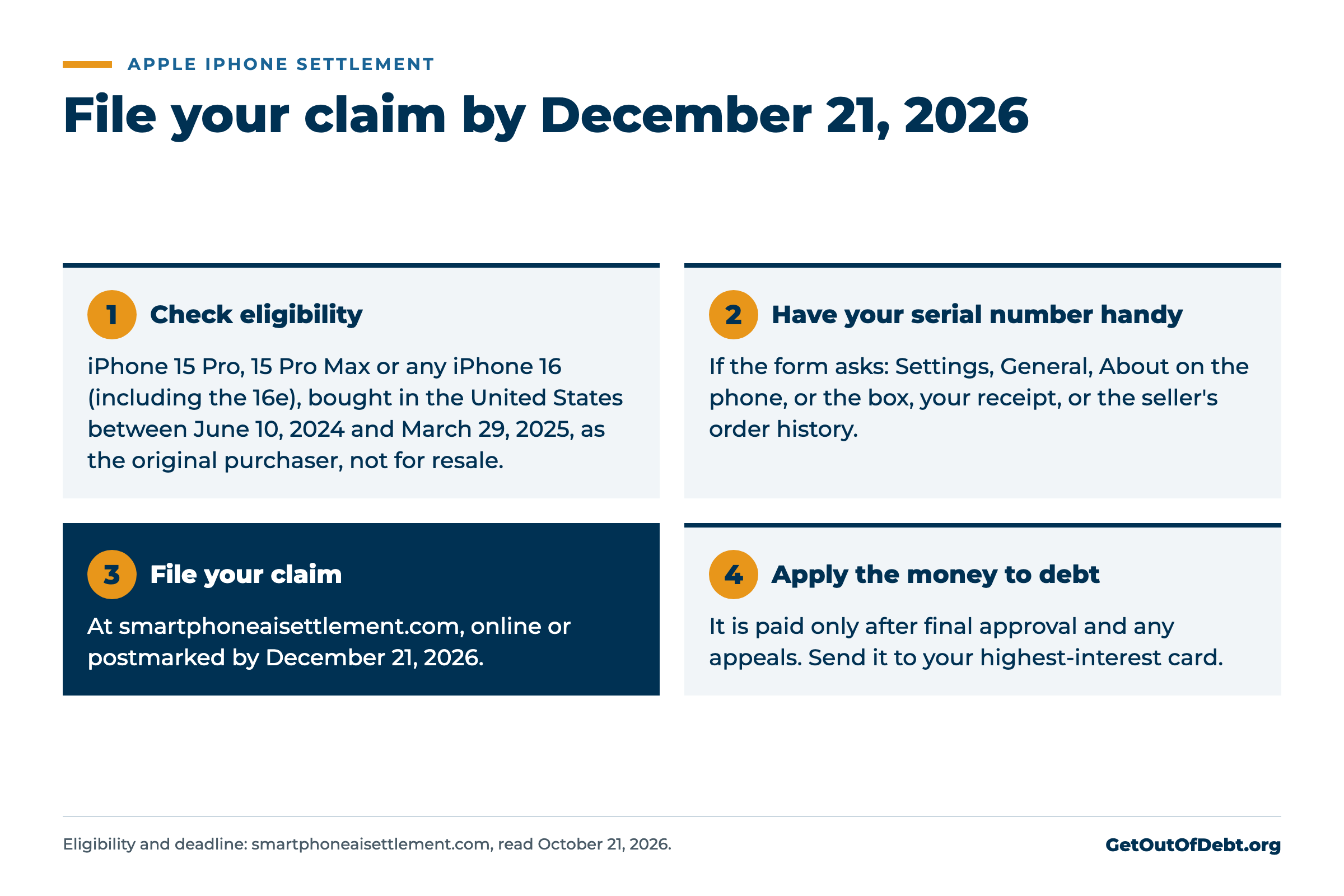
Quick Answer: Apple agreed to pay $250 million to settle claims that it overpromised on Apple Intelligence and Siri features. If you bought an iPhone 15 Pro, 15 Pro Max, or any iPhone 16 model between June 10, 2024 and March 29, 2025, you may be able to claim an estimated $25 per device. That could rise to as much as $95, or fall below $25, depending on how many people file. If you live in the United States, you must have bought the phone in the United States as its original purchaser, and not have bought it for resale. Businesses that bought eligible phones for business use can file too. As of October 21, 2026, claims are open at smartphoneaisettlement.com, and they must be submitted online or postmarked by December 21, 2026. To get paid, file a claim. Doing nothing keeps you in the settlement with no payment. Opting out means no payment; it and objecting share the December 21, 2026 deadline, and the official site explains both. The settlement still needs final court approval; the hearing is currently set for February 24, 2027 (courts can move it, so check the official site).
“In 30 years of watching settlements, the biggest threat isn’t missing the deadline — it’s seeing the headline and thinking ‘I’ll get to it later.’ Later never comes.”
A $250 million class action settlement with Apple over allegedly misleading marketing of Apple Intelligence and Siri features on newer iPhones is now taking claims. If you bought one of the affected models in the window as its original purchaser, this is real money — not a coupon, not a credit on your Apple account, but money (the claim form I used offered PayPal, Venmo or a paper check), paid only after final approval and any appeals. But only if you actually file the claim.
Claiming money you are owed is one good day. What you do over the following year is what actually changes your position.
In the latest issue (Nov 12): A 10% cap on your credit card rate? Here's what's real.
Each weekday I send one short email: one story that caught my attention, why it might matter to you, and one manageable thing you can do with it.
Free. I sell nothing. Unsubscribe any time.
Here’s what the headlines aren’t telling you — and what I’d tell my own family about this settlement right now.
What You Need to Know About the Apple Settlement
This settlement stems from a class action lawsuit (Pirozzi v. Apple Inc.) alleging that Apple marketed its Apple Intelligence features as ready and reliable when they launched with iPhone 15 Pro models in June 2024 — but the features were delayed, buggy, or didn’t work as advertised. Siri, which Apple promoted as supercharged by AI, was a particular sore spot.
Apple has not admitted any wrongdoing — that’s standard in class actions. But they agreed to pay $250 million, which tells you something about how the evidence looked.
Total settlement fund
Estimated per device (cap $95)
Devices potentially eligible
Key detail the headlines skip: The payout is per device, not per person. If you bought an iPhone 15 Pro and later upgraded to an iPhone 16 Pro, you can file for both if each purchase meets the rules above, including a purchase date between June 10, 2024 and March 29, 2025. A couple who each bought two eligible phones could be looking at about $100 at the $25 estimate, up to $380 at the cap, or less if a lot of people file.
Why You Need to Know This — From 30 Years of Watching Settlements
I’ve been helping people navigate money decisions for over three decades, and class action settlements (like the Fidelity data breach settlement offering up to $5,000) are one of the most consistently ignored sources of money people are owed. Here’s why this one matters more than most:
First, the math is real. A lot of class actions pay out only a few dollars per person — enough for a sandwich. This one estimates $25 per device and could go as high as $95, or lower if a lot of people file. That’s meaningful. If you’re carrying credit card debt at 28% APR, $25 applied as an extra payment saves you roughly $7 in interest over a year if that balance would otherwise sit there, and $95 would save about $26. It’s not life-changing, but it’s not nothing. Just remember it’s a claim, not money in the bank, until it’s paid.
Second, the payout shrinks as more people file. Class action settlement funds are divided among everyone who submits a valid claim. The fewer people who file, the higher each person’s share. Filing early doesn’t give you a bigger check directly — but it guarantees you’re in the pool. People who forget or procrastinate get nothing.
Third, the payment is real money — not store credit. Unlike some corporate settlements that give you a coupon or account credit you’ll never use, this one pays money. When I filed my own claim on October 21, 2026, the form offered PayPal, Venmo or a paper check. When it does arrive, after final approval, send it straight to your highest-interest debt. That’s what I’d tell my kids to do.
Watch out for scams. Every major settlement announcement brings a wave of phishing emails and fake claim sites. The official settlement website will come from the court-appointed administrator — not from a random email. Never pay to file a class action claim. If someone asks for your Social Security number or bank login to “process your settlement,” that’s a scam.
Things to Consider Before You File
As of October 21, 2026, claims are open at the official settlement website, smartphoneaisettlement.com. Claims must be submitted online or postmarked by December 21, 2026. The final approval hearing is currently set for February 24, 2027 (courts can move it, so check the official site).
Here’s what that means practically:
- You can file now — the deadline is December 21, 2026
- Eligible devices: iPhone 15 Pro, iPhone 15 Pro Max, iPhone 16, iPhone 16e, iPhone 16 Plus, iPhone 16 Pro, iPhone 16 Pro Max
- Who qualifies: The official site says a class member living in the United States must have bought the phone in the United States, as its original purchaser, and not for resale. Businesses that bought for business use can file too.
- Purchase window: Bought in the United States between June 10, 2024 and March 29, 2025
- What you may be asked for: Your device serial number, Apple Account email, and the phone number associated with the device
Find your serial number now: On your iPhone, go to Settings → General → About and scroll to Serial Number. If you no longer have the phone, check the original box, your receipt, or the order history with whoever sold it to you. Write it down somewhere you won’t lose it.
One thing worth knowing: the $250 million doesn’t all go to claimants. Attorney fees, litigation costs, and settlement administration come out of the pot first. That’s standard — it’s how the system works — but it’s why per-person payouts are always less than the headline number divided by the number of eligible people.
What to Think About Doing Right Now
The claim window is open, and the people who actually file — instead of just meaning to — are the ones who collect. Here’s what I’d tell my own family:
- Check whether you own an eligible device. Did you buy an iPhone 15 Pro, 15 Pro Max, or any iPhone 16 model (including the 16e) in the United States between June 10, 2024 and March 29, 2025? Check your receipts or the order history with whoever sold you the phone (Apple, your carrier, or a store), and don’t forget phones you traded in or gave to family members. Only the original purchaser can file, and not for a phone bought for resale.
- Have your serial numbers handy. For every eligible device you’ve owned, in case the claim form asks. The person who paid for a phone is the one who files for it: if you bought your partner’s phone, you claim it and they don’t. If you’re not sure how a carrier plan or installment purchase counts, check the official site’s FAQ. Each eligible device counts separately toward the payout.
- Set a reminder if you can’t file today. Claims must be submitted online or postmarked by December 21, 2026. Put a reminder on your calendar well before then. The same “file it now” urgency applies to every settlement — the window is always shorter than you think.
- Have a plan for the money. Don’t count on the money until it actually arrives, and it can only arrive after final approval and any appeals. When it does, don’t let it evaporate into general spending. Before it even hits your account, decide where it goes. My recommendation: your highest-interest credit card balance. It’s not exciting, but it’s the highest-return use of found money.
- Tell someone who needs it. Think about who in your life just bought an iPhone in the last two years. Your adult kid. Your sister. Your coworker who’s always stressed about bills. This is one of those moments where a 30-second conversation could put $95 in someone’s pocket — if they know about it and actually file.
The math on settlement money vs. debt: At 28% APR, $25 applied to a card balance that would otherwise sit there saves about $7 in interest over a year; $95 would save about $26. If you and a spouse each bought two eligible devices (four in all), that’s about $100 at the $25 estimate and up to $380 at the cap — enough to make a visible dent in a balance. Found money applied to debt is the highest-return financial move most people never make.
Key Takeaway: Apple’s $250 million settlement estimates $25 per eligible iPhone, up to $95 or less depending on how many people file — real money, not store credit, and only after final approval and any appeals. Claims are open now and due by December 21, 2026. File, and have a plan for where the money goes. If you’re carrying any high-interest debt, that’s your answer.
Two more stories that hit this week you should know about: Social Security is being squeezed from two directions (especially important if retirement is within 10 years), and the 25% EU tariff is already hiding in your household budget.
FAQ
Which iPhones are eligible for the Apple $250 million settlement?
iPhone 15 Pro, iPhone 15 Pro Max, iPhone 16, iPhone 16e, iPhone 16 Plus, iPhone 16 Pro, and iPhone 16 Pro Max purchased in the United States between June 10, 2024 and March 29, 2025. If you live in the United States, you must have bought the phone in the United States as its original purchaser, and not have bought it for resale. Businesses that bought eligible phones for business use can file too.
How much money will I get from the Apple settlement?
The settlement estimates $25 per device. That can rise to as much as $95 or fall below $25, depending on how many people file — fewer claimants means higher individual payouts. The money is not Apple account credit; when I filed, the claim form offered PayPal, Venmo or a paper check.
When can I file my claim for the Apple settlement?
As of October 21, 2026, claims are open at the official settlement website, smartphoneaisettlement.com, and must be submitted online or postmarked by December 21, 2026. Never pay anyone to file a claim for you.
Can I file multiple claims if I owned more than one eligible iPhone?
Yes. The payout is per device, not per person. If you purchased more than one eligible iPhone during the qualifying period, each one counts separately. Follow the claim form’s instructions for listing more than one device.
Do I have to pay taxes on the Apple settlement money?
Class action settlement payments may be taxable depending on how they’re classified. Most consumer settlements like this are treated as a refund of the purchase price and aren’t taxable — but if you receive a 1099, you’ll need to report it. Check with a tax professional if you receive a large payout.
Here’s what I know after three decades of helping people with money: small amounts add up, and the people who do well aren’t the ones who hit the jackpot — they’re the ones who don’t leave money on the table. This settlement check won’t fix everything, but it’s yours. Whether you put it toward a bill or save it for a rainy day, that’s your call. My job is just to make sure you know it’s there. Nobody should tell you what to do with your money — not me, not anyone.
Dealing With Debt? Understanding your options is the first step. See how all your debt relief options compare — including ones most sites won’t tell you about. The Find Your Path quiz gives a recommendation based on your actual numbers, and the Scam-O-Meter checks any company’s complaint history before you sign. Federal Reserve research shows bankruptcy filers recover faster than those who don’t file.



i believe im eligiable for iphone 15 lawsuit