

“When someone tells me they’ve switched entirely to canned meals, they’re usually 60 to 90 days from a debt crisis. That’s not a judgment. That’s a pattern I’ve seen for 30 years.”
Table of Contents
Every weekday I read the enforcement actions, filings and fine print the outlets skip, and turn them into the one or two moves that actually improve your position — a rate worth moving for, a fee you can refuse, a deadline to beat before it costs you.
I write Your Money Actually most weekdays — actionable money information you will not find anywhere else, and the small decisions that compound. It is free, I sell nothing, and I take no money from any company I write about.
What You Need to Know
Steel tariffs are making canned food more expensive — and canned food was already the last affordable option for millions of families. The New York Times reported this week that the 50% tariff on imported steel is hitting tin can manufacturers directly — part of a broader tariff pattern that’s been squeezing grocery bills all year, and those costs are landing on the grocery shelf. For the complete analysis, see my breakdown of seven Federal Reserve studies on tariff costs.
Here’s the number that matters: the Bureau of Labor Statistics shows canned fruits and vegetables cost 5.7% more this March than a year ago. All other food at home? Only 2%. Canned goods are rising nearly three times faster than the rest of your grocery bill.
That might sound small. It isn’t. Not if canned food is most of what you eat.
Why Canned Food Specifically: The tin can is roughly one-third of the wholesale cost of canned fruits and vegetables. Tinplate — the steel used to make cans — is almost entirely imported. There’s no domestic exemption. The U.S. has lost 9 of 12 tinplate production lines since steel tariffs began in 2018. U.S. Steel plans to restart one factory, but manufacturers will “continue to rely heavily on foreign supply for the foreseeable future,” according to the Times. The 50% tariff hits virtually every can on the shelf.
Why You Need to Know It
Every financial guru says “buy in bulk” and “stock up on canned goods” as budget advice. That advice is quietly breaking. The tariff surcharge adds up to 12% to manufacturer costs, according to the American Action Forum, and that’s being passed through to the shelf price.
I’ve counseled thousands of families over three decades. Canned food spending is a leading indicator of household financial distress — and connected to a broader farm crisis that has total farm debt heading toward a record $624.7 billion. When someone’s grocery cart is entirely canned goods, the budget has already failed. They’re in survival mode. And now survival mode just got more expensive.
The part nobody is talking about: food banks are getting squeezed by the same price increases. Feeding America surveys show roughly 70% of food banks report donations down while 95% report purchase costs up. On top of that, billions of dollars in federal food aid deliveries were canceled in 2025. Demand is rising — Feeding America projects 1 in 6 Americans will need food assistance in 2026, up from 1 in 7. The safety net is shrinking at the exact moment more people need it.
Things to Consider
If you’re putting groceries on a credit card, stop and think about what that actually costs. At the average credit card interest rate of 21-24%, a $200 grocery run that you carry for a year costs you $240-$248. You’re financing food at rates that would make a payday lender blush. That’s not a solution. That’s a trap with a monthly minimum payment.
The Credit Card Grocery Trap: If your grocery spending has shifted to credit cards because cash doesn’t cover it, the problem isn’t your grocery budget. The problem is that your overall math is broken — income minus expenses is negative, and credit cards are filling the gap. That gap doesn’t close on its own. It widens every month by the interest rate. Addressing the debt directly is more important than optimizing which canned goods you buy.
This is a structural problem. Your grocery prices went up because of a policy decision about steel. Your food bank has less to give because of federal funding changes. Your SNAP benefit got a modest cost-of-living bump — but new work requirements for adults ages 55 to 64 mean some people who had benefits may lose them. The math is moving against you from multiple directions at once. Wholesale inflation just hit 6%, and the price increases haven’t fully reached the shelf yet.
What to Think About Doing
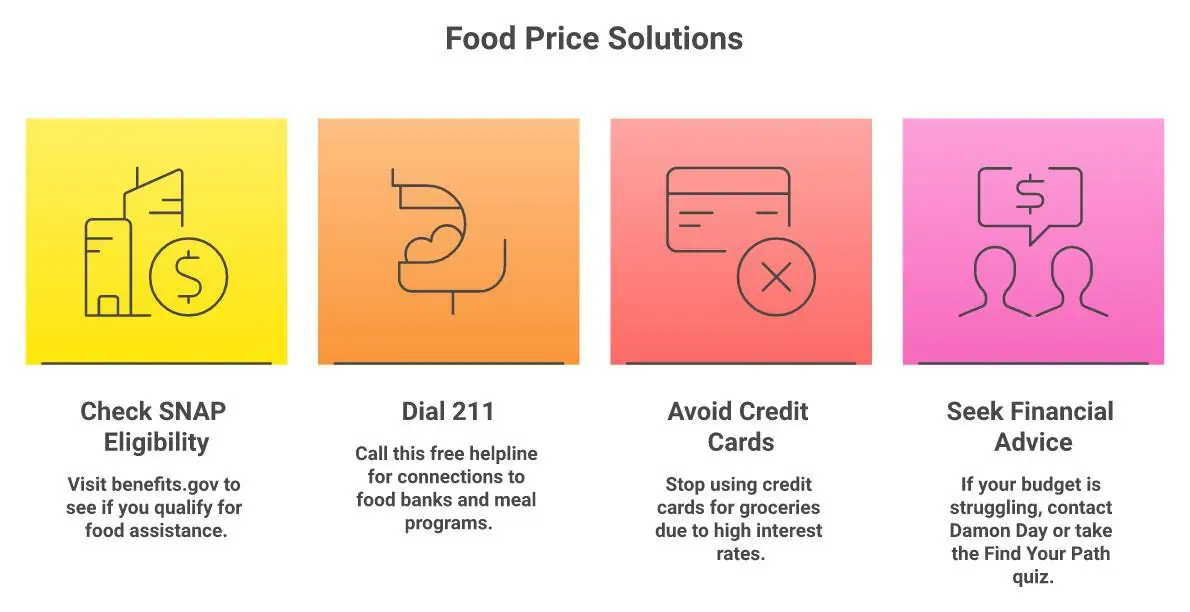
- Check if you qualify for SNAP: Income thresholds for 2026 are higher than many people realize — a single person can earn up to $1,696/month and a family of four up to $3,483/month. Millions of eligible people never apply. Check at benefits.gov — it takes about 10 minutes.
- Call 211: Dial 2-1-1 from any phone. It’s free, confidential, available 24/7, and connects you to food banks, community fridges, meal programs, and other resources near you. In 2022 alone, 211 agencies made 2.4 million connections to food programs. Also try the USDA National Hunger Hotline: 1-866-348-6479.
- If groceries have moved to your credit card: That’s a signal the overall budget is broken. Before the interest charges make it worse, talk to someone who can look at the full picture — not just the grocery line. Do me a favor and schedule a free consultation with Damon Day, an independent debt coach and my co-host on the Get Out of Debt Guy podcast, about whether your current approach is working or whether you need a different plan entirely. I receive no payment for this referral.
- If the math is already broken — income doesn’t cover expenses, debt is growing, you’re choosing between food and bills: That’s not a budgeting problem. That’s a structural problem with a structural solution. Take the Find Your Path quiz — it’ll show you the options that actually match your numbers, including ones nobody markets because nobody profits from them. For the bigger picture on how tariffs are driving Americans toward bankruptcy, the math is worth understanding.
The Bottom Line: Steel tariffs are making the cheapest food more expensive while food banks have less to give. If you’re already stretched, don’t let pride keep you from checking SNAP eligibility or calling 211. And if groceries have migrated to your credit card, that’s the canary — the overall math needs attention before interest charges make it worse. There are faster paths out than most people realize.
This is what I’m seeing from decades of watching how price increases hit the people who can least afford them. Take it as one perspective from someone who’s sat across the table from thousands of families in exactly this situation. Only you know your full picture. Use this to inform your next step, not as a prescription. Send this to someone you know who’s feeling the squeeze — they might not know about the resources that exist.
Related: See the full picture of how policy decisions are driving everyday prices higher.
Dealing With Debt? Understanding your options is the first step. See how all your debt relief options compare — including ones most sites won’t tell you about. The Find Your Path quiz gives a recommendation based on your actual numbers, and the Scam-O-Meter checks any company’s complaint history before you sign. Federal Reserve research shows bankruptcy filers recover faster than those who don’t file.



