
Quick Answer: Fidelity Investments exposed the personal data of 77,000+ customers — including Social Security numbers, driver’s licenses, and bank account and routing numbers — in an August 2024 breach. A $2.5 million class action settlement is now open with payouts up to $5,000 per person. The claim deadline is July 27, 2026. File at FidelityDataSettlement.com. But here’s what the settlement notice doesn’t emphasize enough: the free credit monitoring they’re offering only tells you after someone steals your identity. A credit freeze — which is free and takes 10 minutes per bureau — actually stops it from happening.
Expert Context: I ran a credit counseling organization. Every week, people walked in with financial damage that started with a data breach they didn’t even know about. The breach isn’t the crisis — it’s the 6 to 18 months afterward when someone opens accounts in your name and you don’t discover it until a collector calls about a debt you never took out. That’s when a $5,000 settlement check doesn’t come close to covering the damage.
If you had an account with Fidelity Investments and received a breach notification letter in late 2024, you’re likely eligible for up to $5,000. But the claim window closes July 27, 2026 — and if you don’t file, you get nothing. Here’s exactly what happened, what you’re owed, and the one step Fidelity isn’t pushing hard enough.
Breaches aren’t limited to financial giants. Gas Express / Circle K employees whose Social Security numbers leaked have their own data breach settlement to claim before September 3, 2026.
Each weekday I send one short email: one money story that caught my attention, why it might matter to you, and one manageable thing you can do with it. A couple of minutes, and a dad joke.
In the latest issue (Oct 14): Do you want the money back you left behind?
Free. I sell nothing. Unsubscribe any time.
What Fidelity Actually Exposed
Between August 17 and August 19, 2024, an unauthorized third party Krispy Kreme is paying up to $3,500 to 161,000 affected employees — deadline June 22.com/”>gained access to Fidelity’s computer network and obtained customer information. Fidelity detected the intrusion on August 19 and says it stopped it — but by then, the data was already out.
What was compromised:
- Full names
- Social Security numbers
- Driver’s license numbers
- Financial account numbers
- Bank routing numbers
That’s not a minor breach. That’s everything someone needs to open credit cards, drain bank accounts, file fraudulent tax returns, and take out loans in your name. And it happened at Fidelity — one of the largest financial institutions in the world, managing over $14 trillion in assets.
What the Settlement Offers
The case — In re: Fidelity Investments Data Breach Litigation, Case No. 1:24-CV-12601-LTS in the U.S. District Court for the District of Massachusetts — resulted in a $2.5 million settlement fund. Fidelity has not admitted wrongdoing.
Here’s what you can claim:
- Up to $5,000 for documented monetary losses — unreimbursed fraud charges, fees for credit monitoring you purchased yourself, professional fees related to identity theft recovery, lost wages from time spent fixing the damage
- ~$100 base payment for all eligible class members (exact amount depends on total claims filed — fewer claims filed means larger checks for everyone)
- Additional $50 if you live in California
- Two years of identity theft protection and credit monitoring with $1 million in fraud insurance
The Deadlines That Matter
Critical Dates: The claim deadline is July 27, 2026. If you don’t file by that date, you get nothing — period. The exclusion/objection deadline is June 26, 2026. The final approval hearing is July 9, 2026.
In my experience watching dozens of class action settlements, fewer than 10% of eligible people ever file claims. That means the per-person payouts for those who do file are often significantly higher than the minimum. But you have to actually file — the money doesn’t come to you automatically.
How to File Your Claim This Week
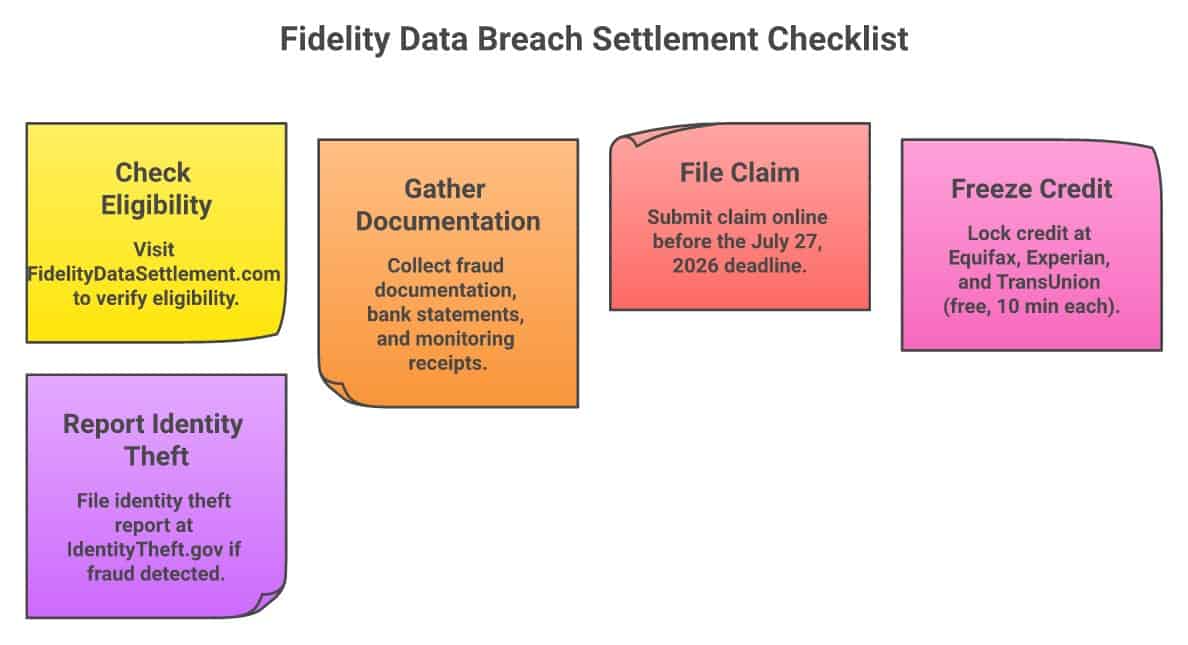
- Step 1: Go to FidelityDataSettlement.com and check whether you’re in the settlement class
- Step 2: If you’ve had any fraud or identity theft since August 2024, gather your documentation — bank statements showing unauthorized charges, receipts for credit monitoring services, records of time spent on the phone with fraud departments
- Step 3: File your claim online (takes about 10 minutes). You can also call (833) 386-6470 or email info@FidelityDataSettlement.com for a paper form
- Step 4: If you’ve experienced suspicious activity, file an identity theft report at IdentityTheft.gov — this strengthens your claim for the full $5,000
Why Credit Monitoring Isn’t Enough — And What Actually Protects You
The settlement includes two years of free credit monitoring. That sounds protective. It isn’t — not by itself.
What people think: “Fidelity is giving me free credit monitoring, so I’m protected.”
The reality: Credit monitoring is a detection tool, not a prevention tool. It sends you an alert after someone has already opened an account in your name. By then, the damage is done — you’re spending hours on the phone trying to close fraudulent accounts, dispute charges, and clean up your credit report. A credit freeze, on the other hand, blocks new accounts from being opened entirely. It costs nothing. And it takes about 10 minutes per bureau.
After running a credit counseling operation, I can tell you that the people who came in with the least damage from data breaches were always the ones who had frozen their credit before anything happened. The people with the worst damage were the ones who relied on monitoring alone and didn’t act until they got the alert — by which point they had three fraudulent credit cards, a personal loan they never applied for, and a credit score that had cratered.
Freeze Your Credit at All Three Bureaus — Right Now
This is free. It’s your legal right under federal law. Do all three — a freeze at one bureau doesn’t protect you at the others:
- Equifax: equifax.com/personal/credit-report-services/credit-freeze/
- Experian: experian.com/freeze/center.html
- TransUnion: transunion.com/credit-freeze
When you legitimately need to apply for credit, you temporarily lift the freeze (takes minutes), then refreeze after. It’s a minor inconvenience that prevents a major catastrophe.
If You Already See Suspicious Activity
If you’ve noticed unauthorized charges, accounts you didn’t open, or collection calls for debts you don’t recognize since August 2024:
- File an identity theft report at IdentityTheft.gov immediately — this creates a legal record
- Place a fraud alert at one bureau (it automatically propagates to all three)
- Freeze your credit at all three bureaus
- Document every dollar you’ve spent fixing this — that’s what gets you toward the $5,000 maximum
- File your Fidelity settlement claim with all documentation attached
Got a Settlement Check Last Year? The IRS Wants to Know
One thing most people don’t realize: class action settlement payments are often taxable income. If you file a claim and receive money from the Fidelity settlement, keep records for your taxes. The IRS treats most settlement payments as taxable unless they’re specifically for physical injury. A $5,000 payout that you don’t report could create a tax headache down the road.
The Bottom Line
Fidelity exposed your most sensitive financial data — Social Security numbers, bank account numbers, routing numbers. The $2.5 million settlement won’t make anyone rich, but $5,000 is real money if you’re behind on bills. File at FidelityDataSettlement.com before July 27, 2026. Then do the thing that actually protects you: freeze your credit at all three bureaus today. It’s free, it takes 30 minutes total, and it’s the difference between an alert that says “someone stole your identity” and a wall that stops them from trying. If you know someone who had a Fidelity account, send them this — most people in the settlement class don’t know it exists.
Frequently Asked Questions
How do I know if I’m part of the Fidelity data breach settlement?
If Fidelity sent you a data breach notification letter in late 2024, you’re likely in the class. You can verify at FidelityDataSettlement.com or call (833) 386-6470. The breach affected customers of FMR LLC d/b/a Fidelity Investments and Fidelity Brokerage Services LLC.
What’s the deadline to file a Fidelity settlement claim?
July 27, 2026. There are no extensions. If you want to opt out or object to the settlement, that deadline is earlier — June 26, 2026. The final approval hearing is July 9, 2026.
How much money will I actually get from the Fidelity settlement?
Every eligible class member gets a base payment of approximately $100 (California residents get an extra $50). If you can document monetary losses from the breach — fraud charges, credit monitoring costs, lost wages — you can claim up to $5,000. The fewer people who file, the larger each check will be.
Does filing a claim affect my Fidelity account?
No. Filing a settlement claim does not affect your Fidelity investment accounts, retirement accounts, or your relationship with Fidelity. The settlement is administered by an independent settlement administrator, not Fidelity itself.
Should I freeze my credit even if I haven’t seen any fraud yet?
Absolutely. Identity thieves sometimes sit on stolen data for months or years before using it. Just because you haven’t seen fraud yet doesn’t mean your data isn’t being held for future use. A credit freeze costs nothing, takes 10 minutes per bureau, and prevents anyone from opening new accounts in your name — whether they try tomorrow or two years from now.
This is what I’m seeing after 30 years of helping people navigate financial crises. The settlement money is helpful, but the credit freeze is what actually protects you going forward. Take this as one experienced perspective — your situation may have details that change the math. Use this as input for your decisions, not a mandate. Nobody — including me — gets to tell you what to do with your money.
Dealing With Debt? Understanding your options is the first step. See how all your debt relief options compare — including ones most sites won’t tell you about. The Find Your Path quiz gives a recommendation based on your actual numbers, and the Scam-O-Meter checks any company’s complaint history before you sign. Federal Reserve research shows bankruptcy filers recover faster than those who don’t file.



