

Quick Answer: If someone in your household could be detained or deported, the financial clock is already ticking. The mortgage doesn’t pause. The car payment doesn’t stop. And if the primary earner is removed without warning, the remaining family members often can’t even access the bank accounts to keep the lights on. A durable financial power of attorney — which many legal aid organizations will prepare for free — is the single most important document you can create this week. Without it, a 3-day detention can spiral into foreclosure, repossession, and debt that takes a decade to climb out of.
Expert Context: I’ve been helping people with debt since 1994. I’ve seen every kind of income disruption — layoffs, strikes, medical emergencies, incarceration, death of a spouse. The families that survive financially are never the ones with the most money. They’re the ones who made a plan before the crisis hit. The families that get destroyed are the ones who assumed they had more time. This post isn’t about politics. It’s about math — and the math says you need to act before the disruption, not after.
More than 100,000 family separations have already occurred in the current deportation push, according to reporting from the Washington Post. Nine out of ten people deported are men — many of them fathers and breadwinners who’ve lived and worked in the U.S. for years. The headlines focus on the policy. Nobody is talking about what happens to the mortgage payment three weeks later.
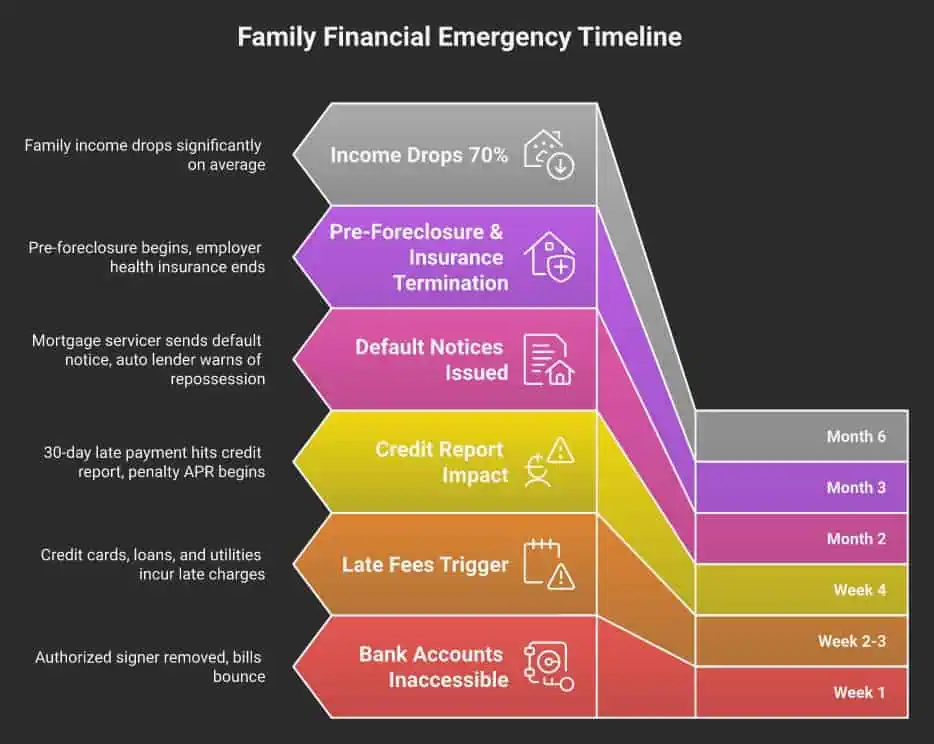
The Financial Disaster Nobody Is Talking About
When a breadwinner is suddenly removed from a household, here’s what happens — not in theory, but in practice, based on what I’ve seen over 30 years:
Every weekday I read the enforcement actions, filings and fine print the outlets skip, and turn them into the one or two moves that actually improve your position — a rate worth moving for, a fee you can refuse, a deadline to beat before it costs you.
In the latest issue (Oct 8): A parent's nursing home bill can become yours
I write Your Money Actually most weekdays — actionable money information you will not find anywhere else, and the small decisions that compound. It is free, I sell nothing, and I take no money from any company I write about.
- The remaining family members often can’t access joint or individual bank accounts because they’re not authorized signers
- Autopay continues until accounts are drained, then payments bounce — triggering late fees, penalty interest rates, and collection calls
- The mortgage servicer starts a 30-day clock. Miss two payments and you’re in pre-foreclosure
- Auto loan servicers can repossess within 60-90 days of missed payments in most states
- Health insurance tied to the detained person’s employer gets terminated — often without notice to the family
- Tax filing becomes complicated or impossible without the spouse’s ITIN or Social Security number
A study from the Urban Institute and Migration Policy Institute found that family income drops an average of 70% in the six months after a parent’s arrest. That’s not a dip. That’s a financial cliff.
The 5 Documents You Need This Week
Do this now — not “when things calm down.” Every one of these documents is harder to execute after someone is detained. Some become impossible. The time to prepare is while everyone is still at the kitchen table.
1. Durable Financial Power of Attorney
This is the single most important document. A durable financial power of attorney gives a person you trust the legal authority to manage your bank accounts, pay your bills, and handle your financial affairs if you’re unable to do it yourself. “Durable” means it stays valid even if you’re incapacitated or unavailable — which is exactly what detention is.
The Daily Money Brief — Free, at 10 AM
Money you may be owed, scams to dodge, and the fine print decoded — the consumer money news that affects your wallet, every weekday.
Without this document, your spouse or family member may not be able to withdraw money from your account, make mortgage payments, or even cancel a subscription. The bank won’t let them — it’s not their account.
- Where to get one free: Many legal aid organizations offer free POA clinics. Call your local legal aid society or search LawHelp.org for your state
- Cost if you pay: Typically $100-300 through an attorney. Some notary services offer basic POA forms for less
- Important: Check with your bank first — some banks have their own POA forms they require. Better to use theirs than discover your generic form doesn’t work when it matters
2. Joint Bank Account Access
The fastest protection: add a trusted family member as a joint account holder on your primary checking and savings accounts. This is different from a POA — a joint holder has full, immediate access without needing to present any documents.
- Go to your bank together (both people must be present with ID)
- Request to add the second person as a joint account holder
- Set up online banking access for both people
- Make sure both people know the login credentials and have the mobile app
Do both — POA AND joint account. The joint account gives immediate access. The POA covers accounts where joint ownership isn’t practical (retirement accounts, business accounts, accounts at banks that don’t allow joint holders easily).
3. The Master Document — Everything in One Place
Write down every financial account, login, password, autopay schedule, and contact number your family needs to keep the household running. One document. One place. Given to one trusted person.
Include:
- Bank account numbers and online banking logins
- Mortgage servicer name, account number, and phone number
- Auto loan servicer, account number, monthly payment amount
- All autopay schedules — which bills, which accounts, which dates
- Health insurance policy number and carrier contact
- Employer name, HR contact, payroll schedule
- Tax preparer name and where last year’s returns are filed
- Social Security numbers or ITINs for all household members
- Children’s schools, emergency contacts, medical providers
Store a physical copy with your trusted person and a digital copy in a secure location (not just your phone — if your phone is confiscated during an arrest, you lose access).
4. Childcare Power of Attorney (Custodial POA)
If you have minor children, a custodial power of attorney designates who will care for your children if both parents are unavailable. Without this document, your children could end up in the child welfare system — even if grandparents or other family members are willing and available to take them.
This is NOT the same as legal guardianship (which requires a court process and can be difficult to undo). A custodial POA is temporary and revocable.
5. Creditor Hardship Letters — Pre-Written
I know this sounds premature. It isn’t. Having a hardship letter template ready to send to your mortgage company, auto lender, and credit card companies can be the difference between keeping your home and losing it.
Most major creditors have hardship programs — payment deferrals, interest rate reductions, forbearance. But they almost never advertise them, and they’re almost always easier to access before you miss a payment, not after.
The letter should say: “I am experiencing a family emergency that may temporarily reduce household income. I am requesting information about hardship accommodations available on my account.” Keep it general. You don’t need to explain immigration status to a credit card company.
What to Do About the Mortgage
The mortgage is the highest-stakes bill in the household. Here’s the specific sequence:
- Right now: Call your mortgage servicer and ask what hardship programs they offer. Ask specifically about forbearance (temporary payment pause) and payment deferral (missed payments moved to end of loan)
- If income drops: Apply for the hardship program immediately — before you miss a payment. The rules are much more favorable when your account is current
- If you miss payments: Contact 211 (United Way) for emergency housing assistance programs in your area. Many states have emergency mortgage assistance funds that are underutilized
- If foreclosure starts: Schedule a free consultation with Damon Day, an independent debt coach and my co-host on the Get Out of Debt Guy podcast, about your full financial picture (I receive no payment for this referral)
Don’t Drain Retirement Accounts
When a family crisis hits, the temptation to cash out a 401(k) or IRA is enormous. Don’t do it unless you’ve exhausted every other option.
The temptation: “We need cash right now — I’ll just pull from the 401(k) and pay it back later.”
The math: A $20,000 early withdrawal from a 401(k) costs you roughly $7,000 in taxes and penalties — immediately. You receive $13,000. And that $20,000, left in the account for 20 more years at 7% growth, would have become $77,000. You’re not borrowing $20,000 — you’re spending $77,000 of your future to get $13,000 today. If bankruptcy becomes necessary later, that retirement money is federally protected — creditors can’t touch it. But once you cash it out, it’s gone.
Free Resources — Where to Get Help Now
- LawHelp.org — Find free legal aid in your state, including POA preparation
- Appleseed Network Deportation Preparation Manual — Free, comprehensive family planning guide covering finances, children, and legal documents
- Immigrant Defense Project — Know Your Rights materials and emergency planning resources
- 211 (United Way) — Emergency assistance programs for housing, utilities, food, and more
- Financial Planning Association — Pro bono financial planners available through the Foundation for Financial Planning
- Damon Day — an independent debt coach and my co-host on the Get Out of Debt Guy podcast; schedule a free consultation about your full financial picture (I receive no payment for this referral)
If You’re Already in Crisis
If a family member has already been detained and you’re scrambling:
- First 48 hours: Contact the detention facility to confirm location. Call your bank to see if you have any existing account access. Do NOT make any financial decisions under panic — you have more time than you think for most bills
- First week: If you can’t access accounts, go to the bank in person with your ID, marriage certificate (if applicable), and any power of attorney documents. Call every creditor and explain you’re experiencing a family emergency — request hardship accommodation
- First month: Contact 211 for emergency assistance. Apply for any benefit programs you may now qualify for (SNAP, Medicaid, CHIP for children, emergency housing assistance). Schedule a free consultation with Damon Day, an independent debt coach and my co-host on the Get Out of Debt Guy podcast, for a look at your whole financial picture (I receive no payment for this referral)
The Bottom Line
This isn’t about politics. It’s about protecting your family from a financial disaster that moves faster than you think. A durable financial power of attorney, joint bank account access, and a master document of all your accounts — those three things, done this week, are the difference between a manageable disruption and a financial catastrophe that takes years to recover from. The income drop hits within weeks. The foreclosure clock starts within 60 days. The time to prepare is right now — while everyone is still at the kitchen table together. If you know a mixed-status family, send them this. Most people don’t plan until it’s too late.
Frequently Asked Questions
Can an undocumented person create a power of attorney?
Yes. Immigration status does not affect your ability to create a power of attorney in any U.S. state. You need to be 18 or older and mentally competent. Many legal aid organizations provide this service for free regardless of immigration status.
Will adding someone to my bank account affect my taxes or benefits?
Adding a joint holder to a bank account does not create a taxable event. However, the joint holder technically has access to all funds, which could affect their eligibility for means-tested benefits like Medicaid or SNAP. Discuss this with a legal aid attorney before proceeding.
What happens to my mortgage if the primary borrower is deported?
The mortgage continues regardless of the borrower’s location. If payments stop, the servicer will begin foreclosure proceedings — typically after 90-120 days of missed payments. Contacting the servicer proactively for forbearance or hardship modification is critical and should happen before any payment is missed.
Can a detained family member sign financial documents?
It depends on the facility and the circumstances. Some detention facilities allow limited access to legal documents, but the process is slow and unpredictable. This is exactly why you should execute a durable power of attorney before any detention occurs — the document remains valid while the person is detained.
Should I move money out of bank accounts as a precaution?
Do not withdraw large sums of cash as a precaution — large cash withdrawals trigger currency transaction reports that create their own complications. Instead, ensure a trusted family member has legal access to the accounts through joint ownership or power of attorney. The money is safer in the bank where it’s insured by the FDIC up to $250,000.
This is what I’m seeing after 30 years of helping families navigate financial emergencies. The families who survive intact are always the ones who planned before the crisis — not the ones with the most money. Take this as one experienced perspective and adapt it to your situation. I can’t tell you what’s right for your family — only you know that. But I can tell you that the cost of doing nothing is almost always higher than the cost of preparing.
Dealing With Debt? Understanding your options is the first step. See how all your debt relief options compare — including ones most sites won’t tell you about. The Find Your Path quiz gives a recommendation based on your actual numbers, and the Scam-O-Meter checks any company’s complaint history before you sign. Federal Reserve research shows bankruptcy filers recover faster than those who don’t file.



