

Quick Answer: American farmers are in crisis — farm bankruptcies jumped 46% in 2025, total farm debt is heading toward a record $624.7 billion, and the median farm actually loses money (negative $1,498 per year). The suicide rate among farmers is 3.5 times the national average. This isn’t just a rural problem. When farmers can’t afford to farm, food prices rise — and 1 in 4 Americans are already putting groceries on credit cards. The farm crisis is a debt crisis, and it’s landing on your kitchen table right now.
Expert Context: I’ve been helping people navigate debt since 1994, and I’ve watched every economic crisis eventually show up in family budgets. What’s happening on American farms right now follows the exact same pattern I’ve seen destroy household finances for 30 years: costs go up, income goes down, debt fills the gap, and shame keeps people from getting help. The only difference is that when it happens to farmers, it hits the rest of us at the grocery store.
Beth Ford runs Land O’Lakes — a farmer-owned cooperative whose network touches half the harvested acres in America. Last week, she went public in Yahoo Finance with a message most people aren’t ready to hear: American farming is collapsing.
Not struggling. Not going through a rough patch. Collapsing.
Each weekday I send one short email: one money story that caught my attention, why it might matter to you, and one manageable thing you can do with it. A couple of minutes, and a dad joke.
In the latest issue (Oct 15): The ones who need the Social Security raise the most keep the least of it
Free. I sell nothing. Unsubscribe any time.
“When farmers can’t make it, the math breaks for everyone. The debt just moves — from the farm to your grocery bill to your credit card.”
Ford described farmers calling her in tears — people whose families have worked the same land for four generations — saying: “I’m going to be the one that couldn’t make it.”
That shame? That feeling of being the one who failed, even though the system failed you? I hear it every single day from people drowning in debt. The words are different, but the pain is identical.
The Daily Money Brief — Free, at 10 AM
Money you may be owed, scams to dodge, and the fine print decoded — the consumer money news that affects your wallet, every weekday.
The Numbers Are Brutal
Let me walk you through what’s actually happening, because the scale of this is something most Americans have no idea about.
Chapter 12 farm bankruptcies hit 315 filings in 2025 — a 46% increase from the year before. In the Midwest alone, filings jumped 70%. Wisconsin saw a 700% increase. Arkansas filed more Chapter 12 cases than any year in the 21st century.
And according to the USDA’s own forecast, the median farm in America makes negative $1,498 per year. That means more than half of U.S. farms are losing money from farming operations. The only reason farm families survive is off-farm income — working second and third jobs to subsidize a farm that doesn’t pay for itself.
Beth Ford put it plainly: less than 5% of farms are profitable. Ninety percent rely on alternative income just to keep the lights on.
How Did We Get Here?
It’s a pileup. Every cost went up at the same time, and every safety net got thinner.
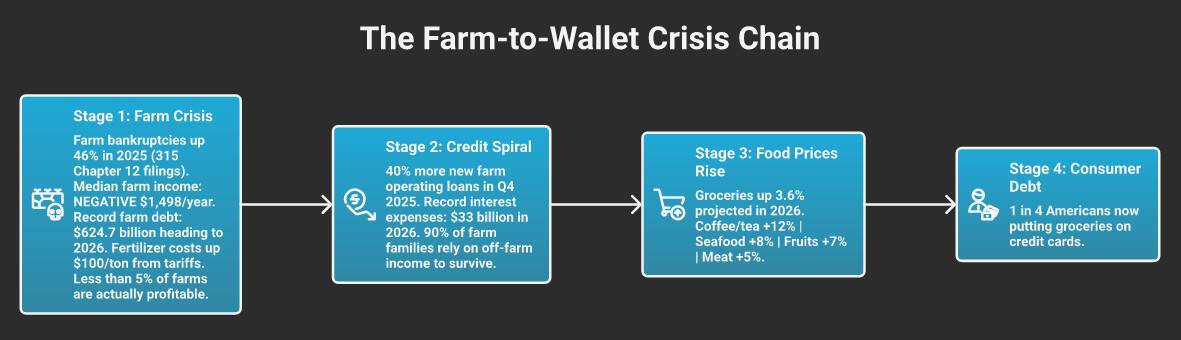
- Record debt loads. Total farm sector debt is projected at $624.7 billion in 2026, with interest expenses hitting a record $33 billion. Farmers are taking out 40% more operating loans than last year — and those loans are 30% larger with longer repayment terms.
- Tariffs raised input costs. Fertilizer costs jumped $100 per ton. Steel parts for tractors and combines got more expensive. The tools you need to farm cost more — and the markets you used to sell to closed.
- Labor disappeared. Two-thirds of U.S. agricultural workers are noncitizen immigrants. Immigration restrictions created staffing gaps that mean produce rots in the field because there’s nobody to pick it.
- USDA programs got cut. The very safety net designed to help farmers through downturns has been reduced at exactly the moment it’s needed most.
Sound familiar? Costs go up. Income goes down. Debt fills the gap. That’s the pattern whether you’re a dairy farmer in Wisconsin or a family in Ohio trying to keep up with your mortgage.
Why This Is a Debt Story — Not Just a Farm Story
Here’s the part that connects directly to your life, even if you’ve never set foot on a farm.
When farmers go broke, food gets more expensive. When food gets more expensive, families borrow more. When families borrow more, they spiral into the same debt trap the farmers are already in.
The Grocery Debt Spiral Is Already Here: The USDA projects food prices rising 3.6% in 2026. Some categories are already spiking: coffee and tea up 12%, seafood up 8%, fruits up 7%, meat up 5%. The Urban Institute found that 1 in 4 American adults are already putting groceries on credit cards and carrying that balance forward — at 20-29% interest.
I wrote about this wholesale inflation pipeline earlier this month. Wholesale prices surged 6% in April — the biggest spike since 2022 — and that hasn’t fully hit your grocery cart yet. It will in July and August.
So the chain goes: farmer can’t afford fertilizer → crop costs more to produce → grocery prices rise → family puts groceries on a credit card → credit card balance grows at 24% APR → family falls behind → shame keeps them from getting help.
The farmer and the family at the grocery store are caught in the same debt machine. The only difference is scale.
The Part Nobody Wants to Talk About
Farmers die by suicide at 3.5 times the rate of the general population. The male suicide rate among farmers and ranchers is 52.1 per 100,000 — compared to 32.0 for working-age men overall.
The contributing factors read like a debt counselor’s intake form: falling income, rising costs, mounting debt, and the suffocating feeling that you’re the one who failed.
I know that feeling. I hear it in every call, every chat, every email. The farmer who says “I’m going to be the one who couldn’t make it” is saying the exact same thing as the reader who tells me “I’m too ashamed to tell my spouse how much we owe.”
The Truth: Debt is math, not morality. Whether it’s $624 billion in farm debt or $15,000 on your credit card, the math broke — not the person. The farmer didn’t fail because they’re irresponsible. The family putting groceries on plastic didn’t fail because they’re lazy. The system squeezed both ends, and debt is what’s left over when the math is broken.
And here’s what breaks my heart: Michigan just cut funding for its farmer suicide prevention program. Farmers now pay $150 an hour out of pocket for counseling sessions — while losing money farming. The people who need help most can’t afford to ask for it.
What This Means for You
If you’re reading this and thinking “what can I even do about a farm crisis?” — here’s what I want you to take away.
- Budget for higher food costs now. The wholesale price surge from April hasn’t fully hit retail yet. By August, your grocery bill will be noticeably higher. If you can adjust now — before the sticker shock — you’ll avoid panic borrowing later.
- Stop shaming yourself for grocery debt. If you’re carrying a credit card balance partly because food costs exploded, that’s not a personal failure. It’s a systemic failure that started on the farm and ended on your statement. Treat it like the math problem it is.
- Recognize the pattern. Rising costs + stagnant income + debt filling the gap = the exact cycle I’ve helped people escape for 30 years. If you see yourself here, the worst thing you can do is wait. The debt doesn’t get smaller while you hope things get better.
- If you’re a farmer reading this — you are not alone. The 988 Suicide & Crisis Lifeline has trained counselors available 24/7 (call or text 988). The Farm Aid hotline at 1-800-FARM-AID connects farmers to financial and legal resources in every state.
Follow the Money: If farmers are going broke, who is getting rich? I traced the money through USDA data, GAO audits, FTC lawsuits, and SEC filings. The answer involves seven distinct groups — from institutional land investors earning 10% annually to seed monopolies facing antitrust suits. Read the full investigation: Who Profits When American Farmers Go Broke?
Key Takeaway
The American farm crisis isn’t happening in a vacuum — it’s a debt crisis that’s flowing straight to your kitchen table through rising food prices. Farm bankruptcies are up 46%. Farm debt is at a record $624.7 billion. The median farm loses money. And the people who grow your food are dying by suicide at 3.5 times the national rate. Meanwhile, 1 in 4 Americans are financing their groceries on credit cards. The farmer and the family at the checkout are caught in the same broken math. Neither one failed. The system did.
My advice is input, not a final answer — only you know your full situation. But I do know this: whether you’re a farmer watching four generations of work slip away or a parent watching your grocery total climb past what you can afford, the shame is the same — and it’s a lie. Debt is math, not morality. And the sooner you treat it that way, the sooner you can actually deal with it.
If you found this helpful, send it to someone who needs to hear it. Maybe it’s a farmer. Maybe it’s a friend who’s embarrassed about their grocery bill. Either way, they shouldn’t have to carry that alone.
Dealing With Debt? Understanding your options is the first step. See how all your debt relief options compare — including ones most sites won’t tell you about. The Find Your Path quiz gives a recommendation based on your actual numbers, and the Scam-O-Meter checks any company’s complaint history before you sign. Federal Reserve research shows bankruptcy filers recover faster than those who don’t file.



