

Written by Steve Rhode, consumer debt expert since 1994 • Last updated May 29, 2026
Quick Answer: A payday loan is a short-term, high-cost loan — usually $500 or less at around 400% APR — and if you can’t pay it back in full on payday, you’ve fallen into the trap it was designed to create. The single most urgent move is to stop the lender from draining your bank account: you have the federal right to revoke their access and place a stop-payment order with your bank, even if you signed an ACH authorization. Do that first, then deal with the balance. Don’t take out a new loan to pay the old one — that’s how a $300 loan becomes $3,000.
What Just Happened to Your Paycheck
You borrowed a few hundred dollars to cover an emergency, and you agreed to pay it back — plus a fee of $10 to $30 for every $100 — out of your next paycheck. When payday came, the full amount was due in one lump sum. But after the lender took it, you didn’t have enough left to make it to the next payday, so you borrowed again. That’s not bad luck. That’s the business model.
The numbers tell the story. The CFPB found that more than four out of five payday loans are reborrowed within a month, and nearly one in four get reborrowed nine or more times. The fee that looked small — $45 on a $300 loan — becomes $45 every two weeks, indefinitely, while the $300 you actually owe never goes down. Most people in the trap have paid far more in fees than they ever borrowed.
The Mistake You’re About to Make: Taking out a second payday loan — or a “consolidation” loan from another payday lender — to pay off the first. This feels like buying time. It is the exact mechanism that turns one loan into a cycle you can’t escape. Every new loan resets the fee clock and adds another lender with access to your bank account. Stop borrowing. Read your real options below first.
Your Options Right Now
What to Do in the Next 48 Hours
- Revoke the lender’s access to your bank account. Tell the lender in writing that you are revoking their ACH authorization. The CFPB provides a free sample revocation letter. This does not erase the debt — but it stops them from emptying your account on payday.
- Place a stop-payment order with your bank — at least 3 business days before the next scheduled debit. You can do this in person, by phone, or in writing. If your bank asks for it in writing, send it within 14 days of your verbal request. Banks usually charge a fee, but it’s far cheaper than an overdraft cascade.
- Know the federal rule — but lean on your bank, not the rule. Under 12 C.F.R. § 1041.8 (effective March 30, 2025), once a lender’s payment attempt fails twice in a row for insufficient funds, they cannot try again without brand-new authorization from you. Important caveat: in early 2025 the CFPB announced it does not intend to actively enforce this rule. The rule is still law, but federal penalties aren’t currently being imposed — so treat revoking authorization through your own bank (steps 1 and 2) as your real protection, not this rule.
- Check whether the loan is even legal where you live — two ways. First, confirm your lender is licensed in your state: call your state attorney general or financial regulator. In many states, a loan from an unlicensed lender is void and uncollectible — you may owe nothing. Second, check your state’s rate cap: about 20 states and DC cap payday loans at roughly 36% APR, so a 300%+ loan there may be unenforceable. Online and tribal-status lenders fail both tests most often. A licensed lender isn’t automatically in the clear either — Enova International’s own SEC filing confirms it forgave $87 million after Virginia accused its NetCredit brand of charging up to 155% interest.
- If payday loans are part of a larger debt problem, bankruptcy can erase them entirely. Payday loans are unsecured debt — they are fully dischargeable in Chapter 7. The automatic stay takes effect the moment you file, which legally forces every lender to stop collecting and stop debiting your account. One timing caution: cash advances over $1,250 from a single lender taken within 70 days before filing are presumed fraudulent under 11 U.S.C. § 523 and can be challenged — so if you just took a large loan, talk to an attorney about timing first. Find one through NACBA, or check the Find Your Path quiz to see if it fits your numbers.
- Talk it through with someone who has no financial stake in your decision. Talk to Damon Day for free — he’ll tell you the truth about your options, not sell you a product. Damon Day, an independent debt coach and my co-host on the Get Out of Debt Guy podcast, whom you can reach at DamonDay.com — I receive no payment for this referral.
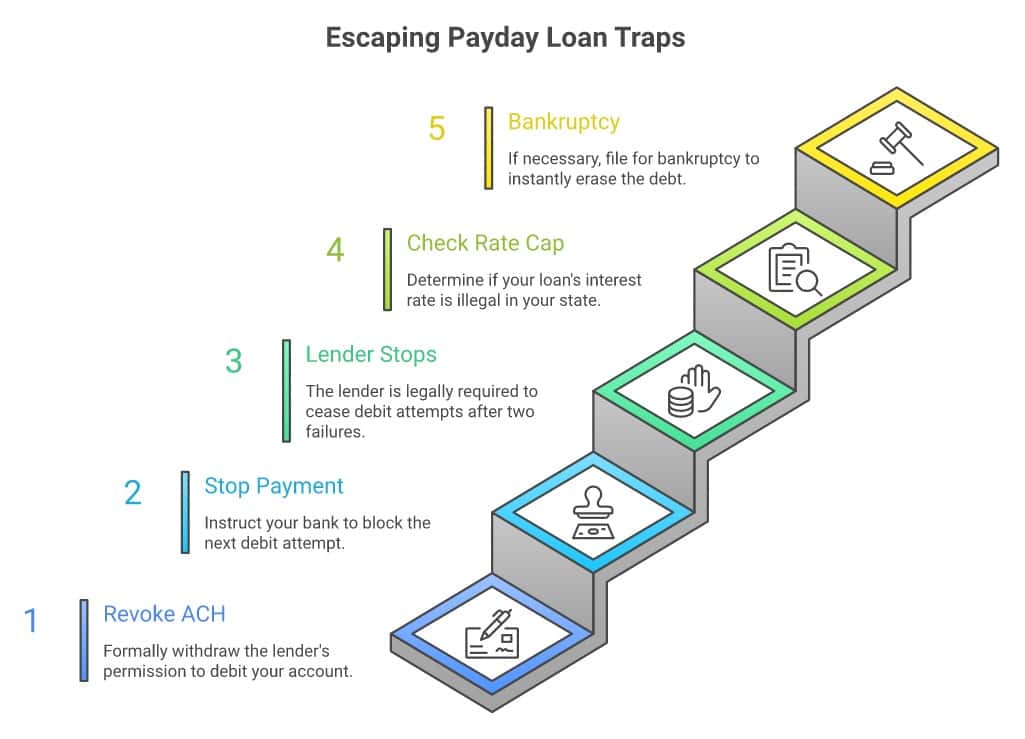
How to Actually Stop It — Your 4 Paths
- Bankruptcy (fastest, most complete). Payday loans are unsecured and wiped out in Chapter 7. The automatic stay stops all debits and collection the instant you file — not weeks later. Federal Reserve research shows bankruptcy filers recover faster than those who keep struggling. This is the right path when payday loans are one symptom of a bigger debt problem.
- Challenge the loan’s legality. If you’re in a 36%-cap state and were charged triple-digit APR, the loan may be unenforceable — you may owe only the principal, or nothing. Get it reviewed by a consumer attorney before you pay another cent.
- Negotiate an extended payment plan — and get it in writing. Many states require lenders to offer a no-cost or low-cost extended payment plan (EPP) if you ask before you default. Request it in writing and keep the lender’s written confirmation. Never accept a verbal promise.
- What WON’T work: another loan. Payday “consolidation” from another high-cost lender, a second payday loan, or a car-title loan to cover the first one all deepen the trap. So does ignoring it — the fees compound and some lenders will sue. There is no version of “borrow your way out” that ends well.
What You Need to Know About Your Rights
Two federal protections matter most when you’re trapped. First, the CFPB’s payment rule under 12 C.F.R. § 1041.8 bars a lender from debiting your account again after two straight failed attempts without new authorization. Second, the Electronic Fund Transfer Act gives you the right to revoke ACH authorization and dispute unauthorized withdrawals. Beyond that, your protection depends almost entirely on your state.
| Where you live | Payday loan rule | What it means for you |
|---|---|---|
| Federal baseline | No APR cap; payment-attempt rule (§ 1041.8) applies | Federal law limits debits, not interest. State law sets the price. |
| Cap states (CO, NM, IL, MN, NE, others — ~20 + DC) | ~36% APR all-in cap | A 300%+ loan here may be void or unenforceable. Get it reviewed. |
| No-cap states (TX, ID, SD, WI, UT) | No meaningful rate limit | APRs of 300%–662% are legal. The trap is deepest here. |
| Storefront ban states (NY, NJ, CT, MA, AZ, others) | Payday lending effectively prohibited | If you got a loan online, it may be from an illegal/tribal lender — likely unenforceable. |
If you live in a 36%-cap or storefront-ban state and a lender charged you triple-digit interest, your loan may not be legally collectible at all. A consumer attorney can tell you in one phone call.
Is Your Lender Even Licensed in Your State? (Check This First)
This is one of the most overlooked escape hatches, and it can be bigger than the interest rate. Many online payday lenders are not licensed to lend in the state where the borrower lives — and in a lot of states, a loan from an unlicensed lender is void and uncollectible, period. Not “you owe the principal but not the interest” — in states like Washington, a small loan made by an unlicensed lender to someone in the state is, in the regulator’s own words, “uncollectible and unenforceable.” The lender can’t sue you on it and can’t legally make you repay it.
The CFPB confirms that if a payday loan is made by a business that isn’t licensed in your state, the loan may be void — meaning the lender “may not have the right to collect or require the consumer to repay” it. Online and tribal-model lenders are the most common offenders, because skipping state licensing is exactly how they operate.
How to check in the next ten minutes: Call or search your state attorney general or your state’s financial-regulator/banking department and ask whether your lender is licensed to make consumer loans in your state. If the answer is no, stop paying, document everything, and take it to a consumer attorney — you may owe nothing at all.
If You’re Active-Duty Military, You Have a Stronger Shield
The Military Lending Act caps the all-in rate (MAPR) at 36% for active-duty servicemembers and covered dependents — and unlike the CFPB payment rule, this cap applies federally, in every state, even to online lenders. If you’re a servicemember being charged more than 36%, the loan likely violates federal law. Document it and bring it to a consumer attorney or your installation’s legal assistance office.
I explain who counts as a covered borrower, and why there is no general federal 36% cap for everyone else, in my breakdown of the federal 36% loan cap.
What If My Lender Claims Tribal Status?
Many online payday lenders claim affiliation with a Native American tribe and argue that “sovereign immunity” puts them beyond your state’s rate cap. Courts have repeatedly narrowed that argument for loans made to consumers off-reservation, and several state attorneys general have won actions against tribal-model lenders charging illegal rates. You can still revoke ACH authorization and place a stop-payment order with your bank exactly as described above — your bank doesn’t care what the lender claims. If a tribal lender is the issue, getting a consumer attorney involved early matters even more, because the legal questions are more complex. See the dedicated crisis guide for tribal payday lenders — including how to stop their bank debits and whether bankruptcy can discharge their debts.
What Happens If I Just Stop Paying?
Stopping the debit protects your bank account, but it doesn’t end the debt — so know what’s next. The lender (or a collector who buys the debt) can sue you, and a court judgment can lead to wage garnishment in most states. A handful of states (like Texas, Pennsylvania, North Carolina, and South Carolina) bar wage garnishment for ordinary consumer debt. Every state also has a statute of limitations — usually three to six years — after which the debt can’t be sued on, though it can still be reported and collectors may still call. The takeaway: don’t just ghost it. Pick a real exit — a payment plan, a settlement, a legality challenge, or bankruptcy — so a surprise lawsuit doesn’t pick one for you.
If a lender keeps debiting your account after you revoked authorization, threatens you, or is charging illegal interest for your state, file a complaint with the CFPB and your state attorney general. If you need legal help but can’t afford an attorney, find free legal aid through LSC.gov.
Steve’s Take
I filed bankruptcy in 1990, so I know exactly what it feels like to owe money you can’t pay and have someone reaching into your account anyway. Here’s what I need you to hear: you did not get here because you’re bad with money. You got here because someone sold you a product engineered to be impossible to repay on the first try. The shame you feel is the product working as designed. In 30 years I’ve watched thousands of people in this exact spot — the ones who did better weren’t smarter or luckier. They just stopped borrowing, protected their bank account first, and looked at the real math instead of panicking. You can do that today.
Free Tool — Wage Garnishment Calculator: Worried about your paycheck being seized? The free Wage Garnishment Calculator shows exactly how much creditors can legally take in your state — and some states prohibit garnishment entirely. Calculate My Risk →
Frequently Asked Questions
Free Tool — Statute of Limitations Checker: Dealing with old debt? The free Statute of Limitations Checker tells you if the collection clock has expired in your state — including the zombie debt and clock-restarting traps collectors use. Check My Status →
I’m trapped in a payday loan cycle — can I actually stop it?
Yes. The first and most urgent step is cutting off the lender’s access to your bank account: revoke their ACH authorization in writing and place a stop-payment order with your bank at least three business days before the next debit. That stops the bleeding. Then you deal with the balance through a payment plan, a legality challenge, or bankruptcy — depending on your situation.
Can I stop a payday lender from taking money out of my bank account?
Yes, even if you signed an ACH authorization. You have the right to revoke that authorization, and separately, you can order your bank to stop the payment — that bank-level action is your most reliable protection. There’s also a federal rule (12 C.F.R. § 1041.8) that bars a lender from trying again after two consecutive failed withdrawals without new permission, but the CFPB has said it won’t actively enforce that rule as of 2025 — so don’t rely on it alone. Important: stopping the debit does not erase the debt — you still owe the balance, but you owe it on your terms, not theirs.
If I file bankruptcy, how fast does it stop the payday lender?
Immediately. The automatic stay under 11 U.S.C. § 362 takes effect the moment your case is filed — not in weeks. It legally forces the lender to stop debiting your account, stop calling, and stop any lawsuit. Payday loans are unsecured debt, so they’re fully erased in a Chapter 7 discharge.
My state caps payday loans at 36% but I’m being charged 400% — is my loan even legal?
Possibly not. In the roughly 20 states and DC with a 36% APR cap, a loan charging triple-digit interest may be void or unenforceable. This is common with online lenders claiming tribal or offshore status to dodge state law. Have a consumer attorney review it before you pay anything — you may owe only the principal, or nothing.
The lender isn’t licensed in my state — do I still have to pay?
Maybe not at all. Many online payday lenders aren’t licensed to lend in the borrower’s state, and in many states that makes the loan void and uncollectible — not just the interest, the whole thing. Washington’s regulator, for example, states plainly that a small loan from an unlicensed lender is “uncollectible and unenforceable.” The CFPB agrees that a loan from an unlicensed business may be void. Verify your lender’s license with your state attorney general or financial regulator first; if they’re unlicensed, stop paying and see a consumer attorney — you may owe nothing.
Should I take out another loan to pay off my payday loan?
No. This is the single most common — and most damaging — mistake. A second payday loan, a “payday consolidation” loan from another high-cost lender, or a car-title loan all reset the fee cycle and add another creditor to your bank account. The CFPB found four out of five payday loans get reborrowed within a month precisely because of this pattern. Stop borrowing and use one of the real exits above.
The lender is threatening to have me arrested — can that happen?
No. You cannot be jailed for owing a payday loan; debtors’ prison doesn’t exist in the U.S. Threatening arrest over a consumer debt is an illegal collection practice. If a lender says this, document it and file a complaint with the CFPB and your state attorney general.
Will my bank charge me for a stop-payment order, and is it worth it?
Most banks charge a fee for a stop-payment order, often around $30. It’s almost always worth it — one prevented debit can save you a $35 overdraft fee, and a failed payday debit can trigger a cascade of overdraft fees far larger than the stop-payment cost. Ask your bank to stop the payment at least three business days before the scheduled withdrawal.
One more thing — everything I share here is based on 30 years of helping people through exactly this. But my advice is input for your decision, not the decision itself. Only you know your full situation. Talk to an attorney, look at your numbers, and make the choice that serves your future.
Important: This guide is for informational purposes only and is not legal advice. Laws vary by state, and your situation may have details that change what options are available to you. For legal advice specific to your case, consult an attorney licensed in your state. NACBA can help you find a bankruptcy attorney, NACA can connect you with a consumer attorney, or talk to Damon Day for free about your situation. Damon is my podcast co-host, and I receive no payment for this referral.
Key Takeaway: The payday loan trap is built to feel inescapable, but it isn’t. Protect your bank account first, stop borrowing, and check whether your loan is even legal in your state. Use the Find Your Path quiz to see your real options. The longer you keep paying fees, the more you hand over for a debt that never shrinks.
The Bottom Line
You’re not bad with money — you were sold a product designed to be impossible to repay on the first try, and four out of five people end up exactly where you are. The system has protections built in: you can cut off the lender’s access to your account today, and in most states the loan itself may be on shaky legal ground. The people who got out didn’t have more money — they acted fast and stopped feeding the cycle. If someone you know is drowning in payday loans, send them this page — it could be the thing that stops their next $45 fee from becoming $450. Start with the Crisis Guides or the Find Your Path quiz.
Dealing With Debt? Understanding your options is the first step. See how all your debt relief options compare — including ones most sites won’t tell you about. The Find Your Path quiz gives a recommendation based on your actual numbers, and the Scam-O-Meter checks any company’s complaint history before you sign. Federal Reserve research shows bankruptcy filers recover faster than those who don’t file.
And if a cash-advance app is part of how you got here, read why earned-wage-access apps are payday loans in a costume — the same cycle, with a friendlier icon.
Right now you are dealing with the thing in front of you, and that is exactly where your attention belongs. When it is handled — and it will be — there is a next stage, and it is the one I most enjoy writing about.
In the latest issue (Nov 6): Owed money on an Amazon return? Check by Dec. 1
Each weekday I send one short email: one story that caught my attention, why it might matter to you, and one manageable thing you can do with it. It is free, I sell nothing, and I take no money from any company I write about.



