

Quick Answer: Mark Csantaveri, the owner of several “MCA debt settlement” companies, pleaded guilty on May 4, 2026 to conspiracy to commit wire fraud in federal court in Camden, New Jersey. According to the Department of Justice, he told struggling small-business owners he would hold their payments in order to negotiate settlements with their merchant cash advance creditors — then he and his co-conspirators kept the money, including more than $1 million spent on gambling. He faces up to 20 years in prison at sentencing on September 29, 2026. If a debt-relief company ever asks you to send your payments to them instead of your creditor, that’s the warning sign at the center of this case.
Expert Context: I ran a credit counseling organization with staff counselors for over a decade, and I’ve spent 30 years documenting how debt-relief fraud works from the inside. The scheme the government described here isn’t new or clever — it’s the oldest move in the predatory-debt playbook, just pointed at a newer victim: small-business owners drowning in merchant cash advances. I’ve watched this exact pitch destroy people, and the tell is always the same.
A New Jersey man who marketed himself as a savior for small businesses buried in merchant cash advance debt has admitted he was running a fraud — and the way he did it is a lesson every business owner and every consumer should learn before they ever hand money to a “debt settlement” company.
What the Government Says Happened
According to the U.S. Attorney’s Office for the District of New Jersey, Mark Csantaveri, 53, of Morristown, pleaded guilty before U.S. District Judge Karen M. Williams to a single-count information charging conspiracy to commit wire fraud. The case is on the federal docket as United States v. Csantaveri, No. 1:25-cr-00793 (D.N.J.). The FBI investigated; he was first charged back in March 2024.
Each weekday I send one short email: one story that caught my attention, why it might matter to you, and one manageable thing you can do with it. A couple of minutes, and a dad joke.
In the latest issue (Nov 9): Check your power bank and your French press
Free. I sell nothing. Unsubscribe any time.
Here is how the Justice Department described the scheme. From around March 2018 through December 2023, Csantaveri and his co-conspirators ran businesses — MCA Cure LLC and LDMS Group LLC in Parsippany, and Evergreen Settlement Group LLC in Rockaway — that claimed to provide debt-relief services to small companies. According to the criminal information he pleaded to, the MCA Cure and LDMS websites falsely claimed the businesses had “helped thousands of companies lower their loan payments up to 80%.” The contracts required victims to make their payments to Csantaveri’s companies in lieu of paying their own creditors.
Instead of negotiating, prosecutors say, Csantaveri and his co-conspirators transferred most of the money to their own personal accounts — and “in many cases” failed to even attempt to contact the victims’ creditors at all. A significant portion went to personal expenses, including gambling at Atlantic City casinos. Over the life of the conspiracy, the DOJ says, the businesses took in roughly $3.7 million from small businesses and moved about $3 million of it into the conspirators’ own accounts, with more than $1 million spent on gambling. The victims included a restaurant in Maryland, a manufacturer in Ohio, and a therapy provider in California and Texas — real businesses, in different industries, all making the same desperate bet.
The victims weren’t careless. Many were cash-strapped owners trying to keep their doors open during the COVID pandemic, according to the FBI. “The cash-strapped victims in this investigation sought Csantaveri’s help, hoping to keep their doors open during the COVID pandemic. Instead, he and his co-conspirators stole millions from unsuspecting owners,” said FBI Special Agent in Charge Stefanie Roddy. U.S. Attorney Robert Frazer said the defendant “turned trust into a weapon and hardship into profit.”
Why This One Matters Beyond One Bad Actor
I want to be careful here. One person admitting fraud doesn’t mean every company offering to help with merchant cash advance debt is a criminal — there are legitimate attorneys and advisors who do real, valuable work for businesses crushed by these advances. But this case is a near-perfect anatomy of how the fraudulent version operates, and the structure is identical whether the target is a small business or a household.
Merchant cash advances are a brutal product to begin with. They aren’t technically loans, so they dodge a lot of lending law; they take a fixed cut of your daily revenue; and the effective interest rates can be staggering. A business owner watching an MCA drain their account every single day is exactly the kind of desperate, time-pressured person a fraudster looks for. That desperation is the raw material. I’ve written before about what actually happens when you default on a merchant cash advance and the confession-of-judgment clause that lets MCA lenders skip the courtroom — the fear those create is precisely what a scheme like this feeds on.
The Pitch: “Stop paying your MCA lender and send your payments to us instead. We’ll hold the money in escrow and negotiate a settlement that cuts what you owe.”
The Reality: The moment your money goes to the middleman instead of your creditor, you’ve lost control of it — and you’re still on the hook for the original debt. In the government’s account of this case, the “escrow” was the trap: it’s where the money sat before it was allegedly diverted to personal accounts and gambling. A legitimate negotiator does not need to take custody of your funds to talk to your creditor.
The Red Flags I’d Watch For
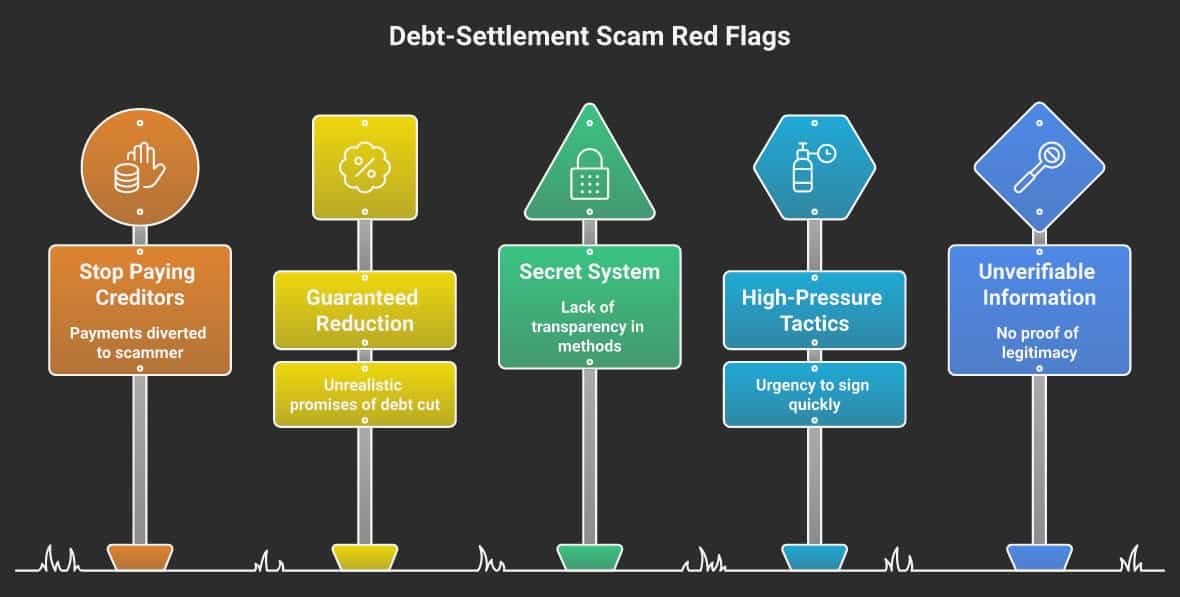
Whether you’re a business owner facing an MCA or a household dealing with consumer debt, the warning signs of a debt-settlement scam are the same. Here’s what I’d treat as a stop sign:
- They want you to stop paying your creditor and pay them instead. This is the single biggest red flag. Your money should go to your creditor or to a genuinely independent, regulated account you control — not into a company’s general bank account.
- They guarantee a specific percentage reduction — “we’ll cut your debt by 80%.” Nobody can promise that up front. Settlement outcomes depend on the creditor, and any guarantee is a sales tactic, not a fact.
- A “proprietary system” they won’t explain. Vague, secret-sauce language is cover for the fact that there’s often no real negotiation happening at all.
- Pressure to sign fast. Fraud needs urgency, because urgency stops you from checking them out.
- You can’t verify them. If you can’t find a real license, a real address, and a clean complaint history, walk away.
Before you sign anything: Run the document through the free Contract Decoder to see what the fine print actually says, and check any company’s complaint history with the Scam-O-Meter before you hand over a dollar. Five minutes of checking is cheaper than $3.4 million in lessons.
What to Do If You’re Drowning in MCA Debt
The honest truth is that the businesses in this case were vulnerable because their underlying debt was genuinely crushing — and the answer to crushing debt is never to hand your money to a stranger who promises magic. If a merchant cash advance is bleeding your business dry, talk to a real bankruptcy or business-debt attorney about your actual options, including whether the debt is even enforceable. I’ve laid out the broader picture in my deeper look at how factor rates, brokers, and the MCA fine print really work, and the research the industry doesn’t advertise. For a sense of how these schemes scale when they’re aimed at investors instead of borrowers, the Par Funding fraud is the cautionary tale.
Key Takeaways
- Mark Csantaveri pleaded guilty May 4, 2026 to conspiracy to commit wire fraud over a fake MCA debt-settlement operation; sentencing is September 29, 2026.
- The DOJ says his companies took in ~$3.7M from 50+ small businesses by promising to negotiate settlements, then diverted the money — including $1M+ on gambling.
- The defining red flag: a debt-relief company that wants you to send payments to them instead of your creditor.
- Never trust a guaranteed percentage reduction, a secret “proprietary system,” or pressure to sign fast.
The Bottom Line
If you’re a business owner staring at a merchant cash advance that’s eating your revenue alive, I understand why a confident voice promising to cut your debt by 80% sounds like a lifeline. But that hope is exactly what a fraudster sells. You are not foolish for being tempted by it — the people in this case were hard-working owners trying to survive a pandemic, and they got robbed by someone who weaponized their trust. The real way out is slower and less glamorous: get your numbers in front of a genuine attorney, keep control of your own money, and never let a middleman stand between you and your creditor. If you know a business owner getting these calls, send them this page — it might be the warning that saves their company.
Frequently Asked Questions
What is a merchant cash advance (MCA) and why is the debt so hard to escape?
A merchant cash advance is a lump sum a business receives in exchange for a fixed slice of its future daily revenue. Because it’s structured as a sale of receivables rather than a loan, it sidesteps much of the lending law that caps interest, and the effective cost can be extremely high. The daily withdrawals are what make it so suffocating — and what makes business owners desperate enough to fall for fraudulent “rescue” offers like the one in this case.
What does it mean that Mark Csantaveri pleaded guilty to conspiracy to commit wire fraud?
Pleading guilty means he admitted in federal court to the charge — this is a matter of public record, not an allegation. Conspiracy to commit wire fraud means he agreed with at least one other person to use interstate electronic communications (emails, wire transfers, websites) to carry out a scheme to defraud. Per the Justice Department, it carries a maximum of 20 years in prison.
How can I tell a legitimate debt-settlement service from a scam?
The biggest tell is who holds your money. A legitimate negotiator does not require you to route your payments through their own bank account, and never guarantees a specific percentage reduction before doing any work. Be wary of secret “proprietary systems,” high-pressure timelines, and any company you can’t independently verify. Check complaint history with a tool like the Scam-O-Meter before signing.
I sent money to a debt-settlement company and now I think it was a scam. What should I do?
Document everything — contracts, emails, payment records — and report it. The FBI took complaints in this case at 800-CALL-FBI, and you can also file with the FTC and your state attorney general. Then talk to a consumer or business-debt attorney about recovering funds and dealing with the original debt that’s still outstanding.
Are merchant cash advance debt-relief companies all scams?
No. There are legitimate attorneys and advisors who genuinely help businesses restructure or challenge MCA debt. The problem is that the space attracts predators because the victims are desperate. Judge any company by the red flags above — especially whether they want custody of your money — not by how confident their marketing sounds.
This is what I’ve learned in 30 years of watching debt-relief fraud, and it’s how I’d warn my own family. Take it as one informed perspective, not a directive — only you know your full situation. Use it as input for your own decision. Nobody gets to tell you what to do with your money. Not a salesman, not me, not anyone.
Dealing With Debt? Before you pay a collector, understand all your debt relief options — including ones the collector won’t tell you about. If the debt feels unmanageable, take the 2-minute bankruptcy quiz to see if the math favors a fresh start. Federal Reserve research shows filers recover faster than those who don’t file.



