

“Debt is math wrapped in emotion. Right now, the math is breaking for a specific group of Americans — and the headlines are burying the lead.”
Last month the Federal Reserve Bank of New York released its quarterly Household Debt and Credit Report. Most headlines led with the topline: Americans owe $1.25 trillion in credit card debt. Some noted it dipped slightly from last quarter’s record of $1.277 trillion and called it progress.
They’re looking at the wrong number.
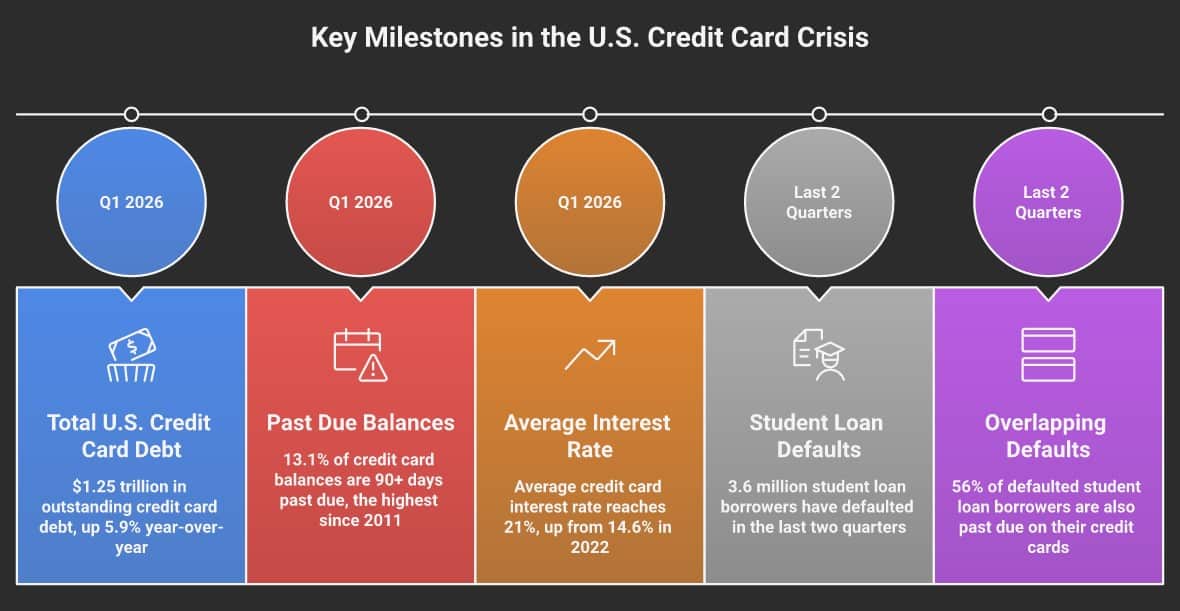
The number that matters — the one buried in the same report — is this: 13.1% of credit card balances are now 90 or more days past due. That’s the highest reading since 2011. Fifteen years. We were still digging out from the 2008 financial crisis the last time we saw stress at this level.
Each weekday I send one short email: one money story that caught my attention, why it might matter to you, and one manageable thing you can do with it. A couple of minutes, and a dad joke.
In the latest issue (Oct 9): Does Financial Literacy Make Financial Sense?
Free. I sell nothing. Unsubscribe any time.
I’ve been helping people with debt for over 30 years. Here’s what I know that the headline doesn’t tell you.
The Daily Money Brief — Free, at 10 AM
Money you may be owed, scams to dodge, and the fine print decoded — the consumer money news that affects your wallet, every weekday.
What You Need to Know
The NY Fed’s Q1 2026 Household Debt and Credit Report shows total household debt hit $18.8 trillion — an all-time record. Credit card balances specifically came in at $1.25 trillion, down from $1.277 trillion in Q4 2025 (which was itself the highest since tracking began in 1999). That seasonal dip is normal; every Q1 sees paydown after holiday spending.
But look at who is paying — and who isn’t.
The NY Fed and TransUnion research both describe what’s happening as a “K-shaped” credit market. The top of the K — people with prime and super-prime credit scores — are largely fine. Their delinquency rates have barely moved. The bottom of the K — subprime and near-prime borrowers — is in genuine distress. Delinquency rates are rising. Balances are growing faster than incomes. And the debt-to-income ratio for near-prime borrowers has jumped 176 basis points since 2019.
One America is servicing its debt just fine. The other is quietly drowning.
The K-Shape Explained: Super-prime borrowers (top 40% by credit score) have seen their financial position improve since 2019. Near-prime and subprime borrowers — roughly the bottom 30% — face rising expenses, higher balances, and a debt-to-income squeeze that’s made every payment harder. When economists say “the consumer is resilient,” they mean half of consumers. The other half doesn’t show up in those averages.
Why You Need to Know It
The interest rate story alone is devastating if you’re carrying a balance. The average credit card rate was 14.6% in February 2022. Today it’s 21%. That’s not a rounding error — that’s the difference between manageable and a trap.
Here’s the math. If you’re carrying $6,500 — the average balance — at 21% and making minimum payments:
- You’ll pay roughly $1,365 in interest in the first year alone
- More than half your minimum payment goes to interest, not principal
- At minimum payment pace, you’ll need over a decade to pay off that balance
Meanwhile, the personal savings rate dropped to 2.6% in April — the lowest since June 2022. Households aren’t building a cushion. They’re spending it to stay even.
Urban Institute economist Breno Braga put it plainly: “When food, housing and healthcare is all more expensive, there is less money to pay off your credit card.” The National Foundation for Credit Counseling is calling this pattern “survival debt” — not discretionary spending debt, not vacation debt, but charging groceries, utilities, and prescriptions because the paycheck doesn’t reach. Credit counseling demand is up 24% year-over-year. Monthly volume is now 60% above the 2018 baseline.
People aren’t struggling because they bought too many lattes. The math is just broken.
The Hidden Accelerant: 3.6 Million Student Loan Borrowers
There’s a second story in this same NY Fed data release that almost nobody is connecting to the credit card numbers.
Roughly 3.6 million federal student loan borrowers entered default in the last two quarters alone — approximately 1 million in Q4 2025 and 2.6 million more in Q1 2026. These aren’t deadbeats. The average defaulter is nearly 40 years old, was current on their loans before the pandemic, and is more likely to live in the South. Over 75% had been current or had no payment due at all as recently as 2019.
What happened to their credit scores? They fell an average of 91 points — from 567 to 476. And when the NY Fed looked at what else these borrowers were doing with their credit, the picture got darker:
- 56% of defaulted student loan borrowers with credit cards are now past due on those cards too
- 40% of those with auto loans are past due on those as well
- 20% of those with mortgages are behind
Student loan default isn’t a contained problem. For the people it hits, it’s a cascading failure across every debt they carry.
Collection Hasn’t Even Restarted Yet: The NY Fed specifically noted that collection efforts for defaulted federal student loan borrowers are currently suspended with no clear timeline for resumption. When collections restart — and they will — the pressure on this group will intensify further. The 13.1% delinquency rate we’re seeing now could worsen before it improves.
Things to Consider
If you’re reading this and nodding along because it sounds like your situation, here’s my honest assessment of where you are and what the math says.
If you’re current but barely: The fact that you’re making payments doesn’t mean the plan is working. If your minimum payments are growing, your balance isn’t shrinking meaningfully, and you’ve cut spending as much as you can — that’s not discipline, that’s a treadmill. The math may not work at 21% no matter how hard you try.
If you’re already behind: The longer a balance sits in serious delinquency, the narrower your options get. Settlement becomes possible but expensive. Lawsuits become more likely. Time matters here.
If you have student loans in addition to credit card debt: The combination is particularly brutal right now. Don’t let student loan anxiety paralyze you on the credit card front — they require different strategies and different timelines. If you’re dealing with both, I broke down how AI layoffs, student loans, and Social Security interact for people juggling multiple debt types at once.
One thing you should NOT do: Raid your retirement account to pay credit cards. I’ve seen this destroy people’s futures. An IRA or 401(k) withdrawal to pay unsecured debt is almost never the right move — the penalties, taxes, and lost compounding almost always make it worse than the alternatives.
The Myth: “If I just work harder and cut more, I can grind my way out of this.”
The Reality: At 21% interest, grinding rarely wins. The math works against you every month you carry a balance. If your income and expenses don’t leave enough margin to outrun a 21% interest rate, the problem isn’t effort — it’s the interest rate. That requires a structural solution, not a motivation solution. I wrote about what actually works when inflation is eating your debt payoff plan — the math is the same problem, different pressure point.
What to Think About Doing
The right move depends entirely on your specific numbers — income, balances, other debts, assets. But here’s a decision framework based on where most people I talk to find themselves:
- Call your card issuer before you miss a payment. Hardship programs exist. Banks would rather reduce your rate temporarily than write off the balance. This works best if you’re current or only slightly behind — once you’re 90+ days late, this window often closes.
- Understand what bankruptcy actually does to credit cards. Unsecured debt — credit cards — is exactly what bankruptcy is designed to discharge. Federal Reserve research shows that bankruptcy filers recover financially faster than people who don’t file. If you’re at 90+ days past due, the credit damage is already happening. The question is whether you come out the other side with a clean slate or just more interest.
- If student loans are part of the picture, keep them separate in your thinking. Federal student loans have income-driven repayment options, hardship pauses, and forgiveness pathways that credit cards don’t. They need their own strategy.
- Run your actual numbers before deciding anything. Don’t guess. Don’t go by how you feel about it. The calculator below shows what each option actually looks like for your situation.
The Bottom Line: The NY Fed data isn’t a story about American profligacy. It’s a story about math that stopped working — for a specific subset of households squeezed by 21% interest rates, flat wages, and rising costs for the basics. If you’re in that group, the answer isn’t shame. It’s finding the option that gets you out fastest with the least damage. That answer is different for everyone. The only wrong move is paralysis.
After 30 years of helping people through debt, I’ve learned one thing: the people who get out are the ones who get honest about the math and make a decision. Not the ones who feel the worst about it. Take what I’ve said here as one informed perspective — only you know your full situation. Use this as input, not instruction. Nobody gets to tell you what to do with your money. Not me, not anyone.
Already at the breaking point? If you can no longer cover even the minimum payments on your debts, my crisis guide on what to do when you can’t make your minimum payments walks through your options in the 180-day window before a charge-off.
Dealing With Debt? Understanding your options is the first step. See how all your debt relief options compare — including ones most sites won’t tell you about. The Find Your Path quiz gives a recommendation based on your actual numbers, and the Scam-O-Meter checks any company’s complaint history before you sign. Federal Reserve research shows bankruptcy filers recover faster than those who don’t file.

