

If your loans are NOT yet in default, major repayment plan changes take effect July 1, 2026 — see what every borrower must do before the deadline.
Written by Steve Rhode, consumer debt expert since 1994 • Last updated June 1, 2026
Quick Answer: Your federal student loan goes into default after 270 days without a payment. Once in default, the government can garnish up to 15% of your wages, seize your tax refund, and even take part of your Social Security — if that has already started, see what to do right now when a defaulted student loan is garnishing your paycheck — all without going to court (though as of mid-2026 those collections are paused — see below). The good news: default is reversible, and you have real options. The two fastest ways out are loan rehabilitation (9 income-based payments, as low as $5/month, which deletes the default from your credit) and consolidation (out of default in weeks). Don’t ignore this — interest and collection fees only grow.
What Just Happened to Your Loans
A federal student loan becomes delinquent the first day after you miss a payment. It goes into default after 270 days — roughly nine months — of missed payments. At that point the entire unpaid balance becomes due immediately, and your loan is handed to the government’s collection machinery.
Here’s what makes student loan default different from almost any other debt: the federal government doesn’t need to sue you or get a judge’s permission to collect. Through administrative wage garnishment, it can order your employer to withhold up to 15% of your take-home pay. Through the Treasury Offset Program, it can seize your tax refund and other federal payments. For older borrowers, it can even take a slice of Social Security. After the long pandemic pause, the New York Federal Reserve reports roughly 3.6 million borrowers entered default across the last two quarters (about 1 million in late 2025 and 2.6 million in early 2026) — the biggest wave since the pause ended. If you’re one of them, you are very much not alone.
Collections status (as of June 2026): The Department of Education paused involuntary collections — wage garnishment and tax-refund seizures — in January 2026, and most analysts expect them to restart in late summer or fall 2026. No firm date has been set. Don’t let the pause lull you: the smart move is to get out of default before garnishment resumes, not after the first letter arrives.
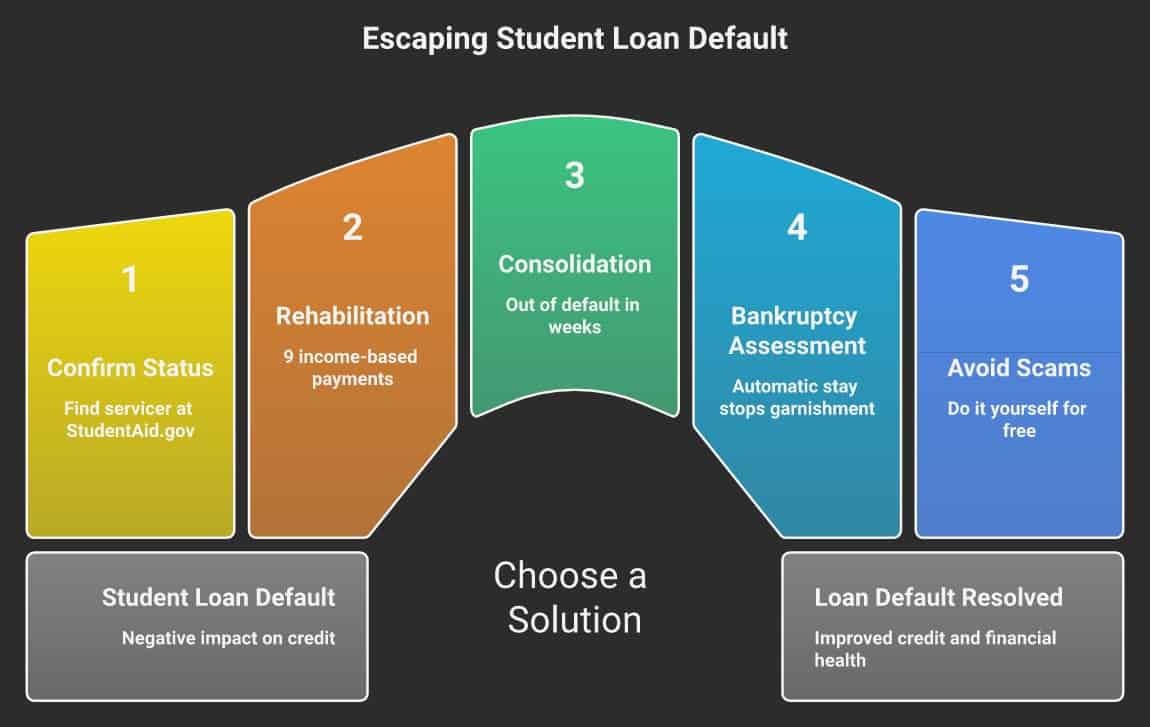
The Mistake You’re About to Make: Paying a company that promises to “fix” your default for a fee. Getting out of default is something you can do yourself for free, directly with your loan servicer or at StudentAid.gov. Debt-relief companies charge hundreds or thousands of dollars for paperwork you can file in an afternoon — and some are outright scams. The other mistake: ignoring it and hoping it goes away. It doesn’t. The balance grows, fees pile on, and the garnishment starts.
Free Tool — Wage Garnishment Calculator: Worried about your paycheck being seized? The free Wage Garnishment Calculator shows exactly how much creditors can legally take in your state — and some states prohibit garnishment entirely. Calculate My Risk →
Your Options Right Now
What to Do in the Next 48 Hours
- Find out who holds your loan and confirm the default. Log in to StudentAid.gov with your FSA ID to see your loan status, balance, and the assigned default servicer or collection agency. To start rehabilitation, you can also call the Department of Education’s Default Resolution Group at 1-800-621-3115.
- Ask about loan rehabilitation. You make 9 monthly payments within 20 days of each due date, calculated from your income and expenses — the minimum can be as low as $5/month. After the 9th payment, the default is removed from your credit report. This is the only path that erases the default itself.
- Or ask about consolidation if you need out faster. A Direct Consolidation Loan can pull you out of active default in weeks, which stops garnishment quickly — but the original default stays on your credit history. (Important: consolidating on or after July 1, 2026 may change which repayment plans you qualify for — ask before you sign.)
- If the debt is truly unmanageable, get a bankruptcy assessment. Student loans can be discharged in bankruptcy more often than people think. Filing triggers an automatic stay the moment your case is filed — not weeks later — which pauses garnishment and collection. NACBA can connect you with a bankruptcy attorney. Take the 2-minute bankruptcy quiz to see if the math favors a fresh start.
- Talk it through with someone who isn’t selling you anything. Talk to Damon Day for free before you pay any company a dime.
Free Tool — Contract Decoder: Have a contract from a debt relief company? The free Contract Decoder analyzes it for red flags, hidden fees, and problematic terms — before you sign anything. Decode My Contract →
How to Actually Get Out of Default — Your Paths
- Loan rehabilitation (the credit-saver). Nine income-based payments, as low as $5/month, and the default is deleted from your credit report. Slower than consolidation, but it’s the only option that removes the black mark. Under current rules you can rehabilitate a loan out of default only once, so make it count. (A 2025 law changes this beginning July 1, 2027 — borrowers will be allowed to rehabilitate a loan twice, though the minimum payment rises from $5 to $10.)
- Consolidation (the fast exit). Replaces your defaulted loans with one new loan in good standing — often within weeks, which stops garnishment quickly. The trade-off: the original default stays in your credit history. Best when garnishment has already started and you need it to stop now.
- Bankruptcy (when the debt is hopeless). The automatic stay halts collection instantly, and discharge of student loans is more achievable than the myths suggest. Here’s how student loan discharge in bankruptcy actually works. Federal Reserve research shows filers recover faster than those who don’t file.
- What WON’T work: Paying a “student loan relief” company. The FTC has shut these down repeatedly. And the temporary Fresh Start program has ended — it’s no longer an option, so ignore anyone who tells you to use it. Note: all of this applies to federal loans. If your loans are private, they default faster (often after 90 days), have no government rehabilitation program, and follow your lender’s rules — contact your lender or a consumer attorney instead.
What You Need to Know About the Collection Powers
Federal student loan collection runs on different rules than private debt. Administrative wage garnishment is authorized without a lawsuit, and the Treasury Offset Program can intercept tax refunds and federal benefits. Here’s how the main exit paths compare:
| Option | Speed out of default | Effect on credit |
|---|---|---|
| Rehabilitation | ~10 months (9 payments) | Default record removed; pre-default late marks remain |
| Consolidation | Weeks | Default stays on credit history |
| Pay in full | Immediate | Default stays unless separately resolved |
| Bankruptcy | Automatic stay is immediate | Bankruptcy reported; collection halts at filing |
One caution on timing: As of early 2026, the Department of Education has cycled through delays and restarts of involuntary collections, with garnishment notices rolling out in batches. The rules can shift — always confirm your current status at StudentAid.gov rather than assuming.
If a collector is breaking the rules — garnishing more than 15%, refusing to offer rehabilitation, or charging you to get out of default — file a complaint with the CFPB and your state attorney general. If you need legal help but can’t afford an attorney, find free legal aid through LSC.gov. For non-bankruptcy consumer legal issues, NACA can connect you with a consumer attorney.
Steve’s Take
I filed bankruptcy in 1990, so I know exactly what that pit-of-the-stomach feeling is when a debt has spun out of your control. Student loan default carries an extra layer of shame because we’re told education debt is “good debt” and falling behind means you failed. That’s nonsense. You took on a loan the system priced badly, and then life happened — a job loss, an illness, a servicer that lost your paperwork. I’ve watched thousands of people climb out of this. The ones who did best didn’t wait for the garnishment letter. They picked up the phone, found out their real options, and acted. The math doesn’t care how you feel about it — but the math is on your side here, because every one of these paths leads out.
Frequently Asked Questions
My student loans are in default — can I really get out?
Yes. The two main paths are rehabilitation (9 income-based payments, which removes the default from your credit) and consolidation (faster, but the default stays on your record). You can also pay in full or, if the debt is unmanageable, explore bankruptcy. Default is not permanent.
Can the government take my paycheck without suing me?
Yes — this is what surprises people most. Through administrative wage garnishment, the Department of Education can order your employer to withhold up to 15% of your disposable pay without a court order. It can also seize your tax refund through the Treasury Offset Program and take up to 15% of your Social Security — though your benefit cannot be reduced below $750/month, and SSI (Supplemental Security Income) is fully protected.
How fast can I stop wage garnishment from student loans?
Consolidation can pull you out of default within weeks, which stops garnishment quickly. If you file bankruptcy, the automatic stay halts collection the moment your case is filed. Rehabilitation works too but takes the full 9 months of payments to complete.
Will rehabilitation actually fix my credit?
Rehabilitation removes the default notation from your credit report after your 9th on-time payment. However, late payments your servicer reported before the loan defaulted (after 90 days past due) will remain. It’s a real improvement, not a complete erase.
Should I pay a company that says it can get me out of default?
No. Getting out of default is free to do yourself at StudentAid.gov or with your servicer. The FTC has repeatedly shut down “student loan relief” companies that charge for free services. If anyone asks for an upfront fee, walk away.
Can student loans be discharged in bankruptcy?
More often than the old myth suggests. The standard is tougher than for credit cards, but discharges happen — and even filing triggers an automatic stay that pauses garnishment. Here’s how it actually works, and NACBA can connect you with an attorney who handles these cases.
Is the Fresh Start program still available to get out of default?
No. The temporary Fresh Start program has ended. Don’t rely on it, and be wary of anyone who tells you to use it — your current options are rehabilitation, consolidation, paying in full, or bankruptcy.
One more thing — everything I share here is based on 30 years of helping people through exactly this. But my advice is input for your decision, not the decision itself. Only you know your full situation. Talk to an attorney, look at your numbers, and make the choice that serves your future.
Important: This guide is for informational purposes only and is not legal advice. Federal student loan rules change frequently, and your situation may have details that change what options are available to you. For advice specific to your case, consult an attorney licensed in your state. NACBA can help you find a bankruptcy attorney, NACA can connect you with a consumer attorney, or talk to Damon Day for free about your situation.
Key Takeaway: Student loan default is serious — the government can garnish your wages and seize your tax refund without a court order — but it is reversible. Rehabilitation (9 payments, as low as $5/month) deletes the default from your credit; consolidation gets you out fastest. Confirm your status at StudentAid.gov and act this week. The longer you wait, the more interest and fees you owe.
The Bottom Line
If your loans are in default, you are not bad with money and you did not fail. You’re one of roughly 3.6 million Americans the system pushed into default in just six months. Congress built the exits — rehabilitation, consolidation, bankruptcy — precisely because default was never meant to be a life sentence. The people who got out fastest are the ones who acted before the garnishment letter arrived. If someone you know is dodging their student loan mail because they’re scared to open it, send them this page — it might be the thing that gets them to act before the wage garnishment starts. Start with the Find Your Path quiz to see which exit fits your numbers.
Dealing With Debt? Understanding your options is the first step. See how all your debt relief options compare — including ones most sites won’t tell you about. The Find Your Path quiz gives a recommendation based on your actual numbers, and the Scam-O-Meter checks any company’s complaint history before you sign. Federal Reserve research shows bankruptcy filers recover faster than those who don’t file.
If your loans were in SAVE rather than default, the trap is different but just as quiet — here’s what “paused” SAVE loans have really been doing to your balance.
Related: If you’re choosing a repayment plan to get out of default, know that the new Repayment Assistance Plan’s lower payment can mean thousands more over 30 years. Compare total cost before you pick a plan.
Right now you are dealing with the thing in front of you, and that is exactly where your attention belongs. When it is handled — and it will be — there is a next stage, and it is the one I most enjoy writing about.
In the latest issue (Oct 16): The check that looks like a scam may be real
Each weekday I send one short email: one money story that caught my attention, why it might matter to you, and one manageable thing you can do with it. It is free, I sell nothing, and I take no money from any company I write about.

