

Here’s a sentence almost no one expects to hear: yes, bankruptcy can erase income tax debt. Not all of it, not in every case, but far more often than the tax-relief industry wants you to believe. I’ve watched people carry IRS debt for years — turning down better jobs to avoid garnishment, losing sleep over a number that only grows — when the taxes sitting on their shoulders were already old enough to be wiped out completely in a bankruptcy filing.
I’m Steve Rhode. I filed bankruptcy myself in 1990 after my business failed, and I went on to run one of the largest nonprofit credit counseling organizations in the country. In 30 years of helping people with debt, the “bankruptcy can’t touch taxes” myth is one of the most expensive pieces of misinformation I’ve seen. Let me walk you through what’s actually true — in plain language, with the real rules.
The Short Answer
Older income taxes can be discharged (legally erased) in bankruptcy if they pass three timing tests. Newer taxes, payroll taxes, and taxes from unfiled or fraudulent returns cannot. So the honest answer is: it depends entirely on how old the tax is and whether you filed your returns. The good news is that the rules are specific and knowable — a bankruptcy attorney can pull your IRS transcripts and tell you in an hour exactly which tax years qualify.
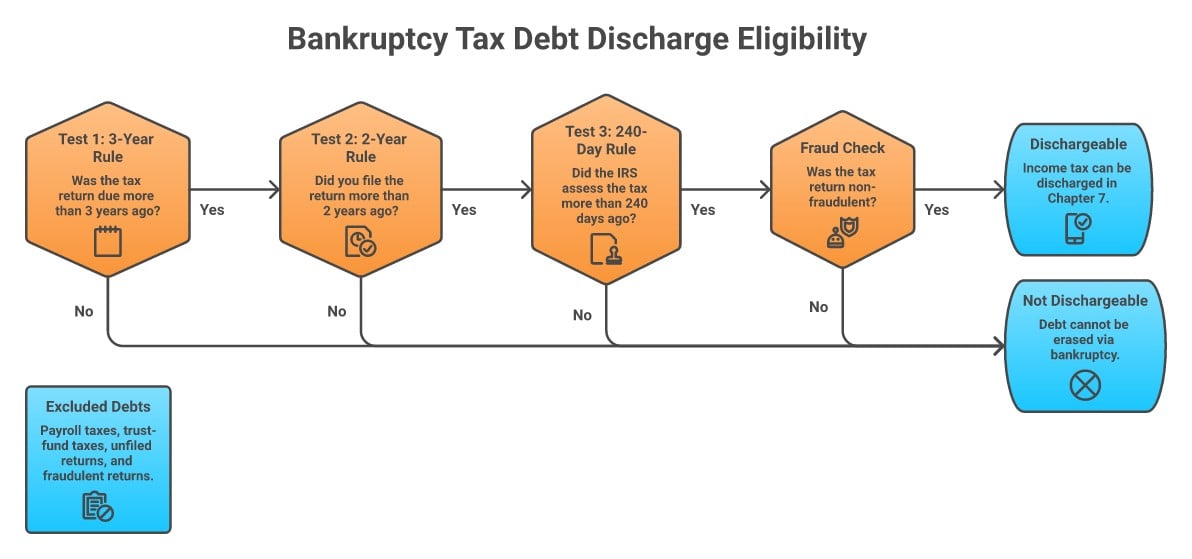
The one number to remember: if a tax year’s return was due more than three years ago, you filed it more than two years ago, and the IRS assessed it more than 240 days ago, that income tax is very likely dischargeable. This is straight from the U.S. Bankruptcy Code — 11 U.S.C. § 523 and 11 U.S.C. § 507 — and it’s confirmed in the IRS’s own Publication 908, the Bankruptcy Tax Guide.
Each weekday I send one short email: one money story that caught my attention, why it might matter to you, and one manageable thing you can do with it. A couple of minutes, and a dad joke.
In the latest issue (Oct 16): The check that looks like a scam may be real
Free. I sell nothing. Unsubscribe any time.
The Three Rules That Decide Everything
For income tax to be wiped out in a Chapter 7 bankruptcy, it has to clear all three of these timing tests. Miss even one and the tax survives.
The Daily Money Brief — Free, at 10 AM
Money you may be owed, scams to dodge, and the fine print decoded — the consumer money news that affects your wallet, every weekday.
1. The 3-Year Rule
The tax return must have been originally due at least three years before you file bankruptcy — and here’s the catch most people get wrong: the clock runs from the return’s due date, not the tax year. A 2022 tax return was due in April 2023 (or October 2023 if you got an extension), so those taxes don’t clear the three-year mark until April 2026 at the earliest. If you filed an extension, add the extra months. People routinely think their taxes are “three years old” a full year before they actually qualify.
2. The 2-Year Rule
You must have actually filed the return at least two years before filing bankruptcy. This is where a lot of people get tripped up: if you never filed, or filed very late, the clock hasn’t started. The lesson is simple and important — file your missing returns now, even old ones, because the two-year clock can’t begin until you do.
3. The 240-Day Rule
The IRS must have assessed the tax at least 240 days before you file. An assessment usually happens shortly after you file a return, but it can also follow an audit. If you recently went through an audit that added tax, that new amount needs to age 240 days. And if you submitted an Offer in Compromise on that tax, the 240-day clock pauses while the offer is pending (plus 30 days after), per IRS Publication 908.
What Bankruptcy Can Never Erase
Even when timing lines up, some tax debts are permanently off the table. Knowing these up front saves heartbreak:
- Payroll and trust-fund taxes. The portion of employment taxes withheld from employees (the “trust fund” piece) is never dischargeable for the person responsible for it.
- Taxes from unfiled returns. No return, no discharge. A “substitute return” the IRS files for you doesn’t count as your filing.
- Recent late returns. If you filed the return late and it became due within the last two years, the tax stays.
- Fraudulent returns or willful evasion. If you filed a fraudulent return or deliberately tried to evade the tax, bankruptcy won’t help — that debt follows you regardless of age.
Chapter 7 vs. Chapter 13: They Treat Taxes Differently
Which chapter you file changes how taxes are handled, and this trips up even some attorneys who don’t do much tax work.
Chapter 7 (Liquidation)
If your income taxes pass the three timing tests, Chapter 7 discharges them outright — the personal liability is gone. This is the cleanest outcome. Most people with qualifying old tax debt want to know if they’re eligible for Chapter 7 first.
Chapter 13 (Repayment Plan)
Chapter 13 doesn’t erase priority (newer) taxes — instead it lets you pay them off through a 3-to-5-year plan, interest and penalties often frozen, with the IRS held at bay the whole time. Older taxes that would qualify in Chapter 7 can be discharged at the end. It’s the right tool when you have a mix of dischargeable and non-dischargeable tax debt.
One important note: under the 2005 bankruptcy law (BAPCPA), Chapter 13 no longer offers the old “super discharge” that wiped out almost any tax provided for in the plan. Today the same dischargeability rules apply in both chapters — Chapter 13 just gives you a structured, protected way to handle the taxes that can’t be erased.
The Two Things That Make Bankruptcy Worth a Look
The Automatic Stay Stops the IRS the Day You File
The moment your bankruptcy petition is filed, the automatic stay under 11 U.S.C. § 362 takes effect and stops IRS levies, wage garnishment, and collection calls — immediately, not weeks later. Even if your taxes ultimately don’t qualify for discharge, that breathing room is real and instant.
Free Tool — Wage Garnishment Calculator: Worried about your paycheck being seized? The free Wage Garnishment Calculator shows exactly how much creditors can legally take in your state — and some states prohibit garnishment entirely. Calculate My Risk →
One Catch: A Tax Lien Can Survive
If the IRS already filed a Notice of Federal Tax Lien before your bankruptcy, that lien can survive the discharge as a claim against property you owned before filing. Your personal liability disappears — the IRS can’t chase you for the money — but the lien may stay attached to that asset. This is exactly the kind of detail a good bankruptcy attorney sorts out before you file, so there are no surprises. If the lien is already filed, my guide on what to do about an IRS tax lien covers release, withdrawal, and how to sell or refinance around it.
What I’d Tell a Friend at My Kitchen Table
If you’re sitting on years-old IRS debt, don’t assume bankruptcy is off the table just because someone — maybe even a tax-relief salesperson — told you “you can’t bankrupt taxes.” That’s only half-true, and the half they leave out is the half that could set you free. The tax-relief industry makes money selling you payment plans and settlements; they have no reason to mention the option that costs them a customer.
Here’s my honest advice: pull your tax transcripts at IRS.gov/account so you know your assessment dates, file any missing returns to start those clocks running, and then sit down with a bankruptcy attorney — you can find one through NACBA — who can map out which years qualify. The consultation is usually free, and the answer might change your life. Federal Reserve research shows people who file bankruptcy recover financially faster than those who keep struggling under debt they can’t pay.
This is math, not morality. You are not a bad person because you owe the IRS. The bankruptcy code exists precisely because Congress understood that good people hit hard years — and for old tax debt, it can be the cleanest fresh start there is.
Everything here is based on three decades of helping people through exactly this. But my advice is input for your decision, not the decision itself. Only you know your full situation, and tax-in-bankruptcy is genuinely complex — talk to a qualified bankruptcy attorney or tax professional, look at your numbers, and make the choice that serves your future.
If you know someone carrying old IRS debt and quietly suffering under it, send them this page. The belief that “bankruptcy can’t touch taxes” keeps people trapped for years — and for many of them, it simply isn’t true.
This is part of our complete guide to handling IRS debt. For the full picture — payment plans, the 10-year collection clock, settling for less, and what to do the moment a notice arrives — see Tax Debt: The Complete Guide to IRS Back Taxes. If the IRS is acting against you right now, go straight to The IRS Says I Owe Back Taxes: What to Do Right Now.
Still hear people say tax debt can never be wiped out in bankruptcy? That’s a myth — I break down exactly why in “They Said Tax Debt Can Never Be Wiped Out in Bankruptcy.”
Dealing With Debt? Understanding your options is the first step. See how all your debt relief options compare — including ones most sites won’t tell you about. The Find Your Path quiz gives a recommendation based on your actual numbers, and the Scam-O-Meter checks any company’s complaint history before you sign. Federal Reserve research shows bankruptcy filers recover faster than those who don’t file.