
Quick Answer: A federal judge has allowed a Fair Credit Reporting Act lawsuit against TransUnion to move forward as a class action, in a case where the lead plaintiff alleges the credit bureau handed her credit file to a company the complaint describes as a fake debt collector. The scary part isn’t the fake collector calling — it’s that a stranger can get your real, accurate credit report and use it to chase you for money you may not owe. If a collector contacts you about a debt you don’t recognize, do not pay or confirm anything on the phone. Demand a written validation letter, pull your free credit reports, and dispute anything that doesn’t belong to you before you give anyone a dime.
Expert Context: I ran a credit counseling organization for over a decade and have reviewed thousands of credit reports — I’ve watched every error pattern, every “this isn’t mine” panic, and every shady collector who counts on you being too scared to ask the one question that stops them cold. When I read how this case alleges a fake collector got hold of a real credit file, I recognized the playbook immediately. The data is the weapon. Take the weapon away and most of these calls fall apart.
On June 3, 2026, a North Carolina federal judge certified a class action against the credit bureau TransUnion, allowing a lawsuit to proceed on behalf of potentially thousands of consumers who allege the company sold their credit reports to users who had no legitimate right to them. The case is a window into something most people never think about: your credit report isn’t locked in a vault. It gets handed out — and the law that’s supposed to control who gets it doesn’t always work the way you’d hope.
Table of Contents
Each weekday I send one short email: one story that caught my attention, why it might matter to you, and one manageable thing you can do with it. A couple of minutes, and a dad joke.
In the latest issue (Nov 9): Check your power bank and your French press
Free. I sell nothing. Unsubscribe any time.
Key Terms Defined
FCRA (Fair Credit Reporting Act): The federal law that governs who is allowed to see your credit report and what they can do with it. It’s the rulebook that’s supposed to protect your file. (CFPB overview)
Permissible purpose: Under the FCRA, a credit bureau can only release your report to someone with a legally approved reason — like a lender you applied to, or a collector working a debt you actually owe. A company has to certify it has a permissible purpose before getting your file.
Debt validation: Your right under the Fair Debt Collection Practices Act (FDCPA) to demand that a collector prove, in writing, that the debt is real and that they have the right to collect it — before you pay anything.
What This Lawsuit Actually Alleges
Let me be precise here, because precision matters with an active case. According to the complaint as reported by ClassAction.org, a North Carolina woman alleges that TransUnion furnished her consumer report to an entity called Liberty Credit Management — which the lawsuit describes as a sham operation connected to a purported fake law firm. The complaint alleges she received a dunning letter in September 2022 claiming she owed $980.76 for a purported line of credit and something labeled “NSF Fraud.”
The heart of the claim, as reported by Law360, is that TransUnion allegedly lacked a valid permissible purpose under the FCRA for releasing her report, and didn’t take steps to verify that the recipient was a legitimate collector with the right to pursue her. The complaint puts it bluntly: “Even a cursory investigation into Liberty Credit Management by Trans Union would have revealed that it was not a legitimate debt collector.”
An important distinction: Class certification means the case is allowed to move forward on behalf of a group — it is not a ruling that TransUnion did anything wrong. These are allegations that still have to be proven in court. I’m not telling you a bureau broke the law. I’m telling you a judge thought the claims were serious enough to let a lot of people sue together, and that the underlying question — who gets your credit file, and why — is one every consumer should understand.
The proposed class is broad: anyone in the United States whose report TransUnion sold over the past five years to a user that certified a permissible purpose but allegedly lacked any real authority to collect on accounts attributed to that person.
Why You Should Care, Even If You’ve Never Heard of Liberty Credit Management
Here’s the insight the headline doesn’t give you. Most people picture a “fake debt collector” as some guy with a burner phone making up a number. And plenty of those exist — I’ve written before about fake collector scams the BBB has investigated and the wave of fraud California regulators have warned about.
But the reason a scammer sounds so convincing is that sometimes they’re not guessing. When a caller has your real name, your real address, and references to real accounts, your gut says “this must be legitimate — how else would they know?” That instinct is exactly what gets people to pay debts they don’t owe. The credit file is what makes the cold call feel warm. Take away the accurate data, and a fake collector is just a stranger making noise.
This is the same engine behind zombie debt — old, often time-barred bills that get bought and resold — and behind the frustration of old debts that keep popping up after you thought they were gone. The common thread is data flowing to people who shouldn’t have it, attached to a demand for money.
Free Tool — Statute of Limitations Checker: Dealing with old debt? The free Statute of Limitations Checker tells you if the collection clock has expired in your state — including the zombie debt and clock-restarting traps collectors use. Check My Status →
How to Tell a Sham Collector From a Real One
You don’t need to be a lawyer to protect yourself. You need one habit: never pay or admit anything on a first phone call. A legitimate collector has zero problem putting it in writing. A fake one does. That single rule filters out an enormous amount of trouble.
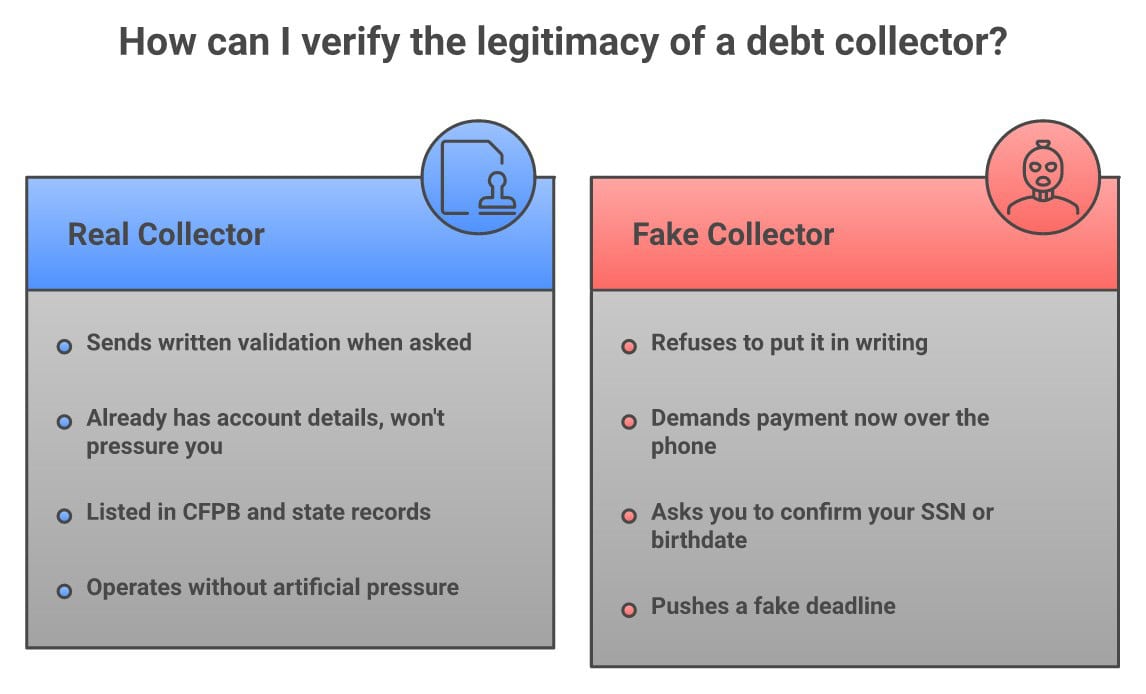
- Demand written validation. Tell the caller to send a debt validation letter and that you won’t discuss anything until you have it. This is your right under the FDCPA, and a real collector will comply.
- Don’t confirm your information. Don’t verify your Social Security number, birth date, or account numbers to someone who called you. They should already have what they need — or they shouldn’t be calling.
- Look the company up independently. Search the name, check your state attorney general and the CFPB complaint database. If a company barely exists outside of dunning letters, that tells you something.
- Pull your own credit reports. Get them free at AnnualCreditReport.com — the only federally authorized source. See what’s actually being reported in your name.
- Don’t pay to “make it go away” before you’ve confirmed the debt is real and yours.
- Don’t give a “settlement” payment over the phone under pressure or a fake deadline.
- Don’t ignore a letter that turns out to be a real lawsuit — that’s a different mistake, and ignoring a genuine debt lawsuit is worse than you think.
The Claim: “If they have my real account details, the debt must be legitimate and I have to pay.”
The Reality: Having accurate information about you does not prove someone has the legal right to collect from you. As this lawsuit alleges, accurate data can end up in the wrong hands. The burden is on the collector to validate the debt — not on you to disprove it. Make them put it in writing first.
Free Tool — Debt Validation Letter Generator: Being contacted by a debt collector? The free Debt Validation Letter Generator creates a personalized FDCPA validation letter in seconds — forcing the collector to prove the debt is real before they can continue. Generate My Letter →
What To Do When a Debt You Don’t Recognize Shows Up
Walk through these steps in order. Don’t skip to paying.
- Request validation in writing within 30 days of first contact. Send it by mail and keep a copy. Until they validate, a collector is supposed to pause collection.
- Pull all three credit reports and look for the account in question. If it’s not there, or the details are wrong, that’s a red flag worth chasing.
- Dispute inaccurate items with each bureau that reports them — TransUnion, Equifax, and Experian each have their own dispute process, and you may need to dispute with all three. If you’ve seen the maddening pattern where a deleted account keeps reappearing, persistence matters.
- If it’s identity theft, file a report at IdentityTheft.gov, the FTC’s official recovery site. That report unlocks extra rights to block fraudulent items.
- If a real collector won’t validate but keeps calling, that itself may violate the law. A consumer attorney can help — and many take FCRA and FDCPA cases for little or no upfront cost because the law lets them recover fees from the other side. You can find one through the National Association of Consumer Advocates (NACA).
And If the Debt Turns Out to Be Real and Crushing
Sometimes you dig in and the debt is yours — and it’s part of a pile that’s bigger than you can dig out of. I want to say something here that the collection industry will never tell you: when debt is genuinely real and genuinely overwhelming, the answer is not years of phone calls, fear, and chipping away while interest swallows your payments. Endless collector fights are not a plan. They’re a treadmill.
In my thirty years doing this, I’ve watched bankruptcy do what no payment plan could — stop the calls, protect a paycheck, and most importantly, protect retirement savings that people too often drain trying to pay creditors who were never going to give them peace. Bankruptcy isn’t failure. It’s a legal reset that, for the right situation, beats every other option on the things that matter most: it stops collections cold, it’s fast, your credit recovers, and it leaves your future intact. If you’re at that point, talk to a real bankruptcy attorney before you cash out a single dollar of your 401(k). You can find one through the National Association of Consumer Bankruptcy Attorneys (NACBA). And if you want to think through which path fits your situation, my Find Your Path quiz will walk you through it without anyone selling you anything.
Key Takeaways
- A judge certified a class action alleging TransUnion released credit reports to a company described as a fake collector — these are allegations, not findings.
- The real lesson: accurate credit data can reach the wrong hands, which is what makes a fake collector convincing.
- Never pay or confirm information on a first call. Demand written validation — real collectors comply, fakes don’t.
- Pull your free reports, dispute what isn’t yours, and use IdentityTheft.gov if it’s fraud.
- If a debt is real and overwhelming, endless collection fights aren’t the answer — and bankruptcy may protect your future better than draining your savings.
The Bottom Line
If you’re holding a letter or a missed call about a debt you don’t recognize, your heart is probably pounding — and I want you to take a breath, because you have more power than the person on the other end wants you to believe. A scary call is not the same as a valid debt. The law puts the burden on them to prove it, in writing, and you are allowed to say “send it to me and I’ll respond” and hang up. That’s not rude. That’s smart. I’ve sat with thousands of people who thought a collector held all the cards, and almost every time, the simple act of asking for proof changed everything. You are not your debt, and you are not powerless. Send this to someone you love who’s been losing sleep over a call like this — one calm fact at the right moment can be the thing that lets them sleep tonight.
Frequently Asked Questions
What does it mean that the TransUnion lawsuit was certified as a class action?
Class certification means a judge has decided the case can move forward on behalf of a group of similarly situated people, rather than just one plaintiff. It is a procedural decision — not a ruling that TransUnion did anything wrong. The allegations still have to be proven in court.
How can a fake debt collector get my real credit report?
Credit bureaus release reports to companies that certify they have a legally permissible purpose under the Fair Credit Reporting Act. This lawsuit alleges that verification can fail — that a report was released to a company that, according to the complaint, had no legitimate right to it. That’s the core issue the case raises.
A collector contacted me about a debt I don’t recognize. What do I do first?
Don’t pay or confirm any personal information on the phone. Request a written debt validation letter, which is your right under the FDCPA. Then pull your free credit reports at AnnualCreditReport.com to see what’s actually being reported before you take any further step.
How do I dispute a debt that isn’t mine?
File a dispute with each credit bureau that’s reporting the account — TransUnion, Equifax, and Experian each have separate processes. If the account is the result of identity theft, file a report at IdentityTheft.gov, which gives you additional rights to block fraudulent items.
What if the debt turns out to be real but I can’t afford it?
If a verified debt is part of a larger amount you genuinely can’t pay, years of collection calls usually aren’t the solution. Depending on your situation, bankruptcy can stop collections quickly and protect retirement savings better than draining them to pay creditors. Speak with a consumer bankruptcy attorney — you can find one through NACBA — before cashing out any retirement account.
This is what I’m seeing after thirty years of helping people dig out of debt — and I’m sharing it as one experienced opinion, not a set of orders. Only you know your whole situation, so take what fits and leave what doesn’t. Nobody gets to decide what you do with your money — not a collector, not a credit bureau, and not me.
Know Your Rights: If a debt collector is contacting you, you have legal protections. See the complete list of FDCPA violations collectors commit most often. Use the free Debt Validation Letter Generator to demand proof of the debt, or check this collector’s complaint history with the Scam-O-Meter.
Dealing With Debt? Before you pay a collector, understand all your debt relief options — including ones the collector won’t tell you about. If the debt feels unmanageable, take the 2-minute bankruptcy quiz to see if the math favors a fresh start. Federal Reserve research shows filers recover faster than those who don’t file.



