

Quick Answer: The $68 million Google Assistant privacy settlement claim portal is open now, and you have until August 27, 2026 to file. If you lived in the U.S. and either bought a Google-made device (like a Nest speaker or Pixel phone) or used Google Assistant between May 18, 2016 and March 19, 2026, you can file a claim at GoogleAssistantPrivacyLitigation.com. Payouts are estimated at $2 to $56 — small money, but it takes about five minutes, and every dollar can go straight toward a bill.
If you’ve ever filed a class action claim, also keep an eye out for the surprise second Facebook settlement payment that started going out in June 2026 — millions of people have a second payment coming and most won’t notice.
Expert Context: I’ve tracked class-action settlements since I launched GetOutOfDebt.org in 2008, and I’ve watched which ones actually pay and which ones evaporate. The pattern I see over and over: the money is real, the deadline is firm, and most people who qualify never bother to file. That’s exactly backwards. When a company has already agreed to pay because it crossed a line, the only mistake left is letting your share sit unclaimed.
Google has agreed to pay $68 million to settle claims that its Assistant recorded people without meaning to — and if you owned a Google device or used the Assistant any time in the last decade, there may be a small check waiting for you.
Claiming money you are owed is one good day. What you do over the following year is what actually changes your position.
In the latest issue (Oct 9): Does Financial Literacy Make Financial Sense?
Each weekday I send one short email: one money story that caught my attention, why it might matter to you, and one manageable thing you can do with it.
Free. I sell nothing. Unsubscribe any time.
The lawsuit, In re Google Assistant Privacy Litigation (Case No. 4:19-cv-04286, U.S. District Court for the Northern District of California), centered on what the case calls “false activations” — moments when Google Assistant woke up and started recording without anyone saying “Hey Google.” The settlement does not require Google to admit it did anything wrong, and I’m not telling you it did. What I can tell you is the company chose to put $68 million on the table rather than keep fighting, and that money is now available to claim.
Who can file a claim
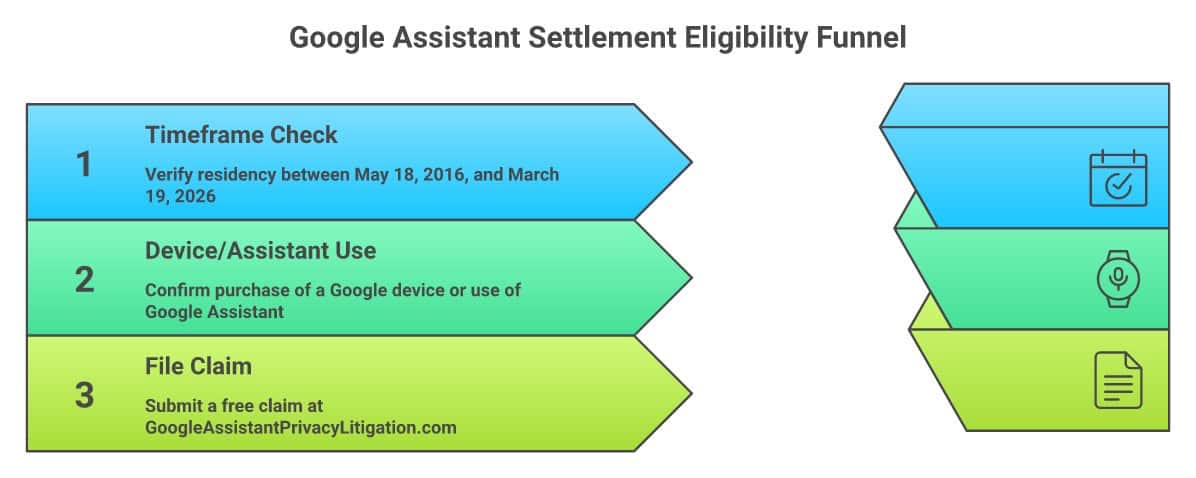
You may be eligible if you are a U.S. resident and, at any point between May 18, 2016 and March 19, 2026, you fell into either of these groups:
- The Purchaser Class — you bought a Google-made device, such as a Nest speaker or display, a Pixel phone, or another product with Google Assistant built in.
- The Privacy Class — your private conversations were recorded or shared with reviewers because Google Assistant activated by mistake, even if you never bought a device.
You can qualify under both. The settlement uses a points system: each eligible device earns points for purchasers (up to three devices), and privacy-class members earn a point each, with a combined cap. The more valid claims that come in, the more the fund gets divided — which is the honest reason early, accurate filing matters.
The Daily Money Brief — Free, at 10 AM
Money you may be owed, scams to dodge, and the fine print decoded — the consumer money news that affects your wallet, every weekday.
How much money are we talking about?
Let me be straight with you, because I’d rather you hear it from me than feel let down later: this is not a windfall. The estimated range is $2 to $56. Device purchasers land toward the higher end (roughly $18 to $56 depending on how many qualifying devices you owned), and privacy-only claimants toward the lower end (around $2 to $10). The exact amount depends on how many people file.
Is $20 going to change your life? No. But if you’re carrying a credit card balance at 25% interest, every dollar you throw at it is a dollar that stops working against you. Found money toward a bill is still money you didn’t have yesterday.
What you’ll need to file
Filing takes about five minutes at the official site, GoogleAssistantPrivacyLitigation.com. A few things to know:
- For a basic privacy claim, you generally don’t need to prove anything — you attest that you used Google Assistant during the class period.
- For the device purchaser claim, you may need proof of purchase: a Google Store order confirmation, your Google account purchase history, a credit card or bank statement, or a retail receipt.
- The deadline to file, opt out, or object is August 27, 2026. The court’s final approval hearing is set for October 1, 2026.
Watch for scams. Any time a big settlement hits the news, fake “claim helper” sites and texts pop up asking for a fee or your Social Security number. The real settlement is free to claim and never charges you. Only use the official URL above, and never pay anyone to file a claim you can file yourself for nothing.
Things to consider before you decide
For almost everyone, the move here is simple: file the claim and move on. But two situations are worth a moment’s thought.
First, if you believe Google’s recordings caused you real, specific harm beyond the privacy violation itself, you have the right to opt out and preserve your ability to sue separately. For the vast majority of people, that’s not worth it — but the option exists, and the deadline to exercise it is the same August 27 date.
Second, if you get a payout, decide now where it goes. A $40 check that lands in your checking account quietly disappears into everyday spending. A $40 check you’ve already decided to send to your highest-interest debt actually does something. Small intentional moves are how people climb out — I’ve watched it happen for thirty years.
This isn’t the only settlement with money sitting on the table right now. If you’re going to spend five minutes filing one claim, check whether you qualify for others too — I’ve covered the Google Play children’s privacy settlement, the Trader Joe’s receipt settlement, and the Comcast data breach settlement. Same idea every time: real money, firm deadline, and most people never claim it.
Key Takeaways
- The $68 million Google Assistant settlement is open; file by August 27, 2026 at GoogleAssistantPrivacyLitigation.com.
- You qualify if you bought a Google device or used Google Assistant in the U.S. between May 18, 2016 and March 19, 2026.
- Estimated payout is $2–$56 — small, but free and quick to claim.
- Device claims may need proof of purchase; basic privacy claims generally don’t.
- Decide where the money goes before it arrives — ideally toward high-interest debt.
The Bottom Line
A small settlement check won’t fix anything on its own — but the habit behind claiming it just might. If you’re the kind of person who lets these things slide because “it’s only twenty bucks,” I’d gently push back: the people I’ve watched dig out of debt are the ones who stopped leaving small money on the table and started pointing every loose dollar in the same direction. File the claim, decide where the money goes before it lands, and let this be the easy first win. You don’t have to do something heroic today — you just have to do the five-minute thing, and then do the next one.
Frequently Asked Questions
How do I file a claim for the Google Assistant settlement?
Go to the official settlement website, GoogleAssistantPrivacyLitigation.com, and complete the claim form. It takes about five minutes. Most privacy claims require no proof; device purchaser claims may require proof of purchase.
What is the deadline to file a Google Assistant settlement claim?
The deadline to file a claim, opt out, or object is August 27, 2026. The court’s final approval hearing is scheduled for October 1, 2026.
How much money will I get from the Google Assistant settlement?
Estimated payouts range from $2 to $56. Device purchasers receive more (roughly $18 to $56), and privacy-only class members less (around $2 to $10). The final amount depends on how many valid claims are filed.
Who is eligible for the Google Assistant privacy settlement?
U.S. residents who, between May 18, 2016 and March 19, 2026, either purchased a Google-made device (like a Nest or Pixel) or had communications recorded by Google Assistant due to an accidental activation. You can qualify under both classes.
Do I need proof of purchase to file?
For a basic privacy claim, generally no. For a device purchaser claim, you may need documentation such as a Google Store order confirmation, account purchase history, a card or bank statement, or a retail receipt.
This is what I’m seeing after watching settlements like this one for years. Take it as one informed perspective, not a directive — only you know your full situation. Use it as input for your own decision. Nobody gets to tell you what to do with your money. Not me, not anyone.
Dealing With Debt? Understanding your options is the first step. See how all your debt relief options compare — including ones most sites won’t tell you about. The Find Your Path quiz gives a recommendation based on your actual numbers, and the Scam-O-Meter checks any company’s complaint history before you sign. Federal Reserve research shows bankruptcy filers recover faster than those who don’t file.



