

Written by Steve Rhode, consumer debt expert since 1994 • Last updated June 12, 2026
Quick Answer: If you can no longer make even the minimum payments on your credit cards, you are at a tipping point — but you have more time and more options than the panic is telling you. Nothing catastrophic happens the day you miss one payment. The real damage builds over about 180 days, and you have that window to act. Stop, breathe, and do three things: figure out your actual numbers, contact your card issuer’s hardship program before you fall far behind, and look honestly at every relief option — including bankruptcy, which can wipe the slate clean and protect your retirement. Do not drain your 401(k) or sign up with the first “debt relief” company that calls. That’s the mistake that turns a hard moment into a disaster.
What Just Happened to Your Budget
You hit the wall every overextended household eventually hits: the minimum payments alone now exceed what you have left after the essentials. This isn’t a character flaw — it’s math. Minimum payments are designed to be small so balances, and the interest the lender earns, stretch on for years. The CFPB explains that paying only the minimum can keep you in debt for decades. When income drops or expenses rise even a little, the minimums are the first thing that becomes impossible.
Here’s what matters most right now: missing a minimum payment is not an emergency the way a garnishment or a frozen bank account is. It’s a slow-moving process, and that means you have time to make good decisions instead of panicked ones.
The Mistake You’re About to Make: Cashing out your 401(k) or IRA to “catch up” on credit card minimums. I understand the impulse — but this is almost always the wrong move. Your retirement accounts are generally protected from creditors and in bankruptcy (401(k)s strongly so; IRA protection outside bankruptcy varies by state), so raiding them to pay unsecured credit card debt trades a protected asset for an unprotected problem — often with taxes and penalties on top. The second mistake: handing the situation to the first debt settlement company that promises to “cut your debt in half.” Read your options first.
Free Tool — Judgment Proof Checker: Think creditors can take everything? Many people in financial hardship are legally protected. The free Judgment Proof Checker shows whether collectors can actually collect anything from you in your state. Check My Status →
Your Options Right Now
What to Do in the Next 48 Hours
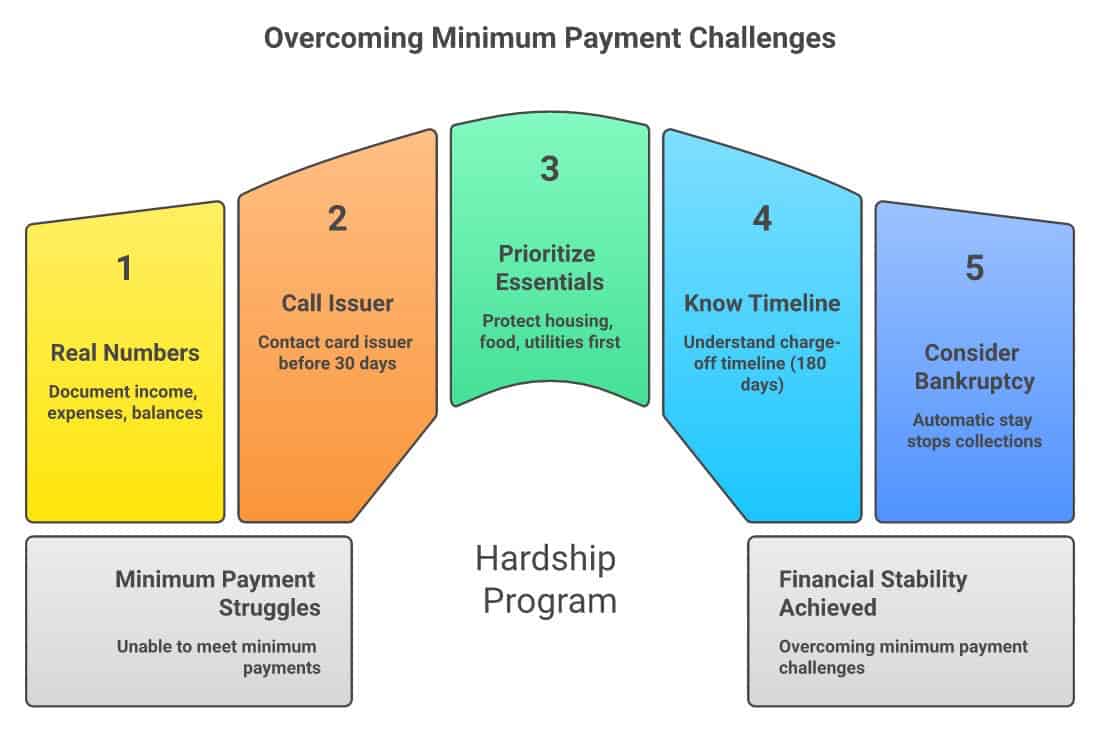
- Write down your real numbers. Total minimum payments due, total balances, your actual take-home income, and your true essential expenses (housing, food, utilities, transportation, medicine). You can’t choose a path until you can see the gap. Run them through my free debt relief options calculator.
- Call your card issuer and ask for the hardship program — before you’re 30 days late. Most major issuers have hardship plans that can lower your interest rate, reduce or pause payments, or waive fees temporarily. (Note: a promotional 0% APR can be canceled after a single late payment under your cardholder agreement — separate from the 30-day credit-reporting clock — so don’t assume one missed payment is harmless on a promo balance.) You have the most leverage before you default, not after. Ask specifically: “What hardship or financial difficulty options do you offer?” Get any agreement in writing.
- Protect the essentials first. If money is short, keep your housing, utilities, food, and necessary medicine paid before unsecured credit cards. A late credit card payment is recoverable. Eviction or a utility shutoff is a deeper crisis. If you’re facing eviction while collectors are calling too, here’s how to handle both at once. Credit card debt is the lowest-priority debt you have. But lowest priority does not mean “ignore it” — an unsecured creditor that isn’t paid can sue you, win a court judgment, and in most states garnish your wages or levy your bank account. If you ever get served with a lawsuit, do not ignore it: respond by the deadline. The point is to pay essentials first, not to pretend the card debt will disappear on its own.
- Understand the timeline so you can plan. You generally have until about 180 days late before the account is charged off. That’s your window — use it to choose a real solution, not to bury your head.
- If the math doesn’t work no matter what, look at bankruptcy honestly. Filing bankruptcy triggers the automatic stay the moment you file — it legally stops collection calls, lawsuits, and garnishments instantly. For many people drowning in credit card debt, a Chapter 7 wipes it out in a few months and protects retirement savings. Take my free 2-minute bankruptcy quiz, or find an attorney through NACBA. Talk to Damon Day for free first if you want an unbiased gut-check. Damon Day, an independent debt coach and my co-host on the Get Out of Debt Guy podcast, whom you can reach at DamonDay.com — I receive no payment for this referral.
How to Actually Stop the Slide — Your Paths
- Bankruptcy (the fastest reset). If your unsecured debt is more than you can realistically repay, Chapter 7 can discharge credit card debt in about 3-4 months and the automatic stay stops collection immediately. It protects your 401(k) and IRA. Federal Reserve research shows filers recover faster than people who keep struggling without filing — and credit scores often rise after discharge because the debt dragging them down is gone.
- Issuer hardship program (if the gap is temporary). If you’ve had a job loss, medical event, or short-term setback and expect to recover, a hardship plan can carry you through. Best for people who can resume payments soon.
- Nonprofit-style debt management (proceed carefully). A debt management plan can lower interest and consolidate payments, but completion rates are low and the multi-year cost to your retirement savings is real. Know the full math before you enroll.
- What usually WON’T fix it: debt settlement. Settlement tells you to stop paying, wrecks your credit for years, charges steep fees, offers no legal protection from lawsuits, and resolves far less debt than the ads imply. Regulators are actively pursuing deceptive settlement companies right now.
What You Need to Know About the Timeline and Your Rights
Federal rules set the framework for what your issuer can do. Late fees are capped under the Truth in Lending Act’s Regulation Z (12 C.F.R. § 1026.52), and the Consumer Financial Protection Bureau oversees credit card practices. These milestones are the typical pattern — some issuers move a little faster or slower — but knowing the general timeline lets you act inside the window instead of reacting after the damage is done.
One correction on late fees: the CFPB’s $8 late fee rule never took effect and was vacated in April 2025, so here is what actually limits a late fee today.
| How Late | What Happens | What You Can Still Do |
|---|---|---|
| 1–29 days | Late fee; possible loss of promotional APR | Call for hardship help — strongest leverage |
| 30 days | Reported to credit bureaus; score drops | Hardship plan still very possible |
| 60 days | Penalty APR may apply to the whole balance | Negotiate; weigh all options |
| 90 days | “Seriously delinquent”; aggressive collection | Decide on a real path now |
| 180 days | Charge-off; debt often sold to a collector | Bankruptcy or settlement decision point |
If a collector breaks the rules — calls at all hours, threatens you, or refuses to verify the debt — file a complaint with the CFPB and your state attorney general. If you need legal help but can’t afford an attorney, find free legal aid through LSC.gov.
Steve’s Take
I filed bankruptcy in 1990, so I know exactly what it feels like to look at numbers that no longer add up and feel like a failure. Let me tell you what I wish someone had told me: you are not your debt, and missing a minimum payment doesn’t make you irresponsible — it makes you human in an economy that hands out credit easily and forgives it slowly. The people I’ve watched come through this best are the ones who stopped paying out of fear and started deciding out of math. Look at the real numbers. Pick the path that gets you free. The shame is the part that keeps you stuck — drop it, and the rest is just decisions.
If a hospital stay is why you fell behind in the first place, see the complete guide to debts that piled up while you were hospitalized for the order to call creditors.
Frequently Asked Questions
I can’t make my minimum payment this month — what happens first?
One missed minimum payment usually means a late fee and possible loss of any promotional interest rate. It typically isn’t reported to credit bureaus until you’re about 30 days late. Nothing catastrophic happens immediately, which gives you time to call your issuer and ask about hardship options.
How long before my credit card is charged off if I stop paying?
Generally about 180 days (six months) of missed payments before the issuer charges off the account and often sells it to a collector. The major credit-damage milestones are 30 days (reported), 90 days (seriously delinquent), and 180 days (charge-off). A charge-off then stays on your credit report for about seven years measured from your date of first delinquency — the first payment you missed that you never caught up on (15 U.S.C. § 1681c) — not from the charge-off date. That 180-day window is your time to choose a real solution.
Should I cash out my 401(k) to pay my credit card minimums?
Almost never. Retirement accounts are generally protected from creditors and in bankruptcy, plus early withdrawals trigger taxes and penalties. Draining a protected asset to pay unprotected credit card debt usually makes your situation worse, not better. Look at every other option first.
I filed bankruptcy — how fast does it stop the collection calls?
Immediately. The automatic stay takes effect the moment you file, legally stopping collection calls, lawsuits, and garnishments — not weeks later. For many people overwhelmed by credit card debt, Chapter 7 discharges it in about three to four months while protecting retirement savings.
Will calling my credit card company hurt me?
No. Asking about a hardship or financial difficulty program does not hurt your credit, and you have the most leverage before you fall behind. Many issuers can lower your rate, pause payments, or waive fees — but you have to ask, and you should get any agreement in writing.
Is debt settlement a good way to handle this?
Usually not. Debt settlement tells you to stop paying, damages your credit for years, charges steep fees, provides no protection from lawsuits, and resolves far less debt than advertised. And if you’ve been enrolled in a program for months with nothing actually settled, you have legal rights — including the right to get your escrow money back. Compare it honestly against bankruptcy and hardship options before enrolling, and check any company’s complaint history first.
One more thing — everything I share here is based on 30 years of helping people through exactly this. But my advice is input for your decision, not the decision itself. Only you know your full situation. Look at your numbers, talk to an attorney if the math is serious, and make the choice that serves your future.
Important: This guide is for informational purposes only and is not legal advice. Laws vary by state, and your situation may have details that change what options are available to you. For legal advice specific to your case, consult an attorney licensed in your state. NACBA can help you find a bankruptcy attorney, NACA can connect you with a consumer attorney, or talk to Damon Day for free about your situation. Damon Day, an independent debt coach and my co-host on the Get Out of Debt Guy podcast, whom you can reach at DamonDay.com — I receive no payment for this referral.
Key Takeaway: Not being able to make your minimums is a serious signal, but it’s not the end — and it’s not an emergency the way a garnishment is. You have roughly 180 days before a charge-off. Use that window: get your real numbers with the debt relief options calculator, call your issuer’s hardship program this week, and look honestly at bankruptcy if the math doesn’t work. The longer you wait in silence, the fewer good options you keep.
The Bottom Line
If you’re reading this with a stack of bills you can’t cover, I want you to hear this clearly: you are not bad with money, and you are not alone — millions of households hit this exact wall, and the economy is built to make it easy to get here and slow to get out. But there is a way out, and the people who take it are the ones who trade shame for math and silence for action. If someone you love is quietly drowning in minimum payments, send them this page — sometimes the kindest thing you can give a person in this spot is the permission to stop panicking and start deciding. Start with your real options and the Find Your Path quiz.
If falling behind on payments has put your electricity, gas, or water at risk, the utility shutoff crisis guide walks through LIHEAP assistance, payment plans, medical certifications, and the exact steps to take in the next 48 hours.
Related: A 2026 survey found people at every income level, including above $300,000, saying they live paycheck to paycheck. Here is what that survey actually asked.
Dealing With Debt? Understanding your options is the first step. See how all your debt relief options compare — including ones most sites won’t tell you about. The Find Your Path quiz gives a recommendation based on your actual numbers, and the Scam-O-Meter checks any company’s complaint history before you sign. Federal Reserve research shows bankruptcy filers recover faster than those who don’t file.
Right now you are dealing with the thing in front of you, and that is exactly where your attention belongs. When it is handled — and it will be — there is a next stage, and it is the one I most enjoy writing about.
In the latest issue (Nov 6): Owed money on an Amazon return? Check by Dec. 1
Each weekday I send one short email: one story that caught my attention, why it might matter to you, and one manageable thing you can do with it. It is free, I sell nothing, and I take no money from any company I write about.



