

Why I’m writing this: This post grew out of a conversation someone had with me through the anonymous Ask Steve chat on this site. I’m not sharing their story — those chats are private, no names, no details, and they stay that way. But the pattern they described is one I’ve seen for more than 30 years, and almost nobody writes about it honestly. So I’m writing about the pattern, not the person. If you’re living some version of this, I hope it helps. And if you want to talk it through privately, you can.
Back in 2012 I wrote about financial domination as a curiosity — the “erotic world” of money slaves and findommes. I treated it like something to gawk at. I was wrong to write it that way, and I want to do better, because in the years since, people have quietly come to me drowning in it. Not laughing about it. Drowning.
So let me say the most important thing first, before anything else:
Each weekday I send one short email: one money story that caught my attention, why it might matter to you, and one manageable thing you can do with it. A couple of minutes, and a dad joke.
In the latest issue (Oct 9): Does Financial Literacy Make Financial Sense?
Free. I sell nothing. Unsubscribe any time.
I’m not here to judge what turns you on, who you give your money to, or what you do behind a screen at 3 a.m. That’s yours. My only job is to make sure you can still see the math — and that the choice is still actually yours to make.
If you’re into this, you’re an adult and you get to decide. I mean that. But I’ve watched this particular dynamic empty retirement accounts and end in real ruin, and the people it hurts almost never see it coming — because by the time the money’s gone, they’ve stopped believing they deserve anything else. That’s the part I want to talk about.
The Daily Money Brief — Free, at 10 AM
Money you may be owed, scams to dodge, and the fine print decoded — the consumer money news that affects your wallet, every weekday.
What financial domination actually is
Financial domination — “findom” — is a fetish where one person (the submissive, sometimes called a “money slave” or “pay pig”) gets a charge out of handing money and gifts to a dominant (the “findomme” or “cash master”). The thrill is in the giving itself: the surrender, the being used, the humiliation, the loss of control. Often there’s no physical contact at all. It lives on cash apps, OnlyFans, wishlists, and X, and it’s far more common now than when I first wrote about it.
Here’s what the research actually shows, because I’d rather give you facts than my opinions. A 2021 study published in Sexuality Research and Social Policy looked closely at the women who run these dynamics. It described how the relationship can be built entirely around “the relinquishing of control to a money mistress” — meaning the draw, for a lot of people, is the surrender itself, not just the money changing hands. And the researchers flagged something worth holding onto: the line between consensual play and exploitation is thin, because “fiscal considerations may in some cases exert considerable influence” over what gets pushed past someone’s stated limits. In plain English — the money has a way of moving the boundaries.
So this isn’t a sermon about a “sick” fetish. In my 30-plus years of watching this, most people who do it go in willingly, with limits they intend to keep, and for plenty of them it never becomes a problem. This post isn’t for them. The trouble starts when the dynamic quietly erodes those limits — and you look up one day and the line you swore you’d never cross is somewhere behind you.
It’s for the person who already knows the math is breaking and can’t make themselves look at it.
If that’s you, let me say one thing before we go any further. You might be reading this disgusted with yourself — ashamed of how much you’ve given, how long it’s gone on, how easily it pulled you in. I want you to hear me: that feeling is lying to you. You’re not weak and you’re not broken. You got caught in something that is built to be hard to leave. And you don’t have to be sure you want to stop to keep reading. You just have to be tired of what it’s costing you.
The thing nobody tells you: the fear isn’t about money
When someone finally reaches out to me about this, they almost never say “I’m worried about my savings.” They say some version of: “I’m scared that if I can’t pay, she’ll drop me.”
Sit with that for a second, because it’s the whole key.
The fear isn’t losing the money. The fear is losing the relationship. And once that’s the fear, the dynamic has quietly flipped something in your head: now spending the money feels like devotion, and protecting your money feels like betrayal. Looking at your own bank statement starts to feel disloyal. That’s why people in this can’t make themselves do the math — the math has been recast as the enemy of the thing they’re most afraid to lose.
This is the trap, stated plainly: You’re not being asked to choose between money and a relationship. You’re being told that the relationship is the spending — that the moment the money stops, so does the connection. When “I’ll keep you as long as you have a paycheck” is the deal on the table, that’s not devotion being rewarded. That’s a countdown.
I’ve said since 1994 that debt is the symptom, not the problem. Debt is what’s left over when the math breaks. With findom the math breaks for a reason that has almost nothing to do with money: somewhere underneath is a need — to be wanted, to be used, to hand over control, to feel that someone, anyone, will keep you if you give enough. That need is the fire. The empty account is just the charred wood left behind.
You will not fix this by trying harder to resist. I’ve watched that fail a hundred times. People white-knuckle it, deprive themselves, the pressure builds, and the pressure is exactly what sends them back. Willpower is not the missing ingredient. Understanding what the dynamic is feeding is.
Where it stops being a choice
I told you I wouldn’t judge a willing adult, and I won’t. But I owe you one hard line, because there’s a place where this stops being a choice at all — and at that point it isn’t a fetish anymore, it’s exploitation, and in some cases a crime.
That line is control of your accounts. The moment someone else has your bank logins, your passwords, access to your devices, or the ability to move your money without you — you are no longer choosing to pay. You’ve lost the ability to choose at all. That’s not submission you’re consenting to; that’s someone else holding the wheel.
This has crossed the line — and it’s an emergency, not a fetish:
- Someone else has your bank passwords, card numbers, or access to your accounts or devices
- You’re being threatened — with exposure, with images, with “telling people” — unless you keep paying (that’s sextortion, and it’s a federal crime)
- Money is moving without your say-so, or you’re being pushed past limits you set
- You’re being cut off from friends and family who might notice
If any of those are true, skip the rest of this article and protect yourself today: change every password from a device they don’t control, call your bank and tell them your accounts are compromised (you don’t owe them the whole story), and report it at ReportFraud.ftc.gov. If there are threats or images involved, the FBI takes reports at ic3.gov. If you’re being threatened or isolated, the National Domestic Violence Hotline (1-800-799-7233) handles financial control too.
And one more thing worth knowing: not everyone on the other end is even who they say they are. Some accounts posing as findommes are just scammers — catfish using stolen photos, running the same script on a dozen people at once. A real findomme and a romance scammer are not the same thing, and plenty of people in this know the difference. But if you’ve never had anything like a real exchange and it’s all demands and pressure from a stranger you’ve never verified, you may not be in a fetish dynamic at all. You may just be getting robbed.
How people actually break free
If you’re still reading, part of you wants out, or at least wants the bleeding to stop. Good. Here’s what actually works — not because I’m telling you to quit, but because these are the things that put the choice back in your hands.
1. Protect the essentials first, then build a wall the urge can’t climb. Before anything else, get a hand around the money you cannot afford to lose — this month’s rent, the mortgage, retirement. If you can, route your paycheck or direct deposit so the survival money lands somewhere separate and harder to reach, and use a low-limit prepaid card for the “spending” so the damage has a ceiling. Then add friction before the urge hits, because in the moment the urge always wins: move savings and retirement into accounts with withdrawal delays, ask your bank for a hold or cooling-off period on transfers, freeze the card you use. The goal isn’t to never feel the pull. It’s to make sure that when you feel it, the money can’t move fast enough to matter. Even if you’re not ready to quit, this one step alone can stop the next $500 from being your rent money.
2. Treat the driver, not the spending. This is the one people skip, and it’s the one that decides whether you actually get free or just relapse in six months. The spending is downstream of something — loneliness, shame, anxiety, depression, a need to surrender control that’s looking for somewhere to land. Research on compulsive spending is consistent: it’s tangled up with shame and with using money to soothe a feeling. You can’t out-discipline a feeling. You have to tend to it — and in practice that means a person trained for it. The right kind of help here is a therapist who understands compulsive and behavioral patterns and won’t shame you for the kink, because one bad first session is all it takes to convince yourself you tried. Look for a sex-positive or kink-aware therapist (the AASECT directory at aasect.org/referral-directory is a good place to start), or anyone who works with compulsive behavior and addiction. You’re not looking for someone to talk you out of who you are. You’re looking for someone to help you figure out what this is feeding, so it stops running the show.
3. Get one person in your corner who knows. Shame’s whole power is secrecy — it works because you’re carrying it alone. You don’t have to tell everyone. You have to tell one safe person, or one professional. And I know “tell someone” sounds easy and feels impossible, so here are the actual words: “I need to tell you something I’m ashamed of. I’ve been giving money to someone online and I can’t stop. I don’t need you to fix it. I just need you not to be alone in it with me.”
If a person in your life feels too risky, a doctor is one of the safest doors there is — and you don’t have to explain the kink, the relationship, or any of the details to walk through it. You need exactly one sentence:
What to say to your doctor — one sentence, no details:
“I have a compulsive spending pattern I can’t stop, and I think it’s affecting my health.”
That’s the whole ask. It tells them nothing you’re ashamed of and everything they need to help. From there they can screen for the depression or anxiety that so often sits underneath this, and point you toward the right support. You can stop there. You don’t owe anyone the rest of the story.
But let me speak to the reader I worry about most — the one who just read that and thought, “I could never. Not a friend, not my family, not a doctor. I can’t say it out loud to anyone.” I hear you. I’m not going to push you somewhere you’re not ready to go, and I want to be clear about one thing: I don’t judge you. Not even a little. So you don’t have to start with the hardest version of telling someone. You can start with the smallest step there is.
And the smallest step is this: get it out of your own head and into words where nobody can see you do it. Write it down on paper you’ll shred. Type it into a note only you will read. Or, if you can’t tell anyone, tell the anonymous Debt Confessional right here on this site — no account, no name, nobody on the other end, just you finally saying the thing out loud where it can’t hurt you. People tell me that naming it, even to no one, takes a few pounds off the weight. Then, when you’re ready, the next door is one where a stranger helps you but never learns who you are — an anonymous helpline like SAMHSA’s, or a Debtors Anonymous meeting online where people use first names only and not one of them will be shocked by your story. You don’t have to break the silence loudly. You just have to break it somewhere — even somewhere that can never trace back to you.
4. Use the free help that exists — it’s real, and it doesn’t cost anything.
Free, confidential, no judgment:
- Debtors Anonymous — a free 12-step program specifically for compulsive spending and debting. No dues, no fees. debtorsanonymous.org
- SAMHSA National Helpline — 1-800-662-4357. Free, confidential, 24/7, for mental health and any compulsive behavior. They’ll help you find local treatment.
- 988 Suicide & Crisis Lifeline — call or text 988. If any part of you has stopped believing you deserve a future, please use this. Not because something’s wrong with you — because you deserve someone in your corner.
Notice what I didn’t do there: I didn’t make getting help conditional on anything. You don’t have to quit the relationship first. You don’t have to be “ready.” You can protect your retirement today and sort out your feelings on your own timeline. Those are two separate jobs, and the money one can’t wait for the heart one to catch up.
And one more thing, because I’ve watched it stop too many people cold: if you slip, you have not failed. This is hard to leave, and almost nobody walks out clean on the first try. A relapse isn’t proof you’re hopeless — it’s proof this is exactly as strong as I’ve been telling you it is. You don’t start over from zero. You pick up from where you are and you go again. The only way to truly lose is to decide one slip means you’re not allowed to try anymore.
About the debt it left behind
Stopping the bleeding is one job. The hole it dug is another — and this part is my actual day job, so let me be useful.
If you’ve run up credit cards, drained savings, or borrowed to keep up, please hear this: that debt does not define you, and it is almost certainly more workable than it feels right now. The shame around how you got here can trick you into thinking you have to quietly suffer through paying it back at 25% interest as some kind of penance. You don’t. The debt is just math now, the same as anybody else’s — and it has the same options anybody else’s does.
The one I most want you to know about, because no one in a shame spiral ever considers it: most of what’s piled up here is unsecured debt — credit cards, personal loans, overdrafts. That’s exactly the kind of debt a bankruptcy can legally erase. I’m not telling you to file. I’m telling you that draining the last of your retirement to pay off debt that a fresh start could wipe clean is one of the most expensive mistakes I see, and you deserve to know it’s on the table before you empty the one account you can never rebuild. Look at all of your options with clear eyes — the math may be far kinder to your future than you think.
How to tell if you’re caught in it
It’s hard to see from the inside, because the dynamic rewrites your sense of what’s normal. So here are the honest signals. You don’t need all of them — two or three is plenty:
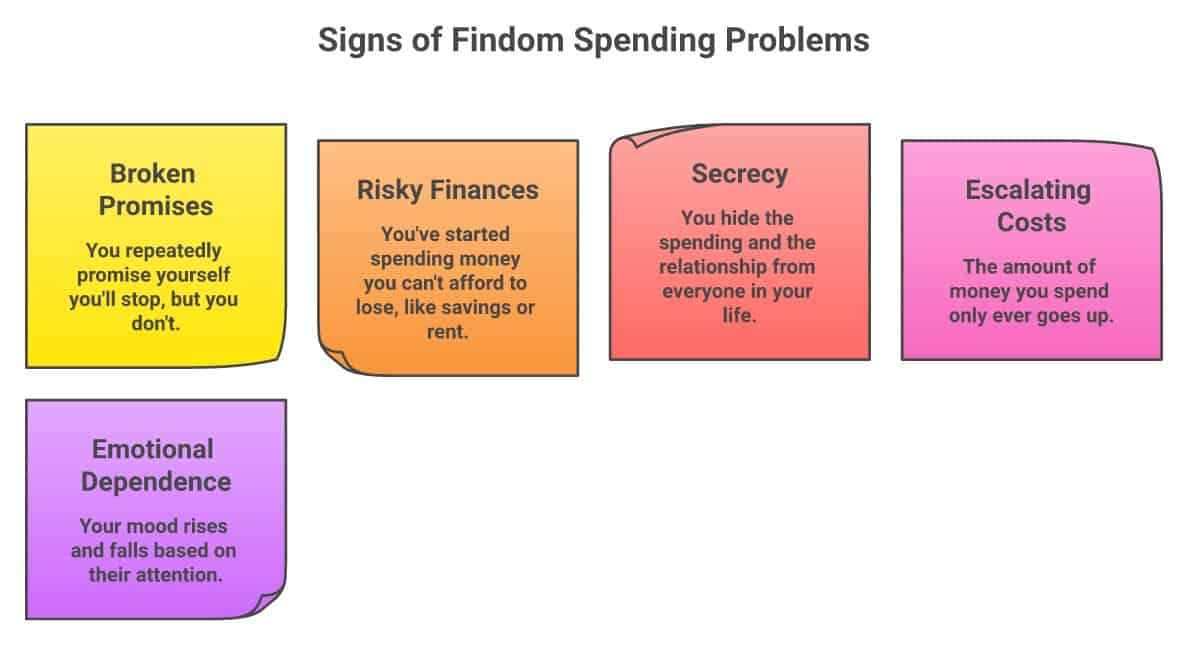
- You keep promising yourself you’ll stop, and you don’t.
- You’ve moved from “fun money” to money you can’t afford to lose — savings, retirement, the rent.
- You hide the spending, or the relationship, from everyone in your life.
- The amount only ever goes up; what satisfied you last year doesn’t now.
- Your mood rides on their attention — euphoric when they respond, hollow when they don’t.
- You’ve started telling yourself losing everything would mean you “served well.”
That last one is the one that worries me most. When the ruin starts to feel like the point — when emptiness becomes the goal instead of the cost — that’s not a money problem anymore. That’s a pain that was there long before any of this, and the dynamic found it. That’s worth talking to someone about. Not because you’re broken. Because you’re worth more than what’s being taken.
If it’s someone you love
Maybe you’re not the one in it. Maybe you’re a spouse, a parent, a friend, and something feels off. Here’s what tends to show up — quietly, because shame keeps it hidden:
- Money disappearing with no explanation — drained accounts, maxed cards, cash withdrawals, gift cards.
- New secrecy around the phone or computer; screens that flip face-down when you walk in.
- A new “online relationship” they won’t talk about, paired with mood swings tied to it.
- Pulling away from family and friends.
- Defensiveness or panic — way out of proportion — when money comes up.
If that’s someone you love, the worst thing you can do is lead with shame — shame is the lock on this door, not the key. You don’t open with “how could you.” You open with “I’m not here to judge you, I’m worried about you, and I’m not going anywhere.” Then you help with the practical part: the password changes, the bank call, the structural barriers. And you point them, gently, toward someone trained to handle the rest. You can’t love someone out of this on your own, and you shouldn’t try to carry it alone either — the same helplines above are for you too.
If you do stop, be honest with yourself about the loss
I’m not going to pretend walking away is just relief. If you stop paying, the attention probably stops too, and that silence is going to feel like a death — because for a while, this was the thing that made you feel wanted, seen, useful, alive. That loss is real. I’m not going to insult you by calling it nothing. The first stretch after you stop is the hardest, and it’s the stretch where people go back, not because the money called them but because the emptiness did. That’s exactly when you lean on the person you told and the help you lined up. You’re not just quitting a habit. You’re grieving something, and grief needs somewhere to go that isn’t your bank account.
What I want you to take from this
I’m not going to tell you what to want or who to be. I told you that at the top and I mean it at the bottom.
But I’ll tell you the math, because somebody has to, and because the dynamic you’re in has a reason for making sure nobody does: in nearly every case I’ve watched over more than 30 years, when everything you have flows to one person whose promise is to keep you only as long as the money lasts, it ends in one place — you, with nothing, and the relationship gone anyway. The thing you were most afraid of losing was never actually being protected. It was being spent.
You can look at that and still choose what you choose. That’s your right. I only want you to be able to look at it — clearly, without the shame, with the choice genuinely back in your own hands. That’s the whole reason this site exists.
And if you got this far and you recognized yourself, or someone you love — that already took something. That’s not nothing. That’s the step before the step.
One more thing, from me to you. Everything here is input — my experience, my read, the facts as I found them. Only you live your life, and only you get to decide what to do with it. Take what’s useful, leave the rest. And if you want to think it through with someone who won’t judge you and won’t repeat a word of it, that’s exactly what the anonymous chat on this site is for. — Steve
If this might reach someone who needs it — someone quietly losing the math while everyone assumes they’re fine — send it to them. Sometimes the permission to look is the only thing missing.
Go deeper: If you want to understand how this happens — the four stages a person moves through, and why it’s never really about the money — I broke it all down in The Four Stages of Sexual Financial Domination: How Debt Becomes a Feeling.
Dealing With Debt? Understanding your options is the first step. See how all your debt relief options compare — including ones most sites won’t tell you about. The Find Your Path quiz gives a recommendation based on your actual numbers, and the Scam-O-Meter checks any company’s complaint history before you sign. Federal Reserve research shows bankruptcy filers recover faster than those who don’t file.



