

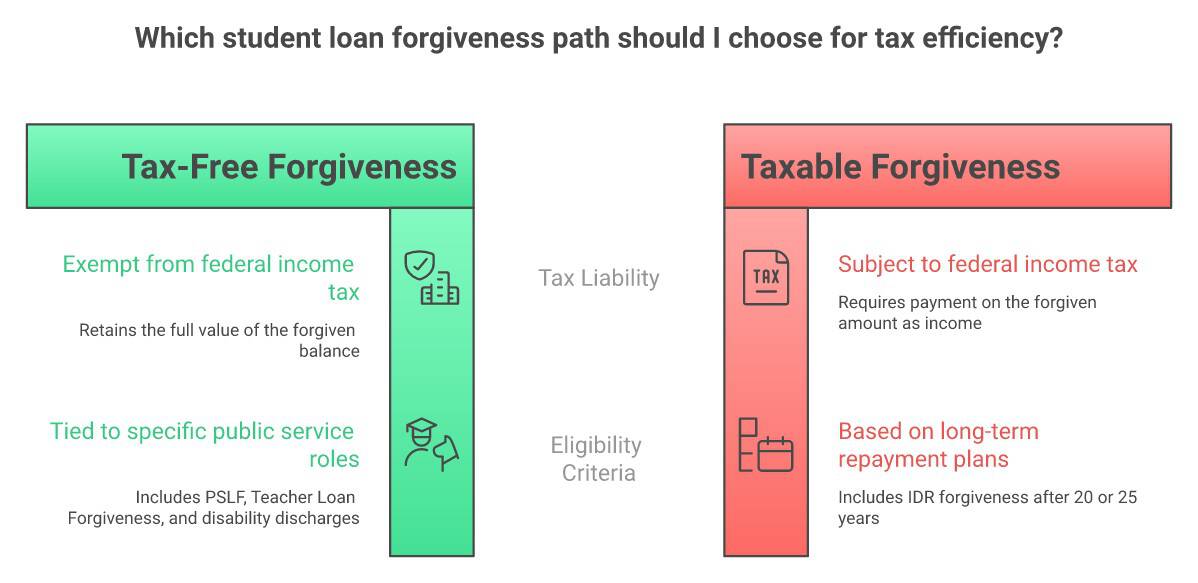
Quick Answer: Student loan forgiveness is taxable again at the federal level starting in 2026. The temporary rule that made most forgiveness tax-free expired on December 31, 2025, and Congress did not extend it. The big change hits income-driven repayment (IDR) forgiveness — the cancellation of your remaining balance after 20 or 25 years of payments — which the IRS now treats as taxable income. But three important kinds of forgiveness are still completely tax-free in 2026: Public Service Loan Forgiveness (PSLF), Teacher Loan Forgiveness, and discharges due to death or total and permanent disability. And even if your forgiveness is taxable, you may owe nothing — if you were insolvent when the debt was canceled, you can legally exclude it.
Related: Federal judges just struck down the new pslf employer restriction — here is what it means for public service borrowers.
Expert Context: I’ve tracked federal student loan and debt relief programs since I founded my first nonprofit in 1994, and one thing I’ve learned the hard way is that the rules change underneath people without anyone sending them a heads-up. For five years, borrowers got used to forgiveness being tax-free. That window just closed, quietly, and a lot of people are going to be blindsided at tax time if no one tells them. This is me telling you.
If you’re counting on student loan forgiveness — especially after decades on an income-driven plan — there’s a tax change you need to understand before it catches you off guard.
Each weekday I send one short email: one story that caught my attention, why it might matter to you, and one manageable thing you can do with it. A couple of minutes, and a dad joke.
In the latest issue (Nov 6): Owed money on an Amazon return? Check by Dec. 1
Free. I sell nothing. Unsubscribe any time.
Here’s the assumption I want to correct, because it was true until very recently: “Student loan forgiveness is tax-free.” From 2021 through the end of 2025, that was largely accurate. The American Rescue Plan Act made most federal student loan forgiveness exempt from federal income tax — but only for loans forgiven after December 31, 2020, and before January 1, 2026.
That provision has now expired. As the IRS Taxpayer Advocate Service explains, forgiveness in 2026 and beyond is once again treated as “cancellation of debt income” unless a specific exception applies. So the assumption that served you fine last year could leave you with a surprise tax bill this year.
Key Terms Defined
Cancellation of debt income: When a lender forgives debt you owe, the IRS generally treats the forgiven amount as if it were income you received — meaning it can be taxed. You’d typically get a Form 1099-C reporting the canceled amount.
Income-driven repayment (IDR) forgiveness: Plans like SAVE, PAYE, and IBR cap your monthly payment based on income and cancel any remaining balance after 20 or 25 years of payments. That canceled balance is what’s now taxable in 2026.
Insolvency exclusion: A long-standing tax rule (IRC Section 108) that lets you exclude canceled debt from income to the extent your debts exceeded your assets when the debt was forgiven. You claim it with IRS Form 982.
Free Tool — 1099-C Tax Calculator: Received a 1099-C for cancelled debt? The free 1099-C Tax Calculator runs the exact IRS insolvency math from Publication 4681 Worksheet 2 — and covers the partial insolvency case most people miss. Run the Calculator →
What’s still tax-free in 2026 — and what isn’t
This is the part the scary headlines usually skip, and it matters a great deal depending on which program you’re in. Not all forgiveness is taxable now. According to the IRS Taxpayer Advocate Service, several major types of forgiveness remain completely free of federal tax.
Still tax-free in 2026
- Public Service Loan Forgiveness (PSLF) — exempt under a separate, permanent part of the tax code. This did not change.
- Teacher Loan Forgiveness — remains tax-free.
- Death and total & permanent disability discharges — do not create a tax liability. (Starting in 2026, claiming this exclusion requires the borrower’s own Social Security number on the tax return — 26 U.S.C. §108(f)(5)(C) requires the taxpayer’s number, not a spouse’s — so make sure it’s there.)
Now taxable federally in 2026
- Income-driven repayment (IDR) forgiveness — the balance canceled after 20 or 25 years is now taxed as income.
- Other general forgiveness that relied on the expired American Rescue Plan exclusion.
The Claim: “My student loan forgiveness will be tax-free, like everyone’s been saying.”
The Reality: That depends entirely on which kind of forgiveness you get. PSLF, teacher forgiveness, and death/disability discharges are still tax-free. But if your balance is canceled through an income-driven repayment plan in 2026, the federal government now counts it as taxable income — a change from the past five years.
The escape valve most people don’t know about
Here’s the good news, and it’s the reason I never want anyone to panic over a tax bomb. Even when forgiveness is taxable, a lot of people end up owing little or nothing — because of the insolvency exclusion.
The rule is straightforward in principle: if, immediately before your debt was forgiven, your total debts were greater than your total assets, you were “insolvent” in the eyes of the IRS. To the extent you were insolvent, you can exclude the forgiven debt from your taxable income by filing Form 982 with your return. The IRS Taxpayer Advocate confirms this option is still available.
Think about who reaches IDR forgiveness after 20 or 25 years: often people whose balances grew because their income was never high enough to cover the interest. Many of them are exactly the people most likely to qualify as insolvent. This isn’t a loophole — it’s a fairness provision built into the tax code, and it exists precisely so canceled debt doesn’t push struggling people into a tax bill they can’t pay. I wrote more about how cancellation-of-debt income and Form 982 work if you want the full picture.
One more wrinkle: your state. Federal tax is only half the story. Some states follow the federal rules, and some don’t — meaning your forgiveness could be tax-free federally but taxed by your state, or vice versa. Because state rules vary and change, don’t assume. Check with your state’s tax agency or a tax professional about how your state treats forgiven student debt before you plan around it.
What to think about doing
- Find out which program is forgiving your loans. PSLF, teacher, and death/disability discharges are tax-free — no action needed on the tax side. IDR forgiveness is the one to plan for.
- If your forgiveness landed right around the cutoff, check which date governs. What matters for taxes is the date your loan was actually discharged, not when the paperwork finished processing. With servicer backlogs, some people who became eligible in 2025 didn’t get their discharge notice until 2026 — verify with your servicer or a tax professional which date applies to you before assuming you owe.
- If you’re nearing IDR forgiveness, estimate the potential tax now, not in April. Knowing the number ahead of time turns a panic into a plan.
- Check whether you’d qualify as insolvent. Add up everything you own and everything you owe. If your debts exceed your assets, Form 982 may wipe out part or all of the tax.
- Don’t drain retirement or savings to pre-pay a tax you might not owe. Run the insolvency math first. Protecting your future security comes before chasing a bill that may shrink to nothing.
- Talk to a tax professional if your forgiven balance is large. This is one of those situations where an hour of advice can save thousands.
Key Takeaways
- The tax-free rule for student loan forgiveness expired December 31, 2025, and was not extended.
- IDR forgiveness (after 20–25 years of payments) is now federally taxable in 2026.
- PSLF, Teacher Loan Forgiveness, and death/disability discharges remain 100% tax-free.
- The insolvency exclusion (Form 982) can eliminate the tax for many borrowers who owe more than they own.
- State tax treatment varies — check your state separately.
The Bottom Line
A rule changed quietly at the end of last year, and the people most likely to get hurt by it are the ones who already carried student debt the longest. If that’s you, take a breath — this is manageable. Find out which program is forgiving your loans, because the tax-free protections for public servants, teachers, and people with disabilities didn’t go anywhere. And if your forgiveness is the taxable kind, remember that owing more than you own isn’t just a hardship — under the insolvency rule, it can be the very thing that erases the tax. You spent decades carrying this debt. Don’t let a surprise at tax time undo the relief of finally being free of it. Forward this to anyone you know counting on loan forgiveness — they need to know the rules changed.
Frequently Asked Questions
Is student loan forgiveness taxable in 2026?
It depends on the type. Income-driven repayment (IDR) forgiveness is federally taxable in 2026 because the temporary tax-free rule from the American Rescue Plan expired December 31, 2025. But PSLF, Teacher Loan Forgiveness, and death or total-and-permanent-disability discharges remain completely tax-free.
Why did student loan forgiveness become taxable again?
The American Rescue Plan Act of 2021 made most federal student loan forgiveness tax-free, but only for loans forgiven after December 31, 2020, and before January 1, 2026 — covering tax years 2021 through 2025. Congress did not extend that provision, so beginning in 2026 the IRS once again treats most forgiveness as cancellation of debt income.
Is PSLF still tax-free in 2026?
Yes. Public Service Loan Forgiveness is exempt under a separate, permanent provision of the tax code, so it remains tax-free in 2026 and beyond. The expiration of the American Rescue Plan exclusion did not affect PSLF.
How can I avoid paying tax on forgiven student loans?
The most common way is the insolvency exclusion. If your total debts were greater than your total assets immediately before the forgiveness, you can exclude some or all of the canceled amount from income by filing IRS Form 982. Many people who reach IDR forgiveness after decades of payments qualify. A tax professional can help you calculate it.
Will my state tax my forgiven student loans?
Maybe. State tax treatment of forgiven student debt varies — some states follow federal rules and some don’t. Your forgiveness could be handled differently at the state level than at the federal level. Check with your state’s tax agency or a tax professional, since the federal change in 2026 doesn’t automatically tell you how your state will treat it.
Dealing With Debt? Understanding your options is the first step. See how all your debt relief options compare — including ones most sites won’t tell you about. The Find Your Path quiz gives a recommendation based on your actual numbers, and the Scam-O-Meter checks any company’s complaint history before you sign. Federal Reserve research shows bankruptcy filers recover faster than those who don’t file.
And if your loans were on the SAVE plan, there’s a related surprise worth knowing about — the truth about what “paused” SAVE loans are really doing to your balance while you weren’t being billed.
Related: Choosing a repayment plan this summer? The new Repayment Assistance Plan launches July 1 — and the lowest monthly payment isn’t always the cheapest loan. Compare the total cost before you enroll.



