

I want to talk about something most money writers won’t touch, because the moment you say the word out loud, people either laugh or look away. Neither reaction helps the person living it.
Financial domination — “findom” — is a fetish in which one person, the submissive, sends money to another person, the dominant, and gets something out of the sending itself. No product changes hands. Often nothing changes hands at all — no photos, no meeting, sometimes not even a video call. The money is the relationship. The people in this world use their own vocabulary, and I’ll use it too because it’s theirs: the submissive who sends the money is a “paypig” or a “money slave,” and the dominant who receives it is a “findomme,” a “goddess,” or a “cash master.” It lives mostly online, on X, OnlyFans, and gifting sites, paid through Cash App and PayPal.
Here’s the first thing I need you to know: it’s real, it’s bigger than you’d guess, and it is not new. Don’t let the modern names fool you — the impulse behind findom is as old as money and power themselves. Findom is a flavor of dominance and submission, and the erotic pull of power over another person is ancient: an Etruscan tomb near Tarquinia, painted around 490 BC, shows a flagellation scene in plainly erotic terms. What’s genuinely modern isn’t the desire — it’s consent. Historians are careful to note that those ancient scenes were rarely consensual in the way we’d mean it today; the idea that this only works when everyone freely agrees is the new part, and it’s the whole ballgame. People have paid to be dominated, showered tribute on someone who treated them with disdain, and tied their worth to how much they could give away, for about as long as there has been money to give. I’d bet that somewhere in the ancient world, long before anyone had a phone, some lovestruck soul handed over a prized goat to someone who barely looked his way — and felt the exact same rush a paypig feels tapping “send” today. The livestock changed. The wiring didn’t.
The internet didn’t invent any of that. It just stripped out every speed bump: no nerve required to do it in person, payment in two taps, a dom available any hour of the day, anywhere in the world. What used to take real-world courage and a face-to-face arrangement now takes a phone and a bad night. That’s why it surged on TikTok, and why there’s now a small but real body of academic research on it. This isn’t a fringe curiosity. It’s a thriving corner of the economy where the only thing being sold is the act of giving money away.
The Daily Money Brief — Free, at 10 AM
Money you may be owed, scams to dodge, and the fine print decoded — the consumer money news that affects your wallet, every weekday.
Every weekday I read the enforcement actions, filings and fine print the outlets skip, and turn them into the one or two moves that actually improve your position — a rate worth moving for, a fee you can refuse, a deadline to beat before it costs you.
In the latest issue (Oct 8): A parent's nursing home bill can become yours
I write Your Money Actually most weekdays — actionable money information you will not find anywhere else, and the small decisions that compound. It is free, I sell nothing, and I take no money from any company I write about.
And that’s exactly why I find it so interesting — not as a sex story, but as a money story. Findom sits at the intersection of sex and money, and it lays open a truth I’ve spent over thirty years watching play out in every kind of debt, since I started doing this work in 1994: debt is rarely about math. Debt is math wrapped in emotion. In all those years sitting across from people in financial crisis, the number on the page was almost never the real problem. People don’t spend their way into ruin because they can’t do arithmetic. They spend because the spending feels like something — relief, belonging, control, punishment, love. Findom just removes the disguise. There’s no car, no vacation, no thing to point at. There’s only the feeling, and the receipt.
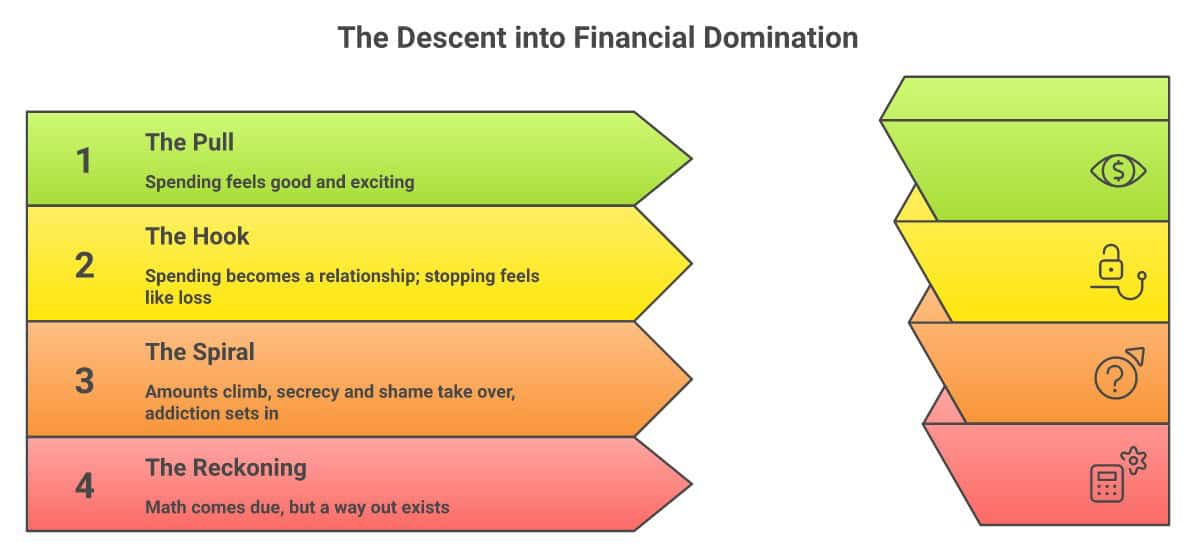
So let me walk you through how it actually unfolds. Not to judge anyone — I’ll say plainly that consenting adults get to make their own choices, and I mean that. But because once you see the four stages, you’ll recognize the shape of them in a lot more than findom. You’ll recognize them in any debt that grew up out of a feeling.
Stage One: The Pull
It starts as a thrill. For the dominant, the appeal is honest and it isn’t only the money — it’s the power. A former findomme named Yevgeniya Ivanyutenko told Rolling Stone exactly what the draw was:
“It was absolutely exhilarating to log on every day and see men sending me money for no apparent reason and nothing in return but my disdain.”
For the person sending the money, the pull is just as real, and at this stage it’s harmless fun. A student named Mark explained it to Vice in the most ordinary terms imaginable:
“Everyone has things they spend money on that give them pleasure, this is mine.”
And he named the feeling underneath it without flinching: “I guess it’s like where gambling meets sex — you’re chasing that thrill.”
Read those two quotes again, because they tell you why I refuse to treat everyone in this picture as a victim. A willing adult who spends money he can afford on something that gives him pleasure is doing what every one of us does. I spend on flying. You spend on whatever lights you up. If that’s where it stayed, there would be nothing here for me to write about. The trouble isn’t the thrill. The trouble is what the thrill turns into — and here’s the part that surprised even me.
The pull isn’t an accident. It’s a formula, and the formula can be taught. The same Rolling Stone profile follows Ivanyutenko after she left the work to teach it — running webinars on brand and character creation, money management, even how to file taxes as a sex worker. She compares findom to professional wrestling: performance art, myth-making, world-building. And she’s blunt about what the job actually requires:
“You don’t have to be supermodel gorgeous in order to do this as long as you understand BDSM power dynamics and your client’s particular buttons.”
That phrase is the tell — your client’s particular buttons. Success, she says, “doesn’t depend so much on hot tips to make your man go wild but on business acumen, and a well-crafted story.” That is the whole thing in one sentence, and it should change how you read everything that follows.
The person on the other end isn’t randomly lucky. They are studying which of your emotional buttons to press — and pressing them on purpose.
Once you know that, the question stops being “why would anyone fall for this?” The buttons are real. We all have them. Someone just learned how to find yours — and that is exactly how a thrill becomes a hook.
Stage Two: The Hook
Somewhere along the line, the kink stops being a thing you do and becomes the relationship you have. This is the hook, and it’s where the emotion quietly takes the wheel from the math.
The researchers see it. In the one peer-reviewed study of findom from the dominant’s side — McCracken and Brooks-Gordon, 2021 — one participant described what keeps the submissive coming back: “The money makes one feel loved and special… the attention is what is addictive.” That study was of the dominants, not the submissives, so I won’t pretend it explains the paypig’s mind from the inside. But it names the currency being traded, and it isn’t dollars. It’s feeling loved.
Once that’s the currency, the math goes invisible. I’ve watched this exact mechanism in ordinary debt for three decades: the spending becomes the proof of something — that you’re generous, that you matter, that you’re devoted — and so protecting your money starts to feel like betrayal. That’s the hook. It’s not “I can’t afford this.” It’s “if I stop, I’ll lose them.” Nobody in this stage is worried about their savings account. They’re worried about being dropped.
Remember Mark, the level-headed student from a moment ago — the one who called it a harmless pleasure he could afford? He also described a single “drain” session that cost him about £600 in one go, and in nearly the same breath called it electrifying. Hold those two facts together, because that is the whole engine of this in one sentence: the loss and the thrill arriving at the exact same instant. When the spending is the high, the size of the number isn’t a brake on it. The number is part of the rush. That’s why “look at what you’re spending” lands on deaf ears. The spending and the looking are the same pleasure — the number isn’t a warning to him, it’s the point.
And here is where I have to be honest about something else, because the hook is also exactly where fraud slips in — and fraud is not something either side ever agreed to. Some accounts posing as findommes aren’t in the lifestyle at all; they’re catfish running a con, using stolen photos to drain whoever bites. One former paypig who crossed over and became a scammer himself told Vice:
“There was a lot of easy money to be made and being a victim gave me an incentive to victimise others.”
So let me draw the line as plainly as I can, because it matters. Consensual findom between adults who know exactly who they’re dealing with — even findom that’s costing someone too much — is their business, not mine to judge. The line where it stops being a choice is in two places: when someone lies about who they are to get the money, or when someone uses what they know about you — your images, your accounts, your secrets — to threaten you into paying. That’s not kink. The first is fraud; the second is extortion. And extortion built on the threat to release intimate images is a serious crime under state and federal law — the FBI’s complaint center logged 54,936 sextortion and extortion complaints and $33.5 million in losses in 2024, up 59% in a single year. If that’s where you are, you’re not a participant in a kink. You’re a victim of a crime, and you can report it.
Stage Three: The Spiral
If the hook sets, the spiral follows, and it has a predictable shape: the amount climbs, the secrecy deepens, and the shame seals the door shut.
The climbing is built in. Like any compulsion, it takes more over time to feel the same — the clinical compulsive-buying research describes the same tolerance pattern you’d see with gambling. What started as a $20 tribute becomes a few hundred, then a paid phone bill, then a credit card someone else is allowed to use. A man named Kurt in Amsterdam, who ended up declared bankrupt, told SBS what the spending actually did for him — and it had nothing to do with money:
“It is like temporarily not existing. It’s just to escape.”
That sentence is the whole story in eight words. The money was never the point. The point was to disappear for a minute. And here’s the math he could only see from the bottom:
“What I’ve spent over the years, I would’ve been able to buy a freestanding house and two really good cars.”
The reason it gets that far is the secrecy, and the secrecy is made of shame. People hide this not because it’s private but because they’re terrified of what it says about them. That fear is the lock on the door — it keeps the spending invisible to the one spouse, friend, or doctor who might have helped, until the only person who knows is the one being paid. I’ve seen the same shame keep people silent about credit-card debt, gambling debt, every kind of debt that grew out of a feeling. The feeling tells you that you are the only one, that no one would understand, and that telling anyone would be the end of you. The feeling is lying to you.
And behind that locked door, the word the people living it reach for isn’t “hobby” anymore. It’s “addiction,” and they mean it clinically, not casually. A 25-year-old named Asif told Vice that it was “the first thing I think of in the morning and the last thing I think about at night.” Then he said the part that matters most:
“For me, it’s an addiction… I’ve tried everything to get past it, but nothing works.”
Another man, Darren, 50, put the same wall a different way: “I don’t know if I could ever stop for good, or how I would.” Stay with what those two men are telling you, because it’s the whole reason a debt site is the right place for this conversation. This is the point where “just say no” stops being advice and starts being an insult. Imagine telling someone in active addiction to simply want it less. We don’t say that to a gambler or a drinker — we’ve learned better — and yet it’s the first thing people fire at someone drowning in a spending compulsion. “Stop spending” is not a plan. It’s a judgment dressed up as one. If willpower were the cure, Asif would already be free; he tried everything, and everything didn’t work. That’s not a character flaw. That’s what addiction is. And it’s exactly why the way out, when we get to it, does not start with a budget.
Stage Four: The Reckoning
Every spiral ends the same way: the math comes due. The account is empty, the cards are maxed, and the feeling that all of it was buying — to be wanted, to escape, to matter — is gone, leaving only the balance. When a writer at Vice asked a man named Mark, who’d lost more than $12,000 to a catfish, what hurt most, his answer wasn’t about the money:
“It was more emotional hurt than financial hurt… No amount of money can heal the emotional hurt I experienced.”
This is the part where, after thirty years, I get to be useful — because the reckoning is the one stage that’s actually fixable. The feeling is the hard part. The math, believe it or not, is the easier part. But you have to do them in this order, because you can’t add up a number you’re still too ashamed to look at.
First, you treat the driver, not the symptom. This is why I said the way out doesn’t start with a budget. You cannot out-budget an addiction any more than Asif could “try everything” his way out of one. The empty account is the burned wood. The fire was the need underneath — to be wanted, to surrender control, to escape for a while. If you only pay off the debt and never touch the need, the spending finds a new outlet. So the real first step isn’t financial at all. It’s telling one person. And if “tell someone” feels impossible — if you can’t imagine saying it out loud — then start smaller. Write it down somewhere no one will see. Then take it to someone who can’t judge you and can’t trace you.
The one sentence to start with. If the specifics are too humiliating to say, you don’t owe anyone the rest of the story. You can walk into a doctor’s office and say only this:
“I have a compulsive spending pattern I can’t stop, and I think it’s affecting my health.”
That’s enough. It opens the door without making you confess a thing you’re not ready to confess. The right help on the other side is a kink-aware, sex-positive therapist who won’t shame you for the fetish — because one shaming session and you’ll never go back. There’s also Debtors Anonymous, free and anonymous, first names only.
I walked through every one of these first steps — the script, the smallest possible move, how to find help that won’t shame you — in detail just yesterday, in a companion piece written for the person who’s living this right now: Findom Took My Savings and I Couldn’t Stop: What I Need You to Know. If any of this is you, start there. It’s the gentlest door I know how to build.
Second, you deal with the wreckage — and here the news is far better than the shame will let you believe. Findom debt usually takes one shape: unsecured debt — credit cards, personal loans, overdrafts. Unsecured debt is exactly the kind bankruptcy exists to address, and I need you to sit with that, because shame will whisper that you have to suffer through every payment as penance. You don’t. Draining your retirement to pay off debt the law might wipe clean is one of the most expensive mistakes a person in this situation can make — your retirement savings are largely protected in bankruptcy, while the credit-card balance usually isn’t owed at all once you file.
I’ll be straight with you about the fine print, because anyone who promises you a clean slate without it isn’t being honest: every case is different. Debt run up through outright fraud — say, lying about your income on a credit application — can sometimes be challenged by a creditor, and timing and your income matter too. That’s exactly why the move here isn’t to guess. It’s to spend one free hour with a real bankruptcy attorney who can look at your actual numbers. You can find one near you through NACBA, the National Association of Consumer Bankruptcy Attorneys. Most offer a free first consultation. Go in knowing the law almost certainly gives you more options than the shame is letting you see.
If account access was shared or images were used to threaten you, that’s the crime line from Stage Two — freeze your credit at all three bureaus, change every password, call your bank’s fraud line, and report it at ReportFraud.ftc.gov or the FBI’s IC3. Paying a blackmailer almost never makes them stop.
Why this matters far beyond findom
I didn’t write this to explain a fetish. I wrote it because findom is the cleanest example I’ve ever found of the thing I most want you to understand about your own money.
Strip away the kink and the four stages are universal. The pull — spending that gives you a feeling. The hook — when the spending becomes proof of who you are, and stopping feels like loss. The spiral — escalation, secrecy, shame. The reckoning — the math, finally, coming due. That’s not just findom. That’s the online cart you fill at two in the morning. The shopping bags you carry in while no one’s home. The sports bet, the scratch tickets, the “I deserve this” that you can’t quite explain the next day. Different stage costume, same four acts — and in every one of them, someone has studied your buttons. The retailer with the countdown timer, the app with the slot-machine pull-to-refresh, the casino with no clocks and no windows. Findom just makes the formula visible by stripping away the product, so all that’s left is the button and the press. Once you can see the formula working on you, you’ve already taken the first step out of it. And if you just read that list and felt your stomach drop because one of them is yours — stay with me, because the way out is the same.
Debt is math wrapped in emotion. You will never out-budget a feeling you won’t look at. But you can do it the other way around — face the feeling first, and the math second — and the math, I promise you, is more forgiving than the feeling ever let you believe. That’s the whole way out, and it’s open to you.
My advice here is input, not instruction. I can show you the stages and the math and the exits, but only you live your life and only you get to decide. I’d just rather you decide with the whole picture in front of you, and without an ounce of shame clouding it. That feeling telling you you’re the only one? It’s wrong. You’re not, and there’s a door — and if any of this is hitting close to home, the companion piece I wrote yesterday is the gentlest one I know.
If this helped you understand someone — or yourself — a little better, send it to the person who needs it. You might be the one who hands them the door.
Dealing With Debt? Understanding your options is the first step. See how all your debt relief options compare — including ones most sites won’t tell you about. The Find Your Path quiz gives a recommendation based on your actual numbers, and the Scam-O-Meter checks any company’s complaint history before you sign. Federal Reserve research shows bankruptcy filers recover faster than those who don’t file.



