

Written by Steve Rhode, consumer debt expert since 1994 • Last updated June 16, 2026
Quick Answer: A debt collector threatening to sue may be bluffing — or not. Under the Fair Debt Collection Practices Act (15 U.S.C. § 1692e), it’s illegal for a collector to threaten legal action they have no intention of taking. But if the debt is real and in their name, they can sue. Your job right now: figure out whether this threat is real, request debt validation in writing, and know that bankruptcy’s automatic stay stops any lawsuit instantly the moment you file. Don’t ignore the threat hoping it goes away.
If the calls about a specific debt — like a retail store card — are the underlying issue, I have a step-by-step guide on how to document every collector call and what the FDCPA prohibits, including a June 2026 case that shows why your paper trail matters.
What a Lawsuit Threat Actually Means
When a debt collector says “we’re going to sue you,” one of two things is happening. Either they’re trying to scare you into paying — a scare tactic collectors use constantly — or they’ve actually sent your file to an attorney and litigation is coming. The problem is you can’t always tell which is which from a phone call.
Here’s what matters: if a collector threatens to take legal action they don’t actually intend to take, that’s a federal law violation. Threatening to sue on a debt that’s past the statute of limitations is also illegal. But if the debt is valid, within the filing window, and they’ve decided to collect through the courts — they can sue. And if they do and you don’t respond, a default judgment gives them tools to garnish your wages, freeze your bank account, or put a lien on your home.
The Mistake You’re About to Make: Freezing and doing nothing. Most people who get a lawsuit threat either panic-pay whatever the collector asks, or they avoid the mail hoping it goes away. Both are wrong. Panic-paying rewards an illegal threat if that’s what it is — and doing nothing turns a bluff into a real default judgment. The right move is to force the collector to show their cards in writing, check whether the debt is time-barred, and have a plan ready in case they actually file.
Your Options Right Now
What to Do in the Next 48 Hours
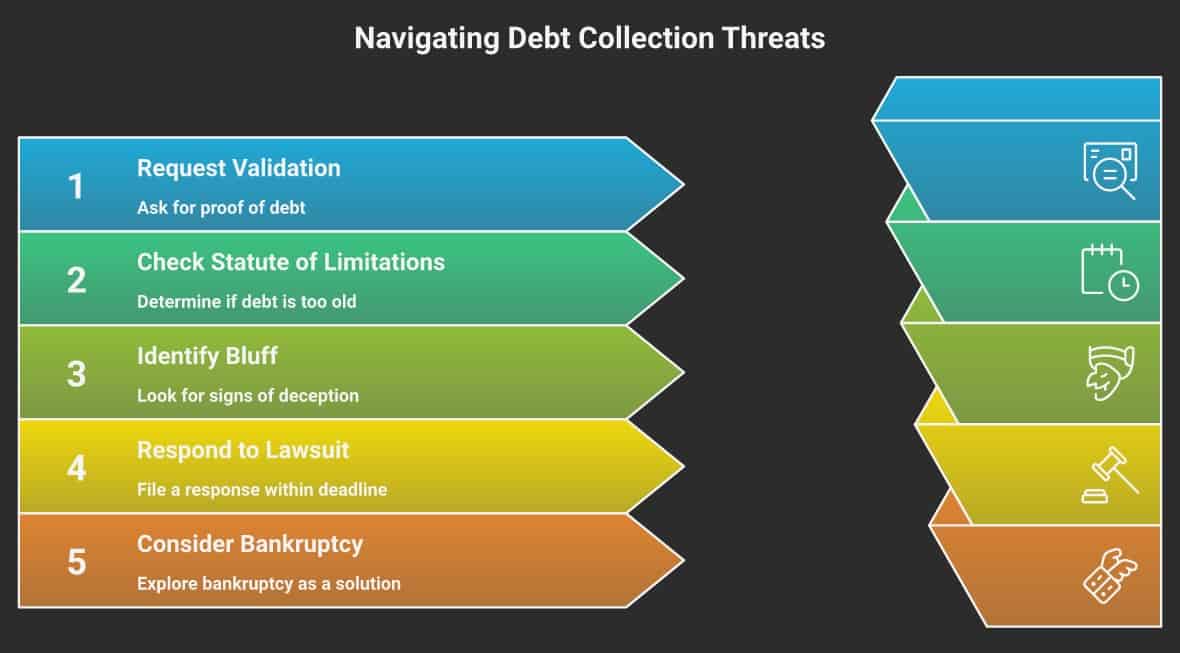
- Request debt validation in writing. Under 15 U.S.C. § 1692g, if you send a written dispute within 30 days of first contact, the collector must stop all collection activity until they verify the debt. Send it certified mail, return receipt requested, to create a paper trail. Keep a copy. This forces them to document that they actually own the debt and can prove the amount.
- Check whether the debt is time-barred. Every state has a statute of limitations for debt lawsuits — after which collectors cannot legally win in court. In New York it’s 3 years, California 4, Texas 4, Florida 4 (reduced from 5 in 2023), Illinois 5 years for credit cards. If your last payment was years ago, check this before doing anything else. A collector threatening to sue on a time-barred debt is violating the FDCPA — you can turn the tables on them.
- Look for signs the threat is a bluff. Real pre-litigation looks like a written letter from an actual attorney. Vague phone threats, no specific court named, boilerplate “we may pursue legal remedies” language, or a letter with fine print saying “no attorney has reviewed your account” — those are signs of an empty threat. The CFPB explains your rights if you’re actually sued.
- If they do file — respond by the deadline. You typically have 20 to 30 days after being served to file a written answer with the court. Failing to respond gives them an automatic default judgment without ever having to prove the debt is valid. Responding does not mean admitting anything. NACBA can connect you with a bankruptcy attorney and NACA can find you a consumer law attorney who handles debt lawsuits — often at low or no cost.
- If you want it stopped instantly, bankruptcy ends it. Filing any chapter of bankruptcy triggers an automatic stay under 11 U.S.C. § 362 that halts all collection activity, including pending or threatened lawsuits, the moment you file — not weeks later. Talk to Damon Day for free about whether that’s the right move for your situation. Damon Day, an independent debt coach and my co-host on the Get Out of Debt Guy podcast, whom you can reach at DamonDay.com — I receive no payment for this referral.
Free Tool — Statute of Limitations Checker: Dealing with old debt? The free Statute of Limitations Checker tells you if the collection clock has expired in your state — including the zombie debt and clock-restarting traps collectors use. Check My Status →
How to Actually Handle This — Your 4 Paths
- Bankruptcy — stops it the moment you file. Under 11 U.S.C. § 362(a), the automatic stay stops any lawsuit, threatened or filed, the instant your bankruptcy petition hits the court. If the collector willfully violates the stay after receiving notice, you’re entitled to actual damages, attorney fees, and potentially punitive damages under § 362(k). This is the nuclear option, but if you’re staring down multiple collection lawsuits it may be the math that makes sense. Federal Reserve research shows bankruptcy filers recover faster than those who delay filing.
- Respond to the lawsuit if they actually file. Filing an answer in court forces the collector to prove they own the debt, that the amount is correct, and that the SOL hasn’t expired. Many debt buyers — companies that purchase old debts for pennies on the dollar — cannot produce adequate documentation. If they can’t prove their case, you win. Deadline is typically 20 to 30 days from service; check your specific court papers.
- Negotiate a settlement before suit is filed. If the debt is real and the SOL hasn’t run out, settling for 40–60 cents on the dollar before a judgment is entered is often cheaper than fighting in court. Get any agreement in writing — the full settled amount, confirmation the rest is forgiven, and a promise not to sell the remaining balance — before paying a dime.
- What won’t stop it: ignoring it. Hoping the threat fades away works only if it was truly a bluff and they move on. If they actually file and you don’t respond, a default judgment lets them garnish your wages, freeze your bank, or put a lien on your home — without ever having to prove the debt in court.
What the Law Says About Collector Lawsuit Threats
Maximum statutory damages you can collect from a collector who makes illegal lawsuit threats (per 15 U.S.C. § 1692k), plus actual damages and attorney fees
Window to send a written validation request after first contact, forcing the collector to prove the debt before continuing collection
Statute of limitations to file your own FDCPA lawsuit against a collector who threatened illegal action
How fast the bankruptcy automatic stay stops a threatened or active lawsuit — the moment the petition is filed, not weeks later
Under 15 U.S.C. § 1692e(5), a debt collector may not “threaten to take any action that cannot legally be taken or that is not intended to be taken.” This means threatening to sue on a time-barred debt — one past the statute of limitations — is a federal FDCPA violation. So is threatening to sue by someone who has no actual intention of filing and is just using legal language to frighten you.
Under 15 U.S.C. § 1692e(3), it’s also illegal to falsely imply that a communication is from an attorney when no attorney has actually reviewed your file. Computer-generated letters with digital attorney signatures — where no actual lawyer looked at your account — are a well-documented FDCPA violation pattern.
| State | SOL for Credit Card Debt | Wage Garnishment for Consumer Debt |
|---|---|---|
| Federal baseline | Varies by state | Max 25% of disposable income (15 U.S.C. § 1673) |
| New York | 3 years (reduced 2022) | Allowed (10% of gross wages or amount over 30x federal minimum wage, whichever is less) |
| California | 4 years | Allowed (25% of disposable income) |
| Texas | 4 years | Prohibited for consumer debts (bank levy of deposited wages still possible) |
| Florida | 4 years (reduced from 5 in May 2023 — Fla. HB 341) | 100% exempt if you’re head of household — but you must claim it within 20 days of the writ being served on the garnishee |
| Pennsylvania | 4 years | Prohibited for consumer debts |
| North Carolina | 3 years | Prohibited for consumer debts |
| Illinois | 5 years (credit cards) | Allowed (15% of gross wages) |
If you live in Texas, Pennsylvania, North Carolina, or South Carolina — consumer creditors cannot garnish your wages even with a judgment. They can still levy your bank account and place liens on property, so the protection is real but not absolute. Texas residents: once wages are deposited in a bank, they lose their garnishment-exempt status. If you’re in Florida, the head-of-household exemption can protect 100% of your wages, but you must actively file a Claim of Exemption within 20 days of the garnishment notice.
If a collector made an illegal lawsuit threat, file a complaint with the CFPB and your state attorney general. You can also file with the FTC. If you need a consumer attorney to pursue FDCPA damages but can’t afford one, many FDCPA attorneys take cases on contingency — their fees come from the collector, not you. Find a consumer attorney through NACA. If you need legal help but can’t afford an attorney for a debt lawsuit defense, find free legal aid through LSC.gov.
Steve’s Take
I filed bankruptcy in 1990. I know what it feels like when a collector uses legal threats as a weapon — they’re counting on fear to make you do something you shouldn’t. Over 30 years I’ve watched people panic-pay collectors who had no intention of ever filing, and I’ve watched others ignore real threats until a judgment wiped out their bank account. The difference between those outcomes is almost always whether someone stopped, asked the right questions, and forced the collector to put it in writing. Request that validation. Check the statute of limitations. Don’t pay a dime until you know whether this threat is legal.
You may have seen people say you never have to pay a collector. Here’s the honest version of that advice — your rights are real, but a summons changes everything.
Free Tool — Wage Garnishment Calculator: Worried about your paycheck being seized? The free Wage Garnishment Calculator shows exactly how much creditors can legally take in your state — and some states prohibit garnishment entirely. Calculate My Risk →
Frequently Asked Questions
A debt collector is threatening to sue me — is this legal?
It depends. Under 15 U.S.C. § 1692e(5), a collector cannot threaten to take legal action they don’t actually intend to take, or that can’t legally be taken. Threatening to sue on a time-barred debt is an FDCPA violation. If the debt is valid, current, and they genuinely intend to file, the threat is legal — but you still have rights and options.
How do I know if the lawsuit threat is real or a scare tactic?
Real pre-litigation typically comes in writing, references a specific court or attorney, and uses precise language about filing. Red flags that it’s a bluff: vague phone warnings about “legal action,” no attorney name, fine print saying “no attorney has reviewed your file,” or a debt that’s years past your last payment. Under 15 U.S.C. § 1692e(3), falsely implying an attorney has reviewed your file when they haven’t is itself a violation.
What happens if a debt collector actually sues me and I don’t respond?
The court enters a default judgment against you automatically — the collector wins without having to prove the debt is valid. That judgment then gives them tools to garnish your wages, freeze your bank account, or place a lien on your property. The CFPB warns that fighting the case before a judgment is entered gives you a far better chance than trying to reverse one afterward.
I filed bankruptcy — how fast does it stop a debt lawsuit?
Instantly. Under 11 U.S.C. § 362(a), the automatic stay takes effect the moment you file your bankruptcy petition — not days later, not when the court notifies the creditor. It stops any pending or threatened lawsuit, wage garnishment, and collection contact. If a collector willfully continues after receiving notice of your filing, you may be entitled to damages under § 362(k).
My last payment was years ago — can they still sue me?
It depends on your state’s statute of limitations. New York: 3 years. California, Texas, and Florida: 4 years (Florida reduced from 5 to 4 years in May 2023 via HB 341). Illinois: 5 years for credit cards. If your last payment was past your state’s limit, the debt is “time-barred” — the collector can no longer win in court, and threatening to sue on it is an FDCPA violation. Important: making a payment or acknowledging the debt in writing can restart the clock in some states.
The debt collector is threatening to garnish my wages — can they do that?
Not without a court judgment first. Collectors must sue, win, and then get a court order before touching your wages. And even then: Texas, Pennsylvania, North Carolina, and South Carolina prohibit consumer debt wage garnishment entirely. Florida’s head-of-household exemption can protect 100% of wages — but you must file a Claim of Exemption within 20 days of garnishment notice. Everywhere else, federal law caps garnishment at 25% of disposable income under 15 U.S.C. § 1673.
What can I do if a collector made an illegal lawsuit threat?
You can sue them under 15 U.S.C. § 1692k for up to $1,000 in statutory damages plus actual damages and attorney’s fees. Many FDCPA attorneys take these cases on contingency — their fee comes from the collector, not you. You have one year from the violation to file. Also file complaints with the CFPB, your state attorney general, and the FTC.
Should I send a written validation request?
Yes — if you’re within 30 days of the collector’s first contact. Under 15 U.S.C. § 1692g, a written validation request forces the collector to stop all collection activity until they document the debt amount, who owns it, and that they have the right to collect it. Send it certified mail and keep a copy. Many debt buyers — companies that purchased your debt for pennies on the dollar — can’t produce adequate documentation and will move on.
One more thing — everything I share here comes from over 30 years of watching people navigate these exact situations. But my perspective is input for your decision, not the decision itself. Only you know your full financial picture. Talk to an attorney, look at your numbers honestly, and make the choice that protects your future — not just the one that stops the fear right now.
If the collector hasn’t yet threatened to sue and is just calling repeatedly, see my guide on what to do when debt collectors are calling you — including how to use the 30-day validation window and send a legally binding cease-and-desist letter.
Important: This guide is for informational purposes only and is not legal advice. Laws vary by state, and your situation may have details that change what options are available to you. For legal advice specific to your case, consult an attorney licensed in your state. NACBA can help you find a bankruptcy attorney, NACA can connect you with a consumer attorney, or talk to Damon Day for free about your situation. Damon is my podcast co-host, and I receive no payment for this referral.
Key Takeaway: A lawsuit threat may be a bluff — but acting like it’s real is always the safer call. Request debt validation in writing, check whether the debt is past the statute of limitations, and don’t pay anything until you know where you actually stand. If they file, you have 20 to 30 days to respond. If you want it stopped before they get that far, the Find Your Path quiz can help you see all your options — including the ones most sites won’t explain.
The Bottom Line
Getting a lawsuit threat doesn’t mean you’re out of options — it means you need to act before the collector does. The system that let this debt pile up also built protections into the law for exactly this moment: the right to demand proof, the right to know whether a threat is even legal, and the right to stop the whole thing in its tracks by filing bankruptcy. The people I’ve seen come through this the best are the ones who stopped panicking long enough to ask the right questions. If someone you know just got a lawsuit threat from a debt collector, send them this page — knowing their rights is the first step to using them. See the complete wage garnishment and debt judgment guide for deeper state-specific rules, or take the Find Your Path quiz for a personalized recommendation.
Dealing With Debt? Understanding your options is the first step. See how all your debt relief options compare — including ones most sites won’t tell you about. The Find Your Path quiz gives a recommendation based on your actual numbers, and the Scam-O-Meter checks any company’s complaint history before you sign. Federal Reserve research shows bankruptcy filers recover faster than those who don’t file.
Related: Before the lawsuit lands, a process server may come looking for you first — and dodging them is the costliest mistake you can make. A Process Server Is Trying to Find Me. Here’s What to Do Right Now.
Related: If the threats escalated to threats of arrest, that’s a separate and explicit FDCPA violation. Here’s what to do: A Debt Collector Threatened to Have Me Arrested.
Right now you are dealing with the thing in front of you, and that is exactly where your attention belongs. When it is handled — and it will be — there is a next stage, and it is the one I most enjoy writing about.
In the latest issue (Nov 6): Owed money on an Amazon return? Check by Dec. 1
Each weekday I send one short email: one story that caught my attention, why it might matter to you, and one manageable thing you can do with it. It is free, I sell nothing, and I take no money from any company I write about.



