

You signed up for a debt settlement program because someone promised you a way out. Maybe they said they’d cut your balances in half. Maybe they told you to stop paying your creditors and send the money to them instead. And now, months or years later, you’re looking at the wreckage: fees gone, debts unsettled or barely touched, collectors circling, and credit worse than when you started. If you’re close to retirement, the fear is sharper — because you don’t have decades to recover from this.
I’ve sat across from people in exactly this spot for over 30 years. So let me tell you the two things that matter most: first, this is not the end of your options. Second — and this is the part nobody warns you about — the biggest cost of a failed settlement program usually isn’t the fees you paid. It’s the time.
Where this topic came from: A recent conversation in my free Ask Steve chat raised exactly this kind of situation. I’m not giving away any personal information here — I never do — but when a real question shows me a gap worth covering, I write the answer for everyone. If you’re facing something like this yourself, ask me about it in the chat. It’s free, it’s private, and I’m not selling anything.
The Quick Answer
If a debt settlement program failed you, you can stop the bleeding today: you can leave the program at any time (you’re never locked in), you may be owed a refund of fees for debts that were never settled, and you still have every debt-relief option you had before — including ones the settlement company never mentioned because they couldn’t profit from them. The urgent move is to stop sending money into a program that isn’t working and reassess from zero.
Each weekday I send one short email: one story that caught my attention, why it might matter to you, and one manageable thing you can do with it. A couple of minutes, and a dad joke.
In the latest issue (Nov 6): Owed money on an Amazon return? Check by Dec. 1
Free. I sell nothing. Unsubscribe any time.
What Actually Goes Wrong
Most debt settlement programs work the same way: they tell you to stop paying your creditors and instead deposit money into a dedicated account they control. The idea is that once enough builds up, they’ll negotiate lump-sum settlements with each creditor. In the meantime, you’re charged fees — often 15% to 25% of your enrolled debt.
Here’s where it breaks down. While you’re not paying your creditors, your accounts go delinquent. Interest and late fees pile on. Some creditors refuse to negotiate at all. Others sue you while you wait. And because settlements happen one debt at a time, the ones at the back of the line can sit unsettled for years — racking up damage the whole time. Industry data shows that only a small fraction of people who enroll actually complete these programs with all their debts resolved.
The hidden cost nobody mentions: If you’re near retirement, the real price of a stalled settlement program isn’t the fees — it’s the years. Every year you spend trapped in a program that isn’t working is a year you’re not rebuilding, not saving, not recovering. That lost time, multiplied across your final working years, can cost far more than the debt itself. The math gets unforgiving when you don’t have decades left to make it back.
How to Tell If You Were Scammed — or Just Sold Something That Doesn’t Work
There’s a difference, and it matters for what you do next. Some companies are outright scams. Others are legal but oversold a product that rarely delivers. Watch for these red flags — the ones that may cross the line into illegal (I covered the full list in this guide to debt settlement scams and FTC rules):
- They charged you fees before settling any debt. Under FTC rules, a for-profit debt settlement company generally cannot collect fees until it has actually settled a debt for you.
- They guaranteed they could “cut your debt in half” or made specific promises about results. No legitimate company can guarantee what a creditor will accept.
- They told you to stop all contact with your creditors and ignore lawsuits or court papers.
- They claimed to be a “government program” or affiliated with one.
- They were vague about fees, or the fees kept changing.
What to Do Right Now
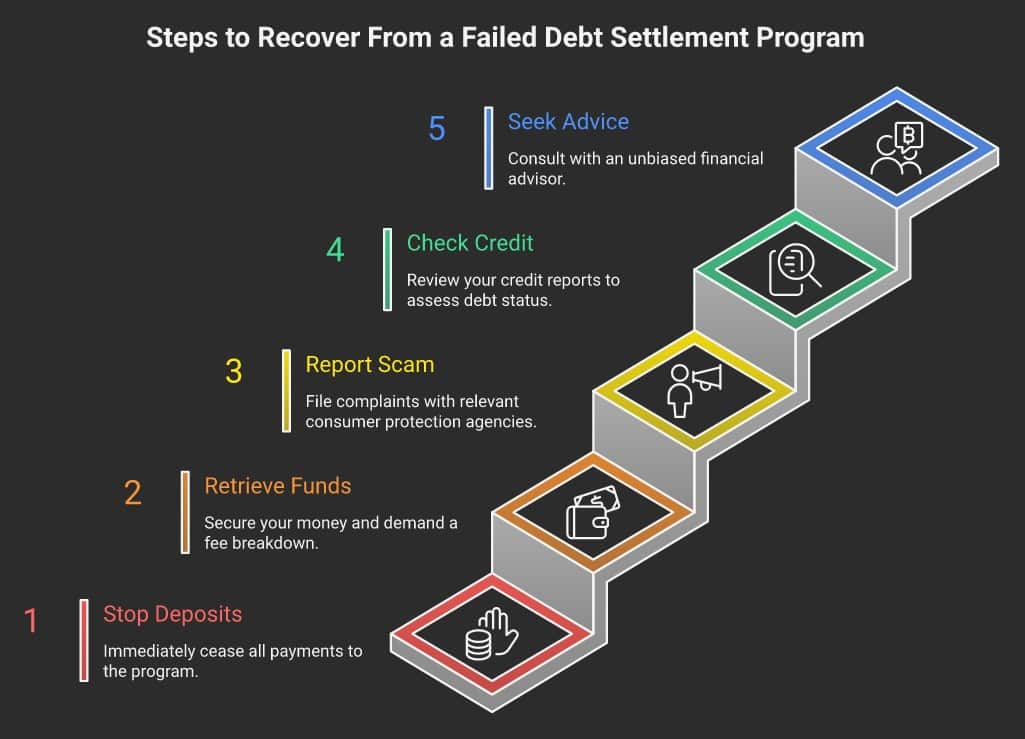
- Stop depositing money into the program. You are never locked into a debt settlement program — you can leave at any time. If it’s not working, every additional dollar you send in is a dollar you could be using to actually resolve your situation.
- Get your money out and demand an accounting. The money in your dedicated settlement account is yours. Request a full accounting of every fee charged and every debt settled. If you were charged fees for debts that were never settled, you may be entitled to a refund under FTC rules.
- Report a company you believe scammed you. File complaints with the CFPB, the FTC, and your state attorney general. If you’re in California, you can also report to the DFPI, which is actively pursuing deceptive settlement companies.
- Take stock of where each debt actually stands. Pull your credit reports free at AnnualCreditReport.com and find out which debts were settled, which are still open, and which may have been sued on. You can’t plan your next move until you know the real picture.
- Look at every option — this time with someone who isn’t selling you anything. The settlement company never told you about the alternatives because they couldn’t profit from them. Talk to Damon Day for free — he’ll give you an honest read with nothing to sell. Damon Day, an independent debt coach and my co-host on the Get Out of Debt Guy podcast, whom you can reach at DamonDay.com — I receive no payment for this referral.
The Option They Never Mentioned
When you’re near retirement with debt you can’t shake, there’s one option settlement companies almost never bring up — because it makes them no money and it protects you better than they ever could: bankruptcy.
I know how the word lands. People hear “bankruptcy” and feel shame, like it’s admitting failure. But here’s the truth I’ve watched play out across thousands of cases: bankruptcy protects your retirement accounts. Your 401(k), your IRA, your pension — those are generally shielded in bankruptcy. A settlement program drains your cash for years while your retirement clock ticks. Bankruptcy can wipe out qualifying unsecured debt in a matter of months and let you start rebuilding immediately, with your retirement savings intact. I walked through exactly how to weigh quitting a settlement program for bankruptcy in a separate piece.
A settlement program spends your final working years. Bankruptcy can give them back.
It isn’t right for everyone, and I’d never tell you it is. But if a settlement program already cost you time and money, you owe it to yourself to at least find out whether the option they hid from you is the one that actually fits. Spend a free hour with a real bankruptcy attorney — NACBA can help you find one — before you write it off.
Myth: “I already paid into a settlement program, so I have to see it through or I’ll lose everything I put in.”
Reality: That’s the sunk-cost trap, and it’s exactly what keeps people stuck. Money already paid out — fees the settlement company has earned under the FTC’s rule, and settlement payments already sent to your creditors — is gone whether you stay or leave. A fee taken on a debt that hasn’t yet been settled and paid on may not have been allowed, and even after a settlement the rule limits the fee to that one debt’s share of the total fee, or to a set percentage of what that settlement saved you. If a fee you paid doesn’t fit those limits, ask for it back. The money still sitting in your program’s dedicated account is different. If the company signed you up over the phone, without an in-person meeting (whether they called you or you called them about their ad), the FTC’s Telemarketing Sales Rule (16 CFR 310.4(a)(5)) generally says you own that money, plus any interest it has earned, and that you can leave at any time without a penalty from the company and get all of it back within seven business days of asking, except fees the company has already earned under the rule. Ask in writing if you can, so you have a record, and if the money isn’t back within seven business days of that request, report it to the FTC and your state attorney general. If a settlement is still being paid out of that account, ask the settlement company and the creditor what happens to that settlement before you take the money out. If you signed up at an in-person meeting, called them on your own without any ad or sales pitch, or your program wasn’t sold over the phone, check your contract and your state’s rules. The only question that matters is what gets you to the best outcome from here — and staying in a program that isn’t working rarely does.
Key Takeaway: A failed debt settlement program is a setback, not a dead end. You can leave anytime, you may be owed refunded fees, and you still have every option — including the one they hid from you. If retirement is close, move quickly: time is the resource you can’t get back. Take the Find Your Path quiz for a recommendation based on your real numbers.
This is what I’m seeing after more than 30 years of helping people dig out of exactly this kind of mess. Take it as one informed perspective — but only you know your full situation. Use it as input for your decision, not a directive. Nobody gets to tell you what to do with your money. Not me, not a settlement company, not anyone.
If someone you love got talked into a debt settlement program that isn’t working — especially if they’re close to retirement — send them this. The sooner they stop the bleeding, the more of their future they get to keep.
Dealing With Debt? Understanding your options is the first step. See how all your debt relief options compare — including ones most sites won’t tell you about. The Find Your Path quiz gives a recommendation based on your actual numbers, and the Scam-O-Meter checks any company’s complaint history before you sign. Federal Reserve research shows bankruptcy filers recover faster than those who don’t file.



