

Fact-checked by Steve Rhode, consumer debt expert since 1994 • Last reviewed June 17, 2026 • Every claim below links to a primary government source.
The verdict: True — and it’s costing you money. If your loans were on the SAVE plan, your payments paused — but interest started running again on August 1, 2025. For most borrowers, your balance is bigger today than it was when interest switched back on last August, even though you haven’t missed a thing. The U.S. Department of Education confirms it.
Each weekday I send one short email: one money story that caught my attention, why it might matter to you, and one manageable thing you can do with it. A couple of minutes, and a dad joke.
In the latest issue (Oct 16): The check that looks like a scam may be real
Free. I sell nothing. Unsubscribe any time.
If you’ve been on the SAVE student loan plan, you’ve probably been told some version of “don’t worry, your loans are paused while the courts sort it out.” That sentence is doing a lot of quiet damage. Here’s what’s actually true — claim by claim.
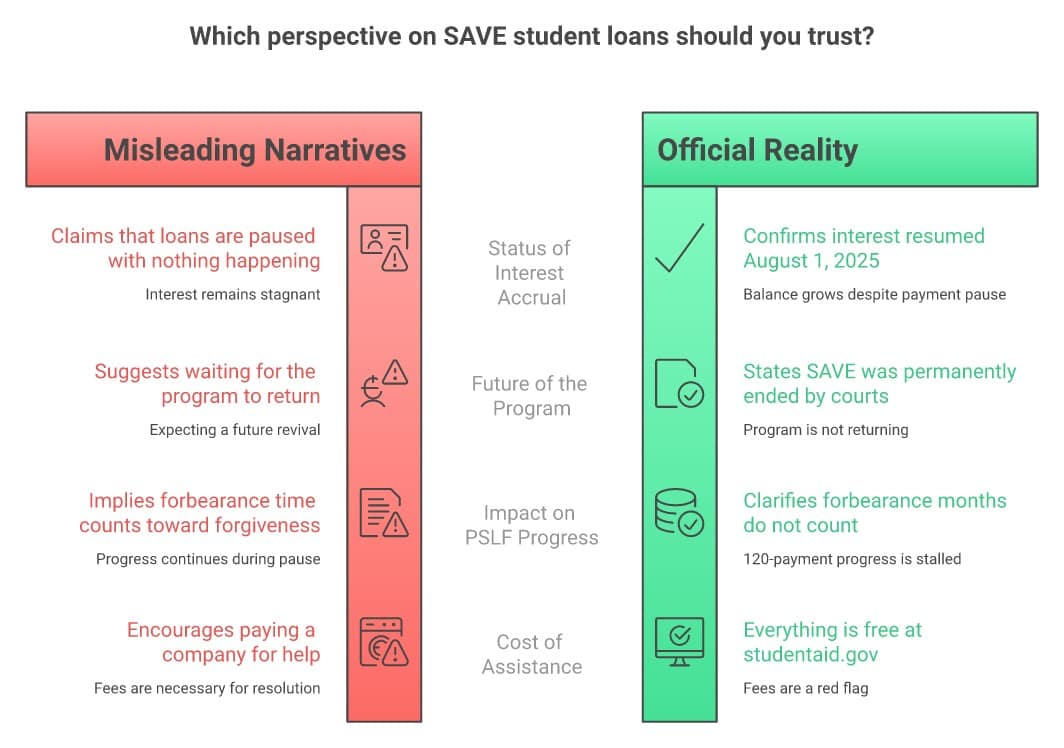
“Your loans are paused during the court case, so nothing is happening to them.”
Your payments paused. Your balance did not. After a roughly 13-month window where the rate was held at 0%, interest switched back on at your full rate on August 1, 2025 for the millions of borrowers who were enrolled in SAVE. Nobody sent you a bill, so it felt like nothing was happening — but for most borrowers the meter has been running ever since, and your balance is higher now than when the “pause” started.
U.S. Dept. of Education — interest resumption announcement (July 9, 2025)
“Just wait it out — the courts will sort it and SAVE will come back.”
SAVE is gone — closed off two different ways. First, a law signed in July 2025 eliminated SAVE going forward and set up replacement repayment plans. Then, in March 2026, a federal court judgment formally vacated the plan’s underlying rule — so there’s no legal foundation left for it even if Congress changed its mind. “Wait and see” isn’t a strategy here — it’s the trap. There is no plan to go back to.
U.S. Dept. of Education — next steps for SAVE borrowers (March 27, 2026)
The months you spent in the SAVE forbearance do not automatically count toward your 120 PSLF payments. So if you’re chasing forgiveness, waiting didn’t just cost you money — it cost you time. There is a way to recover some of it: the PSLF “buyback” program lets you pay to have qualifying months counted — but it’s not free and it’s not automatic. You make a lump-sum payment equal to what you would have owed under a qualifying plan, so it only makes sense if you’re close to the 120-payment finish line. Check whether it’s worth it for you at studentaid.gov before you assume the clock kept running.
“A company can get the interest waived or fix your loans for a fee.”
There is nothing a paid company can do with your federal loans that you can’t do yourself, for free, at studentaid.gov. Anyone charging an upfront fee to “fix” your federal loans — or asking for your FSA ID login — is a red flag. In April 2026 the FTC shut down operations that impersonated the Department of Education and charged borrowers up to $1,400 a month for exactly this.
FTC enforcement action against student-loan relief scam (April 2026)
Why You Were Told This
Part of it is innocent — the rules changed fast, and a lot of well-meaning people are repeating what was true a year ago. When the SAVE forbearance first started, interest really was set to 0%, and for about thirteen months “nothing’s happening” was basically accurate. Then it quietly stopped being true on August 1, 2025, and nobody sends you a letter that says “your balance is now growing again.”
The less innocent part is the industry that lives in that confusion. When millions of people don’t understand what’s happening to their loans, that’s a market — for “debt relief” companies, for fee-charging “document prep” outfits, for outright scammers. The murkier the situation, the more money there is in pretending you need to pay someone to explain it. You don’t.
What to Actually Do
- Log in to studentaid.gov and look at your actual balance. Not what you remember — what it says today. That number tells you how much the “pause” has quietly cost you.
- Watch for your servicer’s notice — July 1, 2026 is when those notices start going out, not a hard deadline. When it arrives, your servicer gives you a 90-day window to pick a new repayment plan. So there’s no need to panic if you’re reading this after July 1 — but don’t ignore the notice, because if you let your 90 days run out you’ll be dropped onto a standard plan that may cost far more per month than you can afford.
- Use the Loan Simulator at studentaid.gov before you choose. Your plan options changed. Run your real numbers against the new plans so you’re choosing with math, not guessing.
- If you’re chasing PSLF, check your payment count now. Confirm whether your forbearance months counted, and ask about the buyback program if you’re close to 120.
- Pay no one a fee to do the routine stuff. Switching plans, checking your balance, and certifying employment are all free at studentaid.gov. Anyone charging you to do those things — or asking for your login — is a red flag.
- If your situation is genuinely tangled, talk to a specialist — that’s different. Default mixed with disability, an old loan that may qualify for discharge, a PSLF count that doesn’t add up — those are real legal questions where a federal student loan attorney earns their keep. Josh Cohen at The Student Loan Lawyer focuses on exactly this area. Ask him directly what he charges — I won’t quote a number I’m not sure of — but a specialist’s read on a knotty federal-loan problem is a fair use of money, in a way that paying someone to click buttons on studentaid.gov never is.
Steve’s Take
I’ve watched the “don’t worry about it” reflex hurt people for thirty years. It almost never serves you with debt. A paused payment feels like relief, and it can be — but only if you understand what’s still moving in the background. Here, the balance is moving. The honest move isn’t to panic; it’s to open the account, look at the real number, and make one clear-eyed choice before a servicer makes it for you. You don’t need to pay anyone to do that. You just need to look.
Frequently Asked Questions
My student loans are paused — is interest really still adding up?
If you were on the SAVE plan, yes. Payments are paused, but interest resumed accruing at your full rate on August 1, 2025. Your balance has been growing since then even though you haven’t been billed. Log in to studentaid.gov to see your current balance.
Is the SAVE plan coming back?
No. A law signed in July 2025 eliminated SAVE going forward, and then in March 2026 a federal court formally vacated the plan’s underlying rule. There is no plan to return to — you’ll need to choose a different repayment plan.
When do I have to switch plans?
Starting July 1, 2026, your loan servicer will contact you and give you a 90-day window to choose a new plan. July 1 is when the notices begin — it’s not a same-day deadline — but don’t ignore the notice when it comes. If you don’t choose, you’ll be placed on a standard plan automatically.
Did my time in SAVE forbearance count toward PSLF?
Generally no — SAVE forbearance months don’t automatically count toward the 120 payments for Public Service Loan Forgiveness. If you’re close to forgiveness, look into the PSLF buyback program at studentaid.gov, which may let you pay to have some of those months counted.
Can a company get my student loan interest waived for a fee?
No. There’s nothing a paid company can do with your federal loans that you can’t do yourself for free at studentaid.gov. Anyone charging an upfront fee, or asking for your FSA ID login, is a red flag — the FTC actively shuts these operations down.
How do I find out exactly how much my balance grew?
Log in to studentaid.gov, find your current principal and accrued interest, and compare it to what you remember owing before August 2025. That difference is what the “pause” quietly cost you while interest ran.
Should I just pay off the interest now to stop it?
It depends on your full picture — your income, your other debts, and whether you’re pursuing forgiveness (in which case paying extra may not help). Don’t drain your emergency cushion to do it. This is exactly the kind of judgment call worth thinking through before you act.
This is what I’m seeing after thirty years of helping people with debt — take it as one informed perspective, not a directive. Only you know your full situation. Look at your real numbers, and make the choice that serves your future. Nobody gets to decide that for you — not a servicer, not a company, not me.
The bottom line: “Paused” meant your payments stopped — not your interest. Since August 1, 2025, most SAVE borrowers’ balances have been quietly growing, and the plan isn’t coming back. Open your account, see the real number, and choose your next plan before the clock runs out. If someone you know still thinks their paused loans are frozen, send them this — it could save them a nasty surprise.
Also: The federal autopay discount just increased to 1% — once your loans are in a stable repayment plan and your servicer account is set up, this is worth enrolling in before September 30, 2026.
Dealing With Debt? Understanding your options is the first step. See how all your debt relief options compare — including ones most sites won’t tell you about. The Find Your Path quiz gives a recommendation based on your actual numbers, and the Scam-O-Meter checks any company’s complaint history before you sign. Federal Reserve research shows bankruptcy filers recover faster than those who don’t file.



