

Update, October 8, 2026: The August 19 date in this post is out of date. The official remission site now gives the deadline as December 31, 2026. No payment is guaranteed; the Justice Department decides each petition. Read my updated post on the final phase and how to file.
If you ever sent money through Western Union to someone who turned out to be a scammer, I want you to read this — and then I want you to call your parents and tell them to read it too. There is real money being returned right now, hundreds of millions of dollars of it, and most of the people who are owed some will never claim it. Not because they don’t qualify. Because they’re too embarrassed to look.
I’ve spent over 30 years sitting across from people who lost money to fraud. The shame is almost always worse than the loss. People convince themselves the money is gone forever and that checking would just reopen the wound. So they never check. And the government ends up holding money that belongs to them.
Let me tell you exactly what this is, who qualifies, and what to do — in plain language, with no catch.
Claiming money you are owed is one good day. What you do over the following year is what actually changes your position.
In the latest issue (Nov 9): Check your power bank and your French press
Each weekday I send one short email: one story that caught my attention, why it might matter to you, and one manageable thing you can do with it.
Free. I sell nothing. Unsubscribe any time.
What you need to know
Back in 2017, Western Union agreed to pay $586 million and admitted it had aided and abetted wire fraud. For years, scammers had used Western Union to collect money from their victims — and by the government’s account, the company’s own conduct made that possible, which is what it admitted to. That $586 million is being used to pay back the people who lost money.
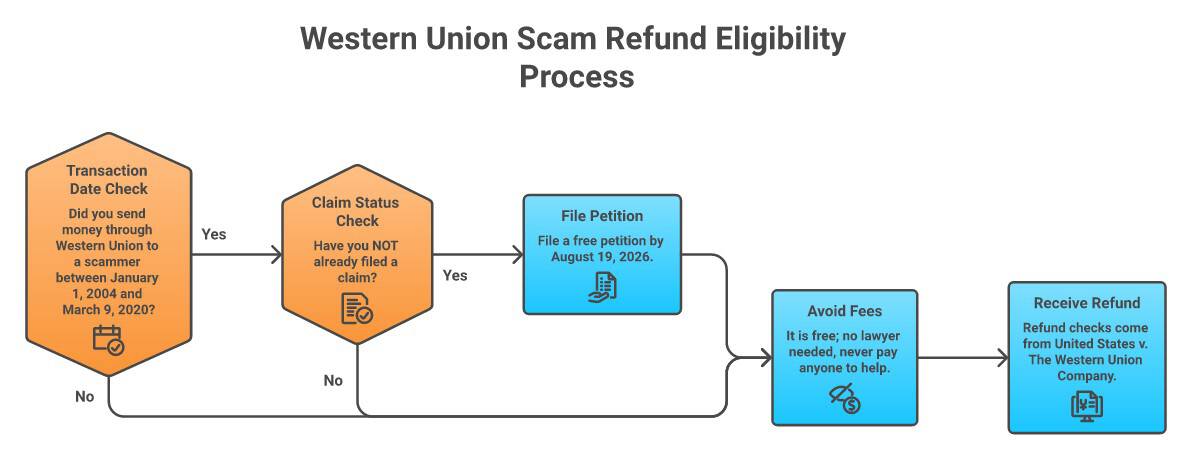
The U.S. Department of Justice is now in Phase 3 of returning that money. Here’s the part most people don’t realize: the eligibility window was expanded. It used to cover transfers between January 1, 2004 and January 19, 2017. It now reaches all the way through March 9, 2020. So even people who were told before that they were outside the window may qualify now.
The deadline to file your petition is August 19, 2026. After that, the window closes.
Why you need to know it
Here’s what 30 years has taught me about fraud refunds: the people most likely to be owed money are the least likely to claim it. Older folks who got caught in a romance scam or a “your grandson is in jail” call. People who wired money for a lottery they “won,” or an advance fee for a loan that never came, or a deposit on an apartment that didn’t exist. These are exactly the scams this program covers.
And those are exactly the people who feel too foolish to come forward. I’ve watched it happen over and over. A widow who sent $4,000 to a man she thought loved her doesn’t want to admit it to her kids, let alone fill out a government form about it. So the money sits there.
Don’t let that be you, or someone you love. Being scammed was not your fault — these operations are professional, and they target good, trusting people on purpose. Claiming your refund is not an admission of anything except that a criminal took advantage of you.
Things to consider
The single most important thing I can tell you: this is free, and you do not need to hire anyone. The FTC says it plainly — you don’t have to pay to file, you don’t need a lawyer, and you should not pay anyone who contacts you claiming they’ll get your money back for a fee. That last part matters, because refund programs like this one attract a second wave of scammers who prey on the victims of the first. If someone calls offering to “help you recover your Western Union money” for an upfront payment, that is itself a scam. Hang up. (This is so common that I’ve written before about how to tell a real refund from a fake one — it’s worth a read.)
The legitimate program is run by a court-appointed administrator called Verita Global LLC (you may have known it by its former name, Gilardi & Co.). Any real refund check will come from a fund tied to the case “United States v. The Western Union Company.” Nobody legitimate will ever ask you to pay a fee to receive it.
A few situations to think through:
- You already filed in an earlier round. You don’t need to file again — your claim is in the system.
- You were told before that you missed the window. Check again. The eligibility dates were extended to March 9, 2020, so an old “no” may now be a “yes.”
- The person who was scammed has passed away. The estate or a representative may still be able to file. It’s worth asking the administrator.
- You’re not sure how much you lost or whether you qualify. File anyway. The administrator reviews the petition; you don’t have to have perfect records to start.
What to think about doing
If you, or someone in your family, sent money through Western Union to a scammer anytime between January 1, 2004 and March 9, 2020, here’s the move:
- File your petition before August 19, 2026. Go to the official remission website or contact the administrator directly. Do it this month while you’re thinking about it — deadlines have a way of arriving faster than you expect.
- Don’t pay anyone to do it for you. The process is free. If a person or company asks for money to “help,” walk away.
- Tell the people in your life who are most at risk. Call your parents. Call your grandparents. (If you’re worried someone has already been targeted, here’s what to do when an elderly parent gets charged for something they didn’t want.) The people who need this most are often the ones who’ll never hear about it on their own — and they may be carrying the quiet shame of a scam they never told anyone about.
If the loss from a scam like this pushed you into debt you’re still digging out of, that’s a separate problem worth solving on its own — and you have more options than you may think. But first things first: if there’s money waiting to come back to you, go get it.
This is what I’m seeing after three decades of helping people through financial fraud, and it’s the same thing I’d tell my own family. Take it as one informed perspective — but only you know your full situation, and only you can decide what’s right. Use this as input for your decision, not a directive. Nobody gets to tell you what to do with your money. Not me, not anyone.
If this might help someone you know — and it almost certainly will — send it to them. The whole reason this money goes unclaimed is that the people owed it are too embarrassed to look. A nudge from someone who loves them is often the only thing that gets them to check.
If you’re a streaming subscriber on YouTube TV or DirecTV Stream, there’s also a Disney antitrust settlement worth checking — $50 million available with a September 8, 2026 filing deadline. Same principle: free money, five minutes, file at the official site only.
If you’re also watching the FTC’s Growth Cave enforcement — the passive income coaching scam that was shut down in early 2026 — I’ve written about when Growth Cave victims might see refunds and what to do while you wait. Same principle: no process yet, no fee ever, bookmark ftc.gov/refunds.
Dealing With Debt? Understanding your options is the first step. See how all your debt relief options compare — including ones most sites won’t tell you about. The Find Your Path quiz gives a recommendation based on your actual numbers, and the Scam-O-Meter checks any company’s complaint history before you sign. Federal Reserve research shows bankruptcy filers recover faster than those who don’t file.



