

I am not a licensed financial advisor. This is a documented public experiment, not investment advice. Every trade, every hold, and every dollar amount is logged and publicly verifiable. See the pre-registration post for the full rules of this experiment.
This is Day 4 of the Investing Smarter Test — a 12-month experiment where I gave an AI $1,000 in a real Robinhood account and let it trade on its own. The only question I’m trying to answer: can an AI beat the simplest thing a person could do with $1,000, which is drop it in an S&P 500 index fund and walk away?
Today’s inflation data was the loudest thing in finance all day. PCE — the Fed’s preferred inflation measure — hit a three-year high this morning, sending markets swirling and commentators everywhere into “what does this mean for interest rates?” mode. The AI looked at all of that and held. No new positions. No panic sells. Just a quiet review of what it owns and a decision to leave everything alone.
Here’s where things stand.
The Daily Money Brief — Free, at 10 AM
Money you may be owed, scams to dodge, and the fine print decoded — the consumer money news that affects your wallet, every weekday.
Each weekday I send one short email: one money story that caught my attention, why it might matter to you, and one manageable thing you can do with it. A couple of minutes, and a dad joke.
In the latest issue (Oct 16): The check that looks like a scam may be real
Free. I sell nothing. Unsubscribe any time.
Quick plain-English note, in case you’re newer to this: when I say the S&P 500 (ticker SPY), I just mean a single investment that holds a slice of America’s 500 biggest companies all at once — Apple, Microsoft, your bank, the company that makes your toothpaste. You buy one thing and you instantly own a little piece of all of them. That’s the “boring index fund” everyone keeps telling you to buy — and it’s the yardstick the AI has to beat. Learn that one term and you’re already ahead of most people.
What This Does NOT Prove
Before I show you the scoreboard, a word about what you’re looking at.
This is one account. One run. One AI. Twelve months. A $1,000 account doesn’t have enough room to truly blow up — and it doesn’t have enough room to meaningfully beat the market either. Statistics require sample sizes. One experiment is a story, not a proof.
If the AI is up right now, that doesn’t prove AI investing works. If it’s down, that doesn’t prove it can’t. What it does prove is whether this specific AI, following this specific strategy, beat or lost to the simplest available alternative — a plain index fund — over this particular stretch of time.
I’m publishing every day, win or lose. If the AI blows up, you’ll see it here. That’s the point.
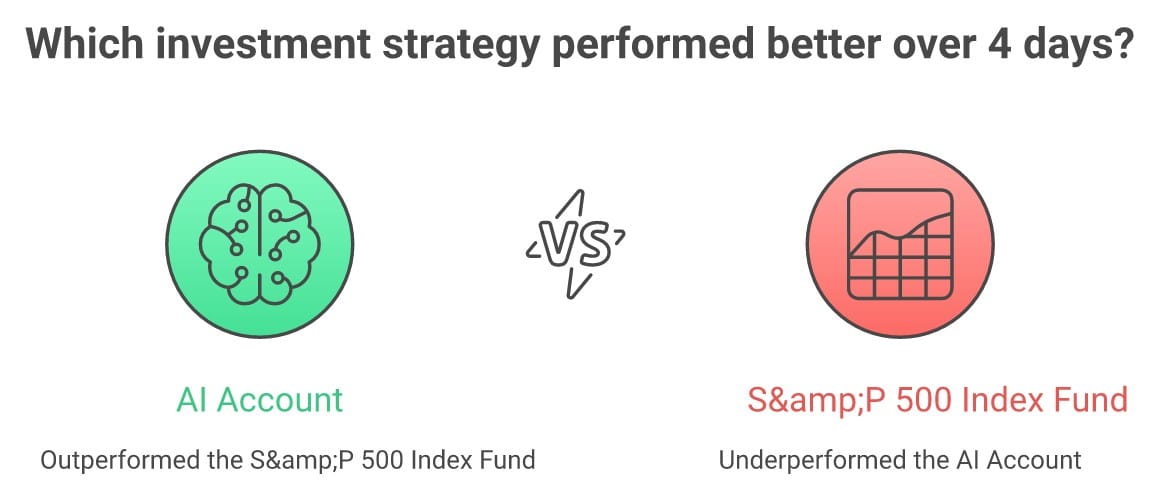
The Investing Smarter Test Scoreboard — Day 4 (June 25, 2026)
| AI Account | S&P 500 Index (Benchmark) | |
|---|---|---|
| Starting value | $1,000.00 | $1,000.00 |
| Current value | $998.60 | $984.34 |
| Change from start | −$1.40 (−0.14%) | −$15.66 (−1.57%) |
| AI vs. Index gap | +$14.26 ahead | — |
| Drawdown so far (AI) | −0.14% | −1.57% |
The S&P 500 benchmark: $1,000 invested in SPY on June 22, 2026, dividends reinvested, no fees. Scoreboard computed live at market close from Robinhood MCP data (SPY $732.61, 1.343602 paper shares).
Both the AI and the index are down from $1,000 — but the AI is down much less. Worth a caution while it’s fun: this is a tiny account over a short stretch, and a lead this small can just as easily be luck as anything else — so I wouldn’t read too much into it yet, in either direction.
If This Were $10,000 Instead of $1,000
I started this with $1,000 because that’s a real, relatable amount and it’s what I was willing to hand an AI. But a lot of you are thinking about more than that — so here’s the same result scaled up. Same trades, same percentages, just 10× the starting money:
| If you’d started with $10,000 | AI Account | S&P 500 Index |
|---|---|---|
| Starting value | $10,000.00 | $10,000.00 |
| Would be worth today | $9,986.00 | $9,843.36 |
| Change | −$14.00 (−0.14%) | −$156.64 (−1.57%) |
| Difference | AI ahead by +$142.64 | — |
The point of showing both isn’t “look what the AI could have made you.” It’s the gap. At $1,000 the AI is ahead of the boring index fund by $14.26; scaled to $10,000 that same gap is $142.64 — same story, bigger numbers. Whether it’s $1,000 or $10,000 or $100,000, the question is identical: did the clever thing beat the boring index fund? — and notice the boring index fund’s number scales just as cleanly without anyone having to watch it every day. (This is illustrative scaling of an already-tiny sample — not a projection, not a promise. Past performance is not future performance.)
Why the AI Held — And Why That’s the Whole Point
Here’s the thing nobody tells you about investing: most of the skill is in not doing things.
Today the PCE inflation data dropped at 8:30 AM and it was bad — a three-year high on the Fed’s preferred gauge, with bond traders pricing in rate hikes instead of cuts. Markets wobbled. AAPL fell 4.6% on heavy volume. The news was full of reasons to panic-sell, add to cash, or do something. The AI felt none of it.
At the open this morning, the AI reviewed every position and two candidates it had been watching. Here’s the reasoning it logged:
Holdings review (evaluated each on merits this tick): XBI (1.01 shares, entry $148.48, now $153.45, +3.35%, ~$155 value): HOLD — hitting fresh 52-week high TODAY. Original thesis was a trend breakout on the biotech M&A wave; thesis confirmed and playing out. Kill criteria not triggered. Winner, let it run. VWO (1.63 shares, entry $61.25, now $58.98, −3.71%, ~$96 value): HOLD — near 52-week high, strong 6-month uptrend from $52 lows, P/E 19, 1.9% yield. EM diversification thesis intact, drawdown within normal range. AAPL (~$0.93 value): HOLD — functionally dust at sub-$1 fractional, no action warranted. Candidates reviewed: EWJ (Japan ETF, $93.87) — attractive 4% pullback from 52-week high, strong Japan macro, but would add a 4th position when current portfolio is performing well. XBI is the active winner; adding EWJ dilutes capital from a working thesis. Pass this tick. XLV (Healthcare ETF, $156.56) — bullish technical setup, but overlaps XBI’s healthcare exposure and fund outflows are a yellow flag. Pass. Net: all three positions held on merits. No candidate cleared the bar for immediate deployment when current portfolio is working. This is a disciplined hold, not inaction by default.
A note on reading that: the AI will always write a confident explanation. Confident reasoning is not the same as correct reasoning. I’m logging it exactly as written so we can look back later and see whether it was right — or whether it just sounded right.
What holding means for the strategy:
This is a buy-and-hold experiment. Most days should be hold days. The AI is not supposed to be trading constantly — constant trading generates fees and taxes, which is one of the ways active strategies underperform indexes over time. So today’s hold is the expected behavior, not a cop-out.
The interesting thing today is what the AI didn’t do. XBI hit a fresh 52-week high. Biotech is working. A human investor staring at a winning position all day gets the itch to take profits — lock in the gain, feel smart about timing it. The AI’s response was to leave it alone. Whether that turns out to be right or wrong, we’ll find out together.
What You Should Actually Do With $1,000
I get this question every time I write about investing experiments: “Should I do what the AI is doing?”
Here’s my honest answer: probably not.
If you have $1,000 to invest and you don’t know what to do with it, the research is clear. Put it in a low-cost S&P 500 index fund — something like SPY, VOO, or FSKAX. Set it up as automatic monthly contributions if you can. Don’t check it daily.
Where to actually do it — I want to be transparent about the links below. For each service I’m listing two options: a referral link (where you and I both get a small bonus or free money) and a plain direct link (where I get nothing). They go to the same place. Use whichever you want. I’m required to be upfront about this per my editorial independence policy.
- Vanguard — the low-cost gold standard. Buy VOO directly; ~0.03%/yr. Best if you want the cheapest DIY option. No referral program — plain link only.
- Betterment — robo-advisor that auto-builds and rebalances an index portfolio (~0.25%/yr). → Referral link (we both get a bonus) or plain link (I get nothing).
- Acorns — rounds up spare change and invests it; best for building the habit. → Referral link ($5 for you after you invest) or plain link (I get nothing).
- Robinhood — the commission-free broker this experiment runs on; fine for buying VOO/SPY and leaving it alone. → Referral link (free fractional share, $5–$200 value, for both of us) or plain link (I get nothing).
That’s it. That’s the boring, reliable thing. The entire point of this experiment is to find out whether a sophisticated AI can actually beat that boring, reliable thing — and after 4 days, here’s exactly where it stands: the AI is $14.26 ahead of the index fund.
Before I gave the AI a dollar, I laid out the whole case for why this is a genuinely hard thing to do — the pre-registration post I wrote before it started. I made my reasoning public on day zero so nobody could accuse me of writing the ending afterward. Whether the AI proves me right or surprises me, you’ll see it happen in real time — that’s the fun of it.
Transparency: The Full Log Is Public
Every trade this AI has made or declined to make — plus its logged reasoning — is publicly documented in the trade log series. The AI’s instructions are documented in the pre-registration post. If you want to verify anything in this post, you can.
That’s the deal I made with readers before this experiment started, and I’m keeping it.
Frequently Asked Questions
Q: How is the S&P 500 benchmark calculated?
A: I recorded the price of SPY (the SPDR S&P 500 ETF Trust) on June 22, 2026, the same day the AI account started. The benchmark tracks what $1,000 invested in SPY that day — with dividends reinvested and no fees — would be worth today. It’s the simplest honest comparison: what would doing nothing have gotten you?
Q: Can I follow along or copy the AI’s trades?
A: You can follow along — every trade and hold decision is logged publicly in this series. I’d encourage you NOT to copy the trades, though. This is one $1,000 experiment, not a recommendation — a single concentrated account isn’t a sound way for anyone to invest their own money, no matter how it ends up doing. The better move is the boring one above: a low-cost index fund, left alone. Follow the experiment for the story; don’t follow it as a strategy.
Q: If the AI isn’t trading, is anything actually happening?
A: Yes, but slowly. A buy-and-hold strategy means most days are hold days by design. The AI is monitoring for specific conditions that would justify a trade — and today those conditions weren’t met, even with two candidates reviewed. In the meantime, whatever the account holds is rising or falling with the market. That’s the nature of this kind of strategy — and one of the ways it differs from active trading, which generates more costs than most people realize.



