

Quick Answer: The Lemonade Insurance data breach settlement offers up to $10,000 in reimbursement for documented losses, a pro-rata cash payment, and three years of free credit monitoring to the more than 190,000 people who received a breach notification letter. The breach involved driver’s license numbers — not Social Security numbers — collected through Lemonade’s auto-insurance quote platform between April 2023 and September 18, 2024. The claim deadline is September 8, 2026. File at LemonadeDataDisclosureSettlement.com.
A similar warning applies to payment apps: 46 states just settled with Cash App over fraud, and consumers there need to watch for legitimate notices too.
Expert Context: I’ve helped people navigate debt-related financial crises and consumer settlements since launching GetOutOfDebt.org in 2008 — and in the more than 30 years I’ve spent in this space, I’ve watched one pattern repeat itself without fail: data-breach settlements go massively unclaimed because people assume they would have heard about it. They wouldn’t have. You’re reading this right now because you almost didn’t.
Lemonade Insurance has agreed to a $10.5 million settlement after a class action lawsuit alleged that its auto-insurance quote platform exposed the driver’s license numbers of more than 190,000 people for roughly 17 months — and the claims window is open right now, with a September 8, 2026 deadline.
Claiming money you are owed is one good day. What you do over the following year is what actually changes your position.
In the latest issue (Oct 8): A parent's nursing home bill can become yours
I write Your Money Actually most weekdays — actionable money information you will not find anywhere else, and the small decisions that compound. It is free, I sell nothing, and I take no money from any company I write about.
Here’s what makes this one unusual — and why I want you to pay close attention to the “who qualifies” section before you assume this doesn’t apply to you.
What Happened at Lemonade
According to the class action complaint, Lemonade’s online auto-insurance quote platform had a design vulnerability: when someone entered basic identifying information to get a quote, the platform automatically populated their driver’s license number. Cybercriminals exploited this to harvest those driver’s license numbers at scale.
The exposure ran from April 2023 through September 18, 2024 — about 17 months. Lemonade agreed to settle the lawsuit on April 16, 2026, in U.S. District Court for the Southern District of New York. The company has not admitted wrongdoing. As with virtually all class action settlements, “agreed to settle” means exactly that — not a finding of guilt, not an admission of liability, just a resolution both sides accepted.
The Daily Money Brief — Free, at 10 AM
Money you may be owed, scams to dodge, and the fine print decoded — the consumer money news that affects your wallet, every weekday.
The Claim: “It was just a driver’s license number — that’s not sensitive data.”
The Reality: Your driver’s license number is more dangerous than most people think. It’s a primary document number that enables synthetic identity fraud — combining your real DL number with a fabricated Social Security number to create a “new” identity that gets credit extended in a mix of real and fake information. Criminals also use DL numbers to create fake physical IDs, file fraudulent insurance claims, and impersonate you in government systems. It’s not “just a license number.” It’s a skeleton key for several types of fraud.
Do You Qualify? Read This Carefully Before You Decide
Here’s the thing that a lot of people will get wrong: this isn’t only for Lemonade policyholders. The breach happened on the quote platform. That means:
- You got a quote from Lemonade between April 2023 and September 18, 2024 — but never bought a policy
- You bought a Lemonade auto-insurance policy during that period
- You received a data breach notification letter from Lemonade
The key qualifier is the breach notification letter. If Lemonade sent you one, you’re almost certainly in the class. Search your email (try “Lemonade,” “data breach,” “notification”) and check your physical mail from that period. If you got a quote from Lemonade and never heard from them at all, you can still check your eligibility at the claim site — LemonadeDataDisclosureSettlement.com — and the claims administrator can tell you whether you’re included.
Don’t let “I never became a customer” stop you from checking. The breach happened at the quote stage. Someone who entered their information for a quote and then walked away from Lemonade entirely may be owed money and has no idea. This is the exact scenario where settlements go unclaimed.
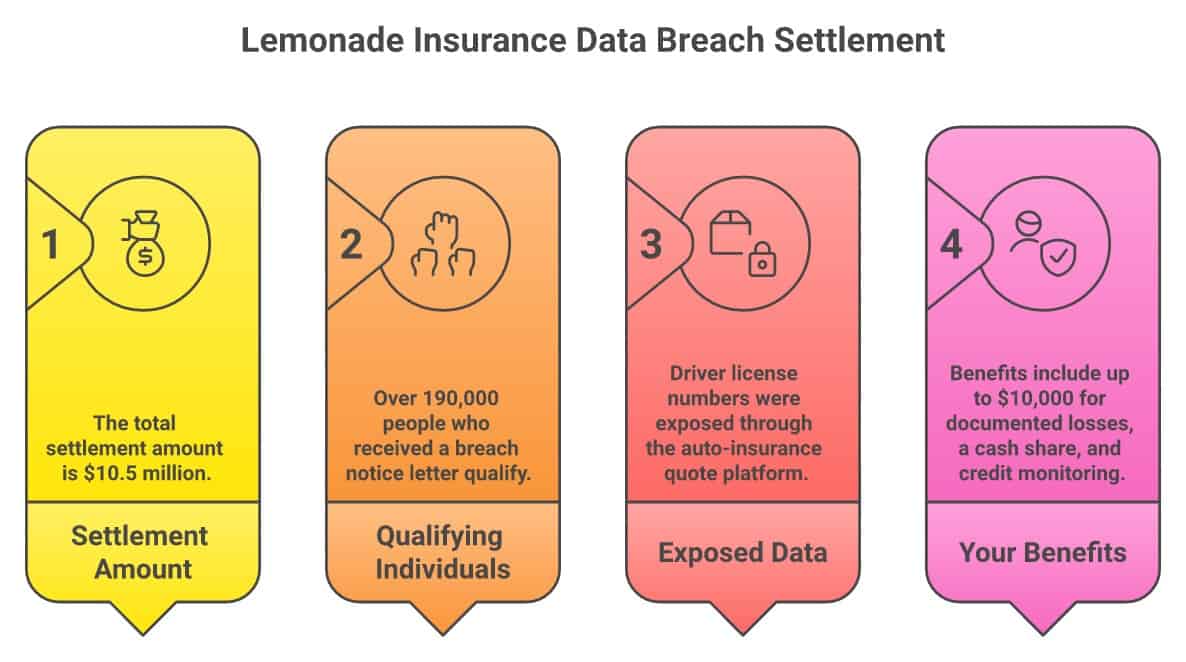
What You Can Get From This Settlement
The settlement provides three separate categories of compensation. You can claim any or all that apply to you:
Tier 1: Documented Loss Reimbursement
Up to $10,000 for out-of-pocket losses you can trace to the breach. This means bank statements showing unauthorized charges, credit reports showing fraudulent accounts opened, letters from the IRS about fraudulent tax filings, or documentation showing you paid for identity-theft remediation services. You need receipts or records — not just a feeling that something went wrong.
Tier 2: Pro-Rata Cash Payment
Even if you have no documented losses, you get a pro-rata cash share of the net settlement fund. The per-person amount depends on how many people file claims — the more claims, the smaller the individual share. This is real money for zero effort. The less time people spend wondering if it’s worth filing, the more money each claimant gets.
The third benefit people overlook most: Three years of credit monitoring and identity protection services, including up to $1 million in identity-theft insurance coverage. This is the protection that matters most if a criminal has had your driver’s license number for months. Credit monitoring alone won’t stop fraud, but it will catch it early — and having $1M in identity-theft insurance means you have professional help recovering if something does happen.
How to File — Exactly What to Do
- Search your email and mail for any Lemonade correspondence: a quote, a policy email, or a data breach notification letter. The notification letter is your key document.
- Go to LemonadeDataDisclosureSettlement.com to access the official claim form. This is the only legitimate claim portal — you should not have to pay anyone to file, and you should not be directed to any other site.
- Gather documentation if you’re claiming losses: bank statements showing unauthorized charges, credit card statements, credit reports with fraudulent accounts, or any costs you incurred dealing with fraud between April 2023 and now.
- Submit your claim before September 8, 2026. Miss the deadline, and there is no exception process.
If you have questions, the claims administrator is Kroll Settlement Administration LLC, reachable at P.O. Box 225391, New York, NY 10150-5391, or by phone at 833-447-6429.
Check for a Fake Claim Site: Settlement scammers create copycat websites that look official and charge a “processing fee.” The real settlement never charges you anything. If you encounter a site asking for money, run the company through the Scam-O-Meter and verify against LemonadeDataDisclosureSettlement.com. See also this piece on how to tell if a class action settlement notice is real or a scam.
Three Things to Do Whether You File or Not
Filing a claim is the right call here — it takes maybe 10 minutes and costs you nothing. But beyond the claim form, there are protective steps that apply regardless:
1. Place a credit freeze at all three bureaus. A credit freeze is free under federal law and stops new credit from being opened in your name — even if someone has your driver’s license number and partial personal information. Do it at Equifax (equifax.com), Experian (experian.com), and TransUnion (transunion.com). It takes about 15 minutes total and you can unfreeze temporarily when you apply for credit.
2. Place a fraud alert. While a freeze is more powerful, a fraud alert at any one bureau (Equifax, Experian, or TransUnion — they’re required to notify the others) requires lenders to take extra verification steps before extending credit in your name. It’s free and lasts one year.
3. Check your state’s DMV fraud resources. Some states allow you to flag your driver’s license number as potentially compromised, which triggers additional verification when it’s used for identification. Check your state’s DMV website — this is an underused protection that fits this exact type of breach.
“Do nothing” is not the right call here. I usually present “do nothing and monitor” as a legitimate option — there are debt situations where waiting is genuinely correct strategy. This is not one of them. Your driver’s license number has been in criminal hands for up to 17 months. The claim is free, the credit freeze is free, and the credit monitoring you get from the settlement is free. There’s no downside to acting.
Key Dates to Mark
Lemonade Settlement Deadline Summary
- Exclusion/objection deadline: August 7, 2026
- Claim form deadline: September 8, 2026
- Final approval hearing: September 10, 2026
The claim and exclusion deadlines are the ones most people need. You can object to the settlement or exclude yourself (opt out) by August 7 if you prefer to retain independent legal rights. If you do nothing, you’re automatically bound by the settlement and give up any future individual lawsuit rights against Lemonade for this breach — so the right move for most people is to file and take the money.
The Bottom Line
If you ever got a Lemonade auto-insurance quote or policy between April 2023 and September 2024 — and especially if you got a breach notification letter — there is money with your name on it sitting in a $10.5 million settlement fund, and it doesn’t get distributed unless you file. I’ve watched too many of these settlements close with millions of dollars returned to defendants because people assumed the amounts were too small to bother, or assumed someone would tell them if they were owed anything. Nobody tells you. You have to claim it. It takes ten minutes, it costs nothing, and the September 8, 2026 deadline will not move. File first, then freeze your credit — in that order, today.
If someone you know had a Lemonade auto-insurance quote or policy in the last few years, please send this to them. I wrote this because most people won’t see the settlement notice, and the deadline doesn’t care whether you knew about it.
Another one closing fast: if you bought beef at the grocery store between 2014 and 2019, there’s an $87.5 million price-fixing settlement with a claim deadline of June 30, 2026 — no receipts needed to file.
This is what I’m seeing after more than 30 years of helping people dig out of debt and clean up after breaches like this one. Take it as one informed perspective — not a directive. Only you know your full situation, and only you get to decide what to do with your money and your time. Use what I’ve laid out here as input for your own call. Nobody gets to make that call for you — not Lemonade, not a settlement administrator, and not me.
Frequently Asked Questions
Am I eligible for the Lemonade Insurance settlement?
You’re likely eligible if you received a data breach notification letter from Lemonade Insurance and your personal information — specifically your driver’s license number — was potentially exposed between April 2023 and September 18, 2024. This includes people who only received a quote from Lemonade during that period and never became policyholders. Check your eligibility at the official claim site: LemonadeDataDisclosureSettlement.com.
What was exposed in the Lemonade data breach?
The Lemonade data breach exposed driver’s license numbers — not Social Security numbers, not full financial account numbers. The exposure happened through Lemonade’s online auto-insurance quote platform, which automatically populated driver’s license numbers when users entered basic identifying information. Cybercriminals exploited this design to harvest DL numbers from people who were merely requesting insurance quotes, according to the class action complaint.
How much can I get from the Lemonade settlement?
The settlement offers up to $10,000 for documented out-of-pocket losses traceable to the breach, with receipts or records required as proof. Even with no documented losses, class members receive a pro-rata cash payment from the net settlement fund — the amount per person depends on how many people file claims. All class members also receive three years of credit monitoring and identity protection services, including up to $1 million in identity-theft insurance coverage. See Top Class Actions for additional details on benefit tiers.
What’s the deadline to file a Lemonade settlement claim?
The claim form deadline is September 8, 2026. The deadline to exclude yourself from the settlement (opt out) or file an objection is August 7, 2026. The final approval hearing is scheduled for September 10, 2026. Claims filed after September 8 will not be accepted — there is no extension process. File at LemonadeDataDisclosureSettlement.com.
Do I need proof of loss to file a Lemonade settlement claim?
Proof is only required if you’re claiming documented losses of up to $10,000 — you’d need bank statements, credit reports, letters from tax authorities, or receipts for identity-protection services purchased because of the breach. For the pro-rata cash payment (available to all class members with no losses to prove), no documentation is needed beyond your basic eligibility information. You should still file even if you have no documented harm, because the pro-rata payment and three years of free credit monitoring are available to all eligible class members regardless of whether fraud actually occurred.
Another claim window is open now: the Flo period-tracker $59.5 million data-sharing settlement — deadline October 15, 2026.
Also open now: the Delta Dental portal tracking settlement ($12.67 million) — file by August 20, 2026.
Dealing with Debt? Understanding your options is the first step. See how all your debt relief options compare — including ones most sites won’t tell you about. The Find Your Path quiz gives a recommendation based on your actual numbers, and the Scam-O-Meter checks any company’s complaint history before you sign. Federal Reserve research shows bankruptcy filers recover faster than those who don’t file.



