

Here’s something you don’t hear every day: you may be owed money for the beef you bought years ago — and the deadline to claim it is tomorrow, June 30, 2026.
Settlements like this open and close all the time — another one with a fast-approaching deadline lets you claim your share of Amazon’s $2.5 billion FTC settlement before July 27, 2026.
Two of the biggest meat companies in the country, Tyson Foods and Cargill, have agreed to pay $87.5 million to settle a lawsuit that accused them of conspiring to keep beef prices artificially high. If you bought beef at a grocery store in one of the affected states between 2014 and 2019, you can file a claim for a piece of that money. You don’t need receipts. It takes a few minutes. And it costs you nothing.
The Daily Money Brief — Free, at 10 AM
Money you may be owed, scams to dodge, and the fine print decoded — the consumer money news that affects your wallet, every weekday.
Claiming money you are owed is one good day. What you do over the following year is what actually changes your position.
In the latest issue (Oct 16): The check that looks like a scam may be real
Each weekday I send one short email: one money story that caught my attention, why it might matter to you, and one manageable thing you can do with it.
Free. I sell nothing. Unsubscribe any time.
I want to walk you through exactly what this is, who qualifies, and how to file — because the window closes tomorrow, and most people don’t even know it exists.
What You Need to Know
This is a price-fixing case. The lawsuit alleged that major beef processors — including Tyson and Cargill — coordinated to limit how much cattle they slaughtered, which pushed the price of beef up at the grocery store. In plain English: the claim is that you were quietly overcharged for years and never knew it.
Tyson and Cargill didn’t admit wrongdoing, but they agreed to settle — Tyson for $55 million, Cargill for $32.5 million, $87.5 million total. (A few other companies named in the case, like JBS and National Beef, have not settled, so this story isn’t fully over.) That settlement money gets divided up among the people who file valid claims.
That’s the part I want you to understand: this money was set aside for ordinary grocery shoppers. If nobody claims it, it doesn’t go back to you in lower prices — it just gets distributed among the smaller group of people who bothered to file. So the people who take five minutes to file are the ones who get paid.
Do You Qualify?
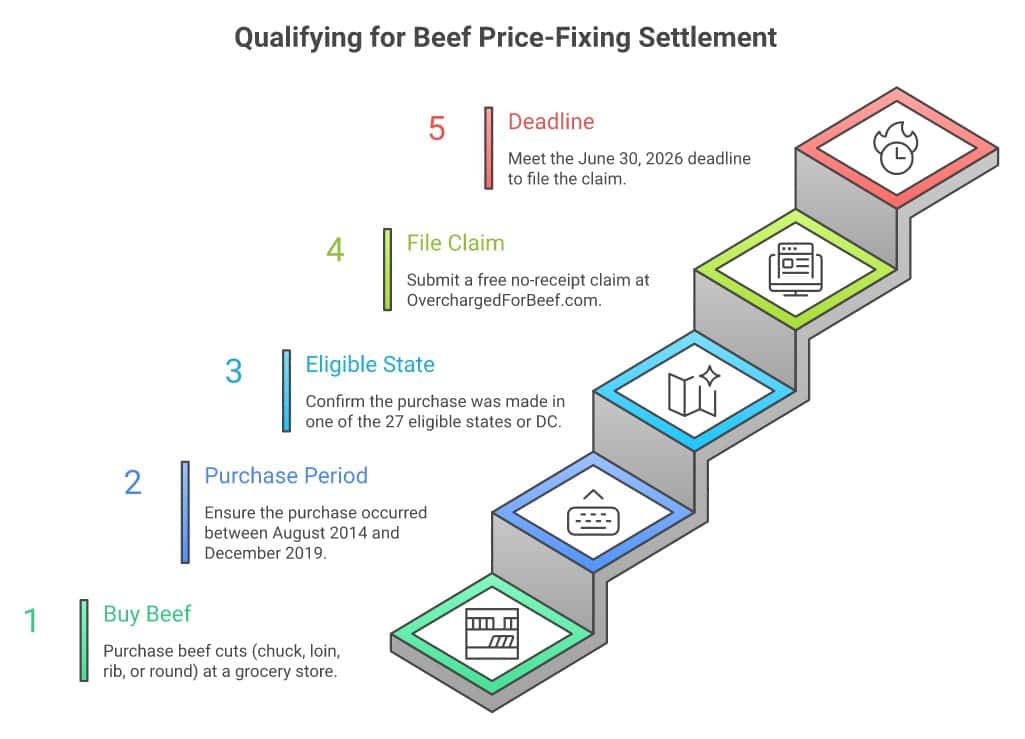
You may be eligible to file a claim if all of these are true:
- You bought beef from chuck, loin, rib, or round cuts — these are the common grocery-store cuts (roasts, steaks, ground beef from these sections). Fresh or frozen both count.
- You bought it between August 1, 2014 and December 31, 2019.
- You bought it indirectly — meaning at a grocery store or supermarket, not directly from Tyson or Cargill.
- You bought it for yourself, your family, or friends — for personal consumption, not to resell.
- You bought it in one of these states (or Washington, D.C.):
Arizona, California, the District of Columbia, Florida, Illinois, Iowa, Kansas, Maine, Massachusetts, Michigan, Minnesota, Missouri, Montana, Nebraska, Nevada, New Hampshire, New Mexico, New York, North Carolina, North Dakota, Oregon, Rhode Island, South Dakota, Tennessee, Utah, West Virginia, and Wisconsin.
If you lived in one of those states during those years and you ate beef from the grocery store, there’s a good chance you qualify. For a lot of families, that’s a yes without even thinking hard about it.
How to File — And the One Thing People Get Wrong
Here’s the part that trips people up, so let me be precise about it.
You do not need receipts to file. Nobody keeps grocery receipts from 2015. The settlement knows that. You file a “no-proof” claim, which means you give an honest estimate of roughly how much beef you bought per month during those years and what you spent.
But here’s the one thing to get right: submit only truthful numbers. The claim is made under penalty of perjury, and the settlement administrator can ask for documentation to verify any claim. So don’t inflate your estimate hoping for a bigger check. Give an honest, reasonable number based on what your household actually bought. A typical family that bought beef regularly is looking at a real, qualifying claim either way.
To file:
- Go to the official settlement website: OverchargedForBeef.com. This is the only authorized site. If a different site asks for your Social Security number or a payment to “process” your claim, close it — that’s not the real one.
- Fill out the claim form. You’ll estimate your monthly beef purchases and spending during the class period.
- Submit it before the deadline — June 30, 2026. Online is fastest. A mailed claim has to be postmarked by the deadline.
Things to Consider
Let me set honest expectations, because I never want you walking away feeling misled.
This is not a windfall. The $87.5 million — after legal fees and administration costs come out of the fund — gets split among everyone who files, in proportion to what they bought. So most people who bought beef regularly during those years can realistically expect somewhere in the range of $30 to $100 or more. The exact amount depends on how much beef you report buying and how many total claims are filed — nobody knows the final number until all claims are counted.
So why bother for a few dollars? Two reasons. First, it’s your few dollars — money that was taken out of your grocery budget through alleged price manipulation, and the only way to get any of it back is to file. Second, the principle matters: when big companies are accused of overcharging millions of households, the settlement only means something if the households it was meant for actually claim it. Filing takes less time than reading this post.
One more thing to consider: if you’re not in an eligible state, or you bought beef outside that 2014–2019 window, you don’t qualify for this one — and that’s fine. Don’t pay anyone to “find settlements” for you. Legitimate class action claims are always free to file, and the official sites never charge you.
What to Think About Doing
If you bought beef at a grocery store in an eligible state between 2014 and 2019:
- File your claim at OverchargedForBeef.com before tomorrow, June 30, 2026. Do it today if you can — don’t let it slip.
- Use an honest estimate of your monthly beef purchases. Truthful numbers only.
- Tell your family. Each adult who made grocery purchases can file their own claim. If your spouse did the shopping some years, they have their own claim too.
And while you’re thinking about money that’s quietly slipping away from you — this is a good moment for a broader habit. Settlements like this are rare and small. The bigger money leaks in most households are the ongoing ones: subscriptions you forgot about, interest on debt you could be attacking, fees you’re paying without noticing. A few dollars from a beef settlement is nice. Plugging a $40-a-month leak you didn’t know you had is life-changing over time.
FAQ
Is the beef settlement claim really free to file?
Yes. Filing a claim at the official site, OverchargedForBeef.com, is completely free. No legitimate class action settlement ever charges you to file, and you should never pay a third party to do it for you.
Do I need receipts to claim the beef settlement?
No. You can file a “no-proof” claim by giving an honest estimate of how much beef you bought per month between August 2014 and December 2019. The administrator can ask for documentation to verify a claim, so submit only truthful numbers — but you do not need to dig up old receipts to file.
How much money will I get from the beef price-fixing settlement?
Most people who bought beef regularly during the 2014–2019 window can realistically expect somewhere in the range of $30 to $100 or more. The $87.5 million — minus legal fees and administration costs — is divided among all valid claims in proportion to how much each person bought, so the final amount depends on total claims filed.
What is the deadline to file the beef settlement claim?
The deadline is June 30, 2026. Online claims must be submitted by that date; mailed claims must be postmarked by then. After that, the window closes.
This is what I’m seeing, and what I’d tell my own family: if you qualify, take five minutes and file. Only you know your own grocery history, so use honest numbers and use your own judgment. Take my advice as input, not instruction — nobody gets to tell you what to do with your money, including me. I just don’t want you leaving money on the table because nobody told you it was there.
Know someone who buys a lot of beef? Send them this before tomorrow’s deadline — it’s the kind of thing people are genuinely glad you flagged.
Dealing With Debt? Understanding your options is the first step. See how all your debt relief options compare — including ones most sites won’t tell you about. The Find Your Path quiz gives a recommendation based on your actual numbers, and the Scam-O-Meter checks any company’s complaint history before you sign. Federal Reserve research shows bankruptcy filers recover faster than those who don’t file.

