
If you or someone you love is on Medicare and has been paying out of pocket for a weight-loss shot, there’s real news this week — but it comes with fine print the headlines are skipping right over.
Starting July 1, 2026, Medicare is opening a new program called the GLP-1 Bridge that lets eligible people get certain weight-loss drugs for a $50-a-month copay. For folks who’ve been paying $1,000 or more a month, that’s a genuine, life-changing difference. But I’ve watched too many people get burned by assuming a headline applies to them when the details say otherwise — so let me walk you through what’s actually true.
What You Need to Know
Here’s the plain version. Medicare is launching a temporary program — they’re calling it a “demonstration,” which is government-speak for a pilot that runs for a set time and may or may not become permanent. It runs from July 1, 2026 through December 31, 2027.
The Daily Money Brief — Free, at 10 AM
Money you may be owed, scams to dodge, and the fine print decoded — the consumer money news that affects your wallet, every weekday.
Every weekday I read the enforcement actions, filings and fine print the outlets skip, and turn them into the one or two moves that actually improve your position — a rate worth moving for, a fee you can refuse, a deadline to beat before it costs you.
In the latest issue (Oct 8): A parent's nursing home bill can become yours
I write Your Money Actually most weekdays — actionable money information you will not find anywhere else, and the small decisions that compound. It is free, I sell nothing, and I take no money from any company I write about.
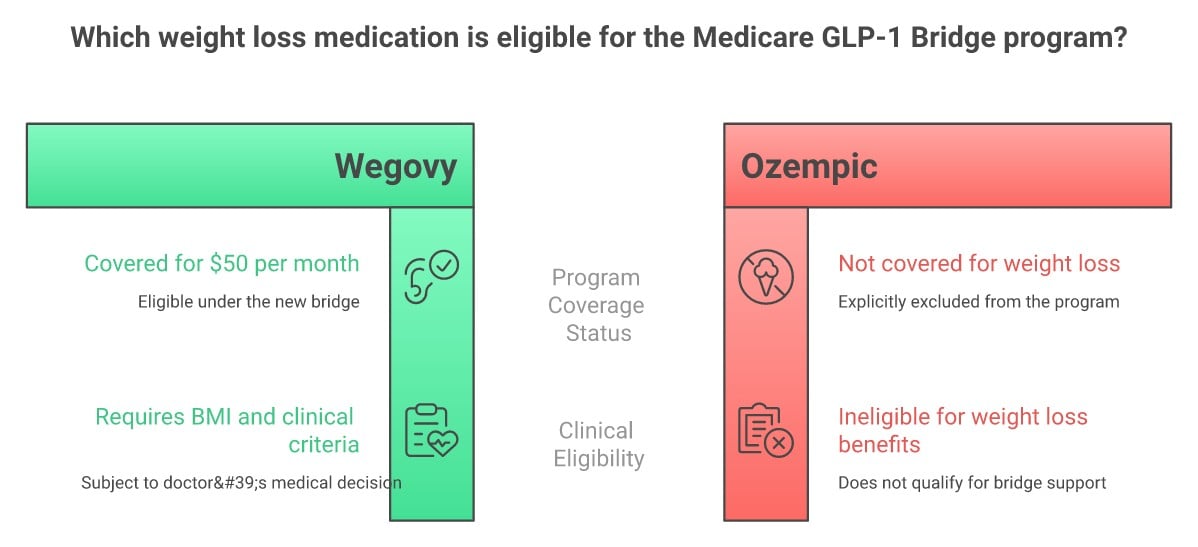
Under this program, if you qualify, you can get certain weight-loss medications for $50 a month for a 30-day supply. The drugs covered are the ones approved specifically for weight loss: Wegovy and Zepbound (and a newer pill called Foundayo). One piece of fine print on Zepbound: only the KwikPen version is covered — if you currently use the Zepbound autoinjector pen, you’d have to switch to the KwikPen to get the $50 price.
And here’s the part the headlines keep getting wrong, so listen closely: Ozempic is NOT on the list for weight loss. Ozempic is approved for diabetes, not weight loss, so it doesn’t qualify for this new program. If you take Ozempic, Medicare may still cover it — but only when it’s prescribed for type 2 diabetes, including for people with diabetes who also have heart disease, the way it always has been. (To be precise: Ozempic’s heart benefit is an add-on for people who already have type 2 diabetes — it’s not a separate coverage door for heart disease on its own.) If you’ve been hoping this news means cheap Ozempic for shedding pounds, I’m sorry to be the one to tell you it doesn’t.
Why You Need to Know It
After 30 years of helping people with their money, here’s what I’ve learned: the gap between what a headline promises and what the rules actually deliver is where families get hurt. Somebody reads “Medicare covers weight-loss drugs,” stops paying for their current prescription, and then finds out three weeks later they didn’t qualify — or their specific drug wasn’t covered — and now they’ve had a gap in a medication they shouldn’t have stopped.
So two things matter here. First, this isn’t automatic. To get into the program you have to meet medical criteria — Medicare requires you to hit a certain Body Mass Index and have your doctor attest to a clinical need. It’s not “anyone on Medicare who wants to lose weight.” Your doctor is the gatekeeper.
Second — and this is good news for everyone, not just the people taking these drugs — this program runs outside the regular Part D system. That’s a technical detail with a real consequence: it places no cost risk on the Part D drug plans, which is the mechanism that keeps it from being reflected in your plan’s premiums. If you were worried this was going to raise your costs even though you’ll never touch a weight-loss shot, the way it’s structured is what keeps that from flowing through to you.
Things to Consider
Let me put my honest hat on, because this is where the money decisions live.
$50 a month is still $600 a year. For someone on a fixed income, that’s not nothing. It might be absolutely worth it for your health — that’s between you and your doctor — but it’s a real line in a tight budget, and it’s a recurring one. Go in with your eyes open about the ongoing cost, not just the relief that it’s cheaper than before.
And here’s a piece of fine print that matters most for the people with the least. If you get “Extra Help” — the low-income subsidy that knocks your prescription copays down to a few dollars or even zero — that help does NOT apply to this $50 Bridge copay. So if you’re used to paying $0 to $3 for your prescriptions, this program would actually cost you $50 a month, not less. For some lower-income folks, that makes the $50 program more expensive than what they pay now, not cheaper. On top of that, the $50 doesn’t count toward your yearly Part D out-of-pocket cap. Run your own numbers before you assume this is a deal for you — for some people it genuinely isn’t.
It’s temporary. The program is currently set to end December 31, 2027 — and that date itself is already a sign of how unsettled this is. It was originally supposed to end December 2026; Medicare pushed it out a year when the follow-on program stalled. That follow-on (they call it the BALANCE Model) was supposed to take over — but Medicare has indefinitely delayed it. CMS cited the need for more data on how these drugs get used, and reports indicate not enough Part D drug plans signed on to meet the participation bar Medicare set. So don’t build a five-year financial plan around a program that’s only guaranteed through 2027. Know that the $50 deal has an expiration date, and the picture after 2027 is genuinely uncertain right now.
Don’t stop paying for anything until your coverage is confirmed in writing. This is the big one. If you’re currently getting a weight-loss drug some other way — paying cash, using a manufacturer coupon, financing it — do NOT cancel that arrangement on the assumption you’re now covered. Wait until you’ve confirmed, in writing, that you qualify and your specific drug is included. A gap in medication you didn’t plan for is worse than paying for one more month.
What to Think About Doing
If this might apply to you or a family member on Medicare:
- Call your Part D plan after July 1, 2026 and ask specifically: “Am I eligible for the Medicare GLP-1 Bridge program, and is my drug covered under it?” Use those words. Don’t accept a vague answer.
- Talk to your doctor about the medical criteria. Because eligibility runs through your doctor’s attestation of BMI and clinical need, that conversation is step one. If your doctor doesn’t bring it up, you bring it up.
- If you’re on Ozempic for weight loss, ask your doctor about Wegovy or Zepbound — the covered alternatives. Same family of drug, but these are the ones the program actually includes. Whether switching is right for you is a medical call, not a money call — but it’s worth asking.
- If you free up money — say you were paying $1,000 a month and now it’s $50 — have a plan for that $950 before it disappears into everyday spending. That’s an $11,400-a-year swing. Pointed at debt or an emergency fund, that’s the kind of money that changes a retirement. (I write a lot about making retirement money go further — including why I took my own Social Security at 62 instead of waiting.)
- If none of this applies to you, you don’t need to do anything — and you shouldn’t see your premiums rise because of it. Sometimes the right move is to read the news, confirm it doesn’t affect you, and move on.
FAQ
Does Medicare cover Ozempic for weight loss in 2026?
No. The new Medicare GLP-1 Bridge program does not cover Ozempic for weight loss, because Ozempic is approved for diabetes rather than weight loss. Medicare may still cover Ozempic when it’s prescribed for diabetes or cardiovascular conditions, as it has in the past. The weight-loss drugs in the program are Wegovy, Zepbound, and Foundayo.
When does Medicare start covering weight-loss drugs, and how much will it cost?
The Medicare GLP-1 Bridge program begins July 1, 2026 and is currently set to run through December 31, 2027. If you qualify, eligible weight-loss drugs cost $50 a month for a 30-day supply.
Who qualifies for the Medicare GLP-1 Bridge program?
You must be enrolled in Medicare Part D and meet medical criteria — a qualifying Body Mass Index and a clinical need, as attested by your doctor. It is not available to everyone on Medicare automatically; your doctor’s documentation is required.
Will this raise Medicare premiums for people who don’t take these drugs?
It shouldn’t. The Bridge program is funded outside the regular Part D system, which was a deliberate design choice to avoid pushing up premiums for the millions of beneficiaries who don’t use weight-loss drugs.
This is what I’m seeing, and what I’d tell my own family: real relief is on the table for some people here, but the fine print matters more than the headline. Talk to your doctor and your drug plan, confirm everything in writing before you change a thing, and only you can decide what’s right for your health and your budget. Take my read as input, not instruction — nobody gets to tell you what to do with your money or your medicine, including me.
Know someone on Medicare who’s been struggling with the cost of these drugs? Send them this — the $50 program is real, but so is the fine print, and they deserve to hear both.
Dealing With Debt? Understanding your options is the first step. See how all your debt relief options compare — including ones most sites won’t tell you about. The Find Your Path quiz gives a recommendation based on your actual numbers, and the Scam-O-Meter checks any company’s complaint history before you sign. Federal Reserve research shows bankruptcy filers recover faster than those who don’t file.

