

Fact-checked by Steve Rhode, consumer debt expert since 1994 • Last reviewed July 2, 2026 • Every claim below links to a primary source.
The verdict: MYTH — and worse than a myth, it’s a federal crime. There is no law that creates a “credit privacy number,” and putting any number that isn’t your real Social Security number on a credit application is a federal offense — and “I didn’t know it was illegal” has not protected people from prosecution — the application you sign certifies the information is true. A man who used CPNs on car loans went to 18 months in federal prison — the numbers he bought turned out to be the stolen Social Security numbers of two children.
Well, Actually…
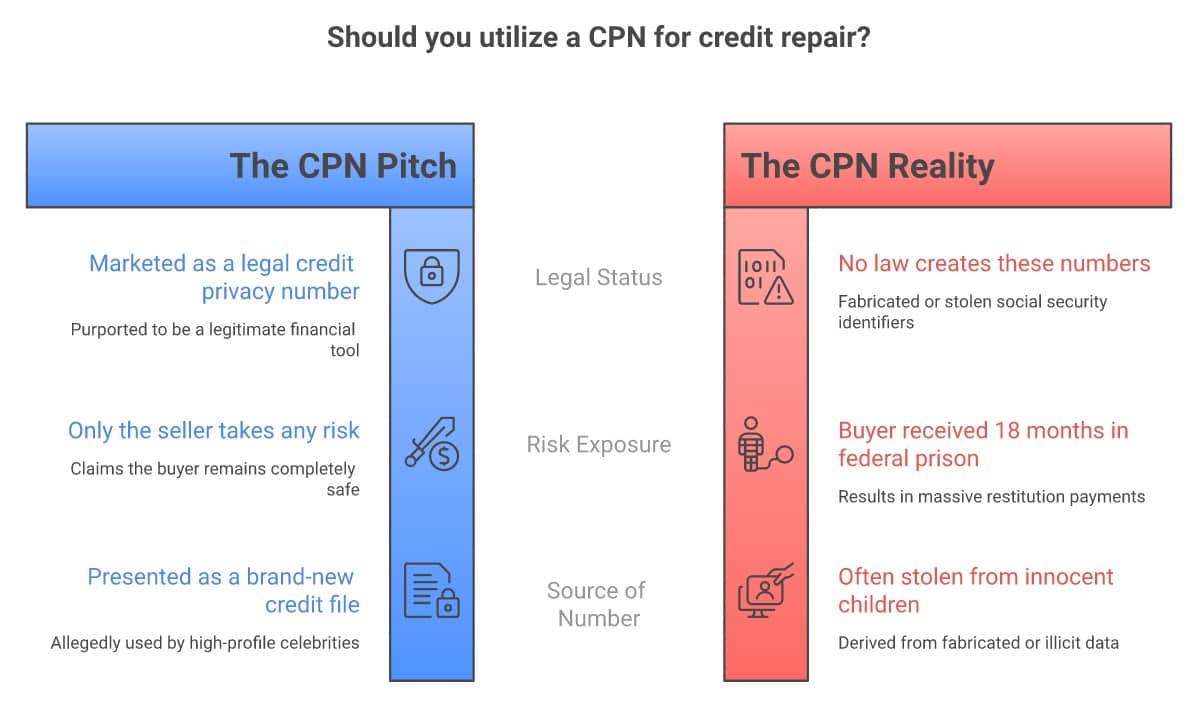
The pitch is everywhere right now — TikTok videos, Telegram channels, Facebook groups: pay a few hundred dollars for a “CPN” (they’ll say it stands for credit privacy number, credit profile number, or credit protection number), use it instead of your Social Security number, and presto — a brand-new credit file with none of your old baggage. The sellers say celebrities and members of Congress use them. They say it’s perfectly legal because “you’re not claiming it’s your SSN.”
Here’s the part they leave out: CPNs do not exist in the law. Not in the Social Security Act, not in the Fair Credit Reporting Act, not anywhere. There is no government agency that issues them and no legal way to have a second credit identity. What the sellers actually hand you is a nine-digit number that is either fabricated to look like an unissued SSN — or is a real Social Security number stolen from someone whose credit is a blank slate. In documented prosecutions — including the DOJ’s Oklahoma case below — the stolen numbers belonged to children.
And the moment you put that number in the SSN field of a credit application, you’ve committed a crime of your own — the seller’s fraud doesn’t absolve you, and yours is the signature on the paperwork. Federal law makes it a felony to falsely represent a number as your Social Security number with intent to deceive — and courts treat submitting a false number on an application you sign as accurate as exactly that — plus a separate crime to knowingly make a false statement on a loan or credit application. If the number belongs to a real person, you can add identity fraud to the list. This isn’t theoretical. In Oklahoma City, Calvin Wayne Cade Jr. used CPNs on financing applications at retailers, banks, and credit unions. The Justice Department’s own press release spells out how that ended: the “CPNs” were the stolen Social Security numbers of children born in 2006 and 2008, he pleaded guilty to making a false statement to a financial institution, and he was sentenced to 18 months in federal prison, three years of supervised release, and $112,924.54 in restitution.
The FTC put out a fresh warning about exactly this in December 2025: avoid any company that promises to create a “new” credit identity or hide your credit history, and any company that tells you to lie on a credit application. That’s the entire CPN business model in one sentence.
“A CPN is a legal credit privacy number — celebrities use them all the time.”
No law creates or recognizes CPNs, and no agency issues them. The “numbers” are fabricated nine-digit strings or stolen Social Security numbers — in the DOJ’s Oklahoma case, they belonged to children born in 2006 and 2008. Public figures protect their privacy with legal tools like business entities and registered agents — not with secret second Social Security numbers, which do not exist.
U.S. Department of Justice, W.D. Okla. press release (Oct. 23, 2018)
“It’s legal as long as you never claim the CPN is your Social Security number.”
Credit applications ask for your Social Security number. Putting another number in that field, intending the lender to rely on it, is a false representation of an SSN — a felony under 42 U.S.C. § 408(a)(7)(B) — and a knowing false statement to a lender under 18 U.S.C. § 1014. A made-up number avoids the identity-theft charge but not the false-statement one. There is no magic wording that makes it legal: the application you sign certifies the information is true.
“If anyone gets in trouble, it’s the company that sold the number — not you.”
The person who went to federal prison in the DOJ case was the customer — the man who used the numbers on his own applications. Sellers face their own charges when investigators catch up with them — but they are often long gone, while the buyer signed the applications and left the paper trail. You are the easiest person in the whole scheme to prosecute.
U.S. Department of Justice, W.D. Okla. (18-month sentence, $112,924.54 restitution)
Free Tool — Debt Collector Rights Lookup: Being contacted by a debt collector? The free Debt Collector Rights Lookup shows your state-specific protections — statute of limitations, garnishment limits, and what collectors are legally prohibited from doing. Look Up Your Rights →
Why You Were Told This
Because desperation is a market. A person with wrecked credit who’s been turned down for an apartment, a car, and a card will pay a few hundred dollars for hope — and the CPN sellers know it. They dress the product up in official-sounding language (“privacy number,” “the same thing celebrities use”), charge hundreds of dollars per number, and carry none of the risk, because you’re the one signing the applications. The same playbook shows up across the illegal credit-repair world — I’ve written about the dispute-everything-as-identity-theft trick and the “609 letter” myth — and it always ends the same way: the seller gets paid, and the customer inherits the consequences. The FTC’s December 2025 alert lists “promises to create a new credit identity” as a defining mark of a credit-repair scam.
What to Actually Do
- If you’re considering a CPN: don’t. There is no legal version of this product. Every dollar spent on one buys you criminal liability exposure, not credit.
- If you already bought or used one: stop using it now, and talk to a lawyer before anything else. Applications you already signed are the risk — a criminal defense attorney can tell you where you stand. Don’t “fix” it with more applications.
- Rebuild the real file — it’s faster than you’ve been told. Pull your free reports at AnnualCreditReport.com, dispute genuine errors yourself for free, and let on-time payments do the compounding. The FTC’s own advice: anything a credit repair company can legally do, you can do yourself for free.
- If the real problem is debt you can’t pay, use the legal fresh start. Bankruptcy is the fresh start that’s actually written into federal law — and Federal Reserve research shows credit scores typically rise substantially in the years after filing, not fall (the Philadelphia Fed’s working paper is one of the underlying studies). Check any company that approaches you first with the Scam-O-Meter.
Steve’s Take
Here’s the bitter irony I want you to sit with. The people selling CPNs are selling a fake fresh start that ends in a courtroom — while the real fresh start, the one actually written into federal law since 1898, is the one everybody’s too ashamed to use. I filed bankruptcy in 1990. Nobody went to prison; my life restarted. If your credit is wrecked because the math broke, you don’t need a stolen child’s Social Security number — you need to run your real numbers and pick a legal path. Shame makes people buy fake documents. Math sets them free.
Frequently Asked Questions
Is a CPN ever legal to use for credit?
No. There is no federal or state law that creates CPNs, and no legitimate agency issues them. On a credit application, the only number that is legal in the SSN field is your own Social Security number — anything else is a federal offense. And no, there’s no “legal for rent and utilities” loophole either — wherever a form asks for your SSN, substituting another number raises the same false-statement problems.
I already bought a CPN — am I in trouble?
Buying a number is not the main danger; using it is. If you’ve already put it on applications, stop using it immediately and talk to a criminal defense attorney about your specific situation before doing anything else. Keep the records of who sold it to you.
The seller told me to get an EIN and build credit on that instead. Is that legal?
An EIN is a legitimate tax ID for a business — but using one in place of your SSN on a personal credit application is the same false-statement problem. The FTC has long warned that the “new credit identity” pitch, whatever number it uses, is the mark of a scam.
Where do CPN sellers even get these numbers?
Two main sources: computer-generated nine-digit numbers designed to look like unissued SSNs, and real stolen Social Security numbers — disproportionately children’s, because a child’s number has a clean, unmonitored credit history (the St. Louis Fed has written about exactly this pattern). In the DOJ’s Oklahoma case, the numbers belonged to children born in 2006 and 2008.
Can I legally get a brand-new Social Security number?
Only the Social Security Administration can issue one, and only in narrow circumstances such as ongoing harassment or domestic violence — and even then your old credit history follows you, because the credit bureaus link the records. A new SSN is not a credit eraser, and anyone selling one is selling fraud.
My credit really is wrecked — what’s the legitimate fresh start?
Time plus on-time payments rebuilds any file. Dispute genuine errors free at the bureaus, and if the underlying debt is unpayable, look honestly at bankruptcy — the legal fresh start. Federal Reserve research shows filers’ scores typically recover faster than people who keep struggling with unpayable debt.
Everything here is one informed perspective from more than 30 years of helping people with debt — input for your decision, not instruction. If you’ve already used a CPN, your next conversation should be with a lawyer, not a website. Only you can decide your path; just make it a legal one.
The bottom line: There is no legal second credit file — a CPN is either a made-up number or a stolen child’s Social Security number, and using one on a credit application is a federal crime that has put buyers in prison. If someone you know is about to pay for a “fresh credit identity,” send them this before they sign anything.
This is a cousin of the government-grant “pay a fee first” scam.
Dealing With Debt? Understanding your options is the first step. See how all your debt relief options compare — including ones most sites won’t tell you about. The Find Your Path quiz gives a recommendation based on your actual numbers, and the Scam-O-Meter checks any company’s complaint history before you sign. Federal Reserve research shows bankruptcy filers recover faster than those who don’t file.



