

If you or someone in your family worked as a home care aide through PPL (Public Partnerships LLC) in New York City, Long Island, or Westchester County, a federal judge just gave preliminary approval to a $162 million settlement that could put money in your pocket — and the most important thing I can tell you is this: you don’t have to do anything right now, and you should not pay a single person who offers to “file your claim” for you.
Let me walk you through what this is, whether it touches you, and the one or two simple things worth doing this week.
What You Need to Know
On July 1, 2026, a federal court in the Eastern District of New York granted preliminary approval to a settlement in a class-action case called Calderon v. Public Partnerships LLC. The workers who brought the case — represented by The Legal Aid Society and the law firm Katz Banks Kumin — alleged that when PPL took over as the statewide payroll company for New York’s Consumer Directed Personal Assistance Program (CDPAP), its broken apps, phone systems, and portal left thousands of caregivers unpaid or underpaid for weeks.
The proposed settlement is $162 million, covering roughly 200,000 personal assistants who provided services downstate — in New York City, Long Island, and Westchester — between March 1, 2025 and April 30, 2026. It still needs final approval; a final approval hearing is scheduled for November 10, 2026. To be clear, these are allegations that were resolved through a settlement, and PPL has agreed to pay to resolve the claims — you can read the details directly from the workers’ own attorneys at The Legal Aid Society.
The Daily Money Brief — Free, at 10 AM
Money you may be owed, scams to dodge, and the fine print decoded — the consumer money news that affects your wallet, every weekday.
Claiming money you are owed is one good day. What you do over the following year is what actually changes your position.
In the latest issue (Oct 9): Does Financial Literacy Make Financial Sense?
I write Your Money Actually most weekdays — actionable money information you will not find anywhere else, and the small decisions that compound. It is free, I sell nothing, and I take no money from any company I write about.
Why You Need to Know It
I’ve spent over 30 years watching how money moves — and who gets left behind when it doesn’t. Home care workers are some of the most financially squeezed people in this whole economy. Many earn close to minimum wage, often have no benefits, and frequently carry credit card balances or medical debt of their own that piled up precisely because a paycheck showed up late or short.
Here’s the pattern I see over and over: the people who are owed money in situations like this are often the least likely to actually collect it. Not because they don’t qualify — because they assume it’s too good to be true, or they think it’s a scam, or they never see the notice because their contact information changed. Real money, owed to real people, goes unclaimed every single year for exactly those reasons.
If a late or missing paycheck from this program pushed you into credit card debt or made you fall behind on bills, this isn’t just back pay — it’s a chance to undo some of the damage that the delay caused in the first place.
Things to Consider
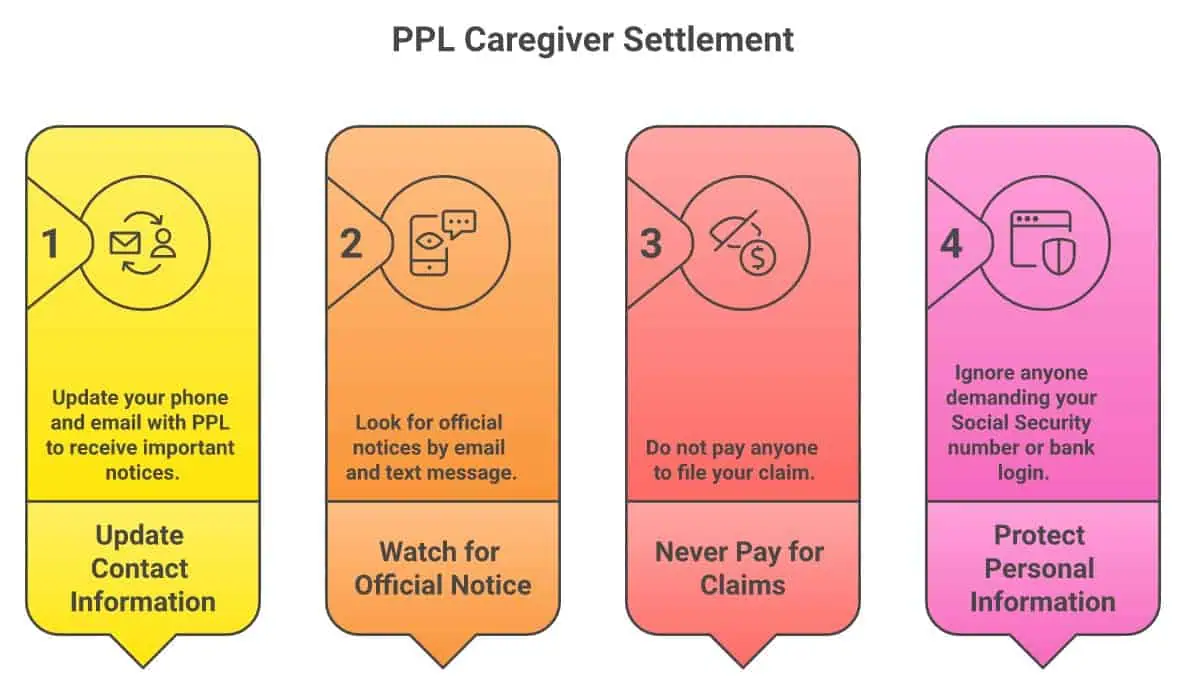
Here’s the part that surprises people: you do not need to file a claim to get paid in this settlement. According to the workers’ attorneys, eligible personal assistants “do not need to take any action now.” If the settlement gets final approval, class members will be notified directly — by email and text message — and the official information lives at the settlement website, publicpartnershipssettlement.com.
That fact matters, because it’s exactly the kind of situation scammers love. Any time there’s a big settlement in the news, a wave of “claim filing services” and fake settlement websites shows up promising to get you your money — for a fee, or in exchange for your Social Security number and bank details. You never have to pay anyone to receive money from a class-action settlement. The real notice comes from the official administrator, and the real website is the one the court approved — not a look-alike you found through an ad.
What to Think About Doing
If this might be you or a family member, here’s the short, calm checklist:
- Make sure PPL has your current phone number and email. The notice is coming by email and text — if your contact information changed since you worked through the program, you could miss it. Updating it is the single most useful thing you can do right now.
- Bookmark the official settlement site — publicpartnershipssettlement.com — and check it directly rather than clicking links from texts or ads you didn’t expect.
- Do not pay anyone to “file” for you, and don’t hand your Social Security number or bank login to a “claims helper.” If someone contacts you demanding a fee or those details to release your settlement money, that’s your scam alarm — hang up.
- If a late paycheck already put you in debt, take a breath and look at the whole picture before you decide what to do with any money that eventually comes. A one-time check is most powerful when it’s aimed at the debt doing the most damage — not spread thin or spent before it arrives.
And honestly? For a lot of people the right move this week is simply to wait and watch — update your contact info, then let the official process come to you. That’s not doing nothing. That’s refusing to be rushed into a scammer’s hands.
This is what I’m seeing after more than 30 years of helping people with debt. Take it as one informed perspective — but only you know your full situation. Use this as input for your decision, not a directive. Nobody gets to tell you what to do with your money. Not me, not anyone. And if you’re not sure whether a debt should be paid off, settled, or wiped out entirely, that’s exactly the kind of thing you can ask me about for free.
Dealing With Debt? Understanding your options is the first step. See how all your debt relief options compare — including ones most sites won’t tell you about. The Find Your Path quiz gives a recommendation based on your actual numbers, and the Scam-O-Meter checks any company’s complaint history before you sign. Federal Reserve research shows bankruptcy filers recover faster than those who don’t file.



