

Fact-checked by Steve Rhode, consumer debt expert since 1994 • Last reviewed July 8, 2026 • Every claim below links to a primary source.
The verdict: Myth. A debt dropping off your credit report after seven years does not erase the debt — it only stops it from being reported. The Consumer Financial Protection Bureau says plainly that “a debt doesn’t generally expire or disappear until it’s paid.” Three different clocks are running at once, and people mash them into one — which is exactly how a collector talks you into paying, or suing you, on a debt you thought was gone.
Well, Actually…
Here’s the part nobody explains when they tell you “seven years and it’s gone.” There isn’t one clock ticking on your old debt. There are three, and they run on completely different tracks.
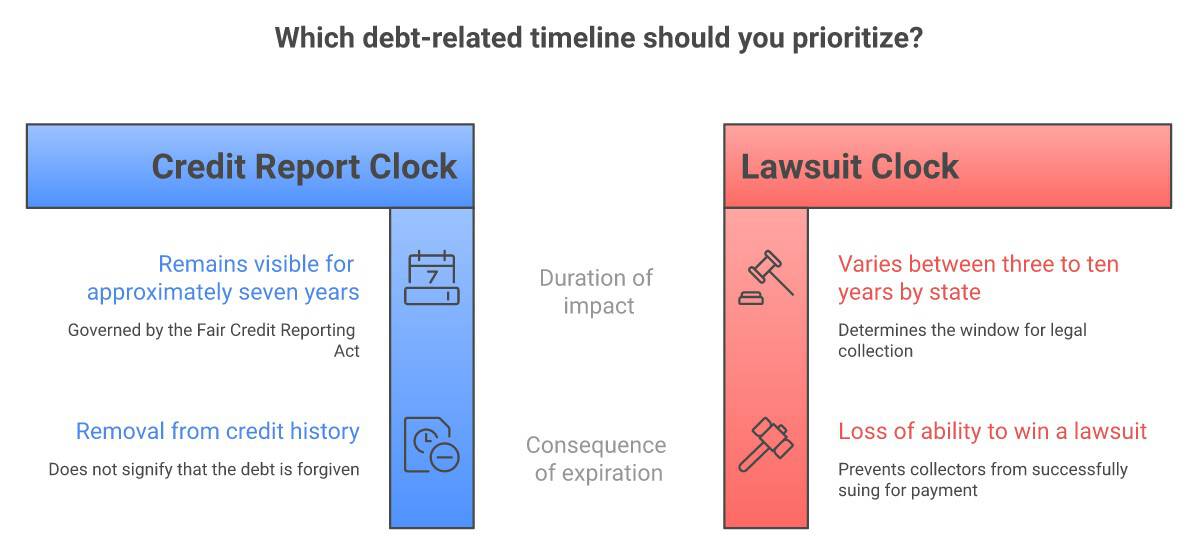
The first clock is the one everybody knows: how long a debt can show up on your credit report. Under the federal Fair Credit Reporting Act, most negative information — late payments, charge-offs, collection accounts — comes off about seven years after the account first went delinquent and stayed that way (the “date of first delinquency” — not the date it was sold to a collector). The CFPB confirms that “a credit reporting company generally can report most negative information for seven years.” (A few things run longer — a bankruptcy can stay on your report for up to 10 years, and some civil judgments longer still.) But that’s a reporting rule. It controls what lenders see. It says nothing about whether you still owe the money.
The second clock is your state’s statute of limitations — the window during which a creditor or collector can actually sue you and win. The CFPB says most states set this window between three and six years, though some allow longer for certain debt types. When that clock runs out, the debt is called “time-barred.” Here’s the part collectors count on you not knowing: once a debt is time-barred, it is illegal for a third-party debt collector to sue you or even threaten to sue you over it. Federal rule 12 C.F.R. § 1006.26 states flatly that “a debt collector must not bring or threaten to bring a legal action against a consumer to collect a time-barred debt.” (This rule covers debt collectors; a few states extend the same protection against the original lender, but not all do.) It still happens — because some collectors bet you won’t show up — and if you ignore the summons a court can enter a judgment against you anyway. So you still have to appear and raise the age of the debt as a defense.
The third clock is the debt itself — and here’s the kicker: it doesn’t have a clock. The obligation you agreed to when you borrowed the money doesn’t evaporate on a schedule. In the CFPB’s own words, “a debt doesn’t generally expire or disappear until it’s paid.” The report clears. The lawsuit window may close. The debt is still, technically, owed. That’s why a collector can call you about a fifteen-year-old balance that hasn’t shown up on your credit report in eight years — and why that call is completely legal. (The one thing that does legally erase the obligation is a bankruptcy discharge — if the debt was discharged, it’s gone for good and no collector can pursue it.)
Once a debt falls off my credit report after seven years, the debt is gone and I don’t owe it anymore.
Falling off your credit report only stops the debt from being reported. The debt itself doesn’t expire — the CFPB states a debt “doesn’t generally expire or disappear until it’s paid.” The seven-year FCRA reporting limit, your state’s statute of limitations on lawsuits, and the underlying obligation are three separate things.
CFPB, “My debt is several years old. Can debt collectors still collect?”
If the debt is too old to sue over, I’m completely safe — they can’t touch me.
Suing on a time-barred debt is itself an FDCPA violation — a collector legally cannot sue or threaten to sue you once the statute of limitations has passed. But it happens anyway, because some collectors bet you won’t show up. If you ignore the summons, you can lose by default judgment even on a debt that was too old to enforce. So you must appear and raise the statute of limitations as a defense — and you may also have your own FDCPA claim against the collector for filing in the first place. In many states, making a payment or even acknowledging the debt in writing can restart the clock, so say nothing that admits the debt.
Free Tool — Statute of Limitations Checker: Dealing with old debt? The free Statute of Limitations Checker tells you if the collection clock has expired in your state — including the zombie debt and clock-restarting traps collectors use. Check My Status →
Why You Were Told This
Two reasons this myth is everywhere. First, it’s an honest mix-up: the seven-year number is real and famous, so people naturally assume it’s the finish line for everything. Nobody ever explained that “off your report” and “no longer owed” are different sentences.
Second — and this is the one to watch — there’s a whole business built on the gap. Old debts get bought and sold for pennies on the dollar to collectors who specialize in exactly these forgotten balances. A collector who calls about a debt that vanished from your report years ago is counting on you not knowing that the statute of limitations may have already run. If they can get you to make one small “good faith” payment, in many states that can reset the clock and make the whole debt legally collectible again. The confusion isn’t an accident. It’s the product.
What to Actually Do
- Don’t pay or promise anything on the phone. A single payment or written acknowledgment can restart the statute of limitations in many states. Say nothing that admits the debt until you know how old it is.
- Make them prove it. Send a written debt validation request — the free Debt Validation Letter Generator does it for you. Under the FDCPA the collector must verify the debt or stop collecting.
- Find out your state’s statute of limitations and the date of your last payment. If the lawsuit window has closed, the debt is time-barred — the CFPB explains how the clock works.
- Never ignore a lawsuit — even on an old debt. Show up and raise the age of the debt as a defense. Ignoring it hands the collector a default judgment.
- If the debt is real and current, weigh your actual options. Compare all your debt relief paths before you send a dime to a collector.
Steve’s Take
I’ve watched people wire money to a collector out of pure relief — “oh thank God, I thought this was gone” — on a debt that was so old no court would have touched it. That payment didn’t just cost them the cash. In a lot of states it woke the whole debt back up and put them right back on the hook. The truth here isn’t “you never have to pay.” It’s “know which clock you’re looking at before you do anything.” The seven-year report rule is the one people quote. The statute of limitations is the one that actually protects you in court. And the obligation itself? That one just sits there. Understand all three and no collector can bluff you.
Free Tool — Debt Validation Letter Generator: Being contacted by a debt collector? The free Debt Validation Letter Generator creates a personalized FDCPA validation letter in seconds — forcing the collector to prove the debt is real before they can continue. Generate My Letter →
Frequently Asked Questions
My old debt fell off my credit report — do I still owe it?
Yes, generally you do. The CFPB says a debt “doesn’t generally expire or disappear until it’s paid.” Falling off your report after seven years only stops it from being reported to lenders — it doesn’t cancel the underlying obligation.
Can a collector still call me about a debt that’s not on my credit report anymore?
Yes. The seven-year credit-reporting limit doesn’t stop collection contact. As long as the debt exists, a collector can contact you about it — even if it hasn’t appeared on your report in years.
What’s the difference between the seven-year rule and the statute of limitations?
The seven-year rule (from the Fair Credit Reporting Act) controls how long a debt appears on your credit report. The statute of limitations is a separate state law that controls how long a collector can sue you and win — the CFPB says most states set it between three and six years, though some allow longer for certain debt types. They are two different clocks that run on different schedules.
If the statute of limitations has passed, can I be sued anyway?
It’s illegal for a collector to sue you on a time-barred debt — federal rule 12 C.F.R. § 1006.26 bars bringing or threatening a lawsuit on one. Some collectors file anyway, betting you won’t respond, and if you ignore it you can lose by default. Appear in court, raise the statute of limitations as a defense, and note that the collector may owe you for the illegal filing. See the CFPB explanation.
Can making a payment on an old debt restart the clock?
In many states, yes. Making a payment — or even acknowledging the debt in writing — can restart the statute of limitations and make the entire debt legally collectible again. That’s why you shouldn’t pay or promise anything until you know how old the debt is.
How do I make a collector prove a debt is really mine?
Send a written debt validation request within 30 days of first contact. Under the Fair Debt Collection Practices Act, the collector must verify the debt before continuing to collect. The free Debt Validation Letter Generator writes the letter for you.
Does the debt ever truly go away on its own?
Generally not by the passage of time alone. The obligation persists until it’s paid, settled, discharged in bankruptcy, or forgiven by the creditor. Age limits what a collector can do (report it, sue over it) — it doesn’t erase the debt.
One more thing — everything I share here is based on over 30 years of helping people through exactly this, but my advice is input for your decision, not the decision itself. Statute-of-limitations rules and clock-restart rules vary by state, so confirm your state’s law or talk to an attorney before you act. Only you know your full situation.
The bottom line: A debt falling off your credit report doesn’t mean you’re free of it — the report clock, the lawsuit clock, and the debt itself are three different things. If someone you know still believes “seven years and it’s gone,” send them this before a collector uses that confusion against them.
Know Your Rights: If a debt collector is contacting you, you have legal protections. See the complete list of FDCPA violations collectors commit most often. Use the free Debt Validation Letter Generator to demand proof of the debt, or check this collector’s complaint history with the Scam-O-Meter.
Dealing With Debt? Before you pay a collector, understand all your debt relief options — including ones the collector won’t tell you about. If the debt feels unmanageable, take the 2-minute bankruptcy quiz to see if the math favors a fresh start. Federal Reserve research shows filers recover faster than those who don’t file.
Related: I paid off my collection — so why is it still on my credit report?



