

Written by Steve Rhode, consumer debt expert since 1994 • Last updated July 8, 2026
Quick Answer: You are generally not personally responsible for your late spouse’s debts. The Consumer Financial Protection Bureau says debts are paid from the person’s estate — and “if there is no money or property left in an estate, or the estate can’t pay, then the debt generally goes unpaid.” A collector cannot make you pay from your own pocket unless you were a joint account holder, a co-signer, or live in a state whose law makes you liable. Do not pay anything yet, and do not admit the debt is yours. Your Social Security survivor benefits are protected by federal law from these collectors.
What Just Happened
Within days or weeks of a death, debt collectors often start calling the surviving spouse. This is not because you owe the money. It’s because collectors know grief and pressure work — and they’re betting you don’t know the rules. When someone dies, their debts don’t vanish, but they also don’t automatically become yours. They become a claim against the person’s estate — whatever money and property they left behind. The estate pays what it can. If the estate is empty, most solo debts simply go unpaid. The collector doesn’t get to reach into your wallet to make up the difference.
The CFPB is blunt about this: “You are generally not responsible for someone else’s debt.” The exceptions are specific, and I’ll walk you through every one below so you know exactly where you stand.
The Mistake You’re About to Make: Paying a debt out of love, guilt, or pressure before you know whether you legally owe it. This is the single most expensive mistake grieving spouses make. It drains money you may need to live on — and once you’ve voluntarily paid a debt you weren’t obligated to pay, recovering that money is nearly impossible. Find out what you actually owe before you send a dollar.
Your Options Right Now
What to Do in the Next 48 Hours
- Say nothing that admits the debt, and pay nothing yet. Tell the collector you’re not confirming responsibility for anything and that all communication should go through the estate. You have the right to request everything in writing.
- Figure out if you were actually on the debt. Were you a joint account holder or co-signer? Then you were already a borrower and are likely liable. Were you only an authorized user on a credit card? The CFPB confirms that “being an authorized user generally does not obligate you to pay the debt.” Make the collector prove you signed.
- Check whether you live in a community property or “necessaries” state. Nine community property states (Arizona, California, Idaho, Louisiana, Nevada, New Mexico, Texas, Washington, Wisconsin) and states with a “doctrine of necessaries” can create spousal liability for some debts, especially medical bills. This is where you need a local attorney — the rules vary sharply by state, and several states have recently reduced this liability.
- Protect your Social Security. Your survivor and retirement benefits cannot be garnished by ordinary debt collectors. 42 U.S.C. § 407 shields Social Security from “execution, levy, attachment, garnishment, or other legal process.” If a collector threatens your benefits, that’s a red flag.
- Get free, honest help before you decide anything. Talk to Damon Day for free, or if the estate is complicated, find a probate or consumer attorney. Damon Day, an independent debt coach and my co-host on the Get Out of Debt Guy podcast, whom you can reach at DamonDay.com — I receive no payment for this referral. Free legal aid is available through LSC.gov.
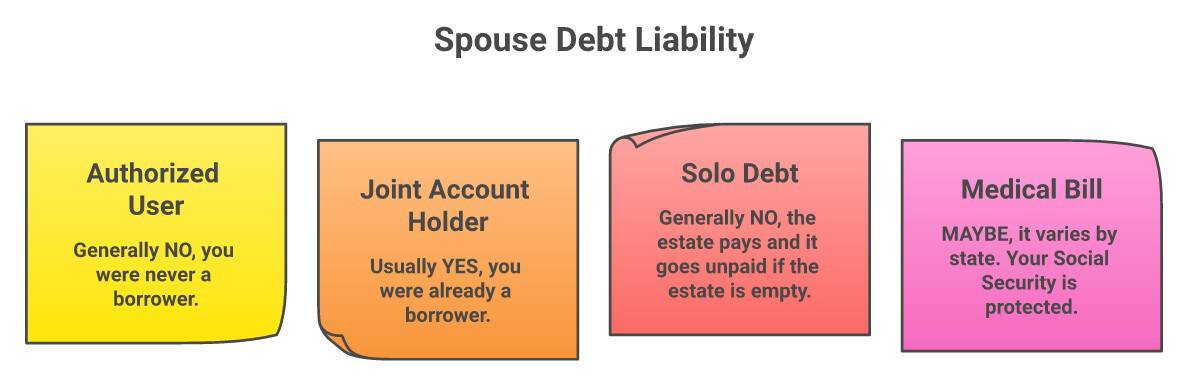
How to Actually Handle It — Where You Really Stand
- Solo debt, and you weren’t on the account. Generally not your responsibility. It’s an estate matter. If the estate can’t cover it, it usually goes unpaid — the CFPB says so directly.
- Joint account or co-signed loan. You’re likely liable — but not because your spouse died. You were already a borrower. This is the one category where paying is usually genuinely owed.
- Medical bills in a “necessaries” state. Some states can hold a spouse responsible for the other’s necessary medical care — but this is changing. Virginia ended surviving-spouse medical-debt liability in 2023, and in Ohio a creditor must first go after the deceased’s estate and can be permanently barred if it misses the six-month deadline to file a claim with the estate. Do not assume you owe a medical bill just because a collector says so.
- What WON’T help. Panic-paying, giving a collector your bank information, or agreeing to a “payment plan” on a debt that was never yours. Any of these can turn a debt you didn’t owe into one you do.
What You Need to Know About Your Rights
What you generally owe on your spouse’s solo debt from your own money
Community property states with special spousal-debt rules
Federal law shielding your Social Security from collectors
Under the Fair Debt Collection Practices Act and the CFPB’s Regulation F, collectors are “not allowed to say or hint that you are responsible for paying the debt with your own money” unless you actually are. They may contact you to identify the estate’s representative, but they cannot misrepresent that you personally owe the money. In September 2024 the CFPB specifically warned that some collectors “try to capitalize on a surviving spouse’s vulnerabilities.”
| Your situation | Are you liable? | Notes |
|---|---|---|
| Authorized user on their credit card | Generally no | CFPB: authorized users are not obligated to pay |
| Joint account holder / co-signer | Usually yes | You were already a borrower |
| Solo debt, you weren’t on it | Generally no | Paid from the estate; unpaid if estate is empty |
| Medical bill, “necessaries” state | Maybe | Varies by state; VA (2023) & MN (2024) recently reduced this |
| Any debt, community property state | Possibly | Community debts may already be partly yours — ask a local attorney |
If you live in a community property state (Arizona, California, Idaho, Louisiana, Nevada, New Mexico, Texas, Washington, or Wisconsin), debts your spouse took on during the marriage may already be partly yours — but even there, your separate property (owned before marriage, or inherited) is generally protected. This is state-specific; talk to a local attorney before assuming anything.
If a collector is telling you that you must pay a debt you don’t owe, file a complaint with the CFPB and your state attorney general. If you need legal help but can’t afford an attorney, find free legal aid through LSC.gov.
Steve’s Take
I filed bankruptcy in 1990, so I know what financial fear feels like — and there is no fear quite like grief plus a ringing phone. Here’s what I want you to hear: the collector calling you three days after the funeral is not doing you a favor by “letting you take care of it.” They are counting on your love and your exhaustion. The people I’ve watched come through this whole are the ones who slowed down, asked “was I actually on this debt?”, and refused to pay a dime until they knew the answer. You are allowed to grieve first and deal with money second. Nobody — no collector, no company — gets to rush you into paying something that was never yours.
Frequently Asked Questions
My spouse just died — am I responsible for their debts?
Generally no. The CFPB says you’re “generally not responsible for someone else’s debt.” Your late spouse’s solo debts are paid from their estate, and if the estate has no money, they usually go unpaid. You’re only personally liable if you were a joint account holder, a co-signer, or your state’s law makes you responsible.
A collector says I have to pay my dead spouse’s credit card. Do I?
Not if you were only an authorized user — the CFPB confirms authorized users generally are not obligated to pay. If you were a joint account holder, you likely are. Ask the collector to prove you signed as a borrower before paying anything.
Can debt collectors take my Social Security to pay my spouse’s debt?
No. Under 42 U.S.C. § 407, Social Security retirement, disability, and survivor benefits are protected from garnishment, levy, and other legal process by ordinary debt collectors. If a collector threatens your benefits, that’s a warning sign to file a complaint. (One caveat: government creditors — such as the IRS for back taxes and state child-support agencies — can reach Social Security in limited ways under separate federal law. This guide is about the private debt collectors calling you, not government collection.)
I live in a community property state. Does that change things?
It can. In the nine community property states, debts incurred during the marriage may already be partly yours. But even there, your separate property is generally protected, and the rules are complex. Talk to a local attorney before assuming you owe a community debt.
Am I liable for my late spouse’s medical bills?
It depends on your state. Some states have a “doctrine of necessaries” that can make a spouse responsible for the other’s medical care — but this is shrinking. Virginia ended surviving-spouse medical-debt liability in 2023, Minnesota did the same as of August 2024, and states like Ohio require creditors to pursue the estate first (and bar them if they miss the six-month deadline). Don’t assume you owe a medical bill just because a collector says so.
What should I do if a collector keeps pressuring me?
Request all communication in writing, and file a complaint with the CFPB and your state attorney general. Collectors are not allowed to falsely imply you personally owe a debt you don’t.
Should I use the life insurance money to pay these debts?
Usually not without advice. Life insurance paid directly to you as beneficiary generally isn’t part of the estate and isn’t owed to your spouse’s creditors. Don’t hand it over to a collector before confirming what you actually owe — that money may be exactly what you need to live on.
One more thing — everything I share here is based on over 30 years of helping people through exactly this. But my advice is input for your decision, not the decision itself. Spousal-liability rules vary a lot by state, and your situation may have details that change the answer. Talk to an attorney licensed in your state before you act. Only you know your full situation.
Important: This guide is for informational purposes only and is not legal advice. Laws vary by state, and your situation may have details that change what options are available to you. For legal advice specific to your case, consult an attorney licensed in your state. NACBA can help you find a bankruptcy attorney, NACA can connect you with a consumer attorney, or talk to Damon Day for free about your situation. Damon Day, an independent debt coach and my co-host on the Get Out of Debt Guy podcast, whom you can reach at DamonDay.com — I receive no payment for this referral.
Key Takeaway: You are generally not responsible for your late spouse’s solo debts — they’re paid from the estate, not from you. Confirm whether you were actually on each debt before paying anything, protect your Social Security, and talk to an attorney this week if a collector is pressuring you. The longer you let guilt drive the decision, the more it can cost you.
The Bottom Line
You are not a bad person for not paying, and you are not “getting away” with anything — the law simply does not make grieving spouses inherit debt they never signed for. The collector calling you is counting on you not knowing that. Now you do. If someone you know just lost a spouse and the phone is already ringing, send them this page — it may save them from paying thousands they never owed. Not sure where you stand? See how all your debt relief options compare, or take the Find Your Path quiz.
Related: whether you’re actually liable for your spouse’s debt.
Dealing With Debt? Understanding your options is the first step. See how all your debt relief options compare — including ones most sites won’t tell you about. The Find Your Path quiz gives a recommendation based on your actual numbers, and the Scam-O-Meter checks any company’s complaint history before you sign. Federal Reserve research shows bankruptcy filers recover faster than those who don’t file.
Right now you are dealing with the thing in front of you, and that is exactly where your attention belongs. When it is handled — and it will be — there is a next stage, and it is the one I most enjoy writing about.
In the latest issue (Nov 6): Owed money on an Amazon return? Check by Dec. 1
Each weekday I send one short email: one story that caught my attention, why it might matter to you, and one manageable thing you can do with it. It is free, I sell nothing, and I take no money from any company I write about.



