

Written by Steve Rhode, consumer debt expert since 1994 • Last updated July 9, 2026
Quick Answer: When you cosigned, you didn’t vouch for someone — you became 100% liable for the whole debt. Now that the borrower stopped paying, the creditor can come straight after you, and federal law says it can collect from you without first trying to collect from the borrower. Don’t panic and don’t pay blindly. First find out exactly who’s calling (original creditor or a debt collector), demand written validation if it’s a collector, and check whether bankruptcy — the borrower’s or your own — changes anything. This is fixable, but ignoring it makes it worse.
What Just Happened to You
You signed as a cosigner — maybe for a child’s student loan, a friend’s car, or a family member’s personal loan — because someone you cared about couldn’t qualify on their own. You may have thought of it as a character reference, or a backstop that only mattered if things went badly wrong. Legally, it was neither. The moment you signed, you became a co-obligor: fully, personally, 100% responsible for repaying the entire debt, exactly as if you had borrowed the money yourself.
If the borrower on a cosigned student loan has died, that is a different situation — here is what the law says about releasing a cosigner.
Now the primary borrower has stopped paying — sometimes without ever telling you — and the account is delinquent or in default. The lender is doing what the law lets it do: turning to the person still standing on the contract. That’s you. Often the first time a cosigner learns anything is wrong is a collection call or a credit-score drop, because the missed payments have already been reported under both names.
The Mistake You’re About to Make: Panicking and immediately paying the collector, or agreeing to a repayment plan over the phone, before you know whether you even legally have to. Some old debts are past the statute of limitations. Some private student loans have terms that changed. And if a debt collector (not the original lender) is calling, you have the right to make them prove the debt in writing before you pay a cent. Read your options below before you send money you may not owe — or owe on terms far worse than you have to accept.
Free Tool — Statute of Limitations Checker: Dealing with old debt? The free Statute of Limitations Checker tells you if the collection clock has expired in your state — including the zombie debt and clock-restarting traps collectors use. Check My Status →
Your Options Right Now
What to Do in the Next 48 Hours
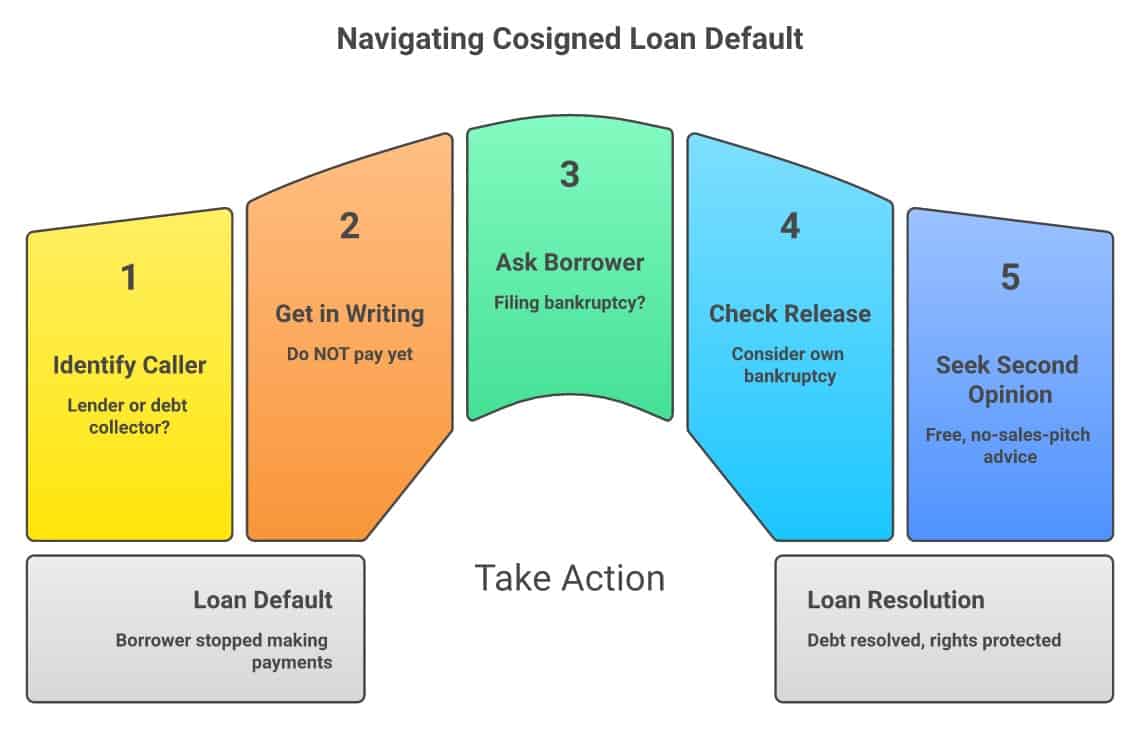
- Find out exactly who is contacting you. Is it the original lender, or a third-party debt collector? It matters. If it’s a collector, the Fair Debt Collection Practices Act covers you as a cosigner — you are a “consumer” obligated on the debt — so you can demand a written validation notice and dispute the amount in writing within 30 days. Collection must pause on the disputed amount until they send proof.
- Do NOT admit the debt or make a payment yet. Get everything in writing first. A single payment or verbal acknowledgment can, in some states, restart the clock on an old debt. If you’re not sure how old the debt is, check it with our free Statute of Limitations Checker before you respond.
- Ask the borrower one direct question: are you filing bankruptcy? This changes your strategy. If the borrower files Chapter 13, the co-debtor stay under 11 U.S.C. § 1301 temporarily bars creditors from collecting a consumer debt from you while their case is active. But that shield is Chapter 13 only — it does not apply to Chapter 7, it ends if the case is dismissed or converted, and the creditor can ask the court to lift it (for example, if the borrower’s plan doesn’t propose to pay that debt). Treat it as temporary breathing room, not a permanent wall.
- Check for a cosigner release — then consider your own bankruptcy as the real reset. Some private student loans and auto loans offer “cosigner release” after a stretch of on-time payments, but in 2015 the CFPB found 90% of applicants were rejected, so don’t count on it. If the balance is large and there’s no realistic way to pay, filing your own bankruptcy discharges your cosigner liability — and the automatic stay stops the calls the moment you file. A bankruptcy attorney can tell you in one meeting whether Chapter 7 wipes it out. Find one through NACBA, and see if you qualify with our Find Your Path quiz.
- Get a free, no-sales-pitch second opinion. Before you agree to anything, talk to Damon Day for free. Damon Day, an independent debt coach and my co-host on the Get Out of Debt Guy podcast, whom you can reach at DamonDay.com — I receive no payment for this referral. He’ll help you see whether settling, releasing, or filing is the right move for your situation — without trying to sell you a program.
How to Actually Stop It — Your 4 Paths
- File your own bankruptcy (the fastest, cleanest reset). If the balance is unmanageable, your own Chapter 7 or Chapter 13 discharges your personal liability on the cosigned debt, and the automatic stay stops collection the moment you file — not weeks later. Federal Reserve research shows filers recover faster than those who keep struggling. This is the option collectors never mention.
- Negotiate or settle directly — you’re the liable party, so you can deal. Because you are fully on the hook, the creditor will often work with you on a lump-sum settlement or payment plan. Get any deal in writing before you pay, and get the words “paid in full” or “settled in full” and a promise to stop reporting negatively, spelled out.
- Pursue the borrower for what you paid (know the limits). As a cosigner who pays, you generally have a right to seek reimbursement from the primary borrower under long-standing suretyship law. Be realistic: it’s a separate legal fight, and if the borrower couldn’t pay the lender, they usually can’t pay you either. Treat this as a possibility, not a plan.
- What WON’T save you: waiting for the borrower’s bankruptcy to rescue you. If the borrower files Chapter 7, 11 U.S.C. § 524(e) says the discharge “does not affect the liability of any other entity” — meaning once their case ends, the creditor is free to pursue you for 100% of the balance. Their bankruptcy protects them, not you. Only the Chapter 13 co-debtor stay helps, and only temporarily.
What You Need to Know About Your Rights as a Cosigner
The single most important thing to understand is what the federal government requires creditors to tell every cosigner before they sign. Under the FTC’s Credit Practices Rule (16 C.F.R. § 444.3), the mandated Notice to Cosigner says, in part: “You may have to pay up to the full amount of the debt if the borrower does not pay… The creditor can collect this debt from you without first trying to collect from the borrower. The creditor can use the same collection methods against you that can be used against the borrower, such as suing you, garnishing your wages, etc.” That is the law in plain English — you can be pursued first, and the account’s default shows up on your credit report too.
One scope note that matters: that specific FTC rule applies to non-bank lenders — finance companies, auto dealers, retailers. If your cosigned loan is held by a bank, savings institution, or federal credit union (which is where most private student loans come from), that particular regulation didn’t govern your loan. It doesn’t change your bottom line: your cosigner contract still makes you equally, fully liable regardless of who the lender is. The rule just puts in plain federal language what your contract already did.
| Situation | Does it protect the cosigner? | Notes |
|---|---|---|
| Borrower files Chapter 13 | Yes, temporarily | Co-debtor stay, § 1301 — consumer debts only; ends if case dismissed or converted |
| Borrower files Chapter 7 | No | § 524(e) — discharge doesn’t affect any other entity’s liability; creditor can pursue you for the full balance |
| You file your own bankruptcy | Yes | Discharges your personal liability; automatic stay stops collection immediately |
| Cosigner release request | Rarely granted | CFPB (2015): ~90% of private-student-loan release applicants rejected; check your contract, apply, but don’t rely on it |
| Third-party collector calling | You have FDCPA rights | Written validation, 30-day dispute, cease-communication — but a cease letter does not stop a lawsuit |
One nuance on state law: most consumer cosigners are “co-makers” who can be pursued directly, exactly as the FTC notice describes. A narrower category — a “guarantor of collection” — may only be liable after the creditor exhausts remedies against the borrower. Which one you are depends on your contract and your state. If you’re unsure, have an attorney read the actual document — don’t assume.
If a debt collector is harassing you, threatening you, or refusing to validate the debt, file a complaint with the CFPB and your state attorney general. If you need legal help but can’t afford an attorney, find free legal aid through LSC.gov, or find a consumer attorney through NACA.
Steve’s Take
I filed bankruptcy in 1990, so I know exactly how it feels to be trapped by a number you can’t pay. Here’s what I want you to hear: cosigning to help someone you love was a generous act, not a stupid one — the paperwork was just far harsher than anyone explained. You are not on the hook because you’re foolish; you’re on the hook because the contract was designed that way. In 30 years I’ve watched good people quietly drain their own retirement to cover a child’s or friend’s loan, and it breaks my heart every time. Run the math before the emotion. Sometimes the loving, responsible move is to protect your own future first — you can’t rescue anyone from inside your own financial hole.
Frequently Asked Questions
I cosigned and the borrower stopped paying — do I really have to pay the whole thing?
Yes, unless you have a defense. As a cosigner you’re a co-obligor, fully liable for 100% of the debt. The FTC’s required cosigner notice (16 C.F.R. § 444.3) states the creditor can collect the full amount from you without first trying the borrower. Your paths out are settling, cosigner release, or bankruptcy — not simply refusing to pay.
The main borrower filed bankruptcy. Does that erase my liability?
No — with one temporary exception. Under 11 U.S.C. § 524(e), the borrower’s discharge doesn’t affect anyone else’s liability, so after a Chapter 7 the creditor can come after you for the whole balance. The exception is the Chapter 13 co-debtor stay (§ 1301), which pauses collection from you while the borrower’s Chapter 13 case is active — but it ends when the case does.
Can I get the collector to stop calling me?
If it’s a third-party debt collector, yes — you have full FDCPA rights as a cosigner. You can demand written validation within the first 30 days (§ 1692g) and send a written cease-communication request (§ 1692c). Important limit: a cease letter stops the phone calls, but it does not stop them from suing you. The original creditor collecting its own debt isn’t covered by the FDCPA.
How do I get released as a cosigner?
Ask the lender whether your loan has a cosigner-release provision and what it requires — usually a set number of consecutive on-time payments and a credit check on the borrower. Be realistic: in 2015 the CFPB found 90% of private-student-loan release applicants were rejected. Apply if you qualify, but don’t treat release as your escape plan.
I filed bankruptcy myself — how fast does it stop the collection?
Immediately. The automatic stay takes effect the moment you file — not weeks later — and it stops collection calls, wage garnishment, and lawsuits on the cosigned debt. If you qualify for Chapter 7, the discharge can wipe out your cosigner liability entirely. Talk to a bankruptcy attorney through NACBA to find out where you stand.
Free Tool — Wage Garnishment Calculator: Worried about your paycheck being seized? The free Wage Garnishment Calculator shows exactly how much creditors can legally take in your state — and some states prohibit garnishment entirely. Calculate My Risk →
Can I make the borrower pay me back if I cover the loan?
Generally yes, in principle — a cosigner who pays has a right to seek reimbursement from the primary borrower under suretyship law. In practice it’s a separate legal action, and someone who couldn’t pay the lender usually can’t pay you either. Plan around actually being responsible for the debt, and treat any reimbursement as a bonus.
The debt is several years old — is it too old to collect?
Maybe. Every state has a statute of limitations on how long a creditor can sue you over a debt. If it’s expired, you may have a complete defense to a lawsuit — but making a payment or even admitting the debt can restart the clock in some states. Check the age with our free Statute of Limitations Checker before you respond, and don’t acknowledge the debt until you know.
Does the missed payment hurt my credit even though I’m “just” the cosigner?
Yes. As a legal obligor, the account appears on your credit report, and the CFPB confirms that late or missed payments are reflected on both your credit report and the borrower’s. That’s why acting quickly matters — the longer the account stays delinquent, the more damage it does to your score.
One more thing — everything I share here is based on 30 years of helping people through exactly this. But my advice is input for your decision, not the decision itself. Only you know your full situation. Talk to an attorney, look at your numbers, and make the choice that serves your future.
Important: This guide is for informational purposes only and is not legal advice. Laws vary by state, and your situation may have details that change what options are available to you. For legal advice specific to your case, consult an attorney licensed in your state. NACBA can help you find a bankruptcy attorney, NACA can connect you with a consumer attorney, or talk to Damon Day for free about your situation. Damon Day, an independent debt coach and my co-host on the Get Out of Debt Guy podcast, whom you can reach at DamonDay.com — I receive no payment for this referral.
Key Takeaway: Being a cosigner on a defaulted loan is serious, but it is not a dead end. Find out who’s calling, protect your rights before you pay, and get an honest read on whether settling or your own bankruptcy is the smarter move. See how all your options compare. The longer you wait, the more it costs you in money and credit.
The Bottom Line
You’re not here because you were reckless — you’re here because you tried to help someone and the fine print was stacked against you. The law gives you real tools: the right to make collectors prove the debt, the right to settle as the liable party, and the right to wipe the liability out entirely through your own bankruptcy if the math demands it. The cosigners I’ve watched come out okay are the ones who stopped, learned their rights, and acted — instead of quietly paying until they were the ones in crisis. If someone you know is about to cosign, or already has and the borrower went quiet, send them this page — it’s the conversation nobody has before they sign. Start with the Find Your Path quiz to see where you stand.
Dealing With Debt? Understanding your options is the first step. See how all your debt relief options compare — including ones most sites won’t tell you about. The Find Your Path quiz gives a recommendation based on your actual numbers, and the Scam-O-Meter checks any company’s complaint history before you sign. Federal Reserve research shows bankruptcy filers recover faster than those who don’t file.
Right now you are dealing with the thing in front of you, and that is exactly where your attention belongs. When it is handled — and it will be — there is a next stage, and it is the one I most enjoy writing about.
In the latest issue (Nov 9): Check your power bank and your French press
Each weekday I send one short email: one story that caught my attention, why it might matter to you, and one manageable thing you can do with it. It is free, I sell nothing, and I take no money from any company I write about.



