

This week, 46 states announced a $45 million settlement with Block, the company behind Cash App, over claims it failed to protect users from fraud. If you use Cash App, Venmo, or Zelle to hold money — not just move it — there’s something in this news you need to understand, and it’s bigger than any one settlement.
What You Need to Know
On July 8–9, 2026, a coalition of 46 state attorneys general announced that Block Inc. agreed to pay $45 million to settle allegations that Cash App misled users about its safety. According to the states, Cash App implied it offered bank-like protections it didn’t actually provide, let people open accounts without a Social Security number or date of birth (which made it easy for scammers to create fake accounts), and offered no official customer-service phone number — so locked-out users often called fake “support” numbers that turned out to be run by scammers. You can read the announcement straight from a participating state in the Alabama Attorney General’s release and Connecticut Attorney General Tong’s release. Block denied wrongdoing.
Here’s the part the headlines blur together: the $45 million is a penalty paid to the states, not a fund that lands in your account. Consumer money-back comes from a separate action — the Consumer Financial Protection Bureau’s earlier settlement with Block, which requires the company to distribute between $75 million and $120 million to defrauded consumers nationwide. Those are two different things, and confusing them is exactly how people miss real money or fall for a fake “claim your settlement” scam.
Why You Need to Know It
I’ve spent 30 years watching how small money problems snowball into big ones, and this settlement points at a trap I see constantly: people treat payment apps like bank accounts. They are not banks. Money sitting in Cash App, Venmo, or Zelle generally does not carry the same protections your checking account does — the same dispute rights when a payment goes wrong, and the same recourse when you’re defrauded. When someone loses $400 to a scam on one of these apps and can’t get it back, that’s often the shove that pushes a tight month into credit-card debt. The settlement isn’t just a story about one company; it’s the government confirming, in writing, that the “bank-like safety” a lot of people assumed simply wasn’t there.
The Daily Money Brief — Free, at 10 AM
Money you may be owed, scams to dodge, and the fine print decoded — the consumer money news that affects your wallet, every weekday.
Claiming money you are owed is one good day. What you do over the following year is what actually changes your position.
In the latest issue (Oct 15): The ones who need the Social Security raise the most keep the least of it
Each weekday I send one short email: one money story that caught my attention, why it might matter to you, and one manageable thing you can do with it.
Free. I sell nothing. Unsubscribe any time.
Things to Consider
Payment apps are genuinely useful — for moving money between people you trust. The risk isn’t using them; it’s storing money in them and assuming it’s as safe as a bank. A few things worth sitting with:
- A balance in an app is money without a safety net. If it’s stolen or sent to a scammer, getting it back is far harder than a fraudulent charge on a debit or credit card.
- “Customer support” you find by searching is where scammers wait. The states specifically flagged that Cash App’s lack of a real phone line sent users to imposter numbers. Never call a “support” number you found in a search or an ad.
- The real risk is speed, not just this company. App transfers are often instant and irreversible — that’s the feature scammers exploit across every platform, not only Cash App.
What to Think About Doing
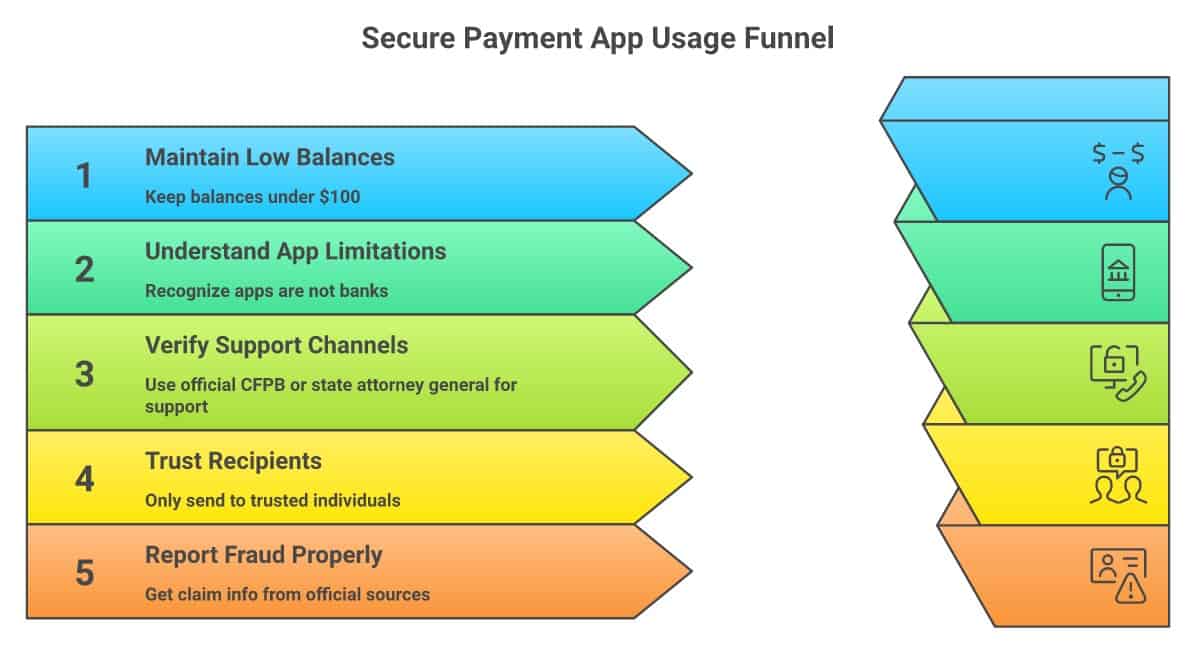
- Move your balance out. Keep app balances low — ideally under $100. Use the app to send money, then let it settle into your actual bank account where it belongs. Don’t use a payment app as a savings or holding account.
- If you were defrauded on Cash App, watch for legitimate notices — and don’t chase them. Consumer redress runs through the CFPB settlement, not the state penalty. Get information only from the CFPB or your state attorney general — never from a link texted or emailed to you claiming you’re owed money. A wave of settlement news is exactly when “claim your refund” scams spike.
- If a real notice arrives, don’t delete it as spam. Legitimate settlement communications can look like junk. Verify it against the CFPB or your state AG rather than acting on it or trashing it.
- Report fraud you’ve suffered. File with the FTC and the CFPB. It builds the record that drives actions like this one.
Steve’s Take
I’m not telling you to throw away your payment apps — I use them too. What I’m telling you is to stop treating them like a bank. A bank is boring on purpose: it has fraud protections, dispute rights, and a real phone number. An app that lets money move in seconds is convenient right up until the second it’s convenient for someone stealing from you. Keep the app for sending a friend $20. Keep your money where it’s actually protected.
Frequently Asked Questions
Is money in Cash App or Venmo protected like money in a bank?
Generally no. Payment apps don’t offer the same fraud protections and dispute rights as a bank account. That gap is exactly what 46 state attorneys general said Cash App misrepresented in the July 2026 settlement. Keep balances low and move money to your bank.
How do I get money back if I was defrauded on Cash App?
Consumer redress comes from the CFPB’s settlement with Block (which requires distributing $75–$120 million to affected consumers), not the $45 million state penalty. Get claim information only from the CFPB or your state attorney general — never from a link that comes to you unsolicited.
Is the $45 million going to pay Cash App users directly?
No. The $45 million is a penalty paid to the 46 participating states. It is separate from the consumer-redress fund in the CFPB settlement. Confusing the two is how people miss real money or fall for fake “claim your settlement” scams.
What is Cash App required to change?
Under the settlement, Block must improve fraud prevention, stop misleading safety claims, drop fraud-enabling marketing, and provide real live customer support — including phone support for a set number of hours each day, per the state attorneys general.
How can I use payment apps more safely?
Use them to send money, not store it. Keep balances low, never call a “support” number you found in a search, and treat instant transfers as irreversible — only send to people and businesses you trust.
This is what I’m seeing after 30 years of helping people with money. Take it as one informed perspective — but only you know your full situation. Use this as input for your decision, not a directive. Nobody gets to tell you what to do with your money. Not me, not anyone.
Dealing With Debt? A single scam or surprise expense is often what tips a tight budget into debt. See how all your debt relief options compare, get a recommendation from the Find Your Path quiz based on your real numbers, and check any company’s complaint history with the Scam-O-Meter before you sign or send.



