

Quick Answer: The “July 10, 2026” tax deadline making headlines this week is real, but it is not what most of the coverage is telling you. It is not a last chance to file your 2022 return for a normal refund — that general deadline was April 15, 2026, and it has already passed. July 10 is the cutoff to file a special protective refund claim to preserve your rights under a court case (Kwong v. United States) that could reopen refunds for people who were hit with penalties or missed refunds during the COVID years. Filing by today only protects your claim — it does not guarantee a check, because the government is still appealing.
Expert Context: I have been helping people untangle money problems since 1994, and if there is one thing I have watched happen over and over, it is a genuinely useful deadline getting flattened into a scary headline that sends people rushing to pay someone for the wrong thing. This one is a perfect example — the real opportunity is narrow, technical, and contingent, and the last thing I want is for you to hand a tax-prep shop a slice of a refund that may never come.
If you have seen a news story this week saying today is your absolute last day to claim a COVID-era tax refund before the IRS keeps it forever, take a breath. The truth is more specific — and for most people, less urgent — than the headline suggests. But there is a small group for whom filing a simple, free protective claim before midnight tonight genuinely matters.
Key Terms Defined
Protective refund claim: A claim you file with the IRS to keep your right to a refund alive while an unresolved legal question is being decided. You do not have to calculate the exact amount — filing it simply stops the clock from running out on you.
Claiming money you are owed is one good day. What you do over the following year is what actually changes your position.
In the latest issue (Oct 8): A parent's nursing home bill can become yours
I write Your Money Actually most weekdays — actionable money information you will not find anywhere else, and the small decisions that compound. It is free, I sell nothing, and I take no money from any company I write about.
Statute of limitations (for refunds): The window in which you can claim money back from the IRS — generally the later of three years from when you filed the return or two years from when you paid the tax. Miss it and the money legally becomes the government’s.
Kwong v. United States / IRC §7508A(d): A court case interpreting a COVID-era disaster-relief law. Under the court’s reasoning, certain deadlines that fell during the pandemic postponement period (January 20, 2020 through July 10, 2023) are treated as due on July 10, 2023 — which pushes the refund-claim window out to July 10, 2026.
Free Tool — Statute of Limitations Checker: Dealing with old debt? The free Statute of Limitations Checker tells you if the collection clock has expired in your state — including the zombie debt and clock-restarting traps collectors use. Check My Status →
What the July 10 deadline actually is
Here is the accurate version, straight from the IRS’s own Taxpayer Advocate. During the pandemic, the government postponed a long list of tax deadlines. A court case, Kwong v. United States, tested how those postponements affect the deadline to claim a refund. Under the court’s reading of the disaster-relief statute, deadlines that landed inside the postponement window are “treated as due on July 10, 2023.” Because you generally have three years to claim a refund, that interpretation stretches the claim window to July 10, 2026.
So this is not about your ordinary 2022 return. It is about a specific legal theory that could reopen refunds and penalty abatements for people who got caught in the pandemic timing. The IRS Taxpayer Advocate estimates “tens of millions” of taxpayers — individuals, small businesses, estates, and trusts — could potentially be affected.
Does this even apply to you?
For a lot of people reading this, the honest answer is: probably not, and that is fine. This matters most if, during roughly January 2020 through July 2023, you were:
- Assessed penalties for filing late, paying late, or missing estimated tax payments
- Charged interest tied to those pandemic-era deadlines
- Owed a refund for tax years 2019 through 2022 that you never claimed because of the confusing shifting deadlines
If none of that describes you — if you filed on time and were not hit with penalties — this particular deadline likely is not your situation. Do not let a headline talk you into a panic that was never aimed at you.
The Daily Money Brief — Free, at 10 AM
Money you may be owed, scams to dodge, and the fine print decoded — the consumer money news that affects your wallet, every weekday.
If you want the fuller backstory on that already-passed general deadline, I covered it in my April piece on the $1.2 billion in 2022 refunds that reverted to the government. And if the real reason you never filed is that you owe the IRS and are scared of what comes next, read whether bankruptcy can wipe out tax debt without touching your retirement.
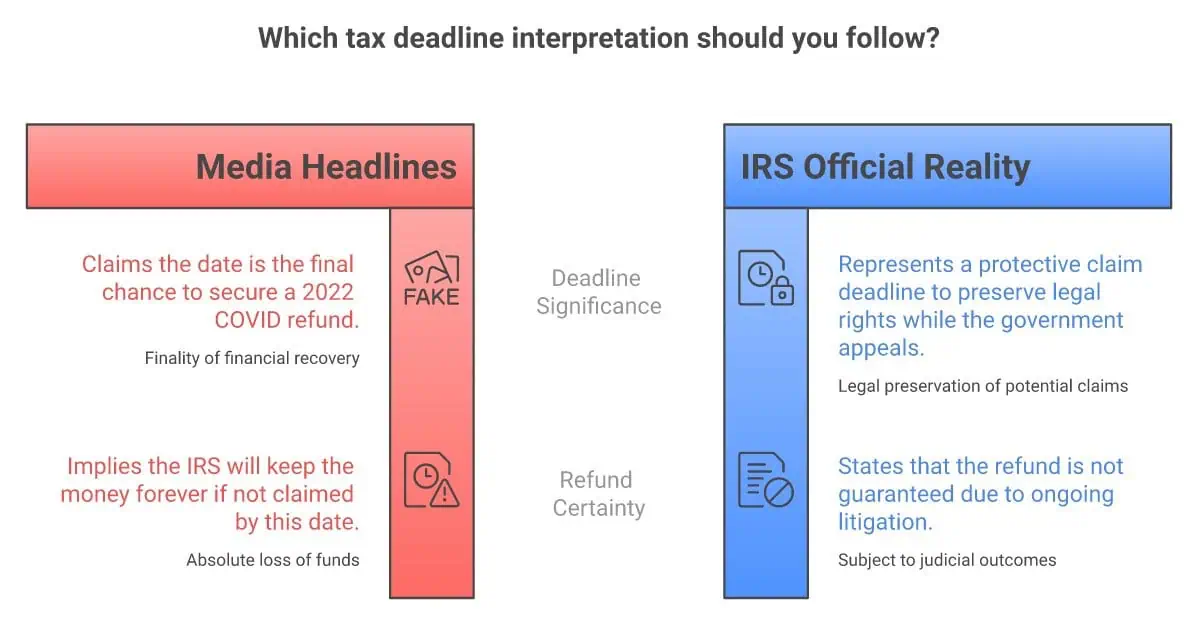
The Claim: “Today is your last day to file your 2022 tax return or the IRS keeps your refund forever.”
The Reality: The general deadline to file a 2022 return for a normal refund was April 15, 2026 — that has already passed. July 10 is a narrower, court-driven protective-claim deadline for people affected by pandemic-era penalties and postponements. The two are not the same thing, and conflating them sends the wrong people rushing while the right people may not realize it is about them.
The one move that costs nothing and preserves your rights
If there is any chance this applies to you, the safest step is to file a protective claim before the deadline. The beauty of a protective claim is that you do not have to nail down the exact dollar amount — you are simply telling the IRS “keep my right to this refund alive while the courts sort it out.”
The IRS Taxpayer Advocate lays out the options. By July 10, 2026, you can file any of the following:
- Form 843 (Claim for Refund and Request for Abatement) — the Taxpayer Advocate specifically advises sending it by certified mail so you can prove you filed on time
- An amended return
- An original return you never filed
- A protective claim to preserve your rights without calculating exact amounts
Do this for free — and prove you did it. You should not pay a tax-prep company a percentage of a refund to file a protective claim, especially one that may never pay out. If you file on paper, send it certified mail and keep the receipt. That receipt is your proof of a timely claim if this ever gets litigated to a conclusion.
The catch nobody’s headline mentions
Here is the part that makes me want to slow everyone down. This refund is not guaranteed. The government is appealing the Kwong decision, and the Taxpayer Advocate is blunt about it: “It may take several years until the issue is finally resolved by the courts.” Whether any of these claims actually get paid depends on how that appeal ends.
So filing by today does one thing: it keeps you in line. If the courts ultimately side with taxpayers, you preserved your seat. If you miss the deadline, the Taxpayer Advocate warns you “will not be eligible for relief even if the Kwong decision is upheld.” That is the whole calculus — a free, low-effort protective claim now buys you a maybe-later, and doing nothing forecloses it entirely.
Key Takeaways
- July 10, 2026 is a protective-claim deadline tied to the Kwong case — not the ordinary 2022 refund deadline (which passed April 15).
- It matters most if you were assessed pandemic-era penalties/interest or missed a refund for tax years 2019–2022.
- A protective claim (or Form 843 by certified mail) preserves your rights without you calculating the exact amount.
- The refund is contingent on the government’s appeal — filing protects the option, it does not guarantee a check.
- Do it free. Never pay a percentage of a refund that may never come.
The Bottom Line
If a headline sent you here in a panic today, I am glad you stopped to read the real story instead of reacting to the scary version. This is not “file tonight or lose everything” — it is a narrow, contingent, court-driven window that matters to a specific group of people who got squeezed by pandemic timing. If that might be you, filing a free protective claim before midnight is a small, smart insurance policy on a maybe. If it is not you, you can close this tab with a clear conscience. Either way, you just did the one thing that protects you best in a world full of urgent-sounding money headlines: you slowed down long enough to find out what was actually true. That instinct will save you far more than any single refund ever could.
Frequently Asked Questions
Is July 10, 2026 the last day to file my 2022 tax return for a refund?
No. The general deadline to file a 2022 return for a normal refund was April 15, 2026, and it has already passed. July 10, 2026 is a separate, narrower deadline to file a protective refund claim under the Kwong v. United States court interpretation, aimed at people affected by pandemic-era penalties and postponed deadlines.
What is a protective refund claim?
It is a claim you file with the IRS to keep your right to a refund alive while an unresolved legal question is being decided. You do not have to calculate the exact refund amount — filing it simply stops the statute-of-limitations clock from closing your window before the courts finish deciding the issue.
How do I file before the deadline?
According to the IRS Taxpayer Advocate, you can file Form 843 (Claim for Refund and Request for Abatement), an amended return, an original return, or a protective claim. If you file Form 843 on paper, send it by certified mail so you have proof you submitted it on time.
If I file, am I guaranteed to get a refund?
No. The refund is contingent, not guaranteed. The government is appealing the Kwong decision, and the Taxpayer Advocate says it may take several years for the courts to finally resolve the issue. Filing by July 10 preserves your right to relief if taxpayers ultimately win — it does not guarantee payment.
Should I pay a tax company to handle this for me?
You should not pay a company a percentage of a refund to file a protective claim, especially one that may never pay out. A protective claim is designed to be simple. If your situation is genuinely complex, a free VITA site or a reputable flat-fee tax professional is a far better choice than anyone taking a cut of a maybe.
This is what I am seeing after three decades of helping people cut through confusing money headlines. Take it as one informed perspective — only you know your full tax situation, and this is not a substitute for advice from a tax professional who can look at your specific facts. Use it as input for your decision, not a directive. Nobody gets to tell you what to do with your money. Not me, not a headline, not anyone.
Dealing With Debt? Understanding your options is the first step. See how all your debt relief options compare — including ones most sites won’t tell you about. The Find Your Path quiz gives a recommendation based on your actual numbers, and the Scam-O-Meter checks any company’s complaint history before you sign. Federal Reserve research shows bankruptcy filers recover faster than those who don’t file.



