

Written by Steve Rhode, consumer debt expert since 1994 • Last updated July 13, 2026
Quick Answer: You just received an SSA overpayment notice. Take a breath — this is not a fraud accusation and it is not a final bill. It is the start of a process you have real rights in. For overpayment notices issued on or after April 25, 2025, SSA will withhold up to 50% of your monthly Title II benefit (retirement, SSDI, survivors) if you do nothing. But if you file any request within 30 days of the notice date, SSA generally cannot start withholding while your request is under review. You have three options — waiver, reconsideration, or rate reduction — and one of them can erase this debt entirely. Act within 30 days.
What Just Happened to Your Check
SSA sends overpayment notices when its records show it paid you more than you were entitled to — sometimes months or years of payments. The reasons range from income changes SSA didn’t know about in time, to bureaucratic errors in SSA’s own records, to benefit recalculations SSA made internally. In many cases, the overpayment was not your fault at all. (A VA benefit overpayment runs through a separate process with its own rules — see what to do if that is your situation.)
The notice typically states a dollar amount and says SSA intends to recover it by withholding part of your monthly check. For Title II benefits (retirement, SSDI, survivors), notices issued on or after April 25, 2025 carry a default withholding of up to 50% of your monthly payment — a jarring change from the 10% default that had been in place. SSI (Supplemental Security Income) recipients face a 10% default withholding rate. But that withholding does not have to start if you act fast.
The Mistake You’re About to Make: Most people who get this notice either panic and start paying immediately, or they freeze and do nothing. Both are wrong. Paying immediately without challenging the amount or requesting a waiver can lock you out of options that could reduce or erase the debt. Doing nothing triggers the 50% withholding. The right move is to file a request — reconsideration, waiver, or rate reduction — within 30 days of the notice date. That one step protects your income while your case is reviewed.
Your Options Right Now
What to Do in the Next 48 Hours
- Find the notice date and count 30 days. The clock starts the day SSA dated the letter (SSA assumes you received it within 5 days of that date). If you file any request within 30 days of the notice date, SSA generally cannot begin withholding while it reviews your request. This is your income-protection window — use it.
- Decide which of the three options fits your situation. Option 1: Reconsideration (Form SSA-561) — “This amount is wrong, or I don’t owe this.” Challenges whether the overpayment happened or its dollar amount. Under 20 C.F.R. § 404.909, you have 60 days from receipt to file reconsideration (SSA presumes receipt 5 days after the notice date, so effectively 65 days from the date on your letter). File within 30 days to stop withholding now. Option 2: Waiver (Form SSA-632-BK) — “It wasn’t my fault AND repaying this would leave me unable to cover basic living expenses.” No hard time limit, but file fast. If fully approved, the debt can be forgiven entirely. Option 3: Rate Reduction (Form SSA-634) — “I owe it but 50% is too much; I can only afford $X/month.” SSA can lower the rate to almost any affordable amount.
- Submit your chosen form immediately. You can file by visiting your local SSA office, calling SSA at 1-800-772-1213, or mailing the completed form. Get a receipt or date-stamp. You can also request multiple options at once — you can request both reconsideration and a waiver, for example. Forms: SSA-632-BK (Waiver) · SSA-634 (Rate Reduction) · SSA-561 (Reconsideration — request at your local office or via the SSA website).
- If you need free help navigating this, get it before you file. Legal Services Corporation (LSC) funds free legal aid programs across the country that handle SSA overpayment cases. The Work Incentives Planning and Assistance (WIPA) program provides free SSA benefits counseling that specifically covers overpayment disputes — one of the most targeted free resources available for this situation. Many SSA-savvy advocates — particularly those working through senior legal aid programs — can review your notice and help you build the strongest case. Find a consumer attorney through NACA for consumer rights help. If bankruptcy is on the table, NACBA can connect you with a bankruptcy attorney.
- Keep copies of everything. Every document SSA sends you, every form you file, every name you speak to. If this case goes to reconsideration or an ALJ hearing, your paper trail is your defense.
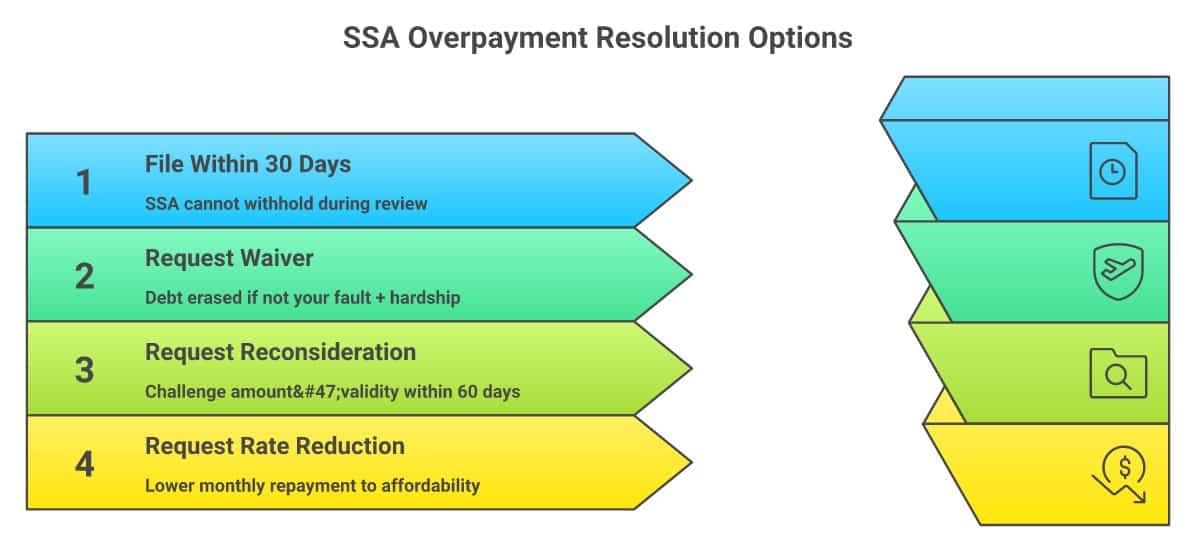
How to Protect Your Check — Your 3 Paths
- Path 1 — Waiver (SSA-632-BK): the debt-erasure option. If the overpayment was not your fault AND repaying it would prevent you from covering basic living expenses (housing, food, clothing, medical care), SSA can forgive the debt entirely. There is no time limit to request a waiver, but file within 30 days of the notice to stop withholding while your waiver is reviewed. The “not at fault” test asks: did you report everything accurately? Did you receive payments you knew were wrong? If SSA made an administrative error, or your circumstances changed and you reported them, you may well be not at fault. For overpayments of $2,000 or less, SSA often grants waivers with minimal documentation if fault is absent. For larger amounts, you’ll complete a financial disclosure (SSA-632-BK) showing income, expenses, and resources. An approved waiver is the only path that eliminates the debt rather than just managing it.
- Path 2 — Reconsideration (SSA-561): challenge the amount or the finding. If you believe SSA’s overpayment determination is wrong — the amount is incorrect, the period is wrong, or you were never actually overpaid — request reconsideration. File within 30 days to stop withholding; you have 60 days before losing the right to reconsider. If reconsideration is denied, you can escalate to an ALJ hearing, the Appeals Council, and ultimately federal court — each with a 60-day window. At every stage, SSA generally cannot collect while a properly filed appeal is pending.
- Path 3 — Rate Reduction (SSA-634): negotiate what you can actually afford. If you agree you owe the money but cannot afford to lose 50% of your monthly check, request a lower withholding rate. Call SSA at 1-800-772-1213 or submit Form SSA-634. SSA can reduce the rate to almost any amount — even $10 to $25 per month — based on your income and expenses. SSA typically tries to recover within 12 months but can stretch repayment up to 60 months if needed.
- What won’t work: Ignoring the notice. Going silent triggers the default 50% withholding after 90 days. Even if the amount is clearly wrong, you still must formally respond — SSA does not self-correct based on your belief alone.
What You Need to Know About Your Rights
50%
Default withholding rate for Title II (retirement/SSDI/survivors) overpayment notices issued on or after April 25, 2025 — if you do nothing within 90 days
30 days
File a request within 30 days of the notice date and SSA generally cannot begin withholding while your case is reviewed
10%
SSI (Supplemental Security Income) default withholding rate — different program, different rules, lower default rate
$0
What you might owe after a successful waiver — SSA can forgive the entire debt if you were not at fault and repayment causes hardship
The SSA overpayment framework flows from the Social Security Act, 42 U.S.C. § 404, which governs recovery of Title II overpayments. The conditions for waiver are in 42 U.S.C. § 404(b), which states SSA “shall waive” recovery when the individual is “without fault” and recovery would defeat the purpose of the program or be “against equity and good conscience.” The current 50% withholding rate was established by SSA Emergency Message EM-25029, effective for notices issued on or after April 25, 2025. SSI overpayment rules are governed separately under 42 U.S.C. § 1383(b).
| Benefit Type | Default Withholding Rate | Key Rule |
|---|---|---|
| Title II (Retirement, SSDI, Survivors) — notices on/after April 25, 2025 | Up to 50% of monthly benefit | SSA EM-25029; file within 30 days to stop withholding pending review |
| Title II — older overpayments (pre-April 25, 2025) | 10% of monthly benefit | Prior rule still applies to older notices |
| SSI (Title XVI) — all notices | Up to 10% of monthly benefit (max ~$96.70/mo in 2025) | SSI rules differ; 10% default regardless of notice date |
| Any program — fraud conviction or determination | Special enhanced rates may apply | Standard protections reduced; get legal help immediately |
If you believe SSA is violating your rights during overpayment recovery, file a complaint with the CFPB and your state attorney general. If you need legal help and cannot afford an attorney, find free legal aid through LSC.gov — many LSC-funded programs have Social Security specialists.
Steve’s Take
I took Social Security at 62. I know what it means to live on that check. When I see someone get an SSA overpayment notice demanding thousands back, my first thought isn’t “you should have known better” — it’s “you have more options than anyone has told you.” The waiver path gets almost no attention in most of the advice you’ll find online, but it can erase the entire debt if you were not at fault and repaying would genuinely hurt you. Over 30 years of working with people in debt, I’ve learned one thing consistently: the people who act fast — even imperfectly — do far better than those who freeze. A notice is not a judgment. File something within 30 days and protect your income while you figure out the rest.
Frequently Asked Questions
Can Social Security really take 50% of my check?
Yes — for Title II overpayment notices issued on or after April 25, 2025, SSA’s default withholding is up to 50% of your monthly retirement, SSDI, or survivors benefit (per SSA Emergency Message EM-25029). Two deadlines matter here: the 30-day protection window and the 90-day automatic-withholding trigger. File any request — reconsideration, waiver, or rate reduction — within 30 days of your notice date and SSA generally cannot start withholding while your case is under review. If you miss 30 days but act before 90 days, you may still negotiate a lower rate. If you do nothing for 90 days, the 50% withholding starts automatically. The 30-day window is the one to focus on.
I got an SSA overpayment notice — how do I get it waived?
File Form SSA-632-BK (Request for Waiver of Overpayment Recovery) with your local SSA office. To qualify, you must show two things: (1) you were not at fault for the overpayment — meaning you reported accurately and did not knowingly accept incorrect payments; and (2) repaying would cause financial hardship — that it would leave you unable to cover housing, food, clothing, or medical care. If both are true, SSA can forgive the debt entirely. There is no strict time limit to file a waiver, but file within 30 days to protect your check while it is reviewed. For overpayments of $2,000 or less (the original overpayment amount, not the remaining balance), SSA can process a simplified administrative waiver. Per POMS GN 02250.350 (effective November 2024), you can request this by phone at 1-800-772-1213.
What if the overpayment was SSA’s fault, not mine?
That works in your favor on a waiver. The “not at fault” test under 42 U.S.C. § 404(b) asks whether you made false statements, failed to share important information, or knowingly accepted wrong payments. If the overpayment happened because SSA made an administrative error or miscalculated your benefit, and you reported your information correctly, you are very likely “not at fault.” Document this clearly in your waiver request and request reconsideration of the overpayment finding as well.
I can’t afford to repay this but I can’t prove I wasn’t at fault — what do I do?
You still have options. Even if a full waiver is denied, you can request a rate reduction using Form SSA-634. SSA can reduce the withholding to almost any amount you can genuinely afford — sometimes as low as $10 to $25 per month — based on a review of your income and expenses. SSA typically aims to recover the debt within 12 to 60 months depending on your financial picture. A rate reduction does not erase the debt, but it turns a crisis into a manageable monthly amount.
Can they send this to debt collectors or sue me?
SSA typically recovers overpayments by withholding from your ongoing benefits, not through lawsuits or third-party debt collectors. However, if you are no longer receiving benefits, SSA can and does refer overpayment debts to the U.S. Treasury for offset — meaning your tax refunds or other federal payments can be seized. For active benefit recipients, the withholding mechanism is the primary tool. This is another reason to address the notice quickly: the most disruptive collection method (Treasury offset) is less likely to come into play while your request is pending.
What if I already paid it back — can I still fight it?
Yes. You can request a waiver even after you’ve repaid the overpayment, and SSA can refund amounts recovered if the waiver is approved. There is no time limit on filing a waiver. This is a fact almost nobody is told. If you paid under pressure without knowing you had the right to challenge it, you can still file SSA-632-BK now and request a refund of what you paid. The strength of your case depends on whether you can show you were not at fault and whether repayment caused genuine hardship at the time.
Is Social Security overpayment debt dischargeable in bankruptcy?
Generally, SSA overpayment debt is dischargeable in Chapter 7 bankruptcy as a general unsecured debt — but there is a critical caveat: SSA can and does file adversary proceedings contesting discharge on grounds of fraud, which triggers a separate court fight. Do not assume this is a clean exit. Speak with a bankruptcy attorney through NACBA before acting on any assumption that the debt will be eliminated in bankruptcy. For many people on fixed incomes facing a large overpayment they cannot repay any other way, bankruptcy is a legitimate path worth evaluating seriously — just evaluate it with an attorney who has handled SSA cases.
I’m on SSDI and just got this notice — does the 50% rule apply to me?
SSDI (Social Security Disability Insurance) is a Title II benefit, so yes — the 50% default withholding rate applies to SSDI overpayment notices issued on or after April 25, 2025, the same as retirement and survivors benefits. SSI (Supplemental Security Income) is different — SSI overpayments use a 10% default withholding rate. Check the top of your notice to see whether it says SSDI or SSI; they are separate programs with separate rules. If you have questions about which program you are in, call SSA at 1-800-772-1213.
One more thing — everything I share here is based on over 30 years of helping people through exactly this. But my advice is input for your decision, not the decision itself. Only you know your full situation. Talk to an attorney, look at your numbers, and make the choice that serves your future.
Important: This guide is for informational purposes only and is not legal advice. Laws and SSA policies can change, and your situation may have details that affect what options are available to you. For legal advice specific to your case, consult an attorney licensed in your state. NACBA can help you find a bankruptcy attorney, NACA can connect you with a consumer attorney, LSC.gov offers free legal aid if you cannot afford an attorney, or talk to Damon Day for free about your situation. Damon is my podcast co-host, and I receive no payment for this referral.
Key Takeaway: An SSA overpayment notice is serious — but it is not final, it is not a fraud accusation, and it does not have to mean losing 50% of your check. File something within 30 days. Request reconsideration if the amount is wrong, a waiver if repaying would cause hardship, or a rate reduction if you need more affordable terms. The waiver can erase the debt entirely. Talk to a benefits attorney or free legal aid this week. The longer you wait, the fewer protections you have.
If the notice you received is from your state about unemployment benefits you were overpaid, the process is different from Social Security — most states give you 10 to 30 days to appeal, and waivers are available for non-fraud cases.
The Bottom Line
Getting a letter that says Social Security wants thousands of dollars back is terrifying, especially when that check is what you live on. But here’s what I’ve watched thousands of people learn too late: an overpayment notice is the beginning of a process you have real rights in, not the end of one. The waiver alone can erase this debt — and most people never ask for it. File within 30 days, protect your income, and then fight the right battle. If someone you know is facing an SSA overpayment demand, send them this page — it may save their check. Take the Find Your Path quiz if you’re also dealing with other debts that feel unmanageable.
Related guides: I’m on Social Security and a Debt Collector Is Threatening Me • Stop Social Security Wage Garnishment • Social Security Overpayment: What It Means and What to Do
Related: what to do if the state says you were overpaid unemployment.
Dealing With Debt? Understanding your options is the first step. See how all your debt relief options compare — including ones most sites won’t tell you about. The Find Your Path quiz gives a recommendation based on your actual numbers, and the Scam-O-Meter checks any company’s complaint history before you sign. Federal Reserve research shows bankruptcy filers recover faster than those who don’t file.
Right now you are dealing with the thing in front of you, and that is exactly where your attention belongs. When it is handled — and it will be — there is a next stage, and it is the one I most enjoy writing about.
In the latest issue (Nov 13): The shelf price isn't always what you pay
Each weekday I send one short email: one story that caught my attention, why it might matter to you, and one manageable thing you can do with it. It is free, I sell nothing, and I take no money from any company I write about.



